PFAS Contamination Lawsuit 2026: The $14 Billion Water Settlement, the Unsettled Injury Claims, and Who Actually Gets Paid
Quick Answer
- Is it real? Yes. MDL 2873 is a federal mass tort with approved settlements from 3M, DuPont, Tyco, and BASF.
- How much? Water systems received billions. Individual personal injury claims have no settlement value yet.
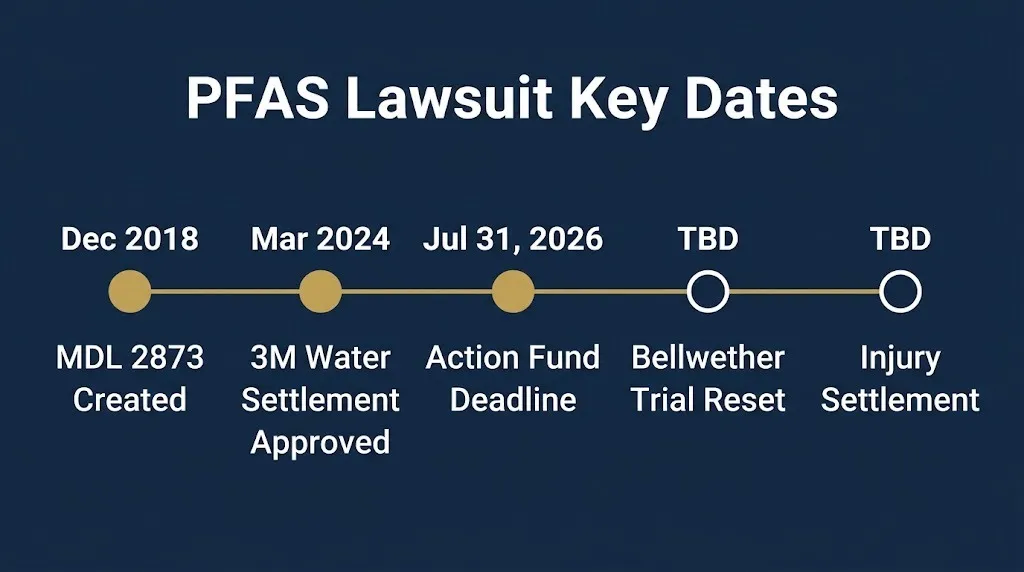
- Key deadline? Water system action fund claims closed July 31, 2026. Testing claims closed March 31, 2026.
The PFAS contamination lawsuit landscape in 2026 is split into two very different realities. Public water systems have already secured over $14 billion in settlements from the makers of firefighting foam. Individuals who claim they were sickened by PFAS have no settlement, no payout schedule, and no clear timeline.
If you’re searching this because you saw a headline about a PFAS payout, you need to know which track you’re looking at. The money that exists belongs to water utilities, not to households. The injury claims are still being litigated in a federal court in South Carolina, and the first bellwether trial has not produced a verdict.
This article breaks down the verified numbers from court records and settlement notices, explains why the water system money is not available to individuals, and flags the one deadline that still matters for personal injury claims: the statute of limitations in your state, not a federal claim form. One detail the headlines hide: the water settlement’s claims window closed in July 2026, so any “file now” offer you see is either for a different case or a scam.
The Facts
| Case | In re Aqueous Film-Forming Foams Products Liability Litigation, MDL No. 2873 |
| Court | U.S. District Court, District of South Carolina |
| Case Number | 2:18-mn-02873-RMG |
| Status | Water system settlements approved and paying. Personal injury track unresolved. |
| Fund Size | Over $14 billion across water settlements |
| Est. Per Person | Not yet determined for personal injury claims |
| Claim Deadline | Water Action Fund: July 31, 2026 (passed) |
| Administrator | Various claims administrators for water settlements |
| Proof Needed | PFAS test results and system documentation for water claims |
Is the PFAS Contamination Lawsuit Real or a Scam?
The PFAS contamination lawsuit is real, and it is documented in federal court records under MDL No. 2873. The defendants include 3M, DuPont, Chemours, Corteva, Tyco, and BASF, and the cases are centralized before Judge Richard M. Gergel in the District of South Carolina.
But the phrase “PFAS lawsuit” covers multiple tracks. The water system track is settled. The personal injury track is not. The sovereign entity track, involving states and municipalities, is partially settled and partially active.
The scam risk sits in the gap between those tracks. A text or ad claiming you can “claim your share of the $14 billion PFAS settlement” is misleading. That money went to public water providers through a court-approved class settlement. Individuals were not part of that class.
How Much Money Is in the PFAS Settlement?
The water system settlements total over $14 billion across four major deals. 3M agreed to a nominal cap of $12.5 billion, with a pre-tax present value of up to $10.3 billion, payable over 13 years. DuPont, Chemours, and Corteva agreed to $1.185 billion. Tyco agreed to $750 million. BASF agreed to $316.5 million.
That money is real and approved. The court granted final approval to the 3M settlement in March 2024 and to the DuPont settlement around the same period. Payments began in 2025 and are scheduled to continue through roughly 2030 for most class members, with trailing payments extending into the early 2030s.
Not yet determined applies to the personal injury track. No global settlement exists. No settlement fund exists. No payout table exists. Any figure you see attached to individual injury claims is an estimate or a lawyer’s marketing, not a court-approved number.
Who Qualifies for the PFAS Water System Settlement?
You may qualify for the water system settlement only if you are a public water provider, not an individual. The class covered public water systems that detected PFAS in their sources or had a duty to monitor for it.
The class definition excluded systems that opted out in December 2023. Eligible systems were divided into two phases: Phase 1 for systems that detected PFAS before June 2023, and Phase 2 for those that detected it later. Phase 2 systems faced the 2026 deadlines that have now passed.
Here is the eligibility checklist for water systems:
- You operate a public water system serving at least 3,300 people.
- You detected PFAS in your wellhead or surface water intake.
- You did not opt out of the class settlement by the December 2023 deadline.
- You submitted testing data and flow rate documentation by the claim deadline.
- You filed the action fund claim before July 31, 2026.
If you are a homeowner or a private well user, you are not in this class. Your path is a personal injury or property damage lawsuit, not a settlement claim.
How Do You File a PFAS Personal Injury Claim?
You file a PFAS personal injury claim by filing a lawsuit in court, not by submitting a form to a settlement administrator. There is no settlement fund to claim against for individual injuries.
The process starts with a lawyer who can evaluate whether your medical condition and exposure history fit the MDL’s listed claims. The court has identified specific conditions for the personal injury track, and the scientific evidence for each is still being tested through Daubert challenges.
Here are the steps:
- Document your exposure. Identify the water source (public system or private well) and the time period.
- Gather medical records. Focus on the listed conditions: kidney cancer, testicular cancer, and others under review.
- Consult a lawyer who handles MDL 2873 personal injury cases.
- File a short-form complaint or a direct action, depending on your state and the MDL process.
- Track the bellwether calendar for trial dates and rulings.
- Do not pay a fee to “reserve” a settlement spot. No such spot exists.
Reality Check: No settlement administrator is calling or texting individuals about PFAS injury payouts. The water system fund is closed to new claims, and the injury fund does not exist yet. Any message asking for your bank details to release PFAS money is a scam.
Why Is the Personal Injury Track Still Unsettled?
The personal injury track is unsettled because the science and causation questions are contested. The court has not produced a bellwether verdict, and without one, there is no anchor for settlement values.
Judge Gergel urged the parties in June 2025 to seek a global settlement of the injury claims. That has not happened. The first bellwether trial, limited to kidney cancer, was set for October 2025 and then postponed. No new date has been confirmed in accessible court records.
The MDL had 15,244 pending actions as of July 1, 2026, and more cases were transferred in August 2026. The volume is growing, but the legal framework for valuing those claims is not.
What Is the North Carolina PFAS Settlement?
The North Carolina PFAS settlement is a separate deal, announced in September 2026, in which DuPont, Chemurg, and Corteva agreed to pay $455 million to the State of North Carolina and 11 local entities. The settlement resolves claims tied to the Fayetteville Works facility and other historical discharges.
The payments run over 15 years, with a net present value of roughly $355 million. Of the total, $18 million is attributed to PFAS contamination unrelated to Fayetteville Works, including a small share tied to AFFF.
This settlement is distinct from the MDL water system settlements. It resolves sovereign claims, not individual injury claims. If you live in one of the affected counties, the money goes to local government entities, not to your household.
What Happens Next in the PFAS Litigation?
The next stages are the bellwether trial reset, Daubert rulings on expert evidence, and possible global settlement talks on the injury track. The water system track is in distribution and has no new claim window.
Expected late 2026 or 2027: The kidney cancer bellwether trial is rescheduled.
Expected 2026 to 2027: Daubert rulings on liver cancer and thyroid cancer expert evidence.
Expected after bellwether: Pressure for a global personal injury settlement increases.
Ongoing through 2030: Water system distributions continue for Phase 1 and Phase 2 claimants.
No deadline for individuals: Personal injury claims are governed by state statutes of limitations, not a federal claim form.
Key Takeaway: The $14 billion is for water systems and is already allocated. The injury claims have no fund, no deadline, and no payout schedule until a bellwether trial produces a verdict or a global deal.
Frequently Asked Questions
Can I file a claim for the $14 billion PFAS settlement as an individual?
No. That settlement is for public water systems. Individuals were not part of the class and cannot claim a share.
Is there a PFAS personal injury settlement in 2026?
No. No global settlement exists for personal injury claims in MDL 2873 as of October 2026.
What cancers are covered in the PFAS lawsuit?
The MDL has focused on kidney cancer, testicular cancer, and other listed conditions. The first bellwether trial was limited to kidney cancer.
What is the deadline to file a PFAS injury lawsuit?
There is no single federal deadline. Each state has its own statute of limitations, so you should check the rules in your state.
Did the PFAS water settlement deadlines already pass?
Yes. The testing claim deadline was March 31, 2026, and the action fund deadline was July 31, 2026.
What is the North Carolina PFAS settlement?
It is a $455 million deal between DuPont, Chemours, Corteva, and North Carolina entities over contamination from the Fayetteville Works facility.
Are PFAS lawsuits still being filed?
Yes. The MDL had over 15,000 pending actions as of July 2026, and more cases are being transferred in.
What You Should Do Now
If you believe you were harmed by PFAS exposure, the action that matters is not a claim form. It is a conversation with a lawyer who can evaluate whether your medical records and exposure history fit the MDL’s listed claims.
Document your water source, gather your medical records, and check your state’s statute of limitations. Do not wait for a “settlement website” to appear for individuals. The water system money is already allocated, and the injury money does not exist yet. The most important date is not a federal deadline. It is the filing deadline in your state.