Personal Injury Lawsuit Mediation in 2026: What Actually Happens, What It Costs, and Why Most Cases Settle Before Trial
Quick Answer
- What is it? A confidential negotiation session with a neutral mediator who has no power to decide your case.
- How much does it cost? Mediator fees vary by market and complexity. Many sessions run half a day to a full day.
- Key deadline? There is no universal mediation deadline. Timing depends on your case and your court’s rules.
Personal injury lawsuit mediation is a structured settlement negotiation facilitated by a neutral third party. It is not a trial, not a deposition, and not a guarantee that your case will settle. The mediator cannot order anyone to pay anything.
If you’re searching this because your lawyer just scheduled a mediation, or because an insurance company suggested one, you’re probably wondering what the day will look like and whether you have to accept whatever number gets put on the table. The short answer: you don’t have to settle, but you should understand what the process is designed to do.
This article explains the verified mechanics of personal injury mediation, from the position statements exchanged beforehand to the private caucuses that drive most of the negotiation. One detail that surprises most first-timers: the mediator often spends more time in separate rooms than in the joint session, and that’s by design.
The Facts
| Process | Mediation (alternative dispute resolution) |
| Facilitator | Neutral third-party mediator |
| Binding? | Only if you sign a settlement agreement |
| Typical Duration | Half a day to a full business day per session |
| Cost | Mediator fees split between parties, varies by market |
| Confidentiality | Generally confidential; statements cannot be used at trial |
| Who Attends | You, your lawyer, opposing counsel, insurance adjuster, mediator |
| Success Rate | Experienced neutrals report roughly 95% resolve before trial |
What Is Personal Injury Lawsuit Mediation?
Personal injury lawsuit mediation is a voluntary settlement conference where a neutral mediator helps both sides evaluate the case and negotiate a resolution. The mediator does not decide who wins or how much you get.
The process exists because trials are expensive, slow, and unpredictable. A mediator who has handled hundreds of injury cases can usually tell both sides, privately, where their positions are unrealistic. That reality check is often the most valuable part of the day.
Most mediations happen after a lawsuit is filed and some discovery has been completed. But they can also occur before suit, or even after a verdict on appeal issues . The timing depends on whether both sides have enough information to evaluate risk.
You are not required to settle. If the gap between the two sides is too wide, you leave, and the case continues. Everything said in mediation is generally confidential and cannot be used against you later .
How Much Does Personal Injury Mediation Cost?
Mediator fees for personal injury cases typically range from a few hundred dollars to several thousand dollars per session, split between the parties. There is no single national rate.
The cost depends on the mediator’s experience, the complexity of the case, and the market. A retired judge handling a multi-party trucking accident will charge more than a sole practitioner mediating a straightforward rear-end collision.
Some courts offer free or low-cost mediation programs for cases under a certain damages threshold. Ireland’s Injuries Resolution Board, for example, provides mediation at no additional cost to claimants . U.S. practice varies by jurisdiction.
Ask your lawyer who pays the mediator and how the fee gets split. In most personal injury cases, each side covers half. That cost is separate from your attorney’s contingency fee and may be treated as a case expense.
Who Is in the Room During a Personal Injury Mediation?
The people in the room typically include you, your lawyer, the mediator, opposing counsel, and an insurance company representative with authority to settle. The defendant rarely attends in person.
That last point matters. The person who hit you is not usually the one deciding whether to pay. The insurance adjuster or a defense representative holds the checkbook, and that person’s presence is what makes a deal possible .
Your lawyer may want you in the office with them while the mediator joins by video. Since the pandemic, many mediations happen over Zoom, with each side in a separate breakout room .
You do not have to speak during the joint session. You can if you want to, but discuss it with your lawyer beforehand. Most of the negotiation happens in private caucuses, where the mediator shuttles between rooms carrying offers and counteroffers.
What Happens at a Personal Injury Mediation Session?
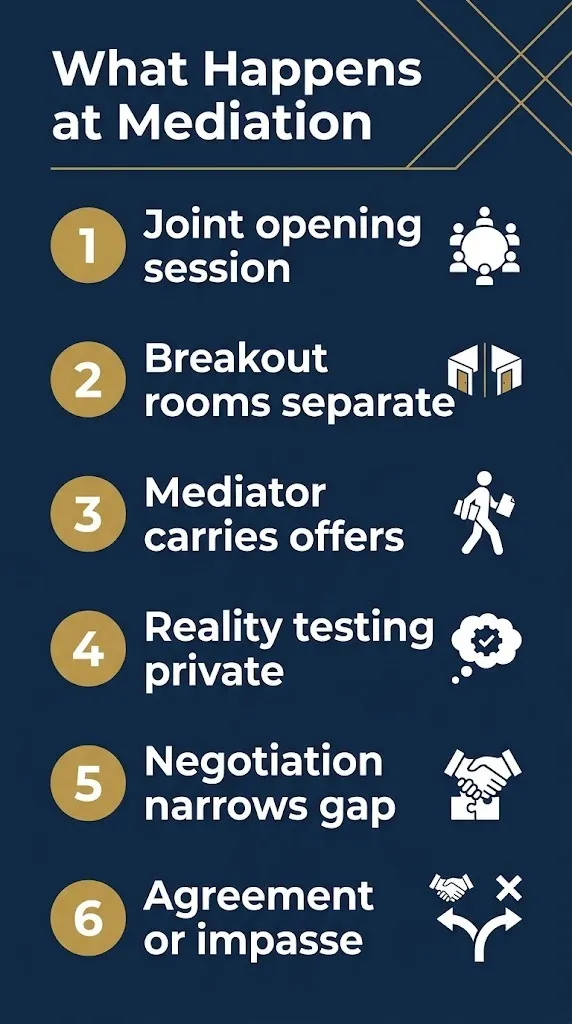
A mediation session follows a predictable structure: opening statements, private caucuses, negotiation, and either an agreement or an impasse. Most of the day happens in separate rooms.
Here is how the day typically unfolds:
- Joint opening. The mediator explains the rules and each lawyer gives a brief opening statement.
- Breakout rooms. You and your lawyer go to one room; the defense goes to another.
- Caucus rounds. The mediator moves between rooms, relaying offers and testing positions.
- Reality testing. The mediator privately tells each side where their numbers are weak.
- Negotiation. Offers and counteroffers narrow the gap, or they don’t.
- Agreement or impasse. If a number is agreed, paperwork gets signed. If not, the case continues.
A straightforward car accident mediation might wrap up in three hours. A complex case with disputed liability can run all day, and some require multiple sessions .
What Is a Mediation Position Statement?
A mediation position statement is a document each side submits to the mediator before the session, outlining the facts, the damages, and the party’s view of the case. It is usually exchanged about a week before mediation.
The statement is normally confidential and seen only by the mediator. But in roughly 10% to 20% of personal injury cases, the parties share their statements with each other beforehand, which experienced mediators recommend .
Sharing can save time. Both sides arrive knowing where the other stands, so the sticker shock happens before the session, not during it. Some plaintiff lawyers share their statement even when the defense declines to reciprocate.
Treat the position statement like a warranty claim packet. The more documentation you include (medical records, wage loss proof, photographs), the easier it is for the mediator to evaluate your side. Vague statements waste the mediator’s preparation time.
How Long Does Personal Injury Mediation Take?
A single mediation session typically lasts from a few hours to a full business day. Complex cases may require multiple sessions spread over weeks.
Most mediations are completed within one day . The half-day format is common for smaller cases. A full day is standard for cases with significant damages or disputed liability.
If the case does not settle on the day, that does not mean mediation failed. Experienced mediators follow up after the session, and roughly 30% to 40% of cases that don’t resolve at the table settle before trial .
The overall timeline from filing to mediation varies. Some cases mediate within six months of filing. Others wait until discovery is nearly complete, which can take a year or more.
Key Takeaway: Mediation is a structured negotiation, not a trial. The mediator has no power to decide your case, and you are never obligated to accept a number you believe is unfair.
Do You Have to Settle at Mediation?
No. You do not have to settle at mediation, and you cannot be forced to accept an offer. Mediation is voluntary in most jurisdictions, and you can leave if the numbers don’t work.
Some courts require parties to attend mediation before trial, but attendance is not agreement. You can show up, listen, negotiate, and still say no .
The pressure to settle comes from the situation, not the law. Trials take time, cost money, and carry risk. A mediator may tell you privately that your case has weaknesses. That is reality testing, not coercion.
If you feel pressured by the mediator or by your own lawyer to accept a number you don’t understand, ask for a break. You can step outside, call someone you trust, and take time to think. A settlement signed under duress is difficult to undo .
Is a Mediation Settlement Binding?
Yes, a signed mediation settlement agreement is generally binding and enforceable. Once you sign, you have given up your right to pursue the claim further.
Courts treat mediated settlement agreements like contracts. If you later refuse to comply, the other side can ask a judge to enforce the agreement. In one Tennessee case, an appellate court enforced a mediated settlement over the plaintiff’s claim that he was under stress and depression when he signed .
The key is what you sign. Some mediations end with a full release and settlement agreement. Others end with a term sheet or memorandum of understanding that gets drafted into a formal agreement later. Know which one you’re signing.
Read every word before you sign. Ask your lawyer to explain anything you don’t understand. Once the ink is dry, changing your mind is expensive and usually unsuccessful.
Reality Check: No legitimate mediator or lawyer will tell you that you must sign on the spot. If you need more time, say so. A settlement that requires you to decide before you understand the terms is not a settlement you should accept.
What Happens If Mediation Fails?
If mediation fails, your case returns to the litigation track. The lawsuit continues, and the next step depends on where you were in the process.
You may proceed to further discovery, a dispositive motion, or trial. The failed mediation does not count against you. In fact, both sides now know more about the other’s position, which can help later negotiations.
Some courts schedule a second mediation or a judicial settlement conference after an impasse. A different mediator may see the case differently or have better luck with the parties.
Your lawyer should debrief you after a failed mediation. Ask what the defense’s final offer was, what the mediator said about your case’s weaknesses, and what the realistic next step looks like. That information is valuable whether you settle next month or go to trial.
What Happens Next After Scheduling a Personal Injury Mediation?
The timeline from scheduling to mediation typically runs four to eight weeks, depending on the mediator’s calendar and the parties’ preparation. The position statements are usually due about a week before the session.
Week 1: Your lawyer selects a mediator and coordinates dates with the defense.
Weeks 2 to 4: Your lawyer prepares the position statement and gathers updated medical records and wage loss documentation.
Week before mediation: Position statements are exchanged with the mediator.
Day of mediation: Opening session, caucuses, negotiation.
Same day or within days: If settled, a written agreement gets signed. If not, the case continues.
Your job before mediation is to be available, review your own records, and understand your bottom line. Know what number you would accept and what number you would walk away from. Discuss that with your lawyer before the session, not during it.
Frequently Asked Questions
What is personal injury lawsuit mediation?
It is a confidential settlement conference with a neutral mediator who helps both sides negotiate. The mediator does not decide the case or award money.
Do I have to accept the mediator’s recommendation?
No. The mediator does not make recommendations or decisions. You decide whether to accept any offer.
How much does mediation cost in a personal injury case?
Mediator fees vary widely. They are typically split between the parties and depend on the mediator’s experience and case complexity.
What should I wear to a mediation?
Business casual is appropriate. You are not in court, but you are in a professional setting. Comfort matters more than formality since the day can be long.
Can I bring someone to mediation with me?
Ask your lawyer. In most cases, the parties attend with counsel. Bringing a friend or family member for support may be allowed but can complicate the confidential process.
What happens if we don’t settle at mediation?
The case continues. You may proceed to further discovery, another mediation, or trial. A failed mediation does not hurt your case.
Is mediation cheaper than trial?
Generally, yes. Mediation costs a fraction of trial preparation and expert fees. But the value of a settlement depends on the number, not just the cost of getting there.
What You Should Do Before Your Mediation
Know your number before you walk in. Discuss your bottom line with your lawyer and write it down. The day moves fast, and the pressure to compromise can cloud your judgment.
Gather your records. Medical bills, wage loss documentation, and photographs are the evidence the mediator uses to evaluate your case. The more organized your file, the stronger your position.
The most important date is not the mediation itself. It’s the day you and your lawyer agree on what you will and will not accept. Set that before the session, and you’ll leave with a decision you can live with, whether the case settles or not.