Social Media Litigation 2026: Mental Health Lawsuit Status, Verdicts and Who Can File
Quick Answer
- It’s real: thousands of lawsuits accuse Meta, TikTok, Snap and YouTube of harming young users through addictive design.
- Money: no claim form exists for families. Meta’s up to $17.1 billion deal pays states, not individuals.
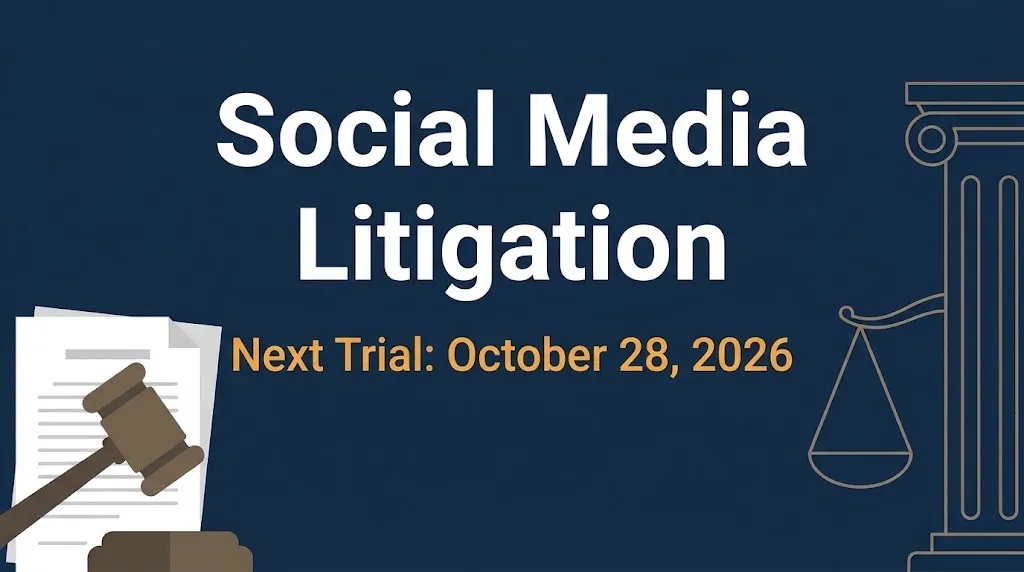
- Deadline: no claim form deadline exists. State filing deadlines apply, and the next trial starts October 28, 2026.
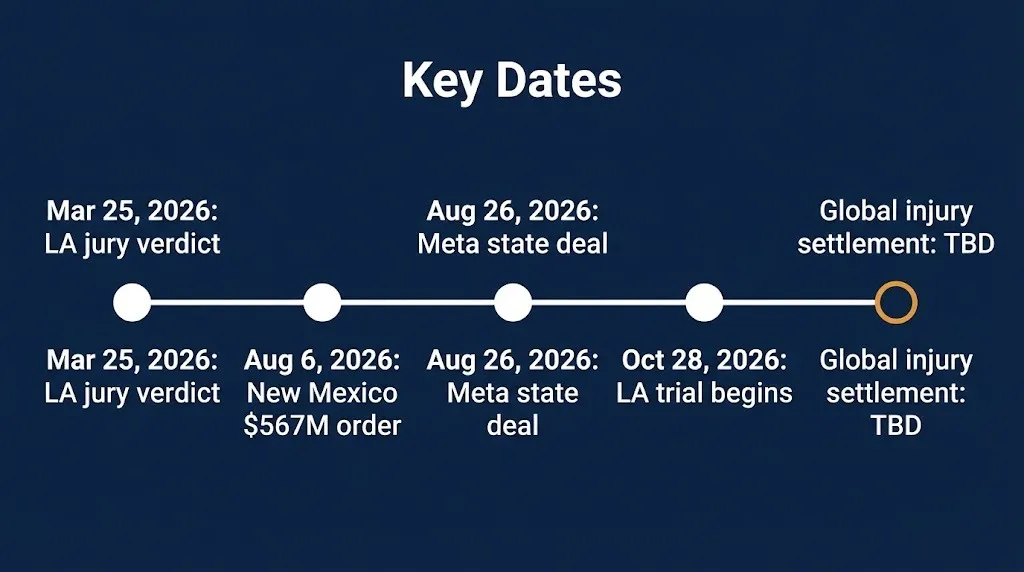
Social media litigation is a wave of lawsuits claiming Instagram, TikTok, Snapchat and YouTube were built to hook young users and harm their mental health. On March 25, 2026, a Los Angeles jury found Meta and YouTube liable for defective design. The award was $6 million.
The suits involve families of minors, school districts and state governments. The federal court held 3,824 pending injury cases on October 1, 2026.
This guide maps every track, explains who may file, and shows what has settled. One surprising detail: Meta’s $17.1 billion state deal pays no individual families.
| The Facts | |
|---|---|
| Case | In re Social Media Adolescent Addiction/Personal Injury Products Liability Litigation (MDL No. 3047) and California’s JCCP 5255 |
| Status | Active. Verdicts, state settlements and trials continue. No global settlement of family injury claims |
| Fund Size | None for families. Meta’s state deal is up to $17.1 billion, paid to states |
| Est. Per Person | Not yet determined |
| Claim Deadline | No claim form. State statutes of limitations apply |
| Administrator | Not yet appointed for families |
| Proof Needed | Not yet confirmed. Law firms generally look for diagnosis or treatment records |
Is social media litigation real, and what is it about?
Yes. Social media litigation is real and active, and 2026 produced the first jury verdicts.
The core claim is about design, not content. Plaintiffs’ lawyers shifted the focus from what users see to how the services were built. Attorneys general asked a court to force Meta to remove features like infinite scroll and autoplay.
Meta’s filing says these cases began in January 2022 and mostly involve users under 18. Alleged harms include depression, anxiety, eating disorders and self-harm. The companies deny the claims.
| Track | Who Sues | Where |
|---|---|---|
| Individual injury | Minors and families | Federal MDL 3047 and California JCCP 5255 |
| School districts | Districts | Federal MDL 3047 |
| State attorneys general | States | Federal and state courts |
| Mass arbitration | Individual Instagram users | Arbitration demands |
Is there a social media settlement you can claim money from?
No. No social media settlement currently lets a family file a claim for money.
Headlines said Meta agreed to pay $17 billion. The fine print says who gets it. The deal pays state governments over ten years and created no consumer fund, administrator or claim form.
It also doesn’t end your rights. The state deal doesn’t release any family’s injury claim. TikTok’s late-September deal with Alabama likewise pays the state.
| Deal | Paid To | Claim Form? |
|---|---|---|
| Meta and state attorneys general (Aug. 26, 2026) | State governments | No |
| TikTok and Alabama (late Sept. 2026) | State of Alabama | No |
| Breathitt County school case (May 2026) | School district | No |
| Snap and TikTok in the K.G.M. case (Jan. 2026) | One plaintiff, amount undisclosed | No |
Who is being sued in the social media mental health lawsuit?
The main defendants are Meta (Instagram and Facebook), TikTok’s parent ByteDance, Snap and Google’s YouTube.
- Meta: the only major defendant a California jury has found liable so far.
- TikTok and Snap: both settled specific cases, but thousands of other claims against them remain pending.
- YouTube: shared the March verdict with Meta and settled some later cases.
- Roblox and Discord: face separate child-safety suits.
The jury split the $6 million award 70 percent to Meta and 30 percent to YouTube. Settlements aren’t admissions. TikTok and Snap didn’t admit wrongdoing.
Key Takeaway: Social media litigation targets Meta, TikTok, Snap and YouTube over product design, and no family claim form exists.
How much have juries and states won so far?
Courts and settlements have produced billions in state-level money and one $6 million individual verdict.
| Case | Amount | Who Receives It |
|---|---|---|
| K.G.M. v. Meta and YouTube (Mar. 25, 2026) | $6 million total | One plaintiff, on appeal |
| New Mexico jury (Mar. 24, 2026) | $375 million civil penalty | State |
| New Mexico public nuisance order (Aug. 6, 2026) | $567 million over five years | State programs |
| Meta and state attorneys general (Aug. 26, 2026) | Up to $17.1 billion over ten years | States |
| Breathitt County school settlement (May 2026) | $27 million combined | School district |
A New Mexico judge ordered the $567 million to fund youth harm programs. That brings the New Mexico total to $942 million, and Meta says it will appeal.
Here’s a number from Meta’s own books. Its September 30 report shows about $19.9 billion in legal-related accruals, up from about $7.3 billion at year-end 2025. Those accruals cover many matters, including the state deal.
How much could a family get from a social media mental health lawsuit?
Not yet determined. No fund exists for individual families, so no per-person amount is set.
The only award to an injured individual is the $6 million verdict. It’s a single plaintiff’s result on appeal, and it doesn’t bind other cases. Settlement amounts in other cases weren’t disclosed.
Think of it like a group dinner bill. There’s no shared pot to split. Each case brings its own receipt.
Amounts depend on:
- Severity and duration of the harm
- Diagnosis and treatment records
- Which platforms were used, and for how long
- Which defendants are named
- State law and the court that hears the case
Reality Check: No one can promise you money from Meta’s $17.1 billion state deal. There is no claim form, so any text, ad or “claim helper” selling one is a red flag. Talking to a lawyer shouldn’t require an upfront fee.
Who may qualify to file a social media mental health lawsuit?
You may qualify if you were under 18 during heavy social media use and later developed a serious condition. A law firm makes that call on the facts.
Intake criteria generally cover conditions like depression, anxiety, eating disorders, body dysmorphia, self-harm and suicidal thoughts. Covered platforms typically include Facebook, Instagram, Snapchat, TikTok and YouTube.
You may have a case if:
- The harm began while you or your child was a minor
- A doctor or therapist diagnosed or treated the condition
- You can show heavy use of a named platform
- You’re still inside your state’s filing deadline
Adults can be plaintiffs too. The first trial involved a young woman who said she became addicted at a young age. No outcome is guaranteed.
Key Takeaway: You may qualify if harm began in adolescence and records support it, but a law firm’s review and your state’s deadline decide the rest.
How do you file a social media mental health lawsuit?
You file through a law firm, not a claims administrator. Most families take these steps first.
- Gather medical, therapy and school records.
- List which apps were used and roughly when.
- Save screenshots, account details and device records.
- Ask a licensed attorney for a case review.
- Expect the firm to check your facts against intake criteria.
- If accepted, the firm files in federal MDL 3047 or California’s JCCP 5255.
- Cases are evaluated one by one.
Firms generally work on contingency, and submitting an online screening form doesn’t file a lawsuit. Read any retainer agreement before you sign.
What is the deadline to file a social media lawsuit?
There’s no claim form deadline, but a statute of limitations can still end your case.
State limitation periods vary by state and by the type of harm. Many states pause the clock for minors, but rules differ. Don’t assume you have time.
Think of it like a warranty claim. File after the window closes, and the answer is no, even with a strong case.
Bold date: the next real calendar date is October 28, 2026, when the next Los Angeles injury trial begins. It isn’t your filing deadline.
Ask an attorney in your state to confirm your exact date.
What is the difference between MDL 3047 and JCCP 5255?
MDL 3047 is the federal court track in Oakland. JCCP 5255 is California’s state court track in Los Angeles.
The federal cases were centralized in the Northern District of California on October 6, 2022. Both tracks gather cases before one judge for shared pretrial work.
| Feature | MDL 3047 | JCCP 5255 |
|---|---|---|
| Court | U.S. District Court, N.D. Cal. (Oakland) | Los Angeles County Superior Court |
| Judge | Yvonne Gonzalez Rogers | Carolyn B. Kuhl |
| Name | In re Social Media Adolescent Addiction/Personal Injury Products Liability Litigation | Social Media Cases |
| Size | 3,824 pending (Oct. 1, 2026) | Counted separately |
Both tracks use bellwether trials. A bellwether is a test case. Think of a sample batch pulled from a factory line to judge the rest.
Key Takeaway: Federal MDL 3047 and California JCCP 5255 run side by side, and bellwether trials test how juries treat the claims.
What happened in the first social media addiction trial?
A Los Angeles jury found Meta and YouTube negligent on March 25, 2026, in the case of a plaintiff known as K.G.M.
Snap settled on January 20 and TikTok on January 27, before the trial began. Meta CEO Mark Zuckerberg and Instagram head Adam Mosseri testified.
Meta argued her struggles would have existed without Instagram. Jurors found the platforms were a substantial factor in the plaintiff’s depression and suicidal thoughts.
The verdict isn’t final. Judge Kuhl denied post-trial motions in early June, and Meta and YouTube filed appeals in July. Appeals can take time, and the result applies only to this plaintiff.
What happened in the state attorney general cases?
Two state enforcement tracks produced big results in 2026: New Mexico’s case and the multistate case against Meta.
New Mexico won first. A jury ordered a $375 million civil penalty on March 24. A judge added $567 million in August.
The multistate trial began in Oakland. Meta settled on August 26, eight days after opening statements. California said the money is paid over ten years, with the state getting at least $1.5 billion if approved.
Meta didn’t admit liability. The consent judgment also requires five years of product changes for users under 18.
Counts differ by source. AP reported 47 states. Meta’s quarterly filing describes 52 attorneys general across states, territories and D.C. Check the consent judgment itself for the final list.
When is the next social media trial?
The next personal injury trial is set to begin October 28, 2026, in Los Angeles.
Judge Kuhl consolidated two teen plaintiffs’ cases for one jury on August 28, over Meta’s objection. She also denied Meta’s bid to keep Zuckerberg and Mosseri off the stand.
Defendants have shifted. An October 20 report says Meta and Snap are the last defendants, with TikTok and YouTube settled. Earlier reports listed YouTube, so confirm on the docket.
| Date | Event |
|---|---|
| October 28, 2026 | Consolidated Los Angeles injury trial begins |
| February 2027 (reported) | Next federal school district trials |
| March 16, 2027 (reported) | Further California injury trial |
| August 6, 2027 (reported) | Further California injury trial |
Key Takeaway: The October 28 Los Angeles trial is the next real test of whether a second jury will blame the platforms.
Why isn’t Section 230 stopping these lawsuits?
Section 230 hasn’t ended these cases because plaintiffs sue over product design, not over what users posted.
Lawyers reframed the claims around how the services were designed. That distinction matters because Section 230 protects platforms from liability for user content.
Courts haven’t settled everything. Open questions include whether platforms owe a duty of care to young users. The New Mexico judge noted some design features raise free speech issues.
You’ll see this argument repeated in appeals. Expect it to shape the October 28 trial, too.
What do Meta and the other companies say in their defense?
Meta says the plaintiffs can’t prove its products caused their harm.
At the K.G.M. trial, its lawyers said no therapist had named social media as the cause. Zuckerberg testified that Meta no longer sets goals to maximize screen time, and that research doesn’t conclusively prove causation.
Meta also says it’s working to protect teens. It said it has worked to identify and remove harmful content. It plans to appeal the New Mexico and Los Angeles rulings.
Here’s the gap worth noting. A company says causation is unproven. One jury disagreed in one case.
One verdict isn’t a rule. But it’s a data point that’s now shaping settlement talks.
What are the school district and mass arbitration claims?
School districts and mass arbitration claimants sit on separate tracks from family injury suits.
Meta settled the first school district case in May 2026. The combined settlement was $27 million across four companies. Tucson Unified and Charleston County are reportedly next, in February 2027.
Mass arbitration works differently. Counsel for more than 200,000 claimants have sent arbitration demands over Instagram since November 2024. These claimants pursue Meta individually, outside court.
Neither track is a class action. None of them creates a family claim form today.
Key Takeaway: School districts, mass arbitration claimants and state attorneys general each run their own cases, and none pays a family through a claim form.
What happens next in social media litigation?
Several dates are set. Many more are still open.
October 28, 2026: The consolidated Los Angeles injury trial begins in JCCP 5255.
Expected, date not confirmed: The California appeals of the K.G.M. verdict move forward.
Expected, date not confirmed: Meta appeals the New Mexico rulings to the state Court of Appeals.
February 2027 (reported): Federal school district trials begin in Oakland.
March 16 and August 6, 2027 (reported): More California injury trials follow.
Frequently Asked Questions
Is there a social media mental health lawsuit I can join?
Individual injury cases are still being filed, but there’s no class action to join.
A law firm reviews your facts and files your case if accepted.
Can I get money from Meta’s $17.1 billion settlement?
No. The deal pays state governments over ten years.
It has no claim form, and it doesn’t release family injury claims.
What is the social media addiction MDL?
It’s MDL No. 3047, a federal case group in Oakland before Judge Yvonne Gonzalez Rogers.
It held 3,824 pending cases on October 1, 2026.
Did Meta lose the first social media addiction trial?
Yes. A Los Angeles jury found Meta and YouTube negligent on March 25, 2026.
The $6 million award is on appeal, so it’s not final.
How long do I have to file a social media lawsuit?
It depends on your state and the type of harm.
Many states pause the clock for minors, so ask an attorney for your date.
Which social media companies have settled?
TikTok, Snap and YouTube each settled specific cases, and Meta settled with states.
No global settlement of family injury claims exists.
When is the next social media trial?
October 28, 2026, in Los Angeles Superior Court.
Meta and Snap are reported as the remaining defendants.
If you’re considering a claim, gather diagnosis and treatment records now. Ask a licensed attorney in your state about your filing deadline.
Watch the Los Angeles trial for early signals. As of October 24, 2026, no claim form exists for families, and the next trial begins October 28.