What Does Compensation Expectations Mean in 2026: Salary, Total Pay, and How to Answer
Quick Answer
- Compensation expectations means the salary or total pay you want for a specific job.
- It includes base salary, bonuses, benefits, and sometimes equity or retirement contributions.
- Most employers expect a range, not a single number, in 2026.
Compensation expectations is a hiring term, not a legal claim. If you are filling out a job application and see this question, the employer wants to know what you expect to be paid. It is not a trick, but it can hurt you if you answer wrong.
The question appears on applications, in recruiter screenings, and in final interviews. Your answer sets the anchor for salary negotiations. If you lowball yourself, you may leave money on the table. If you aim too high without market data, you may price yourself out.
This guide breaks down exactly what the term includes, how to calculate your number, what to say in different situations, and the legal context in 2026. One surprising fact: several states now ban employers from asking salary history, which has shifted the compensation expectations question from a formality to a strategic negotiation point.
The Facts
| Item | Detail |
|---|---|
| Case | Not a lawsuit, a standard hiring question |
| Status | Used by employers in 2026 hiring processes |
| Fund Size | Not applicable |
| Est. Per Person | Varies by role, industry, and location |
| Claim Deadline | None, it is not a claim process |
| Administrator | Not applicable |
| Proof Needed | Market data, not legal proof |
What Does Compensation Expectations Mean on a Job Application?
Compensation expectations means the amount of money you want to earn for the role you are applying for. It is usually a range that includes base salary. Some employers want a specific number. Most accept a range.
The question is not asking about your current salary. It is asking about your target for this job. That distinction matters. In states with salary history bans, employers cannot ask what you currently make, but they can ask what you expect.
Your answer should reflect market rates for the role, your experience level, and your location. A software engineer in San Francisco has different expectations than one in Columbus, Ohio. The employer uses your answer to decide if you fit their budget.
If you answer too low, the employer may offer you less than they would have paid. If you answer too high, you may be screened out before you can explain. That is why a researched range is usually the smartest move.
What Does Total Compensation Expectations Mean?
Total compensation expectations means the full value of everything you want from the employer, not just base salary. That includes bonuses, health benefits, retirement contributions, paid time off, and equity if the company offers it.
Many applicants focus only on base salary and forget the rest. That is a mistake. A job paying $80,000 with a 10 percent bonus, a 401(k) match, and strong health insurance is worth more than a job paying $85,000 with none of those.
When an employer asks about total compensation expectations, they are testing whether you understand the full package. You should answer with a base salary range and mention that you are open to discussing the total package.
- Base salary
- Annual bonus or commission
- Health, dental, and vision insurance
- Retirement plan match
- Stock options or equity
- Paid time off and holidays
- Remote work or flexibility
How Do I Calculate My Compensation Expectations?
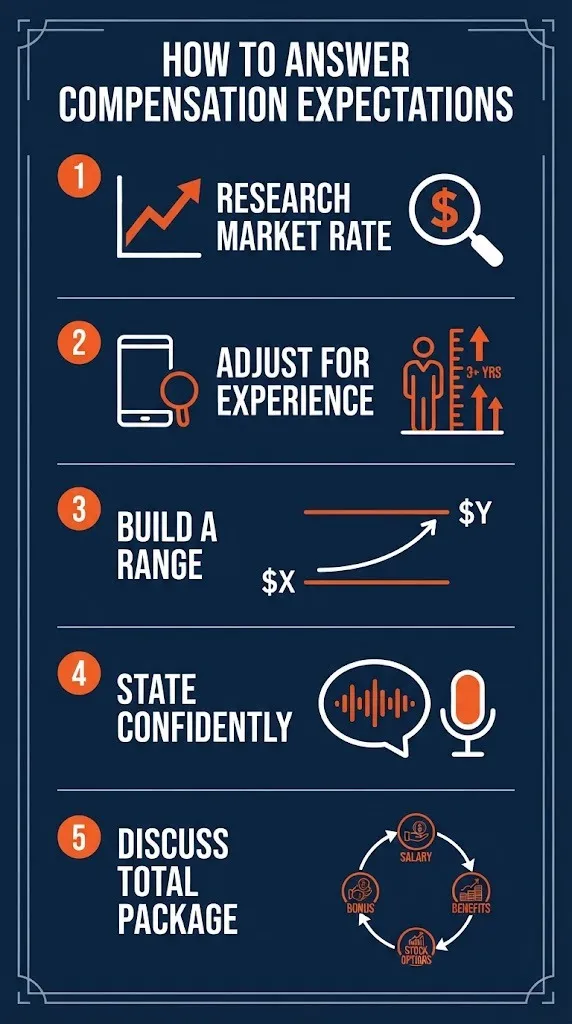
You calculate your compensation expectations by researching market rates for the role, adjusting for your experience and location, and adding the value of benefits. Start with salary data, not your gut feeling.
Salary research comes from public sources like the Bureau of Labor Statistics, industry surveys, and job boards that show pay ranges. Some states now require job postings to include salary ranges, which gives you direct data.
Here are the steps to calculate your number:
- Find the salary range for the role in your city or state.
- Identify where you fall in that range based on experience.
- Add 5 to 10 percent if you have in-demand skills.
- Subtract 5 percent if you are changing industries.
- Build a range with your target at the lower end.
- Add the estimated value of benefits to get total compensation.
The range should be realistic. If the market rate is $70,000 to $90,000 and you have five years of experience, your range might be $80,000 to $90,000. A range that is too wide looks unprepared. A range that is too narrow leaves no room to negotiate.
What Are Compensation Requirements vs Compensation Expectations?
Compensation requirements means the minimum amount you would accept to take the job. Compensation expectations means the amount you hope to get. They are similar but not identical.
Your requirements are your floor. If the employer cannot meet that number, you walk away. Your expectations are your target. That is the number you negotiate toward.
Some applications ask for requirements instead of expectations. The difference is subtle but important. A requirements answer should be your true minimum. An expectations answer should be your realistic target.
Never list a requirement that is higher than your expectations. That signals confusion. Your requirement should be at the bottom of your range. Your expectation should be the midpoint or upper end.
How Do I Answer Compensation Expectations on an Application?
You answer compensation expectations on an application by entering a range based on market data, not a single number. A range gives you room to negotiate. A single number locks you in.
The exact answer depends on whether the application has a required field and whether it accepts text or only numbers. If the field requires a number, use the midpoint of your range. If it accepts text, write the full range.
For example, if the market rate is $65,000 to $85,000 and your experience puts you at the upper end, you might enter “75,000” in a numeric field or “$75,000 to $85,000” in a text field.
Some applicants worry that a range makes them look uncertain. The opposite is true. A researched range shows you know the market. A single number shows you guessed.
Key Takeaway: A market-based range is the strongest answer. It anchors the negotiation without boxing you in.
What Are Your Total Compensation Expectations?
This is the same question as compensation expectations, but it invites you to think beyond base salary. Your answer should include your base salary range plus a brief statement about benefits.
You might say: “I am targeting a base salary of $80,000 to $90,000, and I am open to discussing the full package including bonus and benefits.” That answer gives the employer a clear number while signaling flexibility.
Avoid listing every benefit you want. That turns a salary answer into a wish list. Keep it simple. One sentence about base salary. One sentence about openness to the total package.
If the employer pushes for a specific total compensation number, estimate the value of benefits. A typical benefits package is worth 25 to 30 percent of base salary. So $80,000 in base salary is roughly $100,000 to $104,000 in total compensation.
How Do I Answer Compensation Expectations in an Interview?
You answer compensation expectations in an interview by restating your researched range and asking if it aligns with the employer’s budget. This turns the question into a conversation instead of a one-sided disclosure.
In the interview, you have more room to explain your reasoning. You can mention the market data you reviewed, your relevant skills, and your understanding of the role’s scope.
Here is a sample answer:
“Based on my research and my experience with similar roles, I am targeting $80,000 to $90,000 in base salary. I am also interested in the total package, including bonus and benefits. Does that range align with your budget for this position?”
That answer is confident. It states a range. It invites the employer to respond. It does not apologize for the number.
What Are Annual Compensation Expectations?
Annual compensation expectations means the total amount you expect to earn in one year from the employer. It is usually expressed as an annual base salary plus any expected bonus or commission.
For hourly workers, annual compensation expectations can be calculated by multiplying the hourly rate by the expected number of hours per year. A full-time worker at 40 hours per week works about 2,080 hours per year. So $25 per hour equals $52,000 per year.
For salaried workers, the annual number is simpler. Your base salary is the annual number. Bonus and benefits are added on top.
When an application asks for annual compensation expectations, enter the annual base salary range, not the total with benefits. Most employers compare base salary against their budget.
What Is the 2026 Average Compensation by Industry?
The 2026 average compensation varies widely by industry, role, and location. The Bureau of Labor Statistics publishes national and state wage data, but the averages shift with the economy.
Technology, finance, and healthcare roles typically pay more than retail, education, and hospitality. A software engineer may have average total compensation above $150,000. A retail manager may average under $60,000.
Here are broad 2026 average base salary ranges for selected roles:
| Role | Average Base Salary Range |
|---|---|
| Administrative assistant | $40,000 to $55,000 |
| Registered nurse | $75,000 to $100,000 |
| Accountant | $65,000 to $90,000 |
| Software engineer | $100,000 to $160,000 |
| Marketing manager | $80,000 to $120,000 |
| Construction worker | $45,000 to $70,000 |
These are national averages. Your local market may be higher or lower. Cost of living is the biggest variable.
Reality Check
No employer is obligated to meet your compensation expectations. The question is a screening tool, not a promise. And no law requires you to disclose your current salary, especially in states with salary history bans. Anyone pressuring you to reveal a number before you have the job details is negotiating against you, not with you.
What States Have Salary History Bans in 2026?
As of 2026, more than twenty states and several major cities have laws banning employers from asking about salary history. These laws aim to reduce pay discrimination and break the cycle of underpayment.
States with salary history bans include California, New York, Colorado, Washington, Massachusetts, Illinois, and Maryland, among others. The exact rules vary. Some bans apply only to state agencies. Others apply to all employers.
Under these laws, employers cannot ask what you currently earn. They can ask about your compensation expectations. That distinction is why the expectations question has become more important.
If an employer asks for your salary history in a state where it is banned, you can decline to answer. You may want to check the specific law in your state for details.
How Do I Handle Compensation Expectations When Changing Careers?
When changing careers, your compensation expectations may need to be lower than your previous salary. You are entering a new field without direct experience. Employers will price you as a beginner.
The key is to research the entry-level range for the new field. Set your expectations at the midpoint of that range. Do not anchor to your old salary, because the employer will not match it.
You can also emphasize transferable skills that justify the upper end of the entry-level range. Project management, communication, and data analysis skills transfer across industries. Use them in your negotiation.
A realistic example: a former teacher moving into corporate training might expect $55,000 to $70,000, even if they earned $60,000 before. The new field values the skill set differently.
Key Takeaway: Career changers should anchor to the new field’s market rate, not their old salary.
How Do I Handle Compensation Expectations for Remote Jobs?
Remote job compensation expectations can be tricky because employers often adjust pay based on where you live. Some companies pay the same regardless of location. Others use geographic pay bands.
Research the employer’s pay policy first. If the job posting includes a salary range, check whether it applies nationally or is location-specific. A remote role may list a range like “$90,000 to $130,000 depending on location.”
When you answer, use the range for your location if one is published. If not, use the national range and note your location in the conversation. Do not assume remote means the highest cost-of-living pay.
Some employers are moving toward location-independent pay in 2026, but the trend is uneven. Tech companies and startups are more likely to pay the same everywhere. Traditional employers often keep geographic bands.
What Should I Avoid Saying About Compensation Expectations?
Certain answers hurt your position. Avoid these mistakes.
Do not say “I am open” without giving a number. That forces the employer to guess, and they will guess low.
Do not say “whatever you think is fair.” That signals you have not done research and will accept less.
Do not state a number before you understand the full scope of the role. If you are asked early in the process, you can say you want to learn more about the responsibilities first.
Do not inflate your number to anchor high unless you can justify it with market data. A number that is wildly above the market range gets you screened out.
- Never answer with no number at all
- Never answer with your current salary
- Never answer with a range wider than $15,000
- Never apologize for your number
- Never agree to a number before understanding the full package
What Happens Next: Compensation Expectations in the 2026 Hiring Market
- September 2026: More employers adopt pay transparency as new state laws take effect.
- October 2026: Salary survey data for 2026 releases from major compensation firms.
- November 2026: Year-end hiring slows, but negotiations for January start dates begin.
- December 2026: Employers finalize 2027 compensation budgets and salary ranges.
- January 2027: New salary bands apply to job postings and offers.
Frequently Asked Questions
What does compensation expectations mean?
It means the salary or total pay you want for a specific job.
Should I give a range or a single number?
A range is usually better because it leaves room to negotiate.
What is total compensation?
Total compensation is base salary plus bonus, benefits, retirement, and equity.
Can an employer ask my current salary?
In many states, no. Salary history bans prohibit that question.
How do I calculate my expected salary?
Research market rates for the role, adjust for experience and location, and add benefits.
What if I am asked about compensation before the interview?
Give a researched range and note that you are flexible based on the full role scope.
Is compensation expectations the same as salary requirements?
They are similar. Requirements are your minimum. Expectations are your target.
What is a good compensation expectation answer?
A market-based range with a brief note about openness to the total package.
Closing
Compensation expectations is a simple question with real money attached. Research the market, build a range, and state it confidently. Do not guess. Do not undercut yourself. Do not anchor to your old salary.
The single most important move: know the market rate before you answer. With pay transparency laws expanding in 2026, the data is easier to find than ever.