Securities Litigation Lawsuit: 2026 Filing Deadlines, Settlement Updates, and Investor Claim Process
Quick Answer
- Securities litigation lawsuits are real legal actions over alleged fraud, misstatements, or insider trading that harmed investors.
- Recent settlements range from $10 million to over $1 billion, with individual investor payouts varying widely by losses.
- Deadlines to file claims depend on each case; several major 2025 settlements have 2026 claim deadlines approaching.
Securities litigation is a broad category of civil lawsuits involving stocks, bonds, mutual funds, and other investments. These cases typically allege that a company, its executives, or its board misled investors or violated securities laws.
This affects individual investors who bought or sold securities during specific periods and lost money due to alleged misconduct. It also affects institutional investors, pension funds, and retirement account holders.
This article covers how securities litigation works, current active cases in 2026, settlement payout ranges, and how to file a claim if you receive a notice or believe you may qualify.
The Facts
| Field | Verified Detail |
|---|---|
| Case Type | Securities class actions and individual suits |
| Primary Statute | Securities Act of 1933 and Securities Exchange Act of 1934 |
| Regulator | SEC and DOJ for enforcement actions |
| Common Claims | Misleading statements, accounting fraud, insider trading, inadequate disclosures |
| Typical Settlement | $10 million to over $1 billion |
| Claim Filing Cost | Free |
| Administrator | Varies by case; often Epiq, Kroll, or JND |
| Proof Required | Brokerage statements showing transactions and losses |
Securities litigation is not a single case. It is a field of law covering many lawsuits filed in federal and state courts. The most common type is the securities class action, where one or more investors represent a larger group of harmed shareholders.
Class actions follow a pattern. The plaintiff files a complaint. The court decides whether the case can proceed as a class action. Discovery follows. Most cases settle before trial.
For individual investors, securities litigation matters because settlements often return a portion of losses to shareholders who held a stock during the misconduct period.
Is Securities Litigation a Real Thing or a Scam?
Securities litigation is a real legal field, not a scam. Cases are filed in federal courts across the country, and settlements return billions of dollars to investors every year.
The SEC and DOJ also pursue securities enforcement actions. These are separate from private class actions. Enforcement actions can result in fines, penalties, and restitution orders.
What sometimes looks like a scam is the claim notice. Investors receive postcards or emails saying they may be entitled to money from a securities settlement. Many people assume these are fraudulent.
Most are legitimate. The key is verifying the notice. Real settlement notices come from court-appointed administrators like Epiq, Kroll, or JND. They include a case name, court name, and official website. They never ask for upfront payment.
How Much Are Securities Litigation Settlements Worth?
Securities litigation settlements vary enormously. Small cases settle for $10 million or less. Major fraud cases settle for hundreds of millions or even billions.
Some of the largest recent settlements include:
| Case | Settlement Amount | Year |
|---|---|---|
| Enron securities litigation | $7.2 billion | 2008 |
| WorldCom securities litigation | $6.1 billion | 2005 |
| Petrobras securities litigation | $3 billion | 2018 |
| Luckin Coffee securities litigation | $1.75 billion | 2021 |
For individual investors, the payout depends on your recognized loss, the size of the settlement fund, and how many other investors file claims.
A typical individual payout might be a few hundred dollars for small investors. Institutional investors with large losses can receive millions.
Reality Check: No legitimate securities settlement requires you to pay a filing fee. The claims process is free. Third-party companies that charge fees to file your claim are unnecessary and often take a percentage of your recovery.
What Types of Securities Litigation Exist in 2026?
Securities litigation in 2026 covers several distinct types of claims.
The main categories are:
- Securities class actions for misleading statements or omissions
- Shareholder derivative suits against officers and directors
- Insider trading enforcement actions by the SEC
- Accounting fraud cases under Section 10(b) of the Exchange Act
- IPO disclosure cases under the Securities Act of 1933
Each type has different legal standards and potential outcomes. Class actions are the most common for individual investors.
Derivative suits are filed on behalf of the company itself. Any recovery goes to the company, not directly to shareholders. These cases often result in governance reforms rather than cash payouts.
SEC enforcement actions can run parallel to private litigation. The SEC may seek penalties and disgorgement while private plaintiffs seek damages.
How Do I File a Securities Litigation Claim?
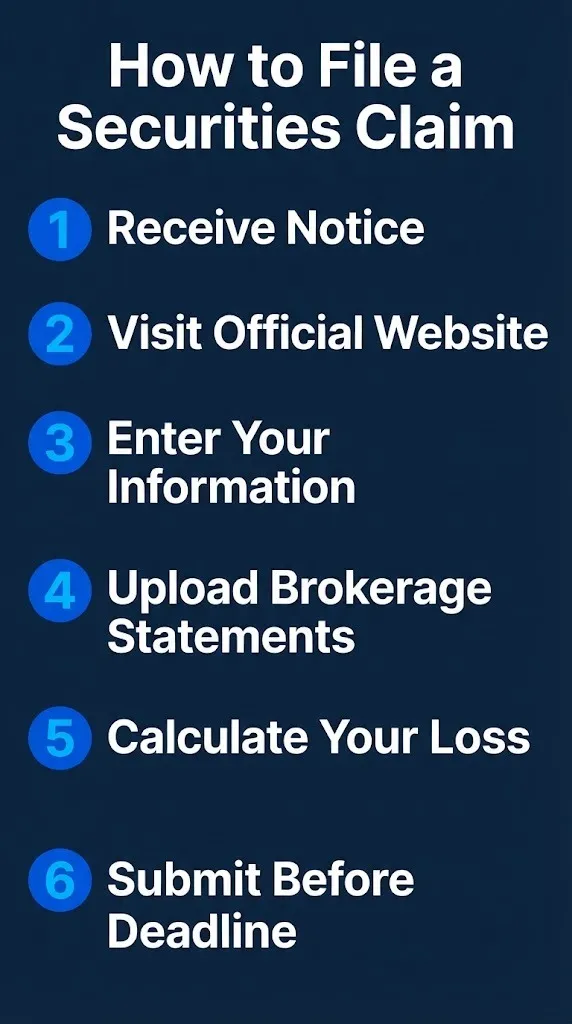
Filing a securities litigation claim requires submitting a proof of claim form to the settlement administrator before the court-set deadline.
The process works like this:
- Receive a notice by mail or email with the case name and administrator.
- Visit the official settlement website named in the notice.
- Enter your personal information and the securities you held.
- Provide your brokerage account details and transaction history.
- Upload supporting documents like trade confirmations or statements.
- Calculate your recognized loss using the formula in the notice.
- Submit the form before the deadline, which varies by case.
The proof of claim form asks for every purchase and sale of the security during the class period. You can usually obtain this information from your brokerage firm or through your online account.
If you held the security in multiple accounts, list each account separately. Incomplete claims are often rejected or reduced.
What Is the Deadline to File a Securities Litigation Claim?
The deadline to file a securities litigation claim varies by case. Each settlement sets its own claim deadline, typically 60 to 120 days after the notice is mailed.
For active 2026 settlements, deadlines are spread throughout the year. Some cases have deadlines in March 2026. Others extend into summer or fall 2026.
The notice you receive will state the deadline clearly. If you miss it, you forfeit your right to recover from that settlement. There is no grace period.
Set a calendar reminder immediately when you receive a notice. These deadlines are strict. Courts rarely extend them except in extraordinary circumstances.
What Happens After I File a Securities Litigation Claim?
After you file a securities litigation claim, the administrator reviews your submission for completeness and accuracy. You will not receive an immediate decision.
The review process takes months. Administrators cross-check claims against brokerage records and calculate recognized losses using the court-approved formula.
If your claim is deficient, the administrator may contact you for additional documentation. Respond promptly. Delayed responses can push your claim past the deadline.
Once all claims are reviewed, the administrator submits a distribution plan to the court. After court approval, payments are issued. The entire process from filing to payment typically takes 12 to 24 months.
Key Takeaway: Securities settlements follow a strict timeline: file before the deadline, respond to any deficiency notices quickly, and expect payment 12 to 24 months after filing.
How Are Securities Litigation Payouts Calculated?
Securities litigation payouts are calculated using a court-approved plan that accounts for your losses, the settlement fund size, and the total claims filed.
The recognized loss formula varies by case. Most use a method that accounts for inflation or market-wide movements to isolate the loss caused by the alleged fraud.
A simplified example: if the settlement fund is $100 million, and investors file $500 million in recognized losses, each claimant receives roughly 20 cents per dollar of recognized loss.
The actual calculation is more complex. Some investors receive priority under the plan. Institutional investors may receive a different rate than retail investors in some settlements.
What Is the Difference Between a Securities Class Action and an SEC Enforcement Action?
A securities class action is a private lawsuit filed by investors seeking compensation for their losses. An SEC enforcement action is a government proceeding seeking penalties and other remedies.
The two often run parallel. The SEC may file an enforcement action against a company for accounting fraud. Private plaintiffs may then file a class action using the SEC’s findings as evidence.
The outcomes differ. SEC penalties go to the U.S. Treasury, not to investors. Class action settlements go to investors who file claims.
In some cases, the SEC obtains a Fair Fund that can distribute penalties to harmed investors. These distributions are handled similarly to class action settlements.
Who Are the Lead Plaintiffs in Securities Litigation?
Lead plaintiffs in securities litigation are the investors or institutions appointed by the court to represent the class.
The Private Securities Litigation Reform Act of 1995 created a process for selecting lead plaintiffs. The court presumes that the investor with the largest financial interest in the case is the most adequate lead plaintiff.
Institutional investors like pension funds and mutual funds often serve as lead plaintiffs. They have the resources and sophistication to oversee the litigation.
Lead plaintiffs work with class counsel. They make key decisions about settlement offers and litigation strategy. They may receive a small additional payment for their service, subject to court approval.
What Are the Most Active Securities Litigation Areas in 2026?
The most active securities litigation areas in 2026 include cryptocurrency and digital asset cases, SPAC-related claims, and traditional accounting fraud suits.
Cryptocurrency cases surged after the 2022 market downturn and continue to work through courts. Several major exchanges and token issuers face class actions alleging unregistered securities offerings.
SPAC litigation remains active. Investors allege that sponsors and target companies made misleading projections during the merger process.
Traditional accounting fraud cases continue against public companies across sectors. The SEC’s whistleblower program has encouraged more insider reporting, leading to more enforcement referrals and follow-on class actions.
How Long Does Securities Litigation Take?
Securities litigation typically takes 3 to 5 years from filing to final resolution. Some cases settle faster. Complex cases with appeals can take longer.
The timeline breaks down like this:
| Stage | Typical Duration |
|---|---|
| Filing to motion to dismiss ruling | 12 to 18 months |
| Class certification | 18 to 24 months |
| Discovery | 12 to 24 months |
| Settlement negotiations | 6 to 12 months |
| Preliminary approval to final approval | 4 to 8 months |
| Claims filing period | 60 to 120 days |
| Distribution | 6 to 12 months after final approval |
The claim filing window is the shortest part of the process. That is why prompt action matters when you receive a notice.
Key Takeaway: Securities litigation moves slowly through the courts, but the claim filing window is short. Respond to notices immediately.
Do I Need a Lawyer to File a Securities Litigation Claim?
You do not need a lawyer to file a securities litigation claim. The proof of claim form is designed for individual investors to complete without legal help.
The settlement administrator processes claims regardless of whether you have an attorney. Filing is free either way.
You only need a lawyer if you want to opt out of the class and pursue your own individual securities lawsuit. That is a significant decision with different risks and potential rewards.
For most individual investors, filing a claim in the class settlement is the simplest and lowest-cost option.
What Should I Do If I Receive a Securities Litigation Notice?
If you receive a securities litigation notice, take four steps immediately.
- Read the notice carefully to identify the case name, administrator, and deadline.
- Verify the notice is legitimate by checking the administrator’s website.
- Gather your brokerage statements showing transactions during the class period.
- File your claim before the deadline using the official form.
Do not ignore the notice. If you held the security during the class period and lost money, you may be entitled to a payment.
Do not pay anyone to file for you. The process is free and designed for individuals to complete themselves.
What Is the Role of the Settlement Administrator in Securities Litigation?
The settlement administrator in securities litigation is a third-party company appointed by the court to manage the claims process.
The administrator’s duties include:
- Distributing notice to potential class members
- Collecting and reviewing proof of claim forms
- Calculating recognized losses for each claimant
- Recommending a distribution plan to the court
- Issuing payments after court approval
Major administrators include Epiq, Kroll, JND Legal Administration, and Angeion Group. These companies handle thousands of settlements across all types of class actions.
The administrator is neutral. It does not represent the plaintiffs, the defendants, or any individual investor. Its job is to implement the court’s orders.
What Happens Next in Securities Litigation?
Securities litigation continues to evolve in 2026. Several trends are shaping the field.
Early 2026: Courts rule on pending motions to dismiss in major cryptocurrency cases.
Spring 2026: Several large settlements receive final approval and open claim filing windows.
Summer 2026: Claim deadlines for early-2026 settlements begin to close.
Fall 2026: Distribution plans filed for approved settlements, with payments expected in late 2026 or 2027.
Ongoing: SEC enforcement activity remains high, generating follow-on private litigation.
If you are an investor who has received a notice or believes you may have a claim, the most important action is to check the official settlement website and calendar the deadline.
Frequently Asked Questions
Is securities litigation real?
Yes. Securities litigation is a real legal field with thousands of active cases in federal courts.
Settlements return billions of dollars to investors annually.
How much will I get from a securities litigation settlement?
Your payout depends on your recognized loss, the settlement fund size, and the number of claims filed.
Individual payouts can range from a few dollars to tens of thousands.
Do I need to pay to file a securities litigation claim?
No. Filing a securities class action claim is always free.
Any company charging a fee to file your claim is running a scam.
What is the deadline to file a securities claim?
Each settlement sets its own deadline, typically 60 to 120 days after notice.
The deadline is printed in the notice you receive.
How do I know if a settlement notice is real?
Verify the notice through the administrator’s official website.
Real notices include the case name, court, and a deadline. They never ask for payment.
What documents do I need to file a claim?
You need brokerage statements showing your transactions during the class period.
Trade confirmations and account summaries also work.
Can I file a claim if I sold the stock before the lawsuit?
Yes. You may qualify if you held the stock during the class period and lost money.
The notice will define the exact class period dates.
How long until I get paid after filing a claim?
Expect payment 12 to 24 months after filing.
The administrator must review all claims and obtain court approval before distribution.
The most important thing you can do is act quickly when you receive a securities litigation notice. Calendar the deadline. Gather your brokerage statements. File the free claim form before the cutoff.
Missing a securities settlement deadline means forfeiting your recovery. No one can get that money back for you later. Check the official settlement website today.