PAGA Lawsuit 2026: What It Is, Who Qualifies, and How Settlements Get Paid
Quick Answer
- A PAGA lawsuit is a real, California-specific legal action that lets an employee sue an employer for Labor Code violations on the state’s behalf.
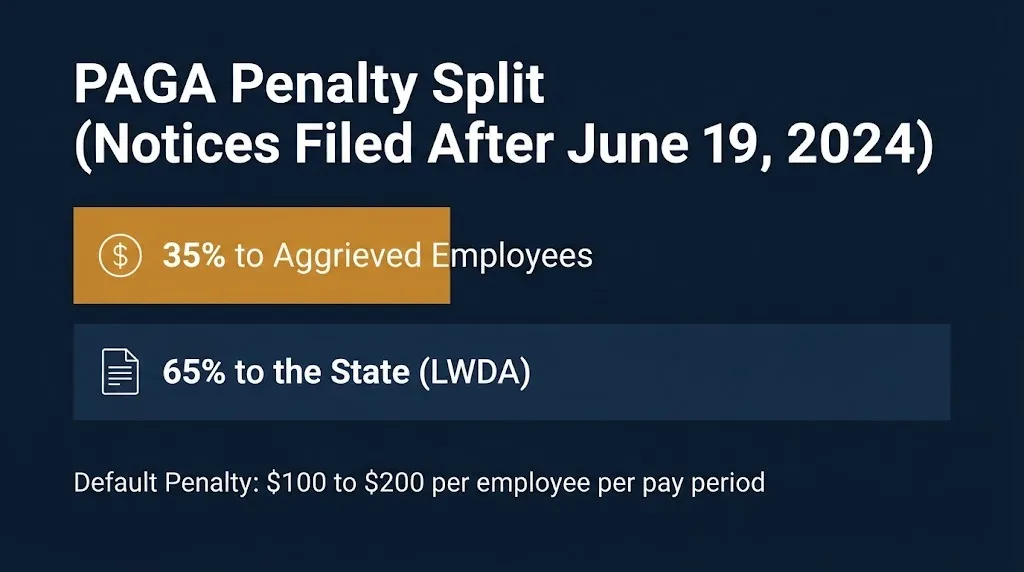
- Confirmed penalties run $100 per employee per pay period for a first violation and up to $200 for subsequent or heightened violations, split 35% to employees and 65% to the state.
- You must file a PAGA notice with the LWDA within one year of the last violation, or your claim can be dismissed.
If you’re asking “what is a PAGA lawsuit,” here’s the direct answer: it’s a California law that lets an individual employee step into the state’s shoes and sue an employer for Labor Code violations, collecting civil penalties that used to be available only to government agencies.
This affects any California employee who believes their employer violated wage and hour law, and it works differently from a typical class action. The single most important number to know: you generally have one year from the date of the last violation to get your PAGA notice filed with the state, or your claim risks being time-barred entirely.
This article breaks down what a PAGA lawsuit actually is, how penalties get calculated, and what changed under California’s 2024 reform law. One detail most guides skip: the state proposed brand new PAGA regulations in February 2026, and they directly affect how future notices and settlements get handled.
The Facts
| Category | Detail |
|---|---|
| Law | California Private Attorneys General Act (PAGA), Labor Code Sections 2698 to 2699.8 |
| In Effect Since | 2004 |
| Major Reform | AB 2288 and SB 92, signed July 1, 2024, retroactive to PAGA notices filed on or after June 19, 2024 |
| Penalty Split | 35% to aggrieved employees, 65% to the state, for notices filed after June 19, 2024 |
| Default Penalty | $100 per employee per pay period (initial violation); $200 per pay period (subsequent or heightened violations) |
| Statute of Limitations | One year from the date of the last alleged Labor Code violation |
| Filing Fee | $75 per PAGA notice submitted to the LWDA |
| Recent Development | LWDA proposed new implementing regulations on February 6, 2026 |
What Is a PAGA Lawsuit?
A PAGA lawsuit is a legal action under California’s Private Attorneys General Act that allows an “aggrieved employee” to sue their employer for Labor Code violations and collect civil penalties on the state’s behalf. It exists only in California.
The law effectively deputizes individual workers as private attorneys general. Instead of waiting for a government agency to act, one employee with a valid claim can pursue penalties that were historically reserved for state enforcement.
PAGA has been in effect since 2004. According to industry tracking, PAGA lawsuits increased over 1,000 percent in the years following enactment, and the LWDA has received roughly 4,000 PAGA notices annually in recent years.
Key Takeaway: A PAGA lawsuit isn’t a typical personal injury claim; it’s a mechanism for enforcing state labor law, with penalties split between the employee and California itself.
Is PAGA a Class Action Lawsuit?
No, a PAGA lawsuit is legally distinct from a class action, even though both can involve large groups of affected employees. This is one of the most common points of confusion.
In a class action, a court certifies a defined group of people who share common claims, and each member typically has the right to opt out. A PAGA claim works differently: one aggrieved employee brings a “representative” action on behalf of the state, and other employees don’t opt in or opt out the same way.
Under the 2024 reform, standing to bring a PAGA claim is now limited to violations the individual plaintiff actually and personally experienced during the one-year statutory period. That’s a tighter standard than it used to be, when a plaintiff with one type of violation could sometimes pursue penalties for entirely different violations affecting other employees.
How Much Can You Get From a PAGA Lawsuit?
Confirmed default PAGA penalties run $100 per employee per pay period for an initial violation and $200 per pay period for subsequent violations, though your actual recovery depends heavily on your case’s specific facts.
Individual payout amounts are not yet determined in any general sense, since they depend on the number of pay periods, number of aggrieved employees, and whether any reductions apply.
| Penalty Scenario | Amount | Condition |
|---|---|---|
| Standard initial violation | $100 per employee per pay period | Default statutory rate |
| Standard subsequent violation | $200 per employee per pay period | Applies after an initial violation |
| Isolated, non-recurring event | $50 per employee per pay period | Lasting the lesser of 30 days or 4 pay periods, under 2024 reform |
| Heightened penalty | $200 per pay period | Only if an agency or court already found the practice unlawful, or the employer’s conduct was malicious, fraudulent, or oppressive |
Of any penalties actually recovered, 35% goes to the aggrieved employees and 65% goes to the state, for PAGA notices filed on or after June 19, 2024. Before that reform, employees received only 25%.
PAGA Penalty Amounts: How Are They Calculated?
PAGA penalties are calculated per employee, per pay period, per violation, which is why total exposure in a large workforce can climb quickly even from a single Labor Code issue. This per-period math is central to understanding your potential recovery.
The 2024 reform introduced several ways penalties can be reduced:
- Employers who took “all reasonable steps” to comply, such as regular payroll audits, may have penalties capped at 15% to 30% of the otherwise applicable amount.
- Employers who cure violations after a dispute arises may qualify for an 85% to 100% reduction in civil penalties.
- Penalties may be reduced up to 70% when an employer seeks to remedy issues after a lawsuit has already been initiated.
Not yet determined applies to any specific dollar figure for your individual situation. The math depends entirely on your pay period history, the number of affected employees, and whether the employer qualifies for any reduction under the current law.
Key Takeaway: The same underlying violation can result in wildly different total penalties depending on whether the employer cured the issue, took proactive compliance steps, or ignored the problem entirely.
What Is a PAGA Settlement and How Does It Get Paid Out?
A PAGA settlement is a court-approved agreement resolving PAGA penalty claims, and unlike many class action settlements, it requires judicial approval before any money moves. This approval step exists specifically because part of the recovery belongs to the State of California, not just the plaintiffs.
Every PAGA settlement must go through court review because the state has a direct financial interest in the outcome. A judge examines whether the settlement amount and its allocation are fair, given the alleged violations and the state’s share.
Once approved, the settlement funds get split according to the statutory formula, generally 35% to aggrieved employees and 65% to the LWDA, unless a court-approved settlement structures the allocation differently within legal bounds.
Reality Check: No legitimate PAGA settlement process requires you to pay an upfront fee to “register” for your share. If you’re contacted about a PAGA settlement, verify it through official court records or your former employer’s HR department before responding to any payment request.
How to File a PAGA Claim in California
Filing a PAGA claim starts with a formal notice to the state, not a lawsuit filed directly in court. Here’s the general process required under current law.
- Confirm you personally experienced a Labor Code violation within the past year.
- Draft a written PAGA notice identifying the specific Labor Code provisions violated, with supporting facts.
- Submit the notice online through the Department of Industrial Relations’ PAGA Filing Portal.
- Pay the required $75 filing fee at the time of submission.
- Send the same notice to your employer by certified mail, since portal submission alone doesn’t count as service.
- Wait through the employer’s cure period, if applicable, and the LWDA’s review window.
- If the LWDA doesn’t act within 65 days, you may file your civil lawsuit in court.
- File your civil complaint within one year of the last violation date, accounting for any tolling.
This resembles a warranty claim that requires notifying the manufacturer before you can escalate; skipping that step can get your claim thrown out regardless of how strong the underlying issue is.
What Is a PAGA Notice and What Must It Include?
A PAGA notice is the formal written complaint you must file with the LWDA and serve on your employer before pursuing a PAGA lawsuit in court. It’s a mandatory first step, not an optional courtesy.
The notice must identify the specific Labor Code provisions allegedly violated, along with enough facts and legal theories to support the claim. You don’t need to identify every affected employee at this stage, but the notice can’t be a bare list of violations without factual support.
- Identify the Labor Code sections you claim were violated
- Include specific facts describing how and when violations occurred
- Submit through the state’s online PAGA Filing Portal
- Send a copy to your employer via certified mail
- Pay the $75 filing fee required for new PAGA notices
Key Takeaway: A vague or boilerplate PAGA notice risks being challenged and dismissed; courts have increasingly scrutinized notices that read like generic templates rather than case-specific complaints.
How Long Do You Have to File a PAGA Lawsuit?
You generally have one year from the date of the last alleged Labor Code violation to get your PAGA notice filed with the LWDA. Missing this window is one of the most common ways PAGA claims get dismissed.
California courts have strictly enforced this deadline. In Esparza v. Safeway, an appellate court struck a PAGA claim because the LWDA notice was filed just 20 days after the one-year statute of limitations had lapsed, even though the underlying lawsuit had technically been filed earlier.
The one-year clock is tolled, meaning paused, during the 65-day period after you notify the LWDA while the agency decides whether to intervene. After the statute of limitations technically expires, a “relation back doctrine” can give you an additional 60 days to amend your complaint without losing your PAGA claim, in specific circumstances.
There’s a narrow exception: if you’re still currently employed and still governed by an allegedly unlawful policy, you may be able to bring claims for violations older than one year.
What Changed Under the 2024 PAGA Reform?
California’s 2024 PAGA reform, signed into law through AB 2288 and SB 92 on July 1, 2024, significantly changed penalty structures, standing requirements, and cure provisions. The changes apply retroactively to any PAGA notice filed on or after June 19, 2024.
Key confirmed changes include:
| Change | Before Reform | After Reform |
|---|---|---|
| Employee share of penalties | 25% | 35% |
| Standing to sue | Broader, less individualized | Limited to violations personally suffered |
| Isolated event penalty | $100 per pay period | $50 per pay period (lesser of 30 days or 4 pay periods) |
| Cure opportunities | Limited | Expanded, including meal/rest break and overtime issues |
| Compliance defense | Not formally recognized | “All reasonable steps” can cap penalties at 15% to 30% |
The reform coalition acted to head off a proposed 2024 ballot measure that would have essentially repealed PAGA outright, resulting in what one law firm described as a compromise both business groups and labor advocates supported.
What New PAGA Regulations Were Proposed in 2026?
On February 6, 2026, the California Labor and Workforce Development Agency issued a Notice of Proposed Rulemaking to add a new chapter to the California Code of Regulations implementing PAGA. This is the first formal rulemaking of its kind since the law took effect in 2004.
The proposed regulations, if finalized, would affect three main areas: the content required in LWDA exhaustion notices, the process for curing alleged violations, and how PAGA settlements get approved. The rulemaking also confirms that the one-year statute of limitations strictly precludes suing over violations that occurred outside that window.
A notable new feature involves oversight of repeat filers. The proposed rules would create prefiling screening for filers designated as “high-frequency” or “vexatious,” with the LWDA maintaining a public list of such filers on its online portal.
Key Takeaway: Despite the 2024 reforms, PAGA filings have continued rising, and the 2026 rulemaking reflects the state’s ongoing effort to curb what regulators have called “boilerplate” claims that add little value beyond generating penalties.
Can an Employer Cure a PAGA Violation to Avoid Penalties?
Yes, California law allows employers to “cure” certain Labor Code violations, and doing so correctly can drastically reduce or eliminate civil penalties owed. This cure process expanded significantly under the 2024 reform.
Employers can now cure a wider range of violations, including meal and rest break issues and overtime pay problems, by paying owed wages plus 7 percent interest and reasonable attorney fees. If the cure is done correctly, penalties tied to that specific violation can be reduced by 85 to 100 percent.
For wage statement violations specifically, a separate procedure applies as of October 1, 2024: employers must both cure the violation and provide written notice by certified mail to the plaintiff or their counsel within 33 calendar days of the PAGA notice’s postmark date.
If the LWDA determines a violation was properly cured, the employee generally cannot proceed to sue in court over that specific violation. If the employee disputes the cure determination, the LWDA sets a hearing within 30 days and issues a final decision within 20 days of that hearing.
Who Qualifies as an “Aggrieved Employee” Under PAGA?
An aggrieved employee is someone against whom one or more Labor Code violations was actually committed, and you don’t need to prove financial damages to qualify. This is a lower bar than many other types of employment claims.
Under the 2024 reform, however, standing to bring a representative PAGA claim is now limited to violations the individual employee personally experienced within the one-year statutory period. This closed a gap where a plaintiff with one narrow violation could sometimes pursue penalties tied to entirely unrelated Labor Code issues affecting other workers.
- You must have personally experienced the specific violation alleged
- The violation must fall within the applicable one-year statutory period
- Current employees governed by an ongoing unlawful policy may have a narrow exception to the one-year window
- You don’t need to show actual financial harm, only that a violation occurred
What Labor Code Violations Can Trigger a PAGA Lawsuit?
Virtually any California Labor Code violation can potentially form the basis of a PAGA claim, since the law was written to enforce the code broadly rather than target specific violation types. This breadth is part of why PAGA exposure worries many employers.
Common categories that generate PAGA claims include:
- Meal and rest break violations
- Unpaid overtime or minimum wage issues
- Wage statement and pay stub errors
- Failure to reimburse business expenses
- Improper wage deductions
Because PAGA penalties apply per employee, per pay period, per violation, even a technical or minor Labor Code issue can generate substantial statutory exposure across a large workforce over time.
Does PAGA Require Arbitration?
Whether a PAGA claim can be forced into arbitration depends on which part of the claim is at issue, and California courts have addressed this in evolving ways. This remains one of the more legally contested areas of PAGA litigation.
Individual PAGA claims, meaning the portion tied to violations the named plaintiff personally experienced, can generally be compelled into arbitration if a valid arbitration agreement exists. The representative portion of the claim, covering other aggrieved employees, has historically been treated differently by California courts, though this area continues to see litigation and clarification.
This distinction is one reason PAGA cases can end up split between arbitration proceedings and traditional court litigation simultaneously, adding procedural complexity beyond what a standard employment lawsuit involves.
What Happens Next
June 19, 2024 (completed): 2024 PAGA reform provisions became retroactively effective for PAGA notices filed on or after this date.
July 1, 2024 (completed): Governor Newsom signed AB 2288 and SB 92 into law, formalizing the PAGA reform package.
October 1, 2024 (completed): New wage-statement-specific cure procedure took effect, requiring the 33-day certified mail notice process.
February 6, 2026 (completed): LWDA issued a Notice of Proposed Rulemaking to formally implement PAGA regulations for the first time since 2004.
Expected, timing unconfirmed: Finalization of the proposed 2026 PAGA regulations, which would affect notice content, cure procedures, and settlement approval standards.
Frequently Asked Questions
What is a PAGA lawsuit in simple terms?
A PAGA lawsuit lets a California employee sue an employer for Labor Code violations on the state’s behalf, collecting civil penalties.
It’s different from a personal injury or wrongful termination claim, since it enforces state labor law broadly.
Any penalties recovered are split between the employee and the State of California.
How much money can I get from a PAGA settlement?
Confirmed default penalties run $100 to $200 per employee per pay period, depending on the type of violation.
Your actual recovery depends on the number of pay periods, employees involved, and any applicable reductions.
Of penalties recovered, 35% goes to aggrieved employees and 65% goes to the state, for notices filed after June 19, 2024.
How long do I have to file a PAGA claim?
You generally must file your PAGA notice with the LWDA within one year of the last alleged violation.
This deadline has been strictly enforced by California courts in prior rulings.
A relation-back doctrine may provide a narrow 60-day extension in specific circumstances after the deadline technically passes.
Is a PAGA lawsuit the same as a class action?
No, PAGA claims are legally distinct from class actions, even though both can involve many affected employees.
PAGA claims don’t require class certification or an opt-out process the same way class actions do.
Standing under PAGA is now limited to violations you personally experienced, following the 2024 reform.
Can my employer avoid PAGA penalties by fixing the problem?
Yes, employers can cure many Labor Code violations to significantly reduce or eliminate civil penalties.
Proper cures can result in an 85% to 100% penalty reduction under the 2024 reform.
A separate 33-day cure process applies specifically to wage statement violations.
Do I need a lawyer to file a PAGA claim?
PAGA notices and lawsuits involve strict procedural requirements, making legal guidance highly advisable.
The filing process includes a formal LWDA notice, a $75 fee, and specific statutory deadlines.
Consult a licensed California employment attorney to evaluate your specific situation before filing.
What happens if the LWDA decides to investigate my PAGA notice?
If the LWDA chooses to investigate, it reviews the claim before you’re permitted to file your own lawsuit.
The agency generally has 65 days to act before you can proceed independently.
If the LWDA declines to intervene, you may then file a civil PAGA lawsuit in court.
Check the official California Labor and Workforce Development Agency site directly if you’re evaluating a potential PAGA claim, and track your one-year filing window carefully. The number to remember: PAGA notices must generally reach the LWDA within one year of the last violation.