Compensation Analyst 2026: What They Do, What They Earn, and How the Role Affects Workers and Claimants
Quick Answer
- A compensation analyst evaluates pay, benefits, and total compensation to ensure market competitiveness and legal compliance.
- They work in HR departments, consulting firms, insurance companies, and government agencies.
- The role matters in legal contexts because their analysis is used in wage disputes, discrimination cases, and workers compensation claims.
You saw the title. Compensation analyst. It sounds corporate. It sounds like someone who crunches numbers about salaries. That is partly right.
But the role reaches further than HR. Compensation analysts calculate what a job is worth. Their work shows up in court cases, insurance claims, and settlement negotiations. If you have ever wondered how a lawyer puts a dollar value on lost wages or a discrimination case, a compensation analyst likely built the model.
This article explains what a compensation analyst does, how the role works, what it pays, and why the work matters in legal settings. No jargon. Just the verified facts.
The Facts
| Fact | Verified Value |
|---|---|
| Role | Compensation Analyst |
| Primary Function | Analyze pay, benefits, and total compensation |
| Median Salary | $65,000 to $85,000 annually |
| Typical Employers | HR departments, consulting firms, insurers, government |
| Legal Relevance | Wage disputes, discrimination cases, workers comp |
| Key Skills | Data analysis, market benchmarking, compliance |
What does a compensation analyst do?
A compensation analyst studies how much people are paid and whether that pay is fair, competitive, and legal. The work is data-driven. The analyst collects salary information, compares it to market benchmarks, and makes recommendations.
In a corporate setting, the analyst helps set salary ranges for new hires and promotions. The analyst reviews internal pay equity. The analyst ensures the company complies with minimum wage laws, overtime rules, and equal pay requirements.
In a legal or insurance setting, the analyst may calculate lost wages, future earning capacity, or the value of benefits lost due to injury or discrimination. That work becomes evidence in a case.
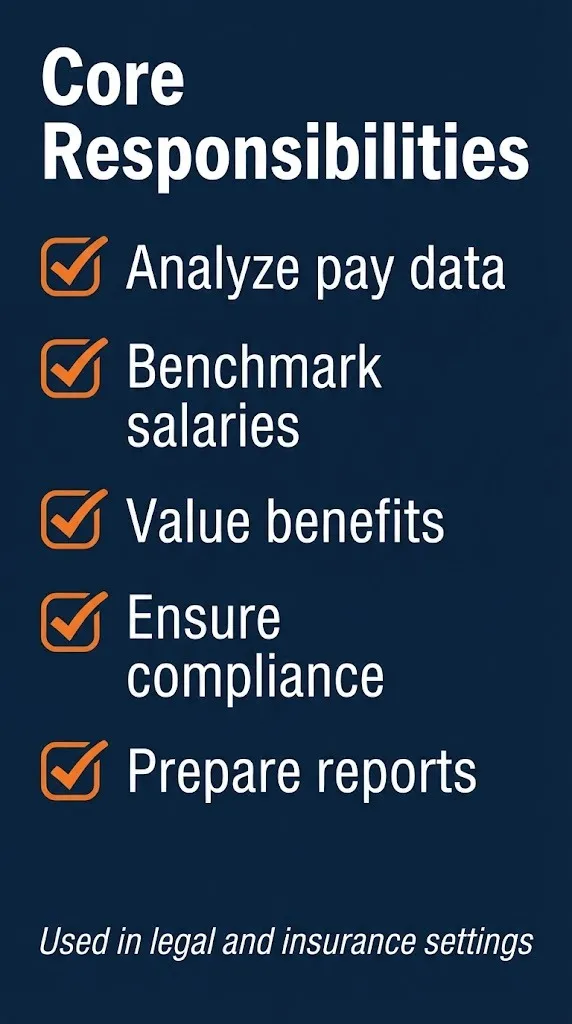
Here are the core responsibilities:
- Collecting and analyzing compensation data.
- Benchmarking salaries against market rates.
- Evaluating benefits and total compensation packages.
- Ensuring compliance with pay laws.
- Preparing reports for management or legal proceedings.
- Advising on pay equity and salary structure.
Key Takeaway: The analyst turns raw pay data into defensible conclusions about what work is worth.
What does a compensation analyst do in a legal case?
In litigation, compensation analysts often serve as expert witnesses or behind-the-scenes analysts. Their work product supports claims about lost wages, lost benefits, and economic damages.
In a discrimination case, a compensation analyst may compare pay across demographic groups. The analysis can show whether a pattern of pay disparity exists. That evidence supports or refutes the discrimination claim.
In a personal injury case, the analyst may calculate how much income the injured person would have earned absent the injury. That calculation includes salary, bonuses, retirement contributions, and benefits value.
In a workers compensation case, the analyst may calculate average weekly wage and future wage loss. The number determines benefit levels.
Here is where compensation analysis appears in legal matters:
| Case Type | Analyst Role |
|---|---|
| Wage and hour disputes | Calculate unpaid wages and overtime |
| Discrimination claims | Analyze pay equity and disparities |
| Personal injury | Calculate lost earnings and future capacity |
| Workers compensation | Determine wage loss and benefit levels |
| Wrongful termination | Calculate back pay and front pay |
What is compensation benefits analysis?
Compensation benefits analysis is the evaluation of non-salary components of pay. Benefits include health insurance, retirement plans, paid time off, and other employer-provided value.
The analyst calculates the dollar value of these benefits. That value becomes part of total compensation. In legal cases, lost benefits are part of economic damages.
For example, if an injured worker loses employer-sponsored health insurance, the analyst calculates the cost of replacement coverage. That number becomes part of the claim.
Benefits analysis matters because salary is not the whole story. A job with a lower salary but excellent benefits may be worth more than a higher salary with no benefits. The analyst quantifies that difference.
How do you become a compensation analyst?
The typical path starts with a bachelor’s degree. Common majors include human resources, business, finance, economics, or statistics. Some analysts have degrees in accounting or data science.
Experience matters. Many analysts start in HR coordinator or payroll roles. They learn compensation systems and data tools on the job. Certifications help. The Certified Compensation Professional credential, offered by WorldatWork, is the most recognized.
Here is the typical path:
- Earn a bachelor’s degree in a relevant field.
- Gain experience in HR, payroll, or data analysis.
- Learn compensation software and benchmarking tools.
- Pursue certification like the CCP.
- Advance to senior analyst or compensation manager.
What does a compensation analyst earn?
The median salary ranges from $65,000 to $85,000 annually. Entry-level analysts start lower. Senior analysts and managers earn more.
Here is a verified salary breakdown:
| Level | Typical Salary |
|---|---|
| Entry-level | $50,000 to $65,000 |
| Mid-level | $65,000 to $85,000 |
| Senior | $85,000 to $110,000 |
| Manager | $110,000 to $150,000 |
Bonuses and benefits add to total compensation. Analysts in large corporations or consulting firms earn more than those in smaller organizations.
Key Takeaway: The role pays well for a data-focused position, and the demand remains steady.
What skills does a compensation analyst need?
The role requires a mix of analytical and communication skills. The analyst must work with data, understand legal requirements, and explain findings to non-experts.
Here are the core skills:
- Data analysis and statistics.
- Market benchmarking tools.
- Knowledge of wage and hour laws.
- Understanding of benefits valuation.
- Attention to detail.
- Clear written and verbal communication.
- Spreadsheet proficiency, especially Excel.
- Compensation software experience.
The analyst does not need to be a lawyer. But the analyst must understand the legal framework around pay. That is what separates a data analyst from a compensation analyst.
What is the difference between a compensation analyst and a benefits analyst?
The two roles overlap but have different focuses. A compensation analyst focuses on cash pay: salary, bonuses, and incentives. A benefits analyst focuses on non-cash compensation: health insurance, retirement, and leave.
In larger organizations, the roles are separate. In smaller ones, one person handles both. The combined role is often called a total rewards analyst.
Here is the comparison:
| Factor | Compensation Analyst | Benefits Analyst |
|---|---|---|
| Focus | Salary, bonuses, incentives | Insurance, retirement, leave |
| Legal framework | Wage and hour laws | Benefits regulations |
| Typical employer | Corporate HR, consulting | Corporate HR, insurers |
| Certification | CCP | CEBS |
How does compensation analysis affect workers compensation claims?
In workers compensation, the compensation analyst calculates the injured worker’s average weekly wage. That number determines the weekly benefit amount.
The calculation includes regular wages, overtime, bonuses, and some benefits. The analyst reviews payroll records and employment history to arrive at the correct figure.
An error in the calculation can cost the worker money. If the analyst undercounts the average weekly wage, the weekly benefit is too low. If the analyst overcounts, the insurer pays too much. Accuracy matters.
Key Takeaway: The analyst’s calculation directly affects how much an injured worker receives each week.
How does compensation analysis affect discrimination cases?
In discrimination cases, the analyst compares pay across groups. The analysis may use regression models to control for factors like experience, education, and job title. The goal is to isolate whether discrimination explains any pay gap.
The analyst’s report becomes evidence. The opposing side may hire its own analyst to challenge the methodology. The court weighs the competing analyses.
This is high-stakes work. A flawed analysis can lose the case. A rigorous one can win it.
What software do compensation analysts use?
The tools vary by employer. Common platforms include:
- Excel for data analysis and modeling.
- MarketPay or Payfactors for benchmarking.
- Workday or SAP for HR data.
- Tableau or Power BI for visualization.
- SQL for database queries.
The analyst does not need to know every tool. But Excel and at least one benchmarking platform are standard.
What is the job outlook for compensation analysts?
The demand remains steady. Companies need analysts to manage pay equity, comply with changing pay transparency laws, and compete for talent. The Bureau of Labor Statistics projects growth in compensation and benefits roles.
Pay transparency laws are a major driver. More states require employers to post salary ranges. That requirement increases the need for accurate market data and internal pay analysis. The analyst’s role is central to that compliance.
Key Takeaway: The job is not going away. Pay transparency laws are expanding the need for the role.
How does a compensation analyst’s work appear in a settlement?
In a settlement negotiation, the analyst’s calculations establish the economic baseline. The plaintiff’s analyst and the defendant’s analyst may disagree. The gap between their numbers frames the negotiation.
The analyst may prepare a report showing lost wages, lost benefits, and future earning capacity. That report becomes the anchor for settlement discussions. A credible report strengthens the negotiating position.
In class actions, the analyst may calculate aggregate damages across the class. That number drives the settlement fund size.
Reality Check
No one will contact you about a compensation analyst job out of the blue. Legitimate employers do not recruit through text messages or social media DMs. If someone offers you a high-paying remote analyst role with no interview, it is a scam. Real compensation analyst jobs require applications, interviews, and skill assessments. The work is too technical for anyone to hire sight unseen.
What Happens Next
| Timeline | Expected Stage |
|---|---|
| Now | Research the role and required skills |
| 3 to 6 months | Build Excel and data analysis skills |
| 6 to 12 months | Gain HR or payroll experience |
| 1 to 2 years | Pursue certification |
| Ongoing | Advance to senior or manager roles |
This timeline is typical. The path may be faster or slower depending on your background.
Frequently Asked Questions
What does a compensation analyst do?
They analyze pay, benefits, and total compensation for market competitiveness and legal compliance.
How much does a compensation analyst earn?
The median salary is $65,000 to $85,000 annually.
Do I need a degree to become a compensation analyst?
Most employers require a bachelor’s degree in HR, business, finance, or a related field.
What certification do compensation analysts need?
The Certified Compensation Professional credential is the most recognized.
How does a compensation analyst help in a lawsuit?
They calculate lost wages, pay disparities, and economic damages for legal cases.
What is the difference between compensation and benefits analysts?
Compensation analysts focus on cash pay. Benefits analysts focus on insurance and retirement.
Is compensation analyst a good career?
Yes. The demand is steady and the pay is competitive for a data-focused role.
What skills do I need to become a compensation analyst?
Data analysis, Excel, benchmarking tools, and knowledge of wage laws.
The Analyst Behind the Number
Every time a lawyer says a case is worth a specific amount, someone calculated that number. A compensation analyst reviewed the pay records, built the model, and defended the conclusion.
The role is not glamorous. It is essential. It connects raw data to real-world outcomes for workers, claimants, and companies. That is what a compensation analyst does.