Workers Compensation Law Firms Near Me 2026: How to Find the Right Lawyer, What They Cost, and What to Ask Before Hiring
Quick Answer
- Workers compensation lawyers handle workplace injury claims, denied benefits, and settlement negotiations.
- Most work on contingency, meaning you pay nothing upfront and the lawyer takes a percentage of your recovery.
- The best firm for you specializes in workers compensation, practices in your state, and has trial experience.
You got hurt at work. You filed a claim. Your employer or the insurance company denied it, delayed it, or offered less than you need. Now you are searching for a workers compensation law firm near you.
The search is harder than it should be. Every firm says it fights for injured workers. Many do not. Some are settlement mills that churn cases without preparing for trial. The difference matters.
This article explains how to find the right workers compensation lawyer, what to expect on fees, what questions to ask, and how to avoid the firms that will not serve you well.
The Facts
| Fact | Verified Value |
|---|---|
| Practice Area | Workers compensation law |
| Fee Structure | Contingency, typically 15% to 25% depending on state |
| Upfront Cost | None in almost all cases |
| State Licensing | Lawyer must be licensed in the state where you were injured |
| Case Duration | 6 to 24 months for most claims |
| Trial Need | Most cases settle, but trial capability matters |
Do I need a workers compensation lawyer?
Not for every claim. A minor injury with a straightforward claim and quick approval may not need a lawyer. You can file, receive benefits, and return to work without legal help.
But you need a lawyer if any of these are true:
- Your claim was denied.
- Your benefits stopped before you returned to work.
- The insurance company disputes your injury or treatment.
- You have a permanent disability.
- Your employer retaliated or threatened your job.
- A settlement offer seems low.
- Your injury prevents you from returning to your old job.
The system is supposed to be worker-friendly. In practice, insurance companies have adjusters and lawyers who handle claims every day. You are at a disadvantage if you go alone.
Key Takeaway: A simple claim may not need a lawyer. A denied, delayed, or disputed claim almost always does.
How do I find workers compensation law firms near me?
Start with referrals, not billboards. Ask other workers, union reps, or lawyers you know for names. Personal recommendations carry more weight than advertisements.
Then verify credentials. Check your state bar’s website for disciplinary history. Look for board certification in workers compensation law if your state offers it. Read reviews, but treat them as one data point.
Here is a practical search process:
- Ask coworkers, union representatives, or other lawyers for referrals.
- Search your state bar directory for workers compensation specialists.
- Check each lawyer’s disciplinary record.
- Read client reviews and case results.
- Schedule consultations with two or three firms.
- Compare their answers and your comfort level.
- Choose the firm that listens and explains, not the one that promises.
The goal is not to find the biggest firm. It is to find the right fit for your specific case.
What should I look for in a workers compensation lawyer?
Experience matters more than advertising. You want a lawyer who handles workers compensation cases daily, not one who dabbles. Workers compensation is a specialized area with its own rules, deadlines, and judges.
Trial capability matters even if your case settles. A lawyer who is not willing to go to trial has less leverage in settlement negotiations. The insurance company knows which lawyers fold.
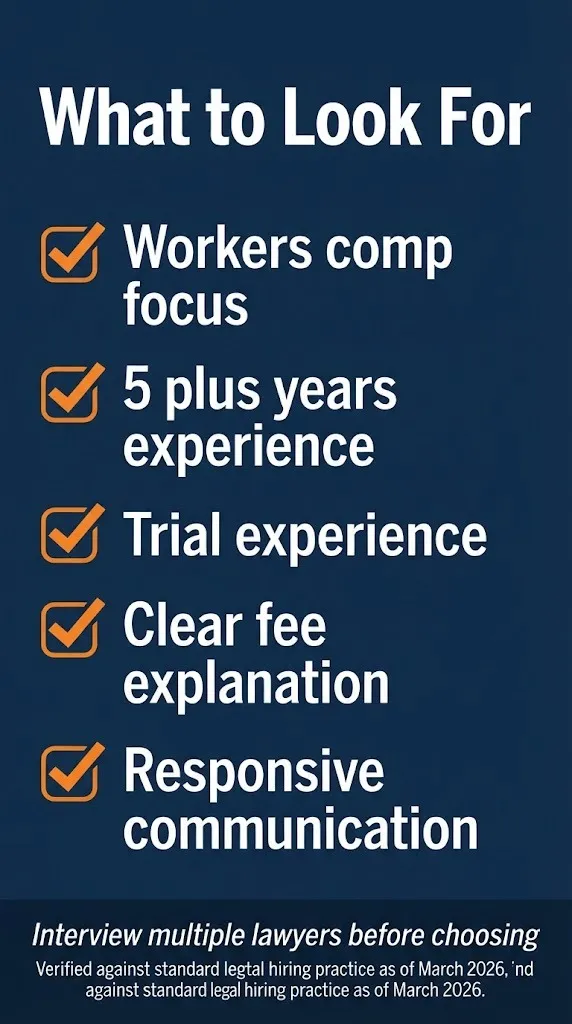
Here is what to look for:
- At least 5 years of workers compensation experience.
- A caseload focused on workers compensation, not general practice.
- Trial experience in workers compensation court.
- Knowledge of your state’s specific rules and benefit levels.
- Clear communication without legal jargon.
- A reasonable caseload that allows attention to your case.
What do workers compensation lawyers cost?
Workers compensation lawyers work on contingency. You pay nothing upfront. The lawyer receives a percentage of your recovery, usually 15% to 25% depending on your state.
Some states cap the fee by law. The judge must approve the fee in many cases. The fee comes out of your settlement or award, not out of your pocket.
Here is a typical fee structure:
| Stage | Fee |
|---|---|
| Initial consultation | Free |
| Case preparation | No upfront cost |
| Settlement | 15% to 25% of recovery |
| Trial or appeal | May be higher percentage |
| Case costs | Deducted from recovery separately |
The percentage is negotiable. Ask about it in the consultation. A good lawyer will explain the fee clearly and put it in writing.
Key Takeaway: You do not need money to hire a workers compensation lawyer. The fee comes from the recovery, not from you.
What questions should I ask a workers compensation lawyer?
The consultation is your chance to evaluate the lawyer. Do not just listen to a sales pitch. Ask hard questions.
Here are the verified questions that matter:
- How many workers compensation cases have you handled?
- What percentage of your practice is workers compensation?
- How many cases have you taken to trial?
- Who will handle my case, you or an associate?
- What is your honest assessment of my claim?
- What is the likely timeline?
- What is the fee percentage and who approves it?
- How do you communicate with clients?
A good lawyer answers directly. A bad lawyer deflects. The way they answer tells you more than the words themselves.
What is the difference between a workers compensation lawyer and a personal injury lawyer?
The two practice areas are related but distinct. Workers compensation covers injuries that happen at work, regardless of fault. You do not need to prove negligence. You only need to prove the injury is work-related.
Personal injury covers injuries caused by someone else’s negligence. You must prove fault. The damages are broader, including pain and suffering.
Some lawyers handle both. Others specialize. If your injury happened at work, you want a workers compensation specialist. If a third party caused your injury, you may also have a personal injury claim.
Here is the comparison:
| Factor | Workers Comp | Personal Injury |
|---|---|---|
| Fault required | No | Yes |
| Pain and suffering | Generally not available | Available |
| Fee percentage | 15% to 25% | 33% to 40% |
| Court | Administrative | Civil court |
| Timeline | Often faster | Often slower |
What if my workers compensation claim was denied?
A denial is not the end. It is the beginning of the fight. You have the right to appeal. The process varies by state but generally includes a hearing before an administrative judge.
A workers compensation lawyer can represent you at the hearing. The lawyer presents evidence, questions witnesses, and argues your case. You can appeal without a lawyer, but your odds are lower.
Common reasons for denial include:
- The insurer claims the injury is not work-related.
- The employer disputes your account.
- Medical records do not support your claim.
- You missed a filing deadline.
- The claim was not reported promptly.
Each denial has a specific response. A lawyer knows which evidence to gather and which arguments to make.
Key Takeaway: A denial is not final. It is a decision you can challenge.
What is the average workers compensation settlement?
There is no reliable average. The amount depends on your injury, your wages, your state’s benefit levels, and whether you have a permanent disability.
Some claims settle for a few thousand dollars. Others settle for six figures. Permanent total disability claims can settle for more.
Here are the factors that drive value:
- The severity of your injury.
- Whether you need surgery.
- Whether you can return to work.
- Your average weekly wage.
- Your state’s maximum benefit rate.
- Whether you have a permanent impairment rating.
A lawyer can estimate your case value after reviewing your medical records and wage history.
How long does a workers compensation case take?
Most cases resolve in 6 to 24 months. Simple claims with clear injuries settle faster. Disputed claims take longer. Cases that go to hearing or trial can extend beyond two years.
Here is a typical timeline:
| Stage | Duration |
|---|---|
| Claim filing and initial benefits | 1 to 3 months |
| Medical treatment and recovery | 3 to 12 months |
| Settlement negotiations | 2 to 6 months |
| Hearing or trial if needed | 6 to 18 months |
| Appeal if necessary | 6 to 12 months |
The timeline depends on your recovery and the insurer’s cooperation.
What should I avoid when choosing a workers compensation lawyer?
Avoid firms that promise a specific dollar amount before reviewing your case. No honest lawyer can guarantee a settlement figure.
Avoid firms that pressure you to sign immediately. A good lawyer gives you time to decide. A bad one wants your signature before you compare.
Avoid firms that do not return calls. If they are unresponsive during the consultation, they will be worse after you hire them.
Avoid firms that handle too many practice areas. A general practice firm may not know the nuances of workers compensation law in your state.
Key Takeaway: The red flags are visible in the first meeting if you look for them.
What happens at the first consultation with a workers compensation lawyer?
The first consultation is usually free. The lawyer reviews your case, asks about your injury and claim status, and explains your options.
Bring these documents:
- Your workers compensation claim number.
- The denial letter if you received one.
- Medical records and bills related to the injury.
- Your employer’s name and insurance company.
- Any correspondence from the insurer.
- A list of questions you want answered.
The lawyer will evaluate whether you have a case worth pursuing. If the lawyer accepts your case, you sign a fee agreement. If not, the lawyer should tell you why.
What is the difference between a workers compensation law firm and a solo practitioner?
A law firm has multiple lawyers and more resources. A solo practitioner offers more personal attention. Both can be good. The right choice depends on your case complexity and your personal preference.
A firm may assign your case to a junior associate. A solo handles it personally. A firm has more backup for trials. A solo knows your case better.
Neither is automatically better. The individual lawyer matters more than the firm size.
Reality Check
No legitimate workers compensation lawyer will cold-call you after an injury. Lawyers are generally prohibited from soliciting clients by phone in personal injury and workers compensation matters. If someone calls claiming they can get you a settlement, hang up. Real referrals come from people you know, bar associations, or your own research. You choose the lawyer. The lawyer does not choose you.
What Happens Next
| Timeline | Expected Stage |
|---|---|
| Now | Gather your claim documents |
| Within 1 week | Schedule consultations with 2 or 3 lawyers |
| At consultation | Ask the questions listed above |
| After hiring | Sign a fee agreement and let the lawyer start |
| Ongoing | Communicate regularly and keep records |
The sooner you hire the right lawyer, the sooner your claim moves forward.
Frequently Asked Questions
Do I need a workers compensation lawyer?
Not for simple claims. Yes for denied, delayed, or disputed claims.
How much does a workers compensation lawyer cost?
Most work on contingency, typically 15% to 25% of your recovery.
How do I find a good workers compensation lawyer near me?
Ask for referrals, check state bar records, and interview multiple lawyers.
What should I bring to the first consultation?
Your claim number, denial letter, medical records, and employer information.
What if my claim was denied?
You can appeal. A lawyer can represent you at the hearing.
How long does a workers compensation case take?
Most resolve in 6 to 24 months. Disputed cases take longer.
What is the difference between workers comp and personal injury?
Workers comp does not require fault. Personal injury does.
Can I fire my workers compensation lawyer?
Yes. You can change lawyers, but the original lawyer may have a lien on the recovery.
The Right Lawyer Is the One Who Fights for You
You do not need the biggest firm or the most billboards. You need a lawyer who knows workers compensation law in your state, returns your calls, and is willing to go to trial if the settlement offer is unfair.
Interview three lawyers. Ask the hard questions. Trust your instincts. The right lawyer will make you feel heard, not sold.