Law Firm Workers Compensation in 2026: What Injured Workers Actually Recover
Quick Answer
- Typical range: Most workers’ comp claims settle between $20,000 and $50,000. The median reported settlement is about $21,800 .
- What drives value: Injury severity, whether surgery was required, your state’s benefit caps, your impairment rating, and whether you have attorney representation.
- Key deadline: Most settlement offers remain open for 30 to 60 days. Missing that window can cost you leverage .
If you’re searching for a law firm workers compensation attorney, you’ve likely already been hurt on the job. Maybe your claim was denied. Maybe the insurance adjuster offered you a number that felt too low.
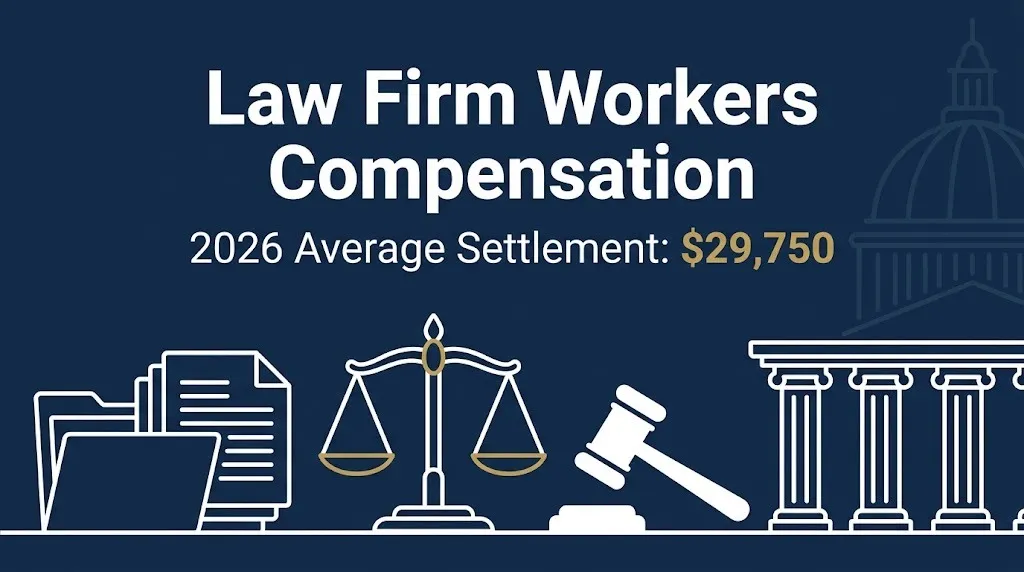
The honest reality: the national average workers’ comp settlement in 2026 sits around $29,750 . But that average hides enormous variation. A minor sprain might settle for $5,000. A spinal fusion can reach $185,000 . A traumatic brain injury can exceed $2 million.
What you recover depends on factors you can influence and factors you can’t. Your state’s laws are fixed. The insurance company’s tactics are predictable. But your medical documentation, your consistency with treatment, and whether you have legal representation are variables you control.
This article breaks down verified 2026 settlement data, explains how attorneys actually add value, and shows you what to expect from the process.
The Facts
| Topic | 2026 Verified Data |
|---|---|
| National Average Settlement | $29,750 |
| Median Reported Settlement | $21,800 |
| Most Common Range | $20,000 to $50,000 |
| Attorney Representation Premium | 30% to 40% higher settlements |
| Typical Timeline (Simple Case) | 6 to 12 months |
| Typical Timeline (Surgical Case) | 12 to 24 months |
| Settlement Offer Window | 30 to 60 days |
What Does a Law Firm Workers Compensation Attorney Do in 2026?
A workers’ compensation attorney handles your claim from filing through settlement or hearing, negotiates with the insurance carrier, gathers medical evidence, and ensures you receive all benefits you’re legally entitled to under your state’s workers’ comp statutes.
The job is bigger than most people realize. Attorneys don’t just show up at a hearing. They manage the entire claim lifecycle.
Here’s what representation actually involves:
- Filing the claim correctly and on time. A missed deadline can kill your case.
- Gathering medical evidence. Independent medical exams, treatment records, and impairment ratings all shape your settlement value .
- Negotiating with the insurance company. Adjusters have quotas. Your attorney has leverage.
- Representing you at hearings or appeals. Denied claims require formal adjudication.
- Calculating the true value of your case. Most injured workers don’t know what they’re owed.
The financial difference is measurable. Workers with attorneys receive settlements 30% to 40% higher on average than those without representation . The contingency fee structure, typically 10% to 20% of permanent disability benefits, means attorneys only get paid when you do .
How Much Can You Get from a Workers Comp Settlement in 2026?
Workers’ comp settlement amounts in 2026 range from $2,000 for minor injuries to over $500,000 for catastrophic disabilities, with the national average around $29,750 and the median closer to $21,800.
The gap between average and median matters. A few large settlements pull the average up. Most injured workers receive far less.
| Injury Severity | Typical Settlement Range | Details |
|---|---|---|
| Minor sprain / strain | $2,000 to $20,000 | Conservative treatment, full recovery |
| Moderate injury | $20,000 to $50,000 | Physical therapy, some work restrictions |
| Herniated disc (no surgery) | $40,000 to $80,000 | Ongoing pain, limited lifting |
| Herniated disc (surgery) | $80,000 to $180,000 | Surgical intervention, longer recovery |
| Spinal fusion | $150,000 to $350,000 | Major surgery, permanent restrictions |
| Traumatic brain injury | $20,000 to $2,000,000+ | Severity-dependent |
| CRPS / RSD | $200,000 to $750,000+ | Chronic pain condition |
The $29,750 national average comes from a 2026 analysis of state workers’ comp board data and attorney-reported settlements . California leads all states with an average of $67,400, driven by higher statutory benefits and strict insurance regulations .
Your specific number depends on seven factors: your state, the body part injured, whether you had surgery, your pre-injury weekly wage, your permanent impairment rating, your age, and whether you have an attorney .
Key Takeaway: Most workers’ comp claims settle for far less than the national average suggests. The median is $21,800, and roughly 55% of injured workers receive between $2,000 and $20,000 .
How Do Attorneys Increase Workers Comp Settlement Amounts?
Attorneys increase workers’ comp settlements by 30% to 40% on average through better documentation, stronger negotiation, and procedural leverage that unrepresented workers don’t have.
The mechanism isn’t magic. It’s about knowing the system and using it.
Insurers typically try to settle claims at 50% to 70% of their true value . They count on injured workers not knowing what their case is worth. An attorney changes that calculation.
Here’s what representation does:
- Generates hearing requests and discovery demands. These consume adjuster time and signal that you won’t accept a lowball offer .
- Requests independent medical evaluations. Insurance-selected doctors systematically rate impairment lower than treating physicians .
- Calculates vocational loss. If you can’t return to your prior job at the same wage, that difference has value.
- Presents a complete demand package. Medical records, wage documentation, impairment ratings, and future care estimates.
One 2026 analysis put it plainly: workers represented by attorneys historically recover 3 to 5 times what unrepresented claimants accept .
The tradeoff is the contingency fee, typically 10% to 20% of your permanent disability benefits . That fee doesn’t apply to medical treatment or temporary disability payments. And it only comes out of what you actually recover.
What Is the Workers Comp Settlement Timeline in 2026?
Most workers’ comp cases take 6 to 12 months to settle for simple injuries and 12 to 24 months for surgical cases. Contested or catastrophic claims can take 2 to 4 years.
The timeline tracks your medical recovery more than your legal strategy. You can’t settle the permanent disability portion until you reach Maximum Medical Improvement (MMI) .
Here’s the stage-by-stage breakdown:
| Stage | Timeline | What Happens |
|---|---|---|
| Report and file | First 30 days | Injury reported, First Report filed |
| Initial treatment | Weeks 2-16 | Doctor visits, therapy, temporary disability payments |
| Medical development | Months 2-12 | Diagnosis, treatment, possible surgery |
| MMI and impairment rating | Months 6-18 | Doctor declares MMI, assigns permanent impairment rating |
| Negotiation or hearing | Months 8-24 | Settlement talks or formal hearing |
| Disbursement | 30-90 days after agreement | Approval, then payment |
Most cases settle after MMI, without ever reaching a formal hearing. But if negotiation stalls, the hearing itself often triggers a final settlement push. Carriers sometimes increase their last offer substantially two weeks before hearing to avoid the risk of an adverse ruling .
Settlement offers typically remain open for 30 to 60 days, though some insurers set shorter deadlines hoping time pressure works in their favor .
How Are Workers Comp Settlement Amounts Calculated?
Workers’ comp settlements are calculated by adding lost wages, permanent impairment value, future medical costs, and vocational loss, then adjusting for liability strength and state benefit caps.
The formula most carriers and attorneys use looks like this:
Lump Sum = (Remaining Weekly Benefit × Disability Weeks) + Future Medical Cost + Permanent Impairment Value
Here’s a real example from Colorado:
- Remaining weekly benefit: $600 × 75 weeks = $45,000
- Future medical cost estimate: $20,000
- Permanent impairment value: ~$60,000
- Pre-negotiation value: $125,000
- Typical first offer: 40-60% of that = $50,000 to $75,000
- Negotiated settlement with attorney: 70-90% = $87,000 to $112,000
The gap between first offer and final settlement is where attorneys earn their fee.
Four components drive the calculation:
- Lost wages (Temporary Total Disability). Most states pay 66.67% of your average weekly wage, capped at a state maximum .
- Permanent impairment. After MMI, a doctor assigns a rating (0-100%). That rating multiplied by your state’s scheduled weeks produces the PPD portion .
- Medical expenses. Past bills and reasonable future care. In lump sum settlements, future medical is capitalized into the total .
- Vocational loss. If you can’t return to your prior job at the same wage, the difference increases settlement value .
Reality Check: No one calls you offering workers’ comp money. If you get a text or email saying you’re owed a settlement, it’s a scam. Real claims start when you report the injury to your employer and file with the state board. Insurance adjusters don’t cold-call injured workers.
How Do You File a Workers Compensation Claim in 2026?
Filing a workers’ comp claim means reporting the injury to your employer immediately, filing the First Report of Injury with your state board, seeking authorized medical treatment, and documenting everything from day one.
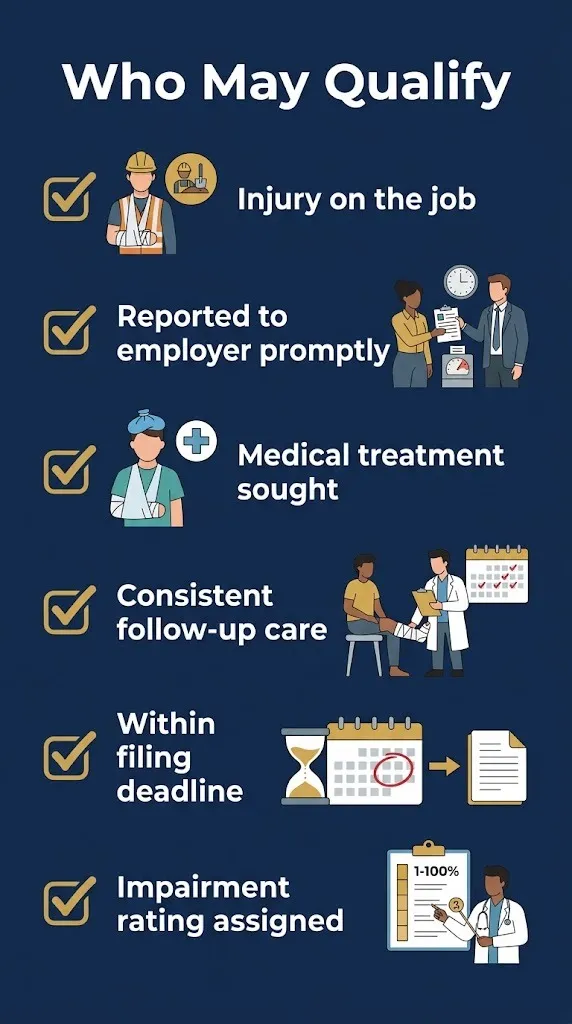
Here are the steps in order:
- Report the injury immediately. Tell your supervisor or HR. Delay weakens your claim.
- File the First Report of Injury. Your employer typically does this, but verify it happened .
- Seek authorized medical treatment. Go to the doctor your employer or insurer designates.
- Document everything. Keep copies of all medical records, wage statements, and correspondence.
- Follow treatment consistently. Missed appointments hurt your credibility and delay MMI .
- Consult a workers’ comp attorney. Early representation locks in evidence and protects your rights.
- Reach Maximum Medical Improvement. Your doctor declares MMI when further treatment won’t materially improve your condition .
- Negotiate or litigate. Your attorney sends a demand package and negotiates. If talks stall, file for a hearing.
The single most important thing you control is consistency with treatment. Gaps in medical care extend MMI without clinical benefit and signal to the insurer that the injury may be less serious than claimed .
What Happens Next in Your Workers Comp Case?
Expected next steps include completing treatment, reaching Maximum Medical Improvement, obtaining an impairment rating, and negotiating a settlement or requesting a hearing.
Here’s the typical timeline from where you are now to resolution:
- Now to 3 months: Continue treatment. Document every appointment and every expense.
- 3 to 6 months: Your doctor may declare MMI. If not, treatment continues.
- 6 to 12 months: Impairment rating assigned. Your attorney prepares a demand package.
- 12 to 18 months: Negotiation period. Most cases settle here.
- 18 to 24 months: If no settlement, formal hearing. Carriers often increase offers before hearing date.
The timeline tracks your medical recovery, not the legal process. You can’t settle the permanent disability portion until MMI is reached.
Frequently Asked Questions
How much is the average workers comp settlement in 2026?
The national average is approximately $29,750.
The median is closer to $21,800, meaning most workers receive less than the average .
Roughly 55% of injured workers receive between $2,000 and $20,000.
Do I need a lawyer for a workers comp claim?
No, but workers with attorneys receive 30% to 40% higher settlements on average .
Attorneys work on contingency, typically 10% to 20% of permanent disability benefits .
They only get paid if you recover.
How long does it take to get a workers comp settlement check?
It typically takes 30 to 90 days from signed agreement to payment in hand.
Approval takes 2 to 6 weeks, then the carrier has 14 to 30 days to issue payment .
What if my workers comp claim was denied?
You can appeal the denial through your state’s workers’ comp board.
Most states allow you to request a hearing where you present evidence .
An attorney can represent you at the hearing.
Can I settle my workers comp case before reaching MMI?
Technically yes, most states allow early settlement.
But early settlements are almost always the carrier’s number, not yours.
Workers who settle before MMI typically receive 30% to 60% of what the case would be worth at MMI .
What is a Compromise and Release settlement?
A Compromise and Release (C&R) is a lump sum settlement that closes your case permanently.
You waive all future rights to wage loss, medical treatment, and impairment benefits .
Once approved by a judge, you cannot reopen the case even if your condition worsens.
How do attorneys calculate workers comp settlement value?
They add lost wages, permanent impairment value, future medical costs, and vocational loss.
Then they adjust for liability strength, state caps, and comparative fault .
Insurers typically open at 40-60% of true value.
What if I can’t return to my old job after injury?
Vocational loss is a component of your settlement.
If you can’t return to your prior occupation at the same wage, that difference increases settlement value .
Your attorney can calculate this loss and include it in the demand.
If you’re navigating a workers’ comp claim right now, start documenting everything today. Medical records, wage statements, correspondence with the insurer. The paper trail is your leverage.
The most important number to remember is your state’s deadline for filing. Most claims must be filed within a specific window after the injury or after the last payment of benefits. Missing it can bar your claim entirely.