Georgia Workers’ Compensation Laws 2026: Rules, Deadlines, and Benefits Explained
Quick Answer
- Georgia law requires employers with 3 or more employees to carry workers’ comp insurance under O.C.G.A. § 34-9-2.
- Weekly wage benefits max out at $800/week for injuries on or after July 1, 2023, capped at 400 weeks for non-catastrophic cases.
- You must report an injury within 30 days and file a formal claim within 1 year, or you risk losing benefits entirely.
If you got hurt on the job in Georgia, state law already answers most of your first questions. Georgia workers’ compensation is a no-fault system. You don’t have to prove your employer did anything wrong to get medical care and wage replacement.
The rules matter because they set hard limits. Miss the 30-day report deadline or the one-year filing deadline, and your claim can die before it starts. Benefits also cap out, both in dollar amount and in time, which is why knowing the numbers up front protects you.
This guide breaks down who is covered, how much you can get, and what deadlines actually run your claim. One detail that surprises a lot of workers: even a “no-fault” system in Georgia lets insurers cut your check to a lower rate after 52 weeks if you’re back at work earning less.
The Basics
| Item | Detail |
|---|---|
| Governing law | Georgia Workers’ Compensation Act, O.C.G.A. Title 34, Chapter 9 |
| Administering agency | State Board of Workers’ Compensation (SBWC) |
| Employer coverage threshold | 3 or more employees, full-time, part-time, or seasonal |
| Max weekly TTD benefit | $800/week (injuries on or after July 1, 2023) |
| Max weekly TPD benefit | $533/week |
| Injury report deadline | 30 days from the accident |
| Claim filing deadline | 1 year from the accident or last authorized treatment |
| Non-catastrophic benefit cap | 400 weeks (TTD), 350 weeks (TPD) |
| Attorney fee cap | 25% of recovery, subject to Board approval |
Anything not shown here as a specific figure should be confirmed on the official SBWC website, since your own claim will depend on your date of injury and wage history.
Does Georgia Require Workers’ Compensation Insurance?
Georgia law requires workers’ compensation coverage for any private employer with 3 or more employees, counted as full-time, part-time, or seasonal workers. That threshold sits higher than most states, where even a single employee can trigger the requirement.
The rule comes from O.C.G.A. § 34-9-2(a)(2). Businesses with fewer than three workers aren’t required to carry a policy, though they can opt in voluntarily.

A few groups fall outside mandatory coverage even at larger companies:
- Sole proprietors and partners (unless they elect coverage)
- Independent contractors
- Casual laborers
- Many agricultural workers
- Domestic servants
- Railroad employees, covered under separate federal law
Employers that skip required coverage face real consequences. They can lose eligibility for government contracts, face fines, and in some cases face criminal exposure. You can check whether your employer is covered right now through the SBWC’s online verification tool at sbwc.georgia.gov.
Key Takeaway: Georgia’s 3-employee threshold is one of the highest coverage triggers in the country, so always verify your employer’s status directly with the state board rather than assuming coverage exists.
What Is the Georgia Workers’ Compensation Act?
The Georgia Workers’ Compensation Act is the state law that trades your right to sue your employer for guaranteed no-fault benefits. It sits in O.C.G.A. Title 34, Chapter 9, and the State Board of Workers’ Compensation administers it.
Under this system, you generally don’t need to prove your employer was negligent. You only need to show the injury happened “out of and in the course of” your job duties.
That trade-off is called the exclusive remedy doctrine. In exchange for guaranteed benefits without a fight over fault, you generally give up the right to sue your employer directly for the injury. There are narrow exceptions, including intentional harm by the employer.
The Board itself doesn’t pay claims. It sets rules, resolves disputes, hears appeals, and enforces deadlines. Actual payment comes from your employer’s private insurance carrier or, for larger companies, a self-insurance program.
How Much Does Workers’ Compensation Pay in Georgia?
Georgia workers’ comp pays two-thirds of your average weekly wage, subject to a state maximum that depends on your injury date. For injuries on or after July 1, 2023, that maximum is $800 per week, with a $50 minimum.
Here’s how the main benefit types break down:
| Benefit Type | Rate | Weekly Max | Duration |
|---|---|---|---|
| Temporary Total Disability (TTD) | 2/3 of AWW | $800/week | Up to 400 weeks |
| Temporary Partial Disability (TPD) | 2/3 of wage loss | $533/week | Up to 350 weeks |
| Permanent Partial Disability (PPD) | Based on impairment rating | Varies by body part | Varies |
Your average weekly wage (AWW) is calculated from your 13 weeks of pay before the injury. Small errors here, like leaving out overtime, can shrink every check for the life of your claim.
Payments start after a 7-day waiting period. If you’re out of work 21 consecutive days or more, that first week gets paid retroactively.
What Is the Maximum Workers’ Comp Benefit in Georgia for 2026?
The maximum weekly benefit in Georgia for 2026 is $800 per week for Temporary Total Disability, applying to injuries on or after July 1, 2023. This figure hasn’t changed since that date.
TPD tops out lower, at $533 per week, since it only covers the gap between old and new wages after you return to lighter or lower-paying work.
Death benefits carry their own separate cap. A surviving spouse can receive up to $320,000 total, plus $7,500 for burial costs. Confirm current mileage reimbursement rates directly with the Board, since these rates get updated periodically and different sources currently list different figures.
Georgia’s maximum rate is tied to your date of injury, not the date you settle or file. A worker hurt in 2019 uses that year’s cap, even if the claim is still open in 2026.
Key Takeaway: Your benefit cap locks in on the date you got hurt, so an old injury doesn’t automatically get bumped up to 2026’s maximum rate.
How Long Can You Receive Workers’ Comp Benefits in Georgia?
Non-catastrophic claims cap TTD benefits at 400 weeks from the date of injury. That’s roughly 7.5 years of potential wage replacement, though most claims resolve well before that limit.
TPD benefits run shorter, capped at 350 weeks. Medical benefits for non-catastrophic injuries also expire after 400 weeks under a rule that took effect in 2013.
There’s an important carve-out. The 400-week medical cap doesn’t apply to maintenance or replacement of certain items originally provided within that window:
- Prosthetic devices
- Spinal cord stimulators
- Intrathecal pump devices
- Durable medical equipment
- Orthotics
- Corrective eyeglasses and hearing aids
If the Board designates your injury as catastrophic, both the time cap and the dollar structure change dramatically, moving toward lifetime benefits instead.
How Do You File a Workers’ Compensation Claim in Georgia?
Filing a Georgia workers’ comp claim means reporting the injury, getting authorized treatment, and submitting the right paperwork within the state’s deadlines. Miss a step, and your benefits can be denied.
Here’s the general sequence:
- Report the injury to your employer, supervisor, or foreman within 30 days.
- Get treatment from a physician on your employer’s posted panel.
- Ask your employer to file the First Report of Injury with their insurer.
- Track your treatment and keep copies of all medical paperwork.
- File Form WC-14 with the SBWC if benefits are denied or delayed, to request a hearing.
- Keep mileage records for every medical trip tied to the claim.
Think of the 30-day report window like the window on a store return without a receipt. Wait too long, and the door closes even if your claim is otherwise solid.
What Is the Deadline to Report a Workplace Injury in Georgia?
You must report a workplace injury to your employer within 30 days of the accident, or you risk losing your right to benefits entirely.
Georgia law does carve out a few exceptions to this strict deadline:
- You were physically or mentally incapacitated and couldn’t report sooner
- Your employer already knew about the accident through other means
- You were the victim of fraud or deceit that prevented timely reporting
Outside those exceptions, courts and the Board apply the 30-day rule strictly. Report the injury the same day if at all possible, in writing when you can, even if symptoms seem minor at first.
Key Takeaway: The 30-day report deadline is separate from the one-year claim-filing deadline, and missing either one independently can end your case.
What Is the Deadline to File a Workers’ Comp Claim in Georgia?
You generally have one year from the date of your accident, or from your last authorized medical treatment, to file a formal claim with the State Board of Workers’ Compensation under O.C.G.A. § 34-9-82.
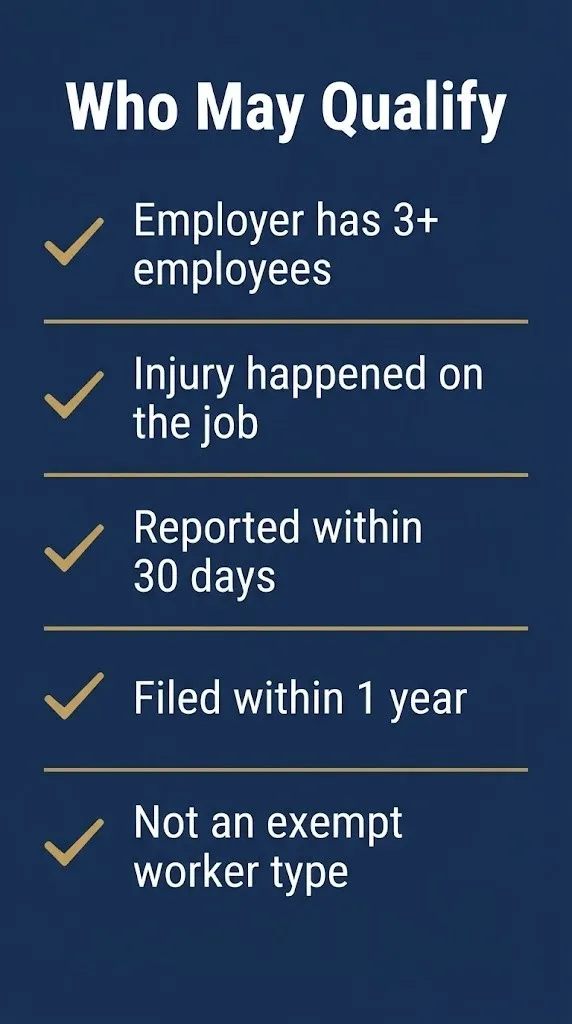
If your employer has already been paying weekly benefits, a different rule can extend that window to two years from the last payment. Rules around what counts as “last payment” get technical fast, so check your claim history against the exact dates on your payment stubs.
Filing late almost always means losing the claim outright. There’s no general hardship exception once the year runs, aside from the same narrow exceptions that apply to the 30-day notice rule.
Reality Check
No government agency or insurance company texts you out of nowhere to say you qualify for a Georgia workers’ comp payout. Filing a claim with the State Board of Workers’ Compensation is free, and you never need to pay an upfront fee to a “claims specialist” to get your paperwork moving. If someone asks for money before you’ve even seen a benefits check, that’s a signal to stop and verify directly with sbwc.georgia.gov.
Can You Choose Your Own Doctor Under Georgia Workers’ Comp Law?
Not freely. Georgia requires you to choose from your employer’s posted panel of physicians, which must include at least six doctors, one orthopedic surgeon, and no more than two industrial clinics.
You do get one built-in option: you can make one change to a different doctor on the same panel without needing permission from your employer or the Board.
If no valid panel is posted at the time of your injury, you may be able to choose your own doctor and have that care authorized. Ask to see the posted panel immediately after reporting your injury and take a photo of it for your records.
What Is a Catastrophic Injury Under Georgia Law?
A catastrophic injury under O.C.G.A. § 34-9-200.1 is a specific, statutorily listed category of severe harm that unlocks lifetime income and medical benefits instead of the standard 400-week cap.
Only certain injury types qualify, and insurers routinely contest the designation at SBWC hearings. Getting this designation approved changes a claim’s entire financial structure, since it removes the standard time limits altogether.
Because insurers have a financial incentive to keep a claim in the non-catastrophic bucket, disputes over this designation are common and often end up before an administrative law judge.
Can Your Employer Fire You for Filing a Workers’ Comp Claim in Georgia?
No. Georgia law prohibits retaliation against an employee for filing a legitimate workers’ compensation claim.
That protection has limits. Georgia is an at-will employment state, and an employer can still terminate you for reasons unrelated to the claim itself, as long as retaliation isn’t the actual motive. Documentation matters here: keep records of your claim timeline alongside any workplace communication about your job status.
Key Takeaway: Retaliation protection covers the act of filing a claim, not every employment decision that happens to follow one, so timing and documentation both matter if you suspect retaliation.
Who Is Exempt From Georgia Workers’ Compensation Coverage?
Several worker categories fall outside Georgia’s mandatory coverage rules, even at companies with three or more employees.
Exempt categories generally include:
- Sole proprietors and business partners (unless they opt in)
- Independent contractors
- Casual laborers
- Agricultural workers, in many circumstances
- Domestic servants
- Railroad employees, covered separately under federal law
If you’re unsure whether your role qualifies for an exemption, the classification often comes down to how much control your employer has over your day-to-day work, not just your job title.
What Happens if Your Employer Doesn’t Have Workers’ Comp Insurance in Georgia?
If your employer is legally required to carry coverage and doesn’t, they face liability for damages and potential criminal penalties under Georgia law.
You still have options if you’re hurt and your employer lacks required coverage. You may be able to pursue a direct injury claim outside the workers’ comp system, since the exclusive remedy protection generally doesn’t apply when an employer skips mandatory coverage.
You can check any Georgia employer’s current coverage status using the verification tool on the official SBWC website before you rely on it existing.
What Are Death Benefits Under Georgia Workers’ Compensation Law?
Death benefits provide financial support to dependents when a work injury causes a fatality, with a surviving spouse eligible for up to $320,000 total plus $7,500 in burial expenses.
These figures depend on dependent status and the worker’s average weekly wage at the time of death. Multiple dependents can change how the total amount gets divided. Confirm exact current figures and mileage reimbursement rates directly with the SBWC, since some published numbers vary by source.
How Do You Appeal a Denied Workers’ Comp Claim in Georgia?
You appeal a denied Georgia workers’ comp claim by filing Form WC-14 with the State Board of Workers’ Compensation to request a hearing before an administrative law judge.
The general appeal path looks like this:
- Receive your denial notice from the insurer.
- File Form WC-14 requesting a hearing.
- Attend a mediation conference, if scheduled.
- Present your case at a hearing before an ALJ.
- Appeal an unfavorable ruling to the Board’s Appellate Division if needed.
- Pursue further appeal through Georgia’s court system in rare cases.
Late benefit payments carry their own penalty structure. Insurers owe a 15% penalty on late weekly checks and a 20% penalty on late settlement payments.
What’s New in Georgia Workers’ Compensation Law for 2026?
For 2026, the core benefit structure remains steady, with the $800/week TTD maximum still applying to injuries on or after July 1, 2023. No statewide rate increase has taken effect for 2026 as of this writing.
Reporting from early 2026 points to a continued decline in overall claim rates across Georgia workplaces, reflecting improved safety trends, even as claim severity for both medical and wage-replacement components has increased in recent years. That combination means fewer claims overall, but higher stakes per claim when one does happen.
What Happens Next
Now through late 2026: Current benefit rates and caps remain in effect for injuries occurring in this period.
Ongoing: The SBWC continues to hear claims, mediations, and appeals under existing 2023 rate rules.
Expected, mid-year review: Georgia’s Legislature and the Board periodically revisit benefit maximums, though no confirmed rate change has been announced for 2026.
If your claim is active: Your 400-week medical and TTD clocks run continuously from your injury date, regardless of legislative activity elsewhere.
Frequently Asked Questions
How many employees trigger mandatory workers’ comp coverage in Georgia?
Georgia requires coverage once an employer regularly has 3 or more employees.
This includes full-time, part-time, and seasonal workers counted together.
What is the maximum workers’ comp check in Georgia right now?
The maximum is $800 per week for Temporary Total Disability, for injuries on or after July 1, 2023.
Older injury dates use the rate in effect at that time instead.
How long do I have to report a work injury in Georgia?
You must report within 30 days of the accident.
Limited exceptions apply for incapacity, fraud, or employer knowledge.
How long do I have to file a formal workers’ comp claim?
Generally one year from the date of injury or last authorized treatment.
Some cases extend to two years from the last benefit payment.
Can I pick any doctor I want for a work injury in Georgia?
No, you must choose from your employer’s posted panel of at least six physicians.
You get one free change to a different doctor on that same panel.
What counts as a catastrophic injury in Georgia?
It’s a specific legal designation under O.C.G.A. § 34-9-200.1 for certain severe injury types.
Catastrophic status unlocks lifetime benefits beyond the standard 400-week cap.
Can my employer fire me for filing a workers’ comp claim?
No, Georgia law prohibits retaliation for a legitimate claim.
Georgia’s at-will employment rules still allow termination for unrelated reasons.
What happens if my employer has no workers’ comp insurance?
They face liability and possible criminal penalties for lacking required coverage.
You may have grounds for a direct injury claim outside the workers’ comp system.
Georgia’s workers’ comp rules run on strict clocks: 30 days to report, one year to file, 400 weeks to collect. Check your own injury date against the state’s rate table on the official SBWC website before assuming any number applies to you. The single fact worth writing down today is the $800/week maximum for injuries dated July 1, 2023 or later.