Compensation Claim 2026: How Workers’ Comp Claims Work, What They Pay, and Deadlines
Quick Answer
- Workers’ comp pays 66.67% of your average weekly wage, tax-free, up to your state’s maximum.
- Most states require you to notify your employer within 30 days of the injury.
- The national average settlement is $29,750, but California averages $67,400 and severe cases exceed $500,000.
A compensation claim is a request for benefits after a workplace injury. Every state requires employers to carry workers’ compensation insurance. That insurance pays for your medical care and replaces part of your lost wages, regardless of who was at fault.
You may be searching because you were hurt on the job. Maybe you fell, hurt your back lifting, or developed carpal tunnel from repetitive work. The first thing you need to know is your state’s notice deadline. In most states, you have 30 days to tell your employer.
This guide covers how claims work, what they actually pay, how settlements are calculated, and the deadlines that end your rights. It uses verified 2026 data from state workers’ comp boards and national insurance research.
The Facts
| Item | What to Know |
|---|---|
| National Average Settlement | $29,750 (2026) |
| California Average | $67,400 |
| Weekly Benefit Rate | 66.67% of average weekly wage (most states) |
| Maximum Weekly Benefit Range | $606 (Mississippi) to over $2,100 (Iowa, Washington) |
| Employer Notice Deadline | 30 days in most states |
| Formal Claim Deadline | 1 to 3 years, varies by state |
How Much Does Workers’ Comp Pay Per Week?
Workers’ comp pays 66.67% of your average weekly wage, tax-free, up to your state’s maximum. Texas uses 70% instead of the standard two-thirds.

The math is simple. If you earn $900 per week, you receive $600 per week in benefits. That’s your two-thirds rate. Your benefits are not taxed, so the take-home value is often close to your regular paycheck.
State maximums create the biggest variation. A warehouse worker in Ohio earning $950 per week receives $633.37 weekly. A construction worker in Texas earning $1,200 per week receives $840. Both amounts are below their state caps, so they get the full rate.
High earners hit the ceiling. In Georgia, the maximum is $800 per week. Anyone earning over $1,200 weekly hits that cap. In California, the maximum is $1,680, so most workers get the full two-thirds.
Payout Table: Weekly Benefit Examples
| State | Worker’s Weekly Wage | Benefit Rate | Weekly Payment |
|---|---|---|---|
| Ohio | $950 | 66.67% | $633 |
| California | $1,600 | 66.67% | $1,067 |
| Texas | $1,200 | 70% | $840 |
| New York | $1,400 | 66.67% | $933 |
What Is the Average Workers’ Comp Settlement in 2026?
The national average workers’ comp lump sum settlement is $29,750 in 2026. Individual settlements range from $2,000 for minor injuries to $500,000+ for severe permanent disabilities.
California leads all states with an average settlement of $67,400. New York follows at $58,200. Illinois averages $55,800. The lowest averages appear in Mississippi, Alabama, and Georgia.
These are averages, not guarantees. A minor strain settles for far less than a spinal fusion. The median reported settlement is closer to $21,800, and roughly 55% of injured workers receive between $2,000 and $20,000.
Surgical cases settle 2 to 4 times higher than conservative-treatment cases. If you had surgery, your case value rises significantly.
What Is a Lump Sum Settlement?
A lump sum settlement is a one-time payment that closes your workers’ comp case permanently. It’s formally called a Compromise & Release (C&R) in most states.
When you sign a C&R, you waive all future rights to wage loss, medical treatment, and impairment benefits for that injury. Once a judge approves it, you cannot reopen the case, even if your condition worsens.
The formula most carriers use is:
Lump Sum = (Remaining Weekly Benefit × Disability Weeks) + Future Medical Cost + Permanent Impairment Value
Insurers typically offer 50 to 70% of the case’s true value. Workers represented by attorneys historically recover 3 to 5 times what unrepresented claimants accept.
How Are Settlements Calculated by Body Part?
Settlement values vary dramatically by body part and severity. A back injury averages $91,844. Multiple body part injuries average $68,749.
Settlement Ranges by Body Part (2026)
| Body Part | Minor | Moderate | Severe |
|---|---|---|---|
| Back | $10K–$30K | $40K–$80K | $150K–$350K |
| Shoulder | $15K–$35K | $50K–$90K | $120K–$200K+ |
| Knee | $12K–$30K | $45K–$85K | $100K–$180K |
| Hand/Wrist | $8K–$20K | $25K–$50K | $60K–$100K |
| Multiple Parts | $20K–$50K | $55K–$110K | $250K–$800K |
Source: National Safety Council, Martindale-Nolo, state workers’ comp board data.
Surgery changes everything. A herniated disc without surgery settles for $40,000 to $80,000. The same injury with surgery reaches $80,000 to $180,000. A spinal fusion can reach $350,000.
Key Takeaway: Workers’ comp pays two-thirds of your wage, tax-free. The national average settlement is $29,750, but surgery and severe injuries push values much higher. California averages $67,400, the highest in the country.
How Do I File a Workers’ Comp Claim?
You file a workers’ comp claim by notifying your employer and then submitting a formal claim to your state’s workers’ comp board. The process has two distinct deadlines you cannot miss.
Here are the steps:
- Report the injury to your employer immediately. Most states require notice within 30 days.
- Seek medical attention. Tell the provider the injury happened at work.
- Get written documentation. Keep copies of everything.
- File the formal claim with your state board. This deadline is longer, often 1 to 3 years.
- Follow all medical instructions. Missed appointments hurt your claim.
- Keep records of lost wages. Document every day you cannot work.
- Respond to insurance company requests. Ignoring them can delay or deny benefits.
The notice should be in writing whenever possible. Verbal notice may satisfy some states, but written notice creates a record.
Reality Check: No one can guarantee a specific settlement amount before reviewing your medical records. Online calculators give estimates, not promises. A lawyer who guarantees a number is not being honest with you.
What Is the Deadline to File a Workers’ Comp Claim?
The deadline to file a workers’ comp claim varies by state, but most allow 1 to 3 years from the date of injury. The employer notice deadline is much shorter, often 30 days.
Two deadlines exist, and confusing them is the most common mistake injured workers make.
Notice Deadline: Tell your employer. This is short. Florida requires 30 days. Illinois requires 45 days. Pennsylvania allows 120 days. California requires 30 days.
Filing Deadline: File the formal claim with the state board. This is longer. Florida allows 2 years. Pennsylvania allows 3 years. Illinois allows 3 years. Massachusetts allows 4 years.
For occupational diseases, the clock often starts when you knew or should have known the condition was work-related, not when you were first exposed.
Missing the notice deadline can result in losing all benefits, even if the injury is well-documented. Some states allow exceptions if the employer had actual knowledge, but relying on that is risky.
What Happens Next?
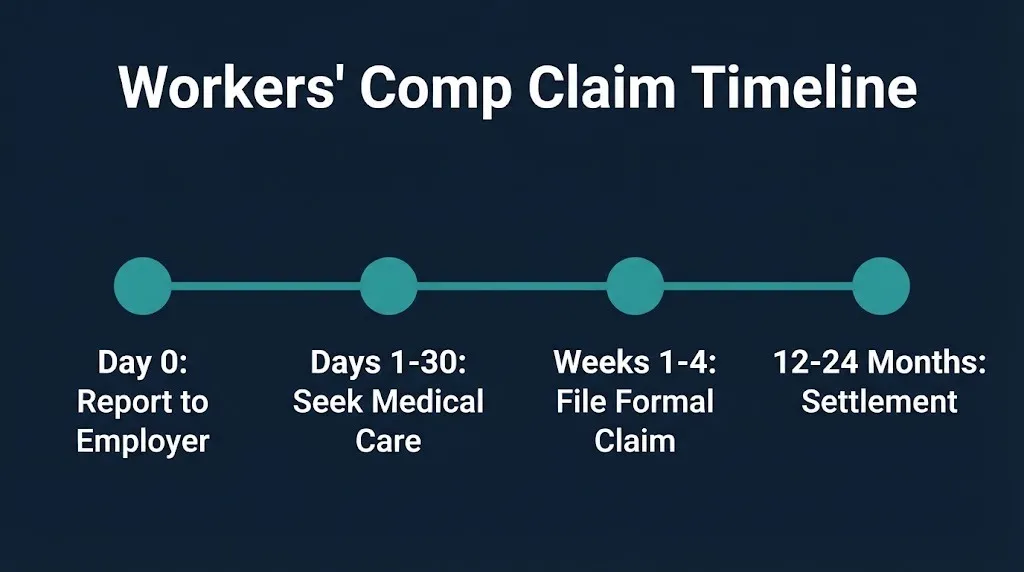
Day 0: Report the injury to your employer in writing.
Days 1–30: Seek medical care and document everything.
Weeks 1–4: File the formal claim with your state workers’ comp board.
Months 1–12: Medical treatment and temporary disability benefits.
12–24 months: Reach Maximum Medical Improvement (MMI) and begin settlement discussions if your case qualifies.
Frequently Asked Questions
How much does workers’ comp pay?
Most states pay 66.67% of your average weekly wage, tax-free, up to a state maximum. Texas pays 70%.
What is the average workers’ comp settlement?
The national average is $29,750. California averages $67,400. Severe surgical cases can exceed $500,000.
How long do I have to report a work injury?
Most states require notice within 30 days. Some allow 45, 90, or 120 days. Report immediately in writing.
Can I get a lump sum settlement?
Yes. A Compromise & Release closes your case permanently. You waive future medical and wage benefits in exchange for one payment.
Do I need a lawyer for workers’ comp?
You can file without one. But workers with attorneys recover 3 to 5 times more than unrepresented claimants.
What if my claim is denied?
You can appeal. The process varies by state. Deadlines for appeals are strict. Consult an attorney promptly.
Can I choose my own doctor?
It depends on your state. Some states require you to see a doctor from your employer’s panel.
How long does a workers’ comp case take?
Minor claims resolve in weeks. Settlements typically take 12 to 24 months. Complex surgical cases take 18 to 36 months.
Report your injury to your employer in writing today if you haven’t already. Keep copies of every document. The most important deadline is your state’s notice requirement, often just 30 days from the injury. Missing it can cost you everything.