Missouri Workers Comp Settlement Chart 2026: Payout Values, Body Part Weeks, and How to Calculate Yours
Quick Answer
- Is it legit? Yes, the chart comes from Missouri statute and state labor department rules.
- How much could you get? PPD pays 66 2/3% of your average weekly wage, capped at $678.18/week.
- Most important deadline? Two years from injury to file a Claim for Compensation with the Division.
What Is the Missouri Workers Comp Settlement Chart?
The Missouri workers comp settlement chart is a statutory schedule that assigns a specific number of weeks to each body part. It does not list dollar amounts. Your payout depends on three numbers: the weeks assigned to your injury, your disability rating as a percentage, and your weekly compensation rate.
Missouri law separates injuries into two categories. Scheduled injuries involve specific body parts listed in the statute, like arms, legs, hands, and feet. Non-scheduled injuries, often called “body as a whole” injuries, cover the back, neck, and internal conditions.

The schedule itself comes from Missouri Revised Statute 287.190. The Missouri Division of Workers’ Compensation publishes the current rates and the official WC-110 chart.
If you were hurt at work and a doctor has given you a permanent disability rating, this chart is the starting point for understanding what your case may be worth. It is not the final number. It is the framework.
The Facts
| Topic | Missouri Workers Compensation Settlement Chart |
| Status | Active. 2026 rates in effect since July 1, 2026. |
| Max PPD Rate | $678.18/week (injuries on or after July 1, 2026) |
| Max TTD Rate | $1,294.71/week (injuries on or after July 1, 2026) |
| Est. Per Person | Varies by body part, disability rating, and wage history |
| Claim Deadline | Two years from injury or last payment (three years if employer failed to report) |
| Administrator | Missouri Division of Workers’ Compensation |
| Proof Needed | Medical records, impairment rating at MMI, wage documentation |
Missouri Workers Comp Settlement Chart: Body Part Values for 2026
The settlement chart assigns weeks of compensation to each body part. The more weeks assigned, the higher the potential value. Here are the key values from Missouri’s statutory schedule.
| Body Part | Statutory Weeks |
|---|---|
| Body as a whole (back, neck, internal) | 400 |
| Arm at the shoulder | 232 |
| Arm between shoulder and elbow | 222 |
| Arm at the elbow | 210 |
| Arm between elbow and wrist | 200 |
| Hand at the wrist | 175 |
| Leg at the hip | 207 |
| Leg at or above the knee | 160 |
| Leg above ankle, below knee | 155 |
| Foot in the tarsus | 150 |
| Complete deafness, both ears | 180 |
| Complete deafness, one ear | 49 |
| Complete loss of sight, one eye | 140 |
If there is complete loss or severance of a scheduled member, Missouri adds a 10 percent bonus to the weeks. That brings a hand from 175 weeks to 192.5 weeks.
The “body as a whole” category at 400 weeks is the highest value on the chart. That is why back and neck injuries often carry the most significant settlement potential in Missouri workers compensation cases.
How Is a Missouri Workers Comp Settlement Calculated?
The basic formula is simple: disability percentage × statutory weeks × weekly rate = estimated PPD value. Missouri uses a three-step calculation that starts with your average weekly wage.
Step 1: Find your compensation rate. Your PPD rate is generally 66 2/3 percent of your average weekly wage from the 13 weeks before your injury. If you earned $900 per week, your rate is $600. If you earned $1,200, your rate is $800, but that gets capped at the state maximum of $678.18 for PPD claims.
Step 2: Identify the weeks for your body part. Use the chart above. A shoulder is 232 weeks. A knee is 160 weeks. The body as a whole is 400 weeks.
Step 3: Apply your disability rating. The doctor at maximum medical improvement assigns a percentage. That percentage is the multiplier.
Here is a worked example. Suppose you injured your shoulder. Your average weekly wage was $900, so your rate is $600. Your doctor assigns a 25 percent disability rating.
25% × 232 weeks × $600 = $34,800
Now change the rating to 35 percent.
35% × 232 weeks × $600 = $48,720
The difference between a 25 percent and 35 percent rating on the same shoulder is nearly $14,000. That gap is why the rating matters so much.
Key Takeaway: The body part chart gives you weeks. The disability rating and your wage history turn those weeks into dollars. Every percentage point is real money.
What Is the Maximum PPD Rate in Missouri for 2026?
The maximum permanent partial disability rate in Missouri for injuries occurring from July 1, 2026 through June 30, 2027 is $678.18 per week. That is up from $670.92 in the prior benefit year.
Missouri ties this cap to the statewide average weekly wage. The PPD max is 55 percent of that figure. Temporary total disability and permanent total disability have a higher cap at $1,294.71 per week, which is 105 percent of the SAWW.
The date of your injury controls which rate applies. An injury in June 2026 uses the old $670.92 maximum. An injury in August 2026 uses the new $678.18 maximum. That difference matters for the life of your claim.
Most workers do not hit the cap. If your average weekly wage is $750, your PPD rate is $500. That is below the maximum, so the cap does not affect you.
What Are Realistic Settlement Ranges for Common Missouri Injuries?
The chart gives a baseline, but actual settlements vary widely. These ranges reflect real-world outcomes reported by Missouri workers compensation attorneys. They assume a covered claim, a completed treatment course, and a permanent disability rating.
| Injury Type | Typical Settlement Range |
|---|---|
| Back strain, conservative treatment | $20,000 to $60,000 |
| Herniated disc, fusion, nerve damage | $75,000 to $200,000+ |
| Simple fracture, full recovery | $10,000 to $30,000 |
| Complex fracture with surgery | $50,000 to $75,000+ |
| Carpal tunnel, tendinitis | $15,000 to $50,000 |
| Traumatic brain injury | $50,000 to $500,000+ |
| Amputation | $100,000 to $1,000,000+ |
These numbers are illustrations from law firm case experience, not guarantees. Your case depends on your specific medical records, your wage history, and how your disability affects your ability to work.
Reality Check: The Chart Is Not a Price List
If you search for “Missouri workers comp settlement chart,” you will find law firm pages that make it look like every shoulder injury is worth $26,100. That is not how Missouri law works. The chart assigns weeks, not dollars. Two workers with the same shoulder injury can receive wildly different settlements based on their wages, their ratings, and whether they returned to their old job. Never accept a settlement based on a chart alone. Get your medical records and your wage calculation reviewed before you sign anything.
How Do You File a Missouri Workers Compensation Claim?
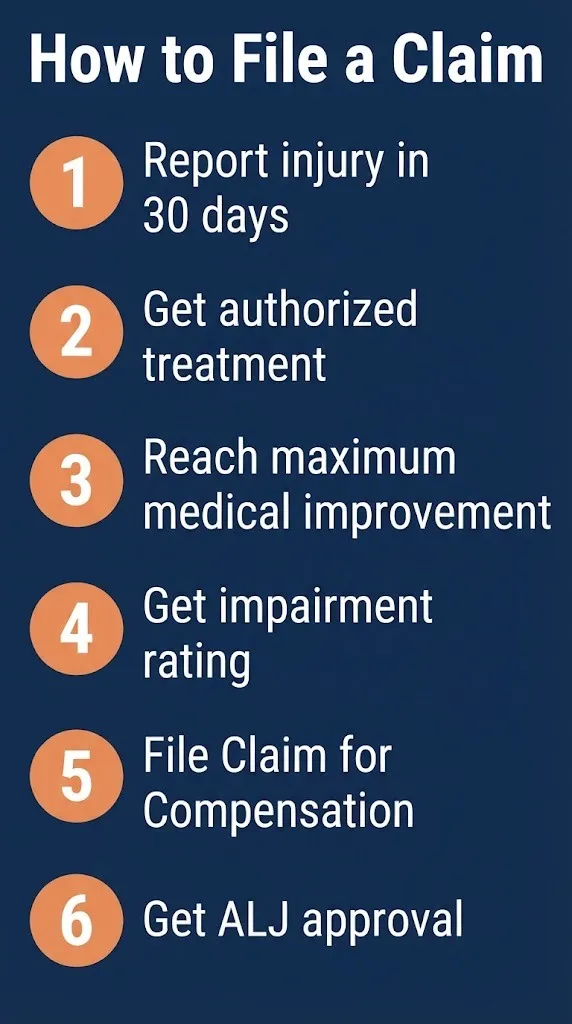
Filing a claim is a formal step that preserves your rights. You do not have to settle just because you file. Here are the steps.
- Report your injury in writing to your employer within 30 days. Email or written notice with a timestamp works.
- Get authorized medical treatment. The employer’s insurance carrier directs care.
- Reach maximum medical improvement. The doctor declares you as recovered as you will get.
- Get your impairment rating. The doctor assigns a percentage of disability.
- File a Claim for Compensation with the Division. This must happen within two years of injury.
- Negotiate or request a conference. The Division can schedule a settlement conference with a judge.
- Get ALJ approval for any settlement. A judge must approve the agreement.
- Receive payment. After approval, the insurer typically issues payment within 30 days.
Filing a claim is like filing a warranty claim on a defective appliance. The warranty exists, but you have to submit the paperwork correctly and on time. Missing a step can void your rights.
What Is the Deadline to File a Missouri Workers Comp Claim?
You have two years from the date of injury or the last payment of benefits to file a Claim for Compensation with the Missouri Division of Workers’ Compensation. If your employer fails to file the required Report of Injury, that window extends to three years.
You also have a 30-day notice requirement to your employer. Written notice within 30 days of the accident protects your claim. Missing the 30-day window does not automatically kill your case, but it gives the insurer a strong argument.
The two-year deadline is strict. Missing it means your claim is permanently barred. Missouri courts treat the statute of limitations as one of extinction, not repose. There is no exception for severe injuries or ongoing treatment.
What Happens If You Miss the Filing Deadline?
Missing the two-year filing deadline usually means you lose the right to workers compensation benefits for that injury. The statute is a hard cutoff. Courts cannot make exceptions simply because your injury was serious.
There is one narrow extension. If your employer never filed the required Report of Injury with the Division, the filing window stretches to three years. That is the only common extension.
The 30-day notice deadline works differently. Missing it does not automatically end your claim, but the insurer will argue that the delay prejudiced their investigation. In limited cases, a judge may excuse late notice. Do not count on it.
What Factors Affect Your Missouri Workers Comp Settlement?
Several variables can push your settlement above or below the chart baseline.
Disability rating. This is the biggest variable. Insurance company doctors often rate disabilities lower than treating physicians. A 10 percent rating versus a 25 percent rating on the same body part can mean tens of thousands of dollars.
Average weekly wage. Your rate is two-thirds of your average weekly wage. If you worked overtime, had a second job, or received bonuses, those earnings may count. Insurance adjusters sometimes miss them.
Future medical needs. If you will need future surgery, therapy, or medication, that value can be added to the settlement. Settling without accounting for future care is a common mistake.
Second Injury Fund. If you had a pre-existing disability that combined with your work injury to create a greater overall disability, you may qualify for an additional award from the Second Injury Fund.
Return to work. If you cannot return to your old job or any job, your claim value increases significantly. If you returned to the same position at the same pay, the value drops.
What Is the Second Injury Fund in Missouri Workers Compensation?
The Second Injury Fund provides additional compensation when a pre-existing disability combines with a new work injury. The fund is a separate source of money from the employer’s insurance.
To qualify, you must show three things. First, you have a permanent disability from a compensable work injury. Second, you had a pre-existing permanent disability that was a hindrance to employment. Third, the combination of the two creates a greater disability than the work injury alone.
A common example: you have a prior back injury that limits your lifting. Then you hurt your knee at work. The knee injury alone might be a 20 percent disability. But combined with your back limitations, you cannot return to any physical work. The Second Injury Fund may cover the difference.
Second Injury Fund claims have their own deadline. You must file within two years of the injury or within one year of filing your claim against the employer, whichever is later.
Key Takeaway: The body part chart is the starting point, but the disability rating, your wage history, and future medical needs are where settlements are won or lost.
What Is the Difference Between TTD, PPD, and PTD?
Missouri workers compensation uses three disability categories. Each plays a different role in your claim.
Temporary Total Disability (TTD) pays while you cannot work at all during recovery. The rate is 66 2/3 percent of your average weekly wage, capped at $1,294.71 per week for 2026 injuries. There is a three-day waiting period, but those days are paid retroactively if you are off more than 14 days.
Permanent Partial Disability (PPD) pays after you reach maximum medical improvement and have a permanent impairment. This is where the settlement chart applies. The rate is capped at $678.18 per week for 2026 injuries.
Permanent Total Disability (PTD) pays if you cannot return to any gainful employment. The rate matches TTD at $1,294.71 per week for 2026 injuries.
The chart on this page covers PPD. TTD and PTD are calculated differently.
What Happens Next in Your Missouri Workers Comp Case?
Within 30 days of injury: Report in writing to your employer. Preserve your claim.
Within 2 years of injury: File a Claim for Compensation with the Division if you have not settled.
After MMI: Get your impairment rating and calculate your PPD value.
Expected 2 to 6 months after filing: Settlement conference or mediation, if the case is disputed.
Expected 6 to 12 months after filing: Administrative Law Judge approval if a settlement is reached.
After approval: Payment typically issued within 30 days.
TBD: If the case goes to a hearing, the timeline depends on the Division’s docket and the complexity of the medical evidence.
Frequently Asked Questions
How much is my Missouri workers comp settlement worth?
Your settlement value depends on your disability rating, the body part injured, and your average weekly wage. The formula is rating percentage times statutory weeks times your weekly rate. No chart can give you a final number without your medical records.
What is the maximum PPD rate in Missouri for 2026?
The maximum permanent partial disability rate is $678.18 per week for injuries occurring July 1, 2026 through June 30, 2027. The maximum TTD and PTD rate is $1,294.71 per week.
How long do I have to file a workers comp claim in Missouri?
You have two years from the date of injury or last payment to file a Claim for Compensation. If your employer never filed a Report of Injury, the deadline extends to three years. You also have 30 days to give written notice to your employer.
What body part is worth the most in Missouri workers comp?
The body as a whole, which includes back, neck, and internal injuries, is valued at 400 weeks. That is the highest value on the statutory schedule. Arms and legs range from 160 to 232 weeks depending on the specific location.
Do I need a lawyer to settle a Missouri workers comp claim?
You are not required to hire a lawyer. But most injured workers who settle without representation leave money on the table. The insurance company’s doctor often rates disabilities lower than treating physicians. An attorney can challenge that rating and negotiate a higher settlement.
What is the Second Injury Fund in Missouri?
The Second Injury Fund pays additional compensation when a pre-existing disability combines with a new work injury to create a greater overall disability. It is a separate source of money from the employer’s insurance. Claims have their own filing deadline.
Can I get pain and suffering in a Missouri workers comp case?
No. Missouri workers compensation does not include compensation for pain and suffering. It covers medical bills, lost wages, and permanent disability. If a negligent third party caused your injury, a separate personal injury claim may allow you to recover pain and suffering damages.
What happens if I miss the two-year filing deadline?
Your claim is permanently barred in most cases. Missouri courts treat the statute of limitations as strict. The only common extension is when the employer failed to file the required Report of Injury, which extends the deadline to three years.
What You Should Do Right Now
If you were hurt at work in Missouri, gather your medical records and your wage stubs from the 13 weeks before your injury. Those two documents drive your settlement calculation. Do not accept a settlement offer before you understand the chart value of your injury.
The single most important date to remember is the two-year filing deadline from your date of injury. Calendar it now.