Liability Insurance vs Workers Compensation 2026: What Each Covers and Where the Gaps Are
Quick Answer
- General liability insurance does not cover employee work injuries.
- Workers compensation covers employee medical bills and lost wages regardless of fault.
- Most states require both, but they protect against completely different risks.
You run a small business. An employee gets hurt. You file a claim with your general liability insurer. Then comes the denial letter.
This happens every day in 2026. Business owners confuse general liability insurance with workers compensation, and the confusion costs them real money. The two policies look similar on paper. They are not similar in practice.
This article explains the exact difference, what each policy covers, what happens when you only have one, and how the claims process actually works.
| The Facts | |
|---|---|
| Coverage Type | General Liability vs Workers Compensation |
| Employee Injuries | Workers comp only |
| Third-Party Injuries | General liability only |
| Fault Required | No for workers comp, yes for liability |
| Legal Requirement | Both, in most states |
| Penalty for No Workers Comp | Fines, lawsuits, personal liability |
| Claim Deadline | Varies by state, often 1 to 3 years |
Does General Liability Insurance Cover Workers Compensation?
No, general liability insurance does not cover workers compensation claims. The two policies are legally distinct and cover different risks.
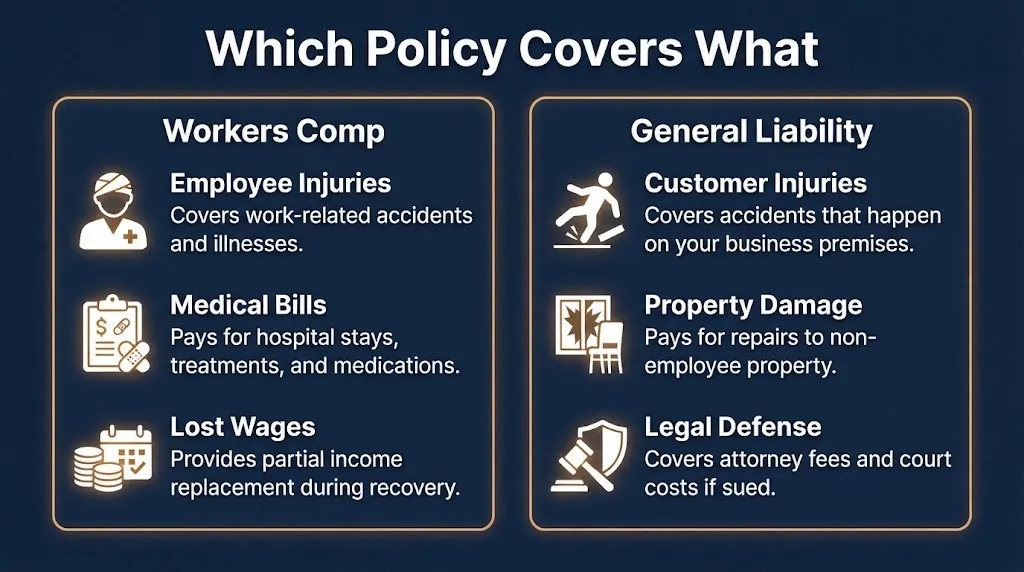
General liability pays for injuries to third parties: customers, vendors, visitors. It also covers property damage you cause to others and certain advertising or personal injury claims.
Workers compensation pays for injuries to your employees. It covers medical bills, a portion of lost wages, disability benefits, and death benefits.
No amount of general liability coverage substitutes for workers comp. If an employee gets hurt and you only have general liability, the claim will be denied.
Key Takeaway: General liability protects you from outsiders. Workers comp protects your employees from workplace injuries. They do not overlap.
What Does Workers Compensation Insurance Cover?
Workers compensation insurance covers employee medical expenses, lost wages, disability payments, and death benefits for work-related injuries or illnesses.
The coverage is no-fault. Your employee does not have to prove you did anything wrong. If the injury happened at work or because of work, the claim is covered.
| Workers Comp Benefit | What It Pays |
|---|---|
| Medical care | Doctor visits, surgery, medication, therapy |
| Wage replacement | Usually 60 to 67% of average weekly wage |
| Permanent disability | Based on impairment rating |
| Vocational rehab | Job retraining if the worker cannot return |
| Death benefits | Funeral costs and survivor payments |
The specific amounts and duration vary by state. Each state sets its own benefit levels and maximum weekly payouts.
What Does General Liability Insurance Cover?
General liability insurance covers bodily injury and property damage you cause to third parties.
If a customer slips in your store, general liability pays their medical bills and your legal defense. If your employee damages a client’s property, general liability covers the repair cost.
| General Liability Coverage | Example |
|---|---|
| Bodily injury to third parties | Customer falls, visitor injured |
| Property damage to others | You damage a client’s equipment |
| Personal and advertising injury | Defamation, copyright claims |
| Legal defense costs | Attorney fees even if you win |
The key word is third party. Employees are not third parties under a general liability policy.
What Is the Difference Between General Liability and Workers Comp?
The core difference is who gets protected. Workers comp covers your employees. General liability covers everyone else.
The other difference is fault. Workers comp pays regardless of who caused the injury. General liability only pays if you were negligent or legally responsible.
| Factor | Workers Comp | General Liability |
|---|---|---|
| Who is covered | Employees | Third parties |
| Fault required | No | Yes |
| Wage loss paid | Yes | No |
| Medical bills paid | Yes | Yes, for third parties |
| Legal defense | Usually not needed | Included |
Think of it like a store return without a receipt. Workers comp is the store policy that takes the item back no questions asked. General liability is the return desk that wants proof you bought it and that it was defective.
Key Takeaway: Workers comp is automatic and no-fault for employees. General liability is fault-based and applies only to outsiders.
What Happens If You Only Have General Liability Insurance?
If you only have general liability insurance and an employee gets hurt, you pay the claim out of pocket.
Your general liability insurer will deny the workers comp claim. Then the employee can sue you personally or through the state workers comp system.
The consequences are severe:
- Medical bills become your personal debt
- Lost wages come out of your business income
- State penalties for not carrying workers comp
- Criminal charges in some states for willful noncompliance
The state may also step in. Most states require workers comp coverage if you have even one employee. Failure to carry it triggers fines per day of noncompliance.
Is Workers Comp Required If You Have General Liability?
Yes, workers compensation is required in most states even if you already have general liability insurance.
The two policies are not interchangeable. Having general liability does not satisfy your workers comp obligation.
| Business Type | Workers Comp Required? |
|---|---|
| One or more employees | Yes, in most states |
| Independent contractors only | Sometimes, depends on state |
| Sole proprietor, no employees | Usually no |
| Partnership, no employees | Usually no |
The exact threshold varies by state. Some states exempt very small businesses or certain industries. Check your state’s workers comp board for your specific requirement.
What Is the Cost Difference Between Workers Comp and General Liability?
Workers comp typically costs more than general liability for high-risk industries, but the price depends on payroll and claims history.
General liability premiums often run from $500 to $2,000 per year for small businesses. Workers comp can range from a few hundred dollars to tens of thousands depending on your industry and payroll.
| Industry | Workers Comp Cost Driver |
|---|---|
| Office work | Low, under $1 per $100 payroll |
| Construction | High, $5 to $20 per $100 payroll |
| Restaurant | Moderate, $2 to $8 per $100 payroll |
| Retail | Low to moderate |
The comparison matters because both premiums hit your bottom line. But skipping one to save money is false economy.
Key Takeaway: Workers comp costs more than general liability in risky industries, but not having it can cost you your entire business.
What Is Workers Compensation and General Liability Insurance Combined?
Workers compensation and general liability insurance combined means buying both policies, often through a business owner’s policy.
A business owner’s policy, or BOP, bundles general liability with commercial property insurance. Workers comp is usually a separate policy, though some insurers offer package deals.
You can buy both from the same carrier, which sometimes earns a discount. But the coverages remain separate under the law.
- BOP: general liability plus property
- Workers comp: separate policy, separate premium
- Package discount: often available
- One insurer: convenient but not required
Bundling does not merge the coverages. An employee injury still goes through workers comp, not your BOP.
What Are the Penalties for Not Carrying Workers Comp?
Penalties for not carrying workers comp include daily fines, business shutdown orders, and personal liability for the injured worker’s costs.
Each state sets its own penalty structure. In some states, the fine is $1,000 to $10,000 per day of noncompliance. In others, the state can shut down your business until you obtain coverage.
| Penalty Type | Example |
|---|---|
| Daily fine | $100 to $10,000 per day |
| Stop-work order | Business closed until compliant |
| Personal liability | Owner pays medical bills and wages |
| Criminal charges | Misdemeanor or felony in some states |
The penalties are designed to make skipping workers comp more expensive than buying it.
Reality Check: No business owner plans to hurt their employees. But the one time an injury happens, the absence of workers comp turns a manageable insurance claim into a business-ending event.
How Does a Workers Comp Claim Work When You Have Both Policies?
When you have both policies, an employee injury triggers a workers comp claim, not a general liability claim.
The process starts with the employee reporting the injury. You file the claim with your workers comp carrier. The carrier investigates, approves or denies, and pays benefits if covered.
Your general liability insurer never gets involved unless a third party was also injured or the employee sues someone other than you.
| Step | Who Handles It |
|---|---|
| Injury report | You, to workers comp carrier |
| Claim investigation | Workers comp adjuster |
| Benefit payments | Workers comp carrier |
| Third-party claim | General liability carrier |
| Employee lawsuit against you | Usually barred by workers comp exclusive remedy |
The exclusivity rule is key. In most states, workers comp is the exclusive remedy for employee injuries. The employee cannot sue you separately if workers comp covers the claim.
What Are the Exceptions to Workers Comp Exclusive Remedy?
Workers comp exclusive remedy bars most employee lawsuits, but exceptions exist for intentional harm, third-party negligence, and uninsured employers.
If you intentionally hurt an employee, the exclusive remedy rule does not protect you. If a third party caused the injury, the employee can sue that third party while still collecting workers comp.
| Exception | Example |
|---|---|
| Intentional employer conduct | Assault, deliberate safety violations |
| Third-party liability | Defective equipment manufacturer |
| No workers comp coverage | Employer failed to carry insurance |
| Dual capacity | Employer also manufactured the product |
These exceptions matter because they open the door to pain and suffering damages, which workers comp does not pay.
How Does General Liability Interact With a Workers Comp Claim?
General liability interacts with a workers comp claim when a third party bears some responsibility for the injury.
If a delivery driver working for your company slips on a client’s icy walkway, the driver gets workers comp from you. The driver may also sue the client through the client’s general liability policy.
Your general liability does not pay the driver. It pays claims by third parties against you, not claims by your employees.
Key Takeaway: General liability and workers comp can both be triggered by one incident, but they pay different people for different reasons.
What Should a Small Business Owner Do to Stay Covered?
A small business owner should verify workers comp requirements, buy general liability, and audit coverage annually.
Follow these steps:
- Check your state’s workers comp requirement for your employee count.
- Buy workers comp from a licensed carrier or state fund.
- Buy general liability or a BOP for third-party risks.
- Review coverage limits each year.
- Report employee injuries immediately.
- Keep payroll records accurate for premium audits.
- Ask your agent about gaps in coverage.
Insurance is not a set-and-forget purchase. It requires annual review as your business changes.
What Happens Next With Workers Comp and Liability Insurance
The insurance landscape in 2026 is shifting toward more premium audits, more AI-driven claims handling, and more state enforcement of coverage mandates.
- Current: Most states enforce workers comp mandates aggressively
- Late 2026: More states add online coverage verification tools
- Expected 2027: Increased fines for misclassifying employees as contractors
- Watch for: Court rulings on gig worker classification affecting comp requirements
These are not confirmed dates. They describe a regulatory trend toward stricter enforcement.
Frequently Asked Questions
Does general liability cover employee injuries?
No.
General liability covers third-party injuries only, never employee work injuries.
Is workers comp mandatory if I have general liability?
Yes, in most states.
Having general liability does not satisfy workers comp requirements.
Can I bundle workers comp and general liability?
You can buy both from one insurer.
The coverages remain separate even when bundled.
What happens if an employee sues me after a work injury?
Workers comp usually bars the lawsuit.
Exceptions exist for intentional harm and third-party negligence.
How much does workers comp cost for a small business?
Cost depends on payroll and industry.
Office work costs less than construction or manufacturing.
What is a business owner’s policy?
A BOP bundles general liability and property insurance.
Workers comp is typically a separate policy.
The Bottom Line
General liability insurance and workers compensation cover different risks. No amount of one replaces the other.
If you have employees, you need workers comp. If you deal with the public, you need general liability. Most businesses need both, and most states require both.
The single most important fact is this: if an employee gets hurt and you only have general liability, the claim is denied and you pay out of pocket. That one gap can end a business faster than any lawsuit from a customer.