Average Workers’ Comp Settlement for Surgery in 2026: What Surgery Does to Your Claim Value
Quick Answer
- Surgery generally increases a workers’ comp settlement because it raises medical costs and shows injury severity.
- Average settlement values vary widely by state, body part, and whether permanent impairment remains after surgery.
- No official national average exists for surgery-specific workers’ comp settlements in 2026.
Workers who need surgery after a work injury have one question above all others. What is the average workers’ comp settlement for surgery, and will surgery increase my claim value?
The honest answer is that surgery usually increases settlement value, but no official average exists. The numbers you see on lawyer websites are marketing estimates, not government data.
Workers’ compensation is a state-run system. Each state has its own benefit rates, impairment schedules, and settlement approval rules. A spine surgery settlement in Illinois looks nothing like one in Texas.
This article breaks down how surgery affects claim value, what factors drive settlement amounts up or down, realistic ranges from published data, and what to do before you sign anything.
The Facts
| Item | Details |
|---|---|
| National Average for Surgery Claims | Not officially published |
| Surgery Impact on Claim Value | Generally increases value |
| Primary Value Drivers | Medical costs, impairment rating, future care |
| State Variation | Extreme |
| Settlement Approval | Required by state workers’ comp board |
| 2026 Rule Changes | None confirmed nationally |
Does Surgery Increase Workers’ Comp Settlement?
Yes, surgery typically increases a workers’ comp settlement. The increase comes from three places at once.
First, the surgery itself is expensive. A spinal fusion, rotator cuff repair, or knee replacement can cost tens of thousands of dollars. Insurers look at the total medical spend when valuing a claim.
Second, surgery proves the injury was serious. An insurer cannot argue you had a minor strain when an orthopedic surgeon opened you up and fixed a torn ligament.
Third, surgery often leaves permanent impairment. That impairment rating converts to weeks of benefits under state law, and those weeks convert to settlement dollars.
Here is how surgery changes the valuation math:
| Claim Element | Before Surgery | After Surgery |
|---|---|---|
| Medical costs | Low, conservative care | High, surgical intervention |
| Injury severity | Disputable | Hard to dispute |
| Impairment rating | Often zero or low | Usually measurable |
| Future medical needs | Minimal | Possible complications |
| Settlement value | Lower | Higher |
Key Takeaway: Surgery raises settlement value by increasing medical costs, proving severity, and creating a permanent impairment rating.
What Is the Average Workers’ Comp Settlement for Surgery?
No official national average exists. The Bureau of Labor Statistics and state workers’ compensation boards do not publish surgery-specific settlement averages.
What exists are lawyer-published estimates and private studies. Those numbers vary so widely that any single “average” is misleading.
A simple arthroscopic knee surgery might settle for $30,000 to $75,000. A multi-level spinal fusion with permanent restrictions might settle for $150,000 to $350,000 or more.
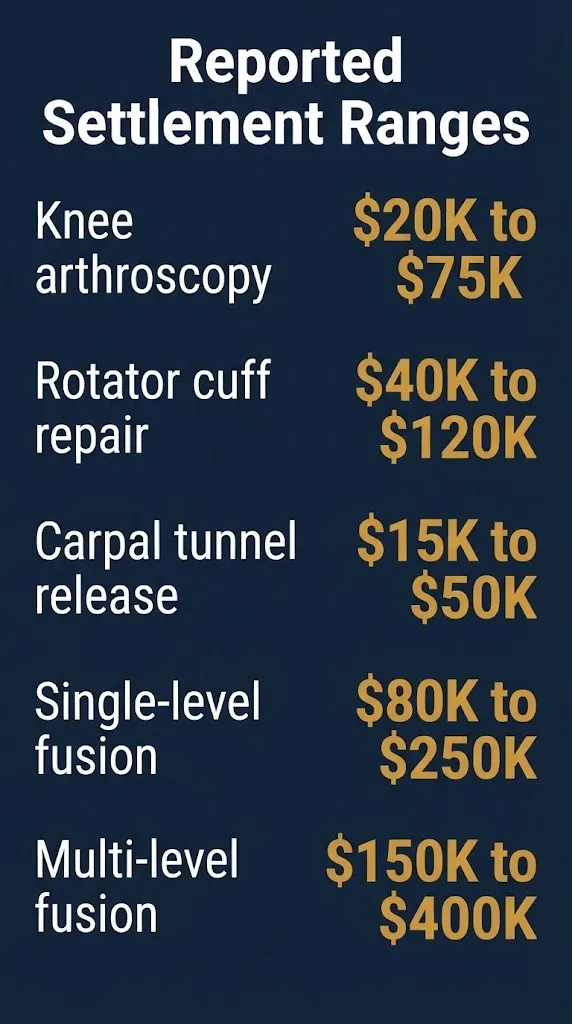
Here are the general ranges reported across legal industry sources for common surgical claims:
| Surgery Type | Reported Settlement Range |
|---|---|
| Knee arthroscopy | $20,000 to $75,000 |
| Rotator cuff repair | $40,000 to $120,000 |
| Carpal tunnel release | $15,000 to $50,000 |
| Single-level spinal fusion | $80,000 to $250,000 |
| Multi-level spinal fusion | $150,000 to $400,000 |
| Hip replacement | $75,000 to $200,000 |
These ranges are not guarantees. Your claim value depends on state law, your wages, your doctor’s restrictions, and the insurer’s risk tolerance.
Does Surgery Increase Workers Comp Settlement in Every Case?
No, surgery does not automatically increase settlement value in every case.
If the surgery is minor, the recovery is complete, and no permanent impairment remains, the increase may be modest. The insurer paid for the surgery, but your future claim may be small.
If the surgery fails or leaves you worse than before, the value may rise significantly. Failed back surgery syndrome, for example, often increases settlement value because future care needs are higher.
The timing of surgery matters too. Surgery before settlement lets the insurer see the outcome. Surgery after settlement is your risk, not theirs, and that risk lowers what they will pay to close the claim now.
What Body Part Gets the Highest Workers’ Comp Settlement?
Spine injuries generally produce the highest workers’ comp settlements. Neck and back surgeries carry the highest medical costs and the most severe permanent restrictions.
Brain injuries and amputations can exceed spine settlements in severe cases, but those claims are less common.
Here is how body parts rank in typical settlement value:
| Body Part | Settlement Rank | Reason |
|---|---|---|
| Spine (neck or back) | Highest | High surgery cost, major restrictions |
| Brain | Highest | Catastrophic, lifelong care |
| Shoulder | High | Surgery common, permanent loss of motion |
| Knee | Moderate to high | Replacement possible |
| Hand or wrist | Moderate | Impairment rated under schedule |
| Foot or ankle | Moderate | Weight-bearing limits |
How Is a Workers’ Comp Settlement Calculated After Surgery?
The calculation starts with your average weekly wage and your impairment rating. Each state assigns a number of weeks for each body part or impairment level.
Here is the basic formula for most states:
| Step | What Happens |
|---|---|
| 1 | Doctor assigns permanent impairment rating |
| 2 | Rating converts to weeks of benefits under state schedule |
| 3 | Weeks multiplied by your compensation rate |
| 4 | Future medical costs estimated and added |
| 5 | Parties negotiate a lump sum |
| 6 | State board approves or rejects |
Your compensation rate is usually two-thirds of your average weekly wage, up to a state maximum. A higher wage means a higher settlement, even for the same surgery.
Key Takeaway: Your pre-injury wage matters as much as your surgery. The same operation settles for more when the injured worker earned more.
Does Having Surgery Before Settlement Increase the Offer?
Yes, having surgery before settlement almost always increases the insurer’s offer.
The insurer knows the surgical outcome, the total medical spend, and the permanent restrictions. That certainty reduces their risk of a bad outcome later, and they pay for that certainty.
Having surgery recommended but not yet performed creates a different kind of pressure. The insurer may offer a lower amount to close the claim before the surgery cost hits.
Here is the sequence that typically produces the highest settlement:
- Injury occurs and is reported.
- Conservative treatment fails.
- Doctor recommends surgery.
- Insurer authorizes the surgery.
- Surgery is performed.
- Recovery and physical therapy completed.
- Doctor assigns permanent impairment.
- Settlement negotiations begin.
What If the Insurance Company Denies My Surgery?
A surgery denial can stall your claim and delay settlement. But it may also increase settlement value if you win the fight.
Insurers deny surgery when they believe a utilization review doctor says it is not medically necessary. You can appeal that denial through your state workers’ comp board.
If an independent medical review overturns the denial, the insurer must pay for the surgery. That outcome strengthens your position because the insurer has already lost one round.
If the denial stands and you pay for surgery yourself, the settlement math changes. You may recover those costs in the settlement, but only if a judge orders it.
Reality Check: No state workers’ comp board bases settlement value on how much pain you say you feel. The records, the surgery, the impairment rating, and your wage drive the number. Anyone promising a specific settlement before seeing those records is guessing.
How Long Does a Workers’ Comp Settlement Take After Surgery?
Expect three to six months after surgery before a settlement is realistic in most states.
You need time to heal, complete physical therapy, and reach maximum medical improvement. The doctor cannot assign a final impairment rating until that point.
Once the rating exists, negotiations move faster. Many cases settle within 60 to 90 days after the impairment evaluation.
The full timeline often looks like this:
| Stage | Typical Timing |
|---|---|
| Surgery date | Day 0 |
| Initial recovery | 6 to 12 weeks |
| Physical therapy | 8 to 16 weeks |
| Maximum medical improvement | 4 to 8 months |
| Impairment rating | Same visit as MMI |
| Settlement negotiation | 1 to 3 months |
| Board approval | 2 to 6 weeks |
| Payment | 2 to 4 weeks after approval |
How Much Does a Workers’ Comp Lawyer Increase a Surgery Settlement?
A workers’ comp lawyer typically increases net settlement value by 20 to 40 percent, after fees, according to industry studies.
The lawyer’s fee is set by state law and must be approved by the workers’ comp board. Most states cap fees at 15 to 25 percent of the settlement.
Insurers know which claims are unrepresented. Those claims settle for less because the injured worker does not know the impairment schedule, the value of future medical care, or how to push back on a low offer.
Here is how the fee math works:
| Scenario | Settlement | Attorney Fee | Net to Worker |
|---|---|---|---|
| No lawyer | $40,000 | $0 | $40,000 |
| With lawyer | $75,000 | $15,000 (20%) | $60,000 |
The worker pays the lawyer but still takes home more money. That is the calculation most injured workers face.
Does Surgery Increase Workers Comp Settlement for a Closed Claim?
No, surgery after a closed claim generally does not increase that claim’s settlement. Once the claim is closed by a full and final settlement, you cannot reopen it for the same injury.
Some states allow reopening if the condition worsens or new medical evidence emerges. But a full and final settlement usually means the insurer bought peace, and the file is closed.
Before you sign a settlement, ask your doctor whether surgery might be needed in the future. If the answer is yes, either wait for the surgery or include future surgery costs in the settlement amount.
What Is a Fair Workers’ Comp Settlement After Surgery?
A fair settlement covers past medical bills, future medical care, wage loss, and permanent impairment. Anything less is not fair, regardless of the number.
Here is the checklist for evaluating an offer:
- Does it cover all past medical bills, including the surgery?
- Does it include enough for future medical care, including possible complications?
- Does it replace wages for the full period you could not work?
- Does it compensate the permanent impairment rating?
- Does it account for your reduced earning capacity?
- Would you be comfortable with this number if the injury never fully heals?
Key Takeaway: A fair settlement is not the highest number an attorney quotes. It is the number that covers medical care, wage loss, and permanent damage without leaving you on the hook.
What Happens Next
Expected 2026: No federal changes to workers’ comp settlement rules are pending.
Ongoing: State workers’ comp boards continue updating impairment schedules and maximum benefit rates.
Your move: Get the surgery authorized, reach maximum medical improvement, and obtain the impairment rating before negotiating.
Before signing: Ask your doctor about future medical needs and get that answer in writing.
Surgery changes your workers’ comp claim from a fight about whether you were hurt to a fight about how much the permanent damage is worth.
The highest settlements come to workers who have the surgery, complete recovery, get the impairment rating, and negotiate from the medical record instead of from pain complaints.
No national average exists, and no one can promise you a number before seeing your file. But surgery, documented impairment, and a clear future medical picture almost always push the number higher.