Atlanta Workers Compensation Attorney: 2026 Guide to Georgia Claims, Fees, and What to Expect
Quick Answer
- An Atlanta workers compensation attorney handles injury claims under Georgia’s no-fault workers’ comp system.
- Georgia attorney fees are capped at 25 percent of your recovery, set by the State Board of Workers’ Compensation.
- You must report a workplace injury in Georgia within 30 days to protect your right to benefits.
An Atlanta workers compensation attorney is a lawyer who represents injured workers in claims against their employers’ insurance carriers. Georgia has its own workers’ compensation laws, deadlines, and benefit schedules that differ from other states.
If you were hurt on the job in Atlanta or anywhere in Georgia, the system is supposed to cover your medical care and part of your lost wages. But claims get denied, payments get delayed, and employers push back.
This guide covers what a workers compensation attorney in Georgia actually does, what it costs, and when hiring one makes sense.
A surprising verified detail: Georgia’s workers’ compensation system covers employers with three or more employees, one of the lowest thresholds in the country. That means even small businesses in Atlanta must carry coverage.
The Facts
| System | Georgia State Board of Workers’ Compensation |
| Employer Coverage Threshold | Three or more employees |
| Attorney Fee Cap | 25 percent of recovery, Board-approved |
| Injury Reporting Deadline | 30 days |
| Claim Filing Deadline | One year from injury date |
| Weekly Benefit Rate | Two-thirds of average weekly wage, capped |
| Typical Resolution Time | 6 to 18 months for straightforward claims |
Is a Workers Compensation Attorney in Georgia Worth Hiring?
Yes, for most serious injuries, a workers compensation attorney in Georgia is worth hiring.
The system looks simple on paper. You report an injury, file a claim, and receive benefits. But insurers have adjusters and lawyers whose job is to minimize what they pay you.
An attorney levels that playing field. They know the deadlines, the forms, and the tactics insurers use to deny or undervalue claims.
For minor injuries with full recovery and an accepted claim, you may not need a lawyer. For anything involving surgery, permanent restrictions, denied claims, or disputes over your ability to work, representation matters.
Studies consistently show represented workers recover more than unrepresented workers, even after attorney fees.
Key Takeaway: You do not need an attorney for every claim. You need one when the claim is denied, delayed, or involves a serious injury.
How Much Does a Workers Compensation Attorney Cost in Atlanta?
Atlanta workers compensation attorneys work on a contingency fee basis.
You pay nothing upfront. The attorney receives a percentage of your recovery only if you win. If you recover nothing, you owe no attorney fee.
In Georgia, attorney fees must be approved by the State Board of Workers’ Compensation. The standard approved fee is 25 percent of your recovery for most cases.
Here is how the fee works:
| Recovery Amount | Attorney Fee (25%) | You Receive |
| $10,000 | $2,500 | $7,500 |
| $25,000 | $6,250 | $18,750 |
| $50,000 | $12,500 | $37,500 |
| $100,000 | $25,000 | $75,000 |
Some attorneys charge less for straightforward cases. Others may seek a higher percentage if the case requires an appeal, though the Board must approve any fee above the standard.
What Does a Workers Compensation Lawyer in Atlanta Actually Do?
A workers compensation lawyer in Atlanta handles every part of your claim from filing to resolution.
Here are the 7 core tasks:
- Investigate your injury and gather medical evidence.
- File all required forms with the State Board of Workers’ Compensation.
- Communicate with the insurance adjuster and medical providers.
- Negotiate for maximum medical and wage benefits.
- Represent you at hearings before an administrative law judge.
- Calculate the full value of your claim, including future medical needs.
- Negotiate and finalize any lump sum settlement.
The attorney also protects you from making costly mistakes. Missing a deadline or signing a settlement too early can permanently reduce your benefits.
Key Takeaway: An attorney’s job is not just arguing at a hearing. Most of the work happens in paperwork, negotiation, and evidence gathering.
What Are the Workers Compensation Benefits Available in Georgia?
Georgia provides four main types of workers compensation benefits.
Medical benefits cover all reasonable and necessary treatment for your injury. That includes doctor visits, surgery, hospital stays, prescriptions, and therapy.
Income benefits replace a portion of your lost wages. Georgia pays two-thirds of your average weekly wage, subject to a cap set annually.
Permanent partial disability benefits compensate you for lasting impairment. Georgia uses a schedule of benefits for specific body parts.
Vocational rehabilitation helps you return to work if you cannot do your old job. That can include retraining and job placement services.
Here is a summary table:
| Benefit Type | What It Covers |
| Medical | All necessary treatment, no copay or deductible |
| Temporary total disability | Two-thirds of wages while fully off work |
| Temporary partial disability | Two-thirds of wage difference if working reduced hours |
| Permanent partial disability | Scheduled weeks based on impairment rating |
| Death benefits | Paid to dependents of workers killed on the job |
When Should You Call an Atlanta Workers Compensation Attorney?
Call an attorney immediately if any of these situations apply to you.
Here are the 6 red flags that signal you need representation:
- Your claim was denied.
- Your employer disputes that the injury happened at work.
- You need surgery or have permanent restrictions.
- The insurer stops your benefits without explanation.
- You are pressured to return to work before your doctor releases you.
- Your employer does not carry workers compensation insurance.
Even if none of these apply, a free consultation with an attorney costs nothing. Most Atlanta workers compensation lawyers offer free case evaluations.
Reality Check: No legitimate attorney will guarantee a specific dollar amount before reviewing your medical records and claim file. Anyone who promises a fixed settlement upfront is selling you a pitch, not a legal service.
How to Choose a Workers Compensation Attorney in Atlanta Georgia
Choosing the right attorney matters more than choosing the biggest billboard.
Here is a 5-step checklist:
- Verify they specialize in Georgia workers compensation, not just personal injury.
- Check their record with the State Bar of Georgia for disciplinary issues.
- Ask how many workers comp cases they handle per year.
- Request references or read client reviews from multiple sources.
- Confirm the fee agreement in writing before signing.
Avoid attorneys who pressure you to sign immediately or who promise specific outcomes. The right attorney explains the process, sets realistic expectations, and lets you decide.
What Is the Workers Compensation Claim Process in Georgia?
The Georgia workers compensation claim process follows a defined sequence.
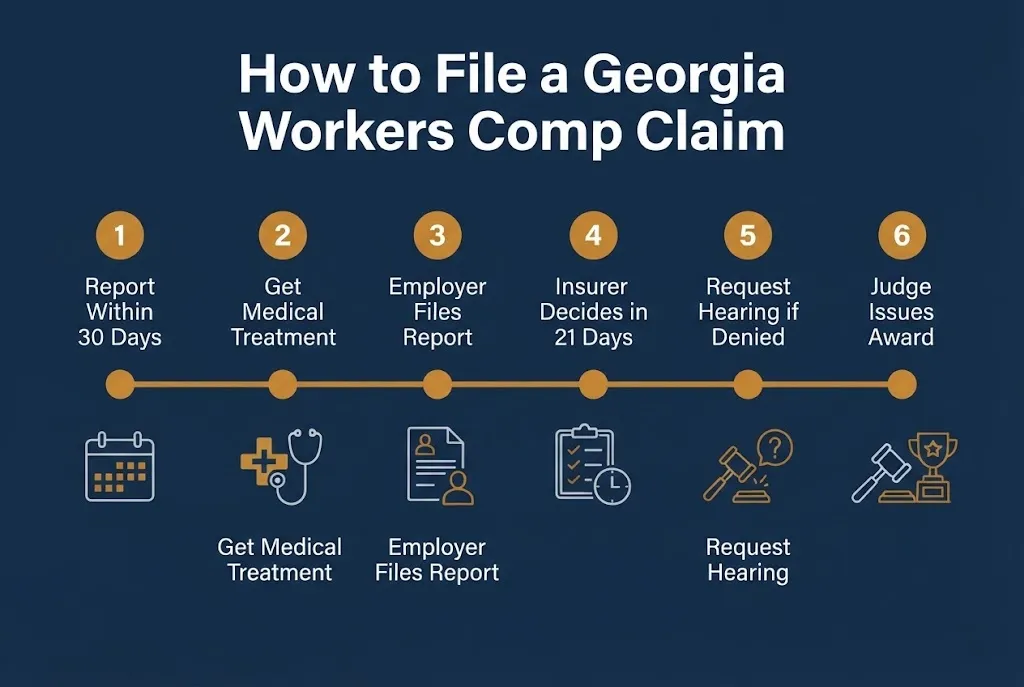
Here are the 7 steps from injury to resolution:
- Report the injury to your employer within 30 days.
- Your employer files a report with their insurance carrier.
- The insurer accepts or denies the claim within 21 days.
- If accepted, you begin receiving medical care and weekly benefits.
- If denied, you can request a hearing before the State Board.
- A hearing is held before an administrative law judge.
- The judge issues an award or the case settles.
The entire process can take months for straightforward claims and years for contested cases.
What Are the Deadlines for Filing a Workers Compensation Claim in Georgia?
Georgia has strict deadlines for workers compensation claims.
You must report your injury to your employer within 30 days. This is the most important deadline.
You must file a formal claim with the State Board of Workers’ Compensation within one year of the injury date.
There are exceptions. If your employer knew about the injury even without a formal report, the reporting deadline may be extended. If your injury develops over time, like a repetitive stress injury, the one-year clock may start when you discover the condition.
Do not rely on exceptions. Report immediately. File immediately. Deadlines are the easiest way to lose a valid claim.
Key Takeaway: The 30-day reporting deadline and one-year filing deadline are absolute in most cases. Missing them usually means losing your right to benefits.
Can You Be Fired for Filing a Workers Compensation Claim in Atlanta?
No, Georgia law prohibits retaliation for filing a workers compensation claim.
Your employer cannot fire you, demote you, cut your hours, or harass you because you filed a claim. Doing so creates a separate legal claim for retaliatory discharge.
That said, Georgia is an at-will employment state. Your employer can still terminate you for legitimate reasons unrelated to your claim.
If you suspect retaliation, document everything. Save emails, texts, and notes about conversations. The timing of your termination relative to your claim filing matters.
What If Your Employer Does Not Have Workers Compensation Insurance in Georgia?
Georgia law requires most employers with three or more employees to carry coverage.
If your employer does not have coverage and you are injured, you still have options. You may file a claim through the Georgia Subsequent Injury Trust Fund or pursue a personal injury lawsuit directly against your employer.
A personal injury lawsuit against an uninsured employer can recover damages beyond workers compensation, including pain and suffering and full lost wages.
An attorney can investigate whether your employer was legally required to carry coverage and what your best path is.
What Is the Average Workers Compensation Settlement in Atlanta?
Settlement amounts in Atlanta vary based on injury severity, wage level, and permanent impairment.
National data shows most workers compensation settlements fall between $2,000 and $40,000. Georgia settlements trend within that range, with higher amounts for surgery and permanent disability cases.
Here is a general settlement table:
| Injury Type | Typical Settlement Range |
| Strains and sprains | $5,000 to $15,000 |
| Fractures | $15,000 to $35,000 |
| Back injuries with surgery | $30,000 to $75,000 |
| Shoulder and knee surgeries | $25,000 to $65,000 |
| Permanent partial disability | $40,000 to $150,000 |
| Catastrophic injuries | $150,000 to $500,000+ |
These are not guarantees. Your specific case depends on your wages, your medical records, and the strength of your evidence.
Key Takeaway: Settlement value depends on documentation. The more thoroughly your injury, treatment, and restrictions are documented, the stronger your negotiating position.
What Happens at a Georgia Workers Compensation Hearing?
A hearing is a formal proceeding before an administrative law judge.
Both sides present evidence. You testify about your injury and how it happened. Your doctor provides medical testimony or reports. The insurer presents its own evidence and witnesses.
The judge then issues a written decision called an award. The award determines whether you receive benefits, how much, and for how long.
Hearings are less formal than jury trials but still follow legal rules. Having an attorney prepare you and present your case matters.
If you lose at the hearing, you can appeal to the State Board’s appellate division and then to Georgia’s superior courts.
How Long Does a Workers Compensation Case Take in Atlanta?
Most straightforward workers compensation cases in Atlanta resolve within 6 to 18 months.
Here is a typical timeline:
| Stage | Timeframe |
| Injury and reporting | Day 1 to 30 |
| Claim decision by insurer | 21 days after filing |
| Medical treatment | 3 to 12 months |
| Return to work or MMI | Varies by injury |
| Settlement negotiations | 1 to 3 months after MMI |
| Hearing, if needed | 3 to 6 months after request |
| Final resolution | 6 to 18 months total |
Contested claims and cases requiring multiple surgeries take longer. Appeals can add a year or more.
Frequently Asked Questions
How much does a workers compensation attorney cost in Atlanta?
Most charge a contingency fee of 25 percent of your recovery.
You pay nothing upfront and owe no fee if you recover nothing.
When should I hire a workers compensation lawyer in Georgia?
Hire a lawyer if your claim is denied, your injury is serious, or your benefits stop.
Even a free consultation can clarify whether you need representation.
What is the maximum workers compensation rate in Georgia for 2026?
The maximum weekly benefit is set at two-thirds of the state average weekly wage.
The exact cap updates annually by the State Board of Workers’ Compensation.
How long do I have to report a workplace injury in Georgia?
You must report within 30 days.
The formal claim deadline is one year from the injury date.
Can I choose my own doctor for a workers compensation injury in Atlanta?
Georgia allows you to choose from a panel of physicians selected by your employer.
If your employer does not maintain a valid panel, you may select your own doctor.
What happens if I am hurt at work and my employer has no insurance?
You may file a claim through a state fund or sue your employer directly.
An attorney can determine your best path based on Georgia law.
Do workers compensation settlements get taxed in Georgia?
No, workers compensation settlements are generally not taxable.
This applies to weekly benefits and lump sum payments.
Can I reopen a workers compensation claim in Georgia?
Yes, if your condition worsens after settlement or award.
There are time limits and procedural requirements for reopening a claim.
If you are hurt at work in Atlanta, report the injury today. Do not wait for the pain to get worse or for your employer to take action.
The single most important step is documentation. The second is calling an attorney if anything about your claim feels wrong. Consultations are free, and the clock is already running.