Workers Compensation Insurance in Michigan 2026: Employer Requirements, Benefit Caps, and Claim Deadlines
Quick Answer
- Workers’ comp coverage is mandatory for most Michigan employers, with thresholds based on employee count and hours worked.
- Injured workers can receive wage loss benefits up to a maximum of $1,201 per week in 2026.
- The critical deadline is 90 days to notify your employer and two years to file a formal claim.
You searched for workers compensation insurance in Michigan because you got hurt on the job, or you run a business and need to know what the law requires. The direct answer is that Michigan uses a private insurance market with specific coverage thresholds set by statute. There is no state fund you buy from directly.
The number that matters most for an injured worker is $1,201 per week, the 2026 maximum benefit. For an employer, the coverage trigger is three employees at one time, or one employee working 35 hours weekly for 13 weeks.
This article breaks down the verified 2026 rules: who must carry coverage, how the benefit formula works, how to file a claim, and what penalties an uninsured employer faces. One detail worth knowing up front: Michigan’s coverage threshold is narrower than many states, and small employers with fewer than three part-time workers may fall outside the mandate entirely.
The Facts
| Item | Verified Detail |
|---|---|
| Governing Law | Michigan Workers’ Disability Compensation Act (Act 317 of 1969) |
| Who Must Carry | Employers with 3+ employees at one time, or 1+ employee at 35+ hours/week for 13+ weeks |
| State Agency | Workers’ Disability Compensation Agency (WDCA) |
| 2026 Max Weekly Benefit | $1,201 per week |
| Benefit Formula | Roughly 80% of after-tax average weekly wage, capped at 90% of state average weekly wage |
| Notice Deadline | 90 days to notify employer |
| Filing Deadline | 2 years from injury or manifestation |
| Uninsured Penalty | Civil fine up to $1,000 per day; misdemeanor charge |
Is Workers Compensation Insurance Required for Every Michigan Employer?
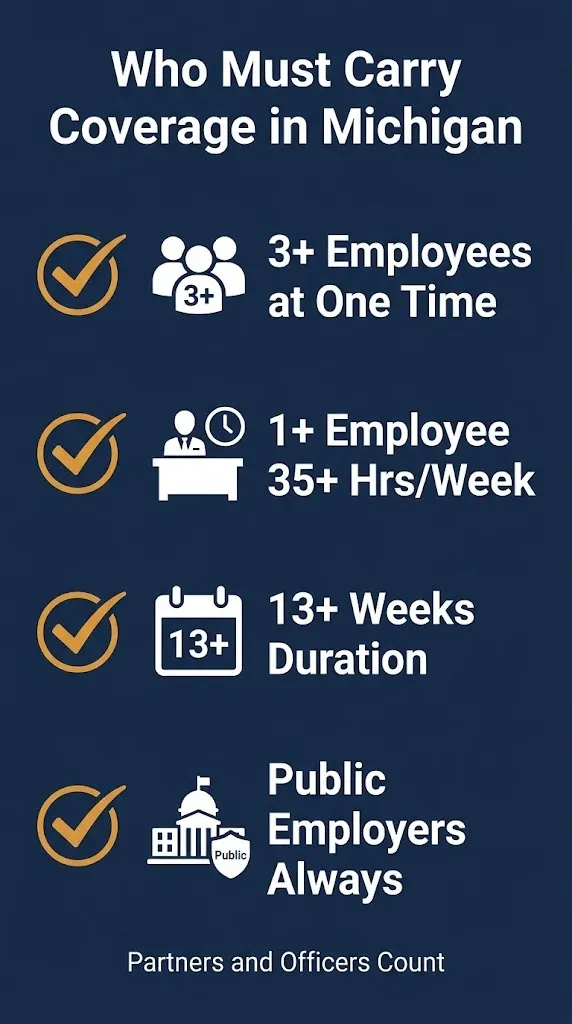
Workers’ compensation insurance is not required for every Michigan employer, but it is required for most. The statute sets two clear triggers, and if your business meets either one, you need coverage.

The first trigger is employee count: three or more employees regularly employed at one time, including part-time workers . The second trigger is duration and hours: one or more employees working 35 or more hours per week for 13 weeks or longer during the preceding 52 weeks .
| Employer Type | Coverage Required? |
|---|---|
| 3+ employees at one time (including part-time) | Yes |
| 1+ employee at 35+ hours/week for 13+ weeks | Yes |
| 2 part-time employees only | Generally no, unless hours/duration trigger applies |
| Sole proprietor with no employees | No (self-employed excluded) |
| Agricultural employer with 3+ regular employees at 35+ hrs/week for 13+ weeks | Yes |
Partners, corporate officers, and LLC managers are treated as employees for coverage purposes . A sole proprietor working alone is never considered an employee of their own business . Employers can comply by purchasing a policy, self-insuring, or filing a proper exclusion form .
How Much Does Workers Comp Pay in Michigan in 2026?
Workers’ comp in Michigan pays roughly 80% of your after-tax average weekly wage, subject to a hard cap of $1,201 per week in 2026. That cap equals 90% of the state average weekly wage, which was $1,333.88 .
The formula matters because the cap hits high earners hard. If your pre-injury earnings were well above the state average, you receive the maximum regardless of your actual wage loss.
| After-Tax Weekly Wage | Approximate Benefit | Capped at $1,201? |
|---|---|---|
| $800 | $640 | No |
| $1,200 | $960 | No |
| $1,500 | $1,200 | No (just under cap) |
| $1,800 | $1,440 | Yes, $1,201 |
| $2,500 | $2,000 | Yes, $1,201 |
There is no minimum weekly benefit in Michigan except for specific loss and death claims . Wage loss benefits begin after you have been off work for seven consecutive days, and if you are off for 14 days or longer, you are entitled to benefits retroactively for the first seven days as well .
Not yet determined applies to any individual claim outcome. The figures above are statutory calculations, not predictions. Your actual benefit depends on your documented wages, your disability status, and whether the carrier disputes the claim.
How Do You File a Workers Compensation Claim in Michigan?
You file a workers’ compensation claim in Michigan by notifying your employer within 90 days and, if the claim is disputed, filing Form WC-117 with the Workers’ Disability Compensation Agency within two years. The 90-day notice is the step that trips up the most workers.
Here are the verified steps:
- Report the injury to your supervisor immediately, even if you think it is minor.
- Seek medical attention and confirm the provider documents the work connection.
- Confirm your employer files Form WC-100 (Employer’s Basic Report of Injury) if disability will last more than one week.
- Track your days off work to confirm you cross the seven-day threshold for wage loss benefits.
- File Form WC-117 (Employee’s Report of Claim) with the WDCA if the insurer denies or delays benefits.
- Respond to any carrier requests for medical records or wage documentation.
- Watch the two-year clock from the injury date for any formal hearing application.
The WDCA’s own guidance is blunt: report any accident at work, however minor, to your employer immediately to prevent possible delay or dispute . A late notice can jeopardize the entire claim even if the two-year filing window is still open.
Key Takeaway: The 90-day notice rule and the two-year filing deadline are two separate clocks, and missing the notice step can sink a claim before the filing deadline even matters.
Reality Check: The Michigan WDCA issued a scam alert in March 2026 warning that people are being contacted by phone, email, and video calls and told they must pay money to receive workers’ comp benefits or settlements. You should never pay a fee to receive benefits. Verify any contact with the WDCA directly before sending money or personal information .
What Happens If a Michigan Employer Has No Workers Compensation Insurance?
An employer with no workers’ comp coverage faces civil fines, injunctions, and criminal charges. The director of the WDCA can file a complaint in circuit court seeking a civil fine of up to $1,000 per day for each day the employer failed to comply within the preceding three years .
The court can also issue an injunction barring the employer from employing anyone until coverage is secured or a surety bond is furnished . Failing to comply with the insurance requirement is a misdemeanor punishable by a fine of up to $1,000, imprisonment for up to six months, or both, with each day counted as a separate offense .
For the injured worker, the consequence is significant: if the employer was uninsured, the employee can sue the employer in civil court for damages, notwithstanding the usual workers’ comp exclusivity bar . That means a negligence lawsuit may be available where it normally would not be.
How Much Does Workers Compensation Insurance Cost in Michigan?
Michigan workers’ comp insurance costs an average of about $0.86 per $100 of payroll, according to 2026 state rate data . Actual premiums vary by industry classification, claims history, and carrier.
Michigan uses its own independent rating bureau, the Compensation Advisory Organization of Michigan (CAOM), rather than NCCI. CAOM files loss costs and classification rules that carriers build their pricing on . The experience modification rate is the biggest lever an employer controls, and a cleaner claims history compounds into lower premiums over time.
Rate changes do happen mid-year. Pie Insurance filed a 6.4% overall workers’ comp rate increase in Michigan effective August 1, 2026, following a 4.7% decrease that took effect in January . Those carrier-specific filings do not change the statutory benefit caps or the coverage thresholds.
What Benefits Are Covered Under Michigan Workers Comp?
Michigan workers’ comp covers four categories of benefits: wage loss, medical care, rehabilitation, and burial expenses in death cases. The statute limits recovery to these specific categories .
Wage loss benefits replace a portion of your lost income after the seven-day waiting period, subject to the $1,201 weekly cap. Medical benefits cover reasonable and necessary treatment for the work injury. Rehabilitation benefits may include vocational services if you cannot return to your prior job. Specific loss benefits apply to amputations, loss of vision, hearing loss, or death, and those claims do not require the seven-day waiting period .
The tradeoff is exclusivity: workers’ comp is generally the exclusive remedy against your employer, meaning you cannot also sue your employer for negligence in most cases. The exception is the uninsured employer scenario described above.
What Happens Next
- Immediately after injury: Report it to your supervisor and seek medical care.
- Within 7 days off work: Wage loss benefits begin after this threshold.
- Within 90 days: Formal notice to your employer must be given.
- Within 2 years: File Form WC-117 with the WDCA if the claim is disputed.
- After filing: The carrier investigates and either pays, disputes, or requests additional information.
Frequently Asked Questions
Is workers comp required for small businesses in Michigan?
It depends on the numbers. Three or more employees at one time triggers coverage, as does one employee working 35+ hours per week for 13+ weeks .
How much is the maximum workers comp benefit in Michigan for 2026?
The maximum weekly benefit is $1,201, based on 90% of the state average weekly wage .
What is the deadline to report a work injury in Michigan?
You must notify your employer within 90 days. The formal filing deadline with the WDCA is two years from the injury .
Can I sue my employer if they have no workers comp insurance?
Yes. An employee of an uninsured employer can bring a civil action for damages, notwithstanding the usual exclusivity rule .
Does Michigan workers comp cover part-time employees?
Yes, if the employer has three or more employees at one time, part-time workers count toward that threshold .
What is the waiting period for wage loss benefits in Michigan?
You must be off work for seven consecutive days before benefits begin. If you are off 14 days or more, you receive benefits for the first seven days as well .
Who sets workers comp rates in Michigan?
The Compensation Advisory Organization of Michigan files loss costs and classification rules. Individual carriers apply their own multipliers on top .