Workers Compensation Insurance Michigan 2026: Requirements, Costs, and How to File a Claim
Quick Answer
- Michigan workers’ comp insurance is mandatory for most employers, with private businesses needing coverage for one or more employees working 35+ hours weekly.
- Average costs run $65 per month for small businesses, or roughly $115 per employee per month based on industry data.
- Injured workers must report injuries immediately and file a formal claim within 2 years of the injury or illness.
Is Workers Compensation Insurance Required in Michigan?
Workers’ compensation insurance is mandatory in Michigan for most employers, and failing to carry it can lead to prosecution and financial penalties. The Workers’ Disability Compensation Act (WDCA) sets specific thresholds for who must comply .
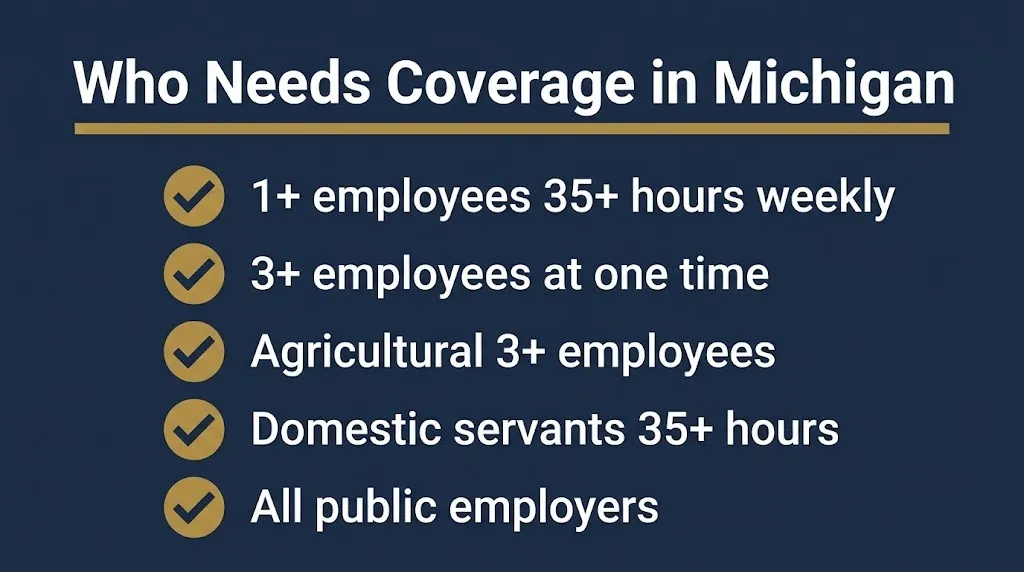
Private employers must carry coverage if they meet any of these criteria:
- Regularly employ 1 or more employees working 35 hours or more per week for 13 weeks or longer during the preceding 52 weeks
- Regularly employ 3 or more employees at one time (including part-time workers)
- Agricultural employers with 3 or more employees working 35+ hours weekly for 13+ consecutive weeks
- Householders employing domestic servants who work 35+ hours per week for 13+ weeks annually
- All public employers
A partner is considered an employee of the partnership. A corporate officer is an employee of the corporation. A member-manager of an LLC is an employee of that LLC .

A sole proprietor working alone is never considered an employee of their own business. If you have no employees, you do not need workers’ compensation insurance .
How Much Does Workers Compensation Insurance Cost in Michigan?
Workers’ compensation insurance in Michigan costs an average of $65 per month for a small business with two employees, according to MoneyGeek’s 2026 data . The Hartford reports an average of $988 per year (about $82 monthly) for its small business customers .
A more detailed industry breakdown shows costs of $115 per month per employee, or $1,378 annually per employee . Actual premiums depend on several factors:
| Cost Factor | Impact on Premium |
|---|---|
| Payroll size | Higher payroll means higher premiums |
| Industry risk | Roofing and construction pay more than office work |
| Claims history | Clean records earn lower rates |
| Number of employees | More workers increase total cost |
| Coverage limits | Higher limits cost more |
Construction trades pay significantly different rates. Based on $150,000 annual payroll, general contractors pay $625 to $938 monthly, HVAC contractors pay $400 to $600 monthly, and roofers pay $1,125 to $1,875 monthly .
The Experience Modification Rate (EMR) is the single biggest lever on your premium. An EMR of 0.85 means you pay 15% less than the base rate. An EMR of 1.20 means you pay 20% more .
Key Takeaway: Michigan workers’ comp costs vary widely by industry, but small businesses can expect to pay roughly $65 to $115 per month per employee, with construction trades paying significantly more.
What Does Michigan Workers Compensation Insurance Cover?
Michigan workers’ compensation covers medical care, wage replacement, and vocational rehabilitation for work-related injuries and illnesses. Benefits begin from the first day of employment .
Medical benefits include all reasonable and necessary care: surgical, hospital, dental services, crutches, hearing apparatus, chiropractic treatment, and nursing care. These services are provided indefinitely as long as there is a need related to the injury .
Wage loss benefits generally equal 80% of your after-tax average weekly wage, calculated using the highest 39 weeks of the last 52 weeks of gross wages before injury . There is a 7-day waiting period for wage loss benefits. If disability lasts beyond one week, benefits start on the eighth day. If disability continues for two weeks or longer, the worker is paid for the first week as well .
Vocational rehabilitation is available if you cannot perform work for which you have previous training or experience. Services include job placement assistance, retraining support, or guidance in starting a business. The employer or insurance carrier pays for these services .
Workers’ compensation does not cover:
- Injuries you caused yourself intentionally
- Injuries from being intoxicated or using drugs at work
- Injuries from illegal activities
- Injuries from horseplay
How Do You File a Workers Compensation Claim in Michigan?
You file a workers’ compensation claim in Michigan by reporting the injury to your employer immediately, then filing a formal claim with the state agency if your employer does not report it for you. The process has strict deadlines.
Here are the steps:
- Report the injury to your supervisor immediately. Most workers are covered from the start of employment .
- Get medical treatment. During the first 28 days, your employer has the right to choose the doctor. After 28 days, you may choose your own doctor if you notify your employer and insurer .
- File Form WC-117 if your employer will not file the claim for you. This is the Employee’s Report of Claim .
- File Form WC-104A if your claim is disputed. This is the Application for Mediation or Hearing .
- Meet the notification deadline. You must notify your employer within 90 days of the injury or risk losing benefits .
- File within the statute of limitations. Formal claims must be filed with the Michigan Workers’ Compensation Agency within 2 years of the injury or illness .
If you have questions, call the Workers’ Disability Compensation Agency toll-free at 1-888-396-5041 or email [email protected] .
Reality Check: No legitimate workers’ compensation program requires you to pay a fee to file a claim or check your status. Filing is free through the state agency. If someone asks for payment to “process” your claim, it is a scam.
What Happens If Your Employer Does Not Have Workers Compensation Insurance?
If your employer does not have workers’ compensation insurance, they face prosecution and financial penalties, and you may still receive benefits through the state’s uninsured employers fund. The WDCA requires all covered employers to provide an approved means of assuring benefits will be paid .
Employers can comply through three methods:
- Purchasing insurance from a private carrier
- Self-insuring if they meet qualification requirements
- Executing an exclusion form where applicable
The State of Michigan does not ordinarily pay workers’ compensation benefits. Most employers purchase a policy from a private insurance company or operate as authorized self-insurers .
Failure to comply with coverage requirements could result in prosecution and financial penalties. The WDCA provides flexibility to ensure coverage is available only where it is needed .
When Can You Settle a Workers Compensation Claim in Michigan?
You can settle a Michigan workers’ compensation claim through a redemption agreement after 6 months have elapsed from the date of injury, subject to approval by a workers’ compensation magistrate. A redemption is a complete and final settlement of your claim by payment of a single lump sum .
You are not required to accept a redemption settlement. It becomes final 15 days after approval . The carrier must notify the employer of the proposed redemption agreement at least 10 business days before a hearing .
A lump sum advance is different from a redemption. A lump sum advance is prepayment of all or part of the present value of your employer’s established and undisputed liability. Your employer or carrier may be ordered to pay this advance based on your application, even if they object .
If you receive a settlement, notify your employer or their insurance carrier of any wages earned during the benefit period. Michigan law does not permit payment of weekly benefits to persons employed and receiving wages equal to or greater than wages earned on the date of injury, except for specific loss or permanent and total disability .
What Happens Next in Michigan Workers Compensation in 2026
Here is the expected timeline for Michigan workers’ compensation matters in 2026:
Ongoing: MIOSHA enforcement continues under the Department of Labor and Economic Opportunity (LEO), with penalties aligned to federal standards .
2026: Employers continue to see workers’ comp rate fluctuations based on claims history and industry classification.
March 2, 2026: Electronic submission deadline for MIOSHA Form 301 data for establishments with 20-249 employees in high-hazard industries or 250+ employees in any industry .
Ongoing: Michigan Workers’ Disability Compensation Agency continues enforcement of insurance coverage requirements to maintain a “level playing field” among employers .
Frequently Asked Questions
How much does workers compensation insurance cost in Michigan?
Average costs are about $65 per month for a small two-employee business, or $115 per month per employee for a more detailed industry average. Construction trades pay significantly more.
Is workers compensation insurance required for all Michigan employers?
No, not all. Private employers must carry coverage if they have 1+ employees working 35+ hours weekly for 13+ weeks, or 3+ employees at one time. Sole proprietors with no employees are exempt.
What is the deadline to file a workers compensation claim in Michigan?
You must notify your employer within 90 days of the injury and file a formal claim within 2 years. Missing the 90-day notification can jeopardize your entire claim.
How long do you have to work for an employer to get workers compensation in Michigan?
Most workers are covered under workers’ compensation from the start of employment, with no minimum waiting period .
Can you sue your employer for a work injury in Michigan?
Generally no. Workers’ compensation is the “exclusive remedy” for work injuries. However, if a third party’s negligence contributed to your injury, you may file a separate personal injury lawsuit.
What happens if your employer does not have workers compensation insurance?
The employer faces prosecution and financial penalties. The WDCA requires all covered employers to provide an approved means of assuring benefits will be paid.
How long do workers compensation benefits last in Michigan?
Weekly benefits continue as long as you are disabled, which could be for the rest of your life. Benefits can be reduced by up to 50% after age 65 at 5% per year up to age 75, or upon receipt of Social Security retirement benefits .
Check Your Employer’s Coverage and Know Your Deadlines
If you are injured on the job, report it immediately and document everything. The 90-day notification deadline is the single most important date in your claim. Missing it can cost you benefits even if the two-year filing window is still open.
Call the Workers’ Disability Compensation Agency at 1-888-396-5041 if you have questions about your rights. If your claim is denied, you can appeal through mediation or a formal hearing.