Massachusetts Workers Compensation Insurance Rates 2026: The 14.6% Cut, the SJC Ruling, and What Employers Actually Pay
Quick Answer
- The current general rate level reflects a 14.6% average decrease effective July 1, 2024.
- The SJC affirmed the rejection of a 7.1% rate increase for 2025 but remanded the 14.6% cut for explanation.
- Assessment rates for insured private employers rose to 0.05688 effective July 1, 2026.
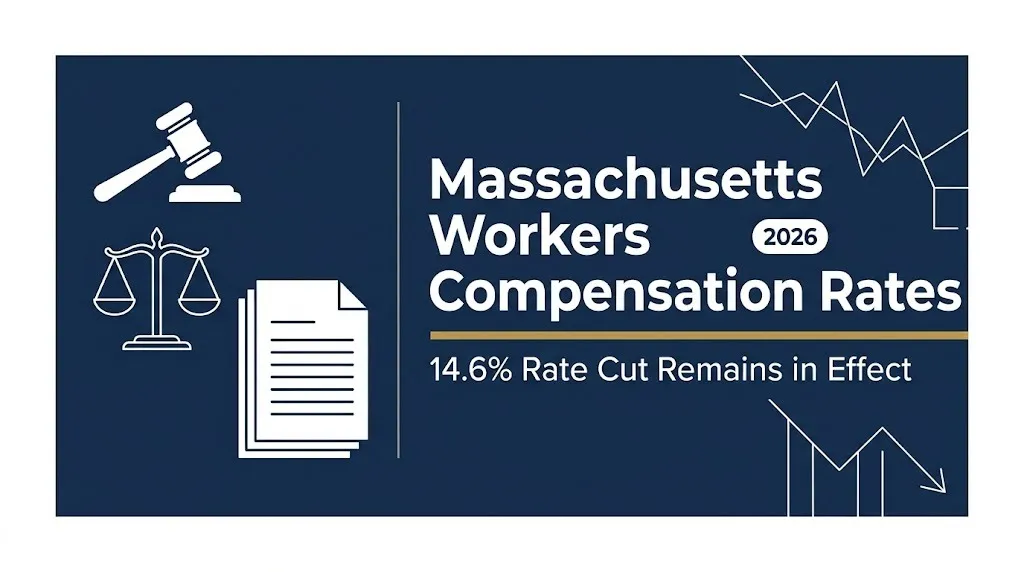
Massachusetts workers compensation insurance rates in 2026 sit in an unusual position. The general rate level is still 14.6% lower than it was before July 2024. That cut saved employers an estimated $87 million.
But the legal foundation for that cut is shaky. In July 2026, the Supreme Judicial Court told the Commissioner of Insurance he needed to “show his work” on how he arrived at 14.6%, a number he picked without explanation. The rates themselves were not vacated. They remain in effect while the case goes back for further proceedings.
For employers, this means premiums are lower than they would have been without the cut. It also means a future correction is possible if the Commissioner cannot justify the math.
The Facts
| Item | Detail |
|---|---|
| Current Rate Level | 14.6% below pre-July 2024 rates |
| 2024 Savings | Approximately $87 million for employers |
| 2025 Filing Rejected | WCRIBMA requested 7.1% increase, denied |
| SJC Ruling Date | July 6, 2026 |
| DIA Assessment Rate | 0.05688 for insured private employers (eff. 7/1/2026) |
| Rating Bureau | Workers’ Compensation Rating and Inspection Bureau of Massachusetts |
| Market Type | Competitive private market with assigned risk pool |
Is the Massachusetts workers compensation rate cut legitimate or a scam?
The 14.6% rate cut is legitimate and remains in effect, ordered by the Commissioner of Insurance in 2024 and upheld as an action he had authority to take. The issue is not whether the cut was real. It is whether the Commissioner adequately explained how he chose that specific percentage.
The Supreme Judicial Court affirmed the Commissioner’s rejection of the WCRIBMA’s proposed 7.1% increase for July 2025. The court agreed with his findings that the bureau’s rate methodology was flawed, particularly its use of only two years of loss data when five years better accounted for COVID-era distortions.
Where the court drew the line was on the 14.6% figure itself. Rejecting a rate filing and setting a specific replacement rate are two different jobs. The second requires an explanation. The court found none was provided.
What this means for you:
- The current rates stand. You are not overpaying relative to what was ordered.
- The case was remanded, not reversed. The Commissioner must now justify the 14.6% or adjust it.
- A retroactive correction is possible but unlikely. A mid-term adjustment in late 2026 or 2027 is the more probable outcome if the math does not hold up.
This is not a consumer scam situation. It is an administrative law dispute between the rating bureau, the Attorney General, and the Division of Insurance over how rates get calculated.
Key Takeaway: The 14.6% cut is real and still in effect. The SJC just wants the Commissioner to prove his math.
How much do Massachusetts workers compensation insurance rates cost in 2026?
Massachusetts workers compensation rates vary dramatically by industry classification, from under $0.50 per $100 of payroll for office workers to over $9 per $100 for roofing and high-risk construction. The statewide average sits around $1.02 to $1.17 per $100 of payroll depending on the source and mix of classifications.
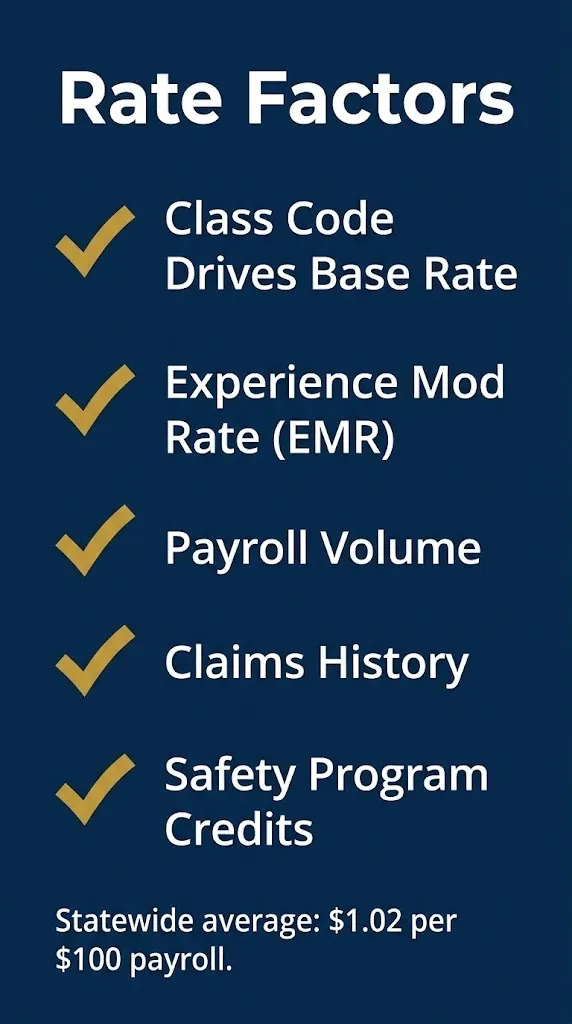
What you actually pay depends on three factors: your class code, your payroll, and your experience modification rate.
| Industry | Approximate Rate per $100 Payroll |
|---|---|
| Office / Clerical | $0.35 |
| Technology / IT | $0.29 |
| Retail Store | $0.82 |
| Restaurant | $1.40 |
| Healthcare | $1.75 |
| Manufacturing | $2.46 |
| Electrical | $2.57 |
| Plumbing | $2.81 |
| Construction | $4.09 |
| Trucking / Transport | $4.91 |
| Landscaping | $4.45 |
| Roofing | $9.95+ |
Those figures come from rate calculators calibrated to 2026 market conditions and NCCI class code data. Real quotes will vary based on carrier appetite, your claims history, and how you are classified.
The experience modification rate (EMR) is the biggest lever you control. An EMR below 1.0 means you pay less than the class rate. Above 1.0 means you pay more. A clean claims history compounds into lower premiums year over year.
Key Takeaway: Your rate is set by class code, but your EMR is where the real savings live.
What is the 14.6% rate cut and how did it happen?
The 14.6% rate cut was ordered by the Commissioner of Insurance in 2024 after he rejected the rating bureau’s proposed 7.6% decrease as insufficient. The bureau wanted a smaller reduction. The Commissioner ordered a bigger one. The insurance carriers sued.
The backstory matters because it explains why rates are where they are in 2026.
In late 2023, the WCRIBMA proposed cutting rates by 7.6% effective July 1, 2024. The Commissioner reviewed the filing and disagreed with the bureau’s methodology. The bureau had used two years of loss data to calculate indemnity paid losses, a method it had used for over twenty years. The Commissioner wanted five years to smooth out COVID-era anomalies.
He rejected the filing and ordered a 14.6% decrease instead. The bureau appealed. The Supreme Judicial Court heard the case and issued its ruling in July 2026.
The court agreed with the Commissioner on the data question. Five years was more reasonable than two given the pandemic’s effect on claims. But on the 14.6% figure, the court found no explanation.
“As our high school mathematics teachers reminded us: you need to show your work,” the court wrote.
The case is now back with the Commissioner, who must either justify the number or adjust it.
Key Takeaway: The 14.6% cut came from the Commissioner rejecting the bureau’s smaller proposal and ordering a bigger one, but he never explained how he picked that number.
What did the SJC rule in the workers compensation rate case?
The Supreme Judicial Court ruled on July 6, 2026, that the Commissioner of Insurance has the authority to reject rate filings and order specific decreases, but he must explain his reasoning for any specific rate he orders. The court affirmed the rejection of the 7.1% increase but remanded the 14.6% decrease for further explanation.
The decision was a partial win for both sides.
What the court affirmed:
- The Commissioner correctly rejected the WCRIBMA’s proposed 7.1% increase for July 2025.
- His use of five years of loss data instead of two was supported by the record.
- His concern about the bureau’s underwriting profit methodology was valid.
What the court remanded:
- The 14.6% figure for the 2024 decision lacked any explanation.
- The Commissioner’s directive on class code 9033 (public housing authority employees) also needed justification.
- The Commissioner must now provide a “reasoned explanation” or adjust the rates.
The practical effect is that rates stay where they are for now. But the uncertainty means carriers and employers should watch for a potential correction in late 2026 or 2027.
Key Takeaway: The court said the Commissioner has the power but not the blank check. He must show his math on the 14.6%.
Reality Check
No one is texting you about Massachusetts workers comp rates. This is a regulatory and actuarial process between the Division of Insurance, the rating bureau, and the courts. If you get a call or email claiming you are owed a refund from the rate case or need to pay a fee to lock in lower rates, that is not how this works. Rate changes apply to policies at renewal, through your carrier, automatically. You do not need to file anything or pay anyone to get the benefit of a rate reduction.
How are Massachusetts workers compensation insurance rates set?
Massachusetts workers compensation rates are set through a filing process with the Division of Insurance, where the WCRIBMA proposes loss costs and the Commissioner approves, rejects, or modifies them. Massachusetts is one of a few states that does not use NCCI for rate setting. It has its own independent rating bureau.
The process works like this:
- The WCRIBMA files proposed rates with the Division of Insurance, usually on a two-year cycle but sometimes annually.
- The State Rating Bureau and the Attorney General’s Office review the filing and submit advisory recommendations.
- The Commissioner of Insurance holds hearings, reviews evidence, and issues a decision.
- The Commissioner can approve, reject, or order a different rate than what was proposed.
- Carriers then apply the approved loss costs plus their own expenses and profit margin to set actual premiums.
The Commissioner’s authority comes from Massachusetts General Laws Chapter 152, Section 53A. He can order a specific decrease if he finds existing rates are excessive.
What happened in 2024 and 2025 is that the Commissioner used that authority aggressively, rejecting the bureau’s proposals and substituting his own numbers. The SJC said he can do that, but he has to explain how he picked the number.
Key Takeaway: Rates go through a formal filing and hearing process, and the Commissioner has broad authority, but that authority comes with an obligation to explain.
What are the DIA assessment rates for 2026?
The Department of Industrial Accidents assessment rate for insured private employers is 0.05688 effective July 1, 2026, up from 0.0482 in the prior year. This is a separate charge added to workers compensation premiums, not a change to the base rates themselves.
Assessment rates fund the DIA’s operations, including the Workers’ Compensation Trust Fund for uninsured claims. They apply to all policies effective on or after July 1 each year.
| Employer Type | Insured Assessment Rate | Self-Insured Rate | Group S.I. Rate |
|---|---|---|---|
| Private | 0.05688 | 0.06885 | 0.06387 |
| Private Opt-Out | N/A | 0.01114 | 0.01033 |
| Public Self-Insured | N/A | 0.00000 | 0.00000 |
The rate is applied to your standard premium. If your annual premium is $50,000, the assessment adds roughly $2,844. That is separate from the base rate change and applies regardless of the SJC ruling.
Key Takeaway: The DIA assessment went up for 2026 even as the base rate debate continues. Budget for it at your next renewal.
How does the assigned risk pool work for Massachusetts employers?
The Massachusetts Workers Compensation Assigned Risk Pool provides coverage for employers who cannot obtain voluntary market insurance, often because of high-risk operations or poor claims history. The residual market share was estimated at 11.5% as of April 2026, meaning just over one in ten workers compensation policies in the state is written through the pool.
The pool works as a placement of last resort. If two carriers reject your application, you can apply to the WCRIBMA for assigned risk coverage.
Key features of the assigned risk pool:
- Rates are set by the rating bureau, not negotiated with a carrier.
- No carrier shopping is available. You get assigned to a servicing carrier.
- Coverage is guaranteed for eligible employers who cannot find voluntary market coverage.
- Premium is typically higher than voluntary market rates because of the risk profile.
The residual market share has been declining, from 13.6% in 2022 to 11.5% in 2026. That means more employers are finding voluntary coverage as the market softens.
For high-risk trades like roofing, the assigned risk pool can be expensive. One 2026 analysis showed roofing class 5545 priced at $41.21 per $100 of payroll in the residual market versus $21.64 per $100 through a voluntary market carrier with the right class structure.
Key Takeaway: The assigned risk pool is a safety net, not a bargain. If you are stuck there, exploring voluntary market options can cut your rate in half.
What happens next with Massachusetts workers compensation rates?
The Commissioner of Insurance must now provide a reasoned explanation for the 14.6% rate decrease or adjust it, following the SJC’s remand. The current rates remain in effect during this process, but a correction in late 2026 or early 2027 is possible.
Expected timeline:
- July 2026: SJC issued its ruling remanding the 14.6% decision.
- Late 2026: Commissioner expected to issue a supplemental decision or order explaining the 14.6% figure.
- Early 2027: Potential rate adjustment if the explanation does not hold or if the Commissioner modifies the cut.
- July 1, 2027: Next scheduled rate filing effective date, though the timing depends on how the remand resolves.
Employers should not assume their rates will stay at current levels indefinitely. The uncertainty cuts both ways. If the Commissioner justifies the 14.6%, rates stay. If he cannot, a correction could mean higher premiums.
The best move is to use the current rate environment to improve your experience modification rate. A lower EMR follows you regardless of what happens with the general rate level.
Key Takeaway: Rates are stable for now, but a correction is possible. Your EMR is the one factor you can control regardless of what the Commissioner decides.
Frequently Asked Questions
What is the current workers compensation rate in Massachusetts?
The general rate level reflects a 14.6% decrease ordered in 2024. Actual rates vary by class code, ranging from under $0.50 to over $9 per $100 of payroll.
Did Massachusetts workers compensation rates go down in 2026?
No new general rate change was approved for 2026. The 14.6% cut from 2024 remains in effect while the SJC remand plays out.
What did the SJC rule on workers compensation rates?
The court affirmed the rejection of a 7.1% increase for 2025 but remanded the 14.6% cut, saying the Commissioner must explain how he calculated that specific number.
Who sets workers compensation rates in Massachusetts?
The WCRIBMA files proposed rates, and the Commissioner of Insurance approves, rejects, or modifies them. Massachusetts does not use NCCI for rate setting.
What is the experience modification rate?
Your EMR is a multiplier based on your claims history compared to others in your class. Below 1.0 means you pay less. Above 1.0 means you pay more.
Can I get workers compensation insurance if I am rejected by carriers?
Yes. The assigned risk pool provides coverage for employers who cannot obtain voluntary market insurance after two rejections.
What are the DIA assessment rates for 2026?
The insured private assessment rate is 0.05688 effective July 1, 2026. This is added to your premium separately from the base rate.
Will Massachusetts workers compensation rates go up in 2027?
Not yet determined. It depends on whether the Commissioner can justify the 14.6% cut on remand or whether a correction is ordered.
Your Next Step
Check your current workers compensation policy to see what class code you are assigned and what rate you are paying per $100 of payroll. Compare that to the ranges in this article.
If your EMR is above 1.0, a safety program and claims review can lower it over the next three years. That savings follows you regardless of what the Commissioner decides about the 14.6%.
The single most important date to remember: July 1, 2027, the next scheduled rate effective date. Mark it on your calendar and review your renewal terms before then.