Florida Workers Compensation Insurance Companies 2026: Rates, Carriers, and How to Get a Quote
Quick Answer
- Florida’s workers comp market is highly competitive with dozens of carriers and a Herfindahl-Hirschman Index of 260.
- The 6.9% rate decrease effective January 1, 2026 continues a nine-year trend of reductions.
- Construction employers need coverage with 1+ employees; non-construction with 4+ employees.
Florida workers compensation insurance companies in 2026 operate in one of the most competitive markets in the country. No single insurer holds more than 11% market share. Rates dropped again this year, the ninth straight year of decreases. And the state’s residual market, the Florida Workers’ Compensation Joint Underwriting Association, exists only for employers who genuinely cannot find coverage elsewhere.
That is the good news. The complicated news is that not every carrier writes every industry. Roofers are struggling to find voluntary market coverage as rates keep falling. Construction companies face the strictest requirements. And the quote you get depends heavily on your class code, your payroll, and your experience modification rate.
This article breaks down who the major carriers are, what rates actually look like in 2026, how the state’s rate-setting process works, and what you need to prepare before you request a quote.
The Facts
| Item | Detail |
|---|---|
| 2026 Rate Change | 6.9% decrease effective January 1, 2026 |
| Ninth Consecutive Year | Rate decreases every year since 2017 |
| Market Concentration | Herfindahl-Hirschman Index of 260 (highly competitive) |
| Top Carrier Market Share | American Financial Group at approximately 11% |
| Residual Market | Florida Workers’ Compensation Joint Underwriting Association |
| Construction Requirement | 1 or more employees |
| Non-Construction Requirement | 4 or more employees |
| Max Weekly Benefit (2026) | $1,358 |
Which Florida workers compensation insurance companies are legitimate?
Florida workers compensation insurance companies are legitimate when they are licensed by the Florida Office of Insurance Regulation and appear in the state’s official carrier database. The market includes national carriers, regional specialists, and captive insurers, all competing for business in a state that ranks among the lowest-cost workers comp markets in the country.
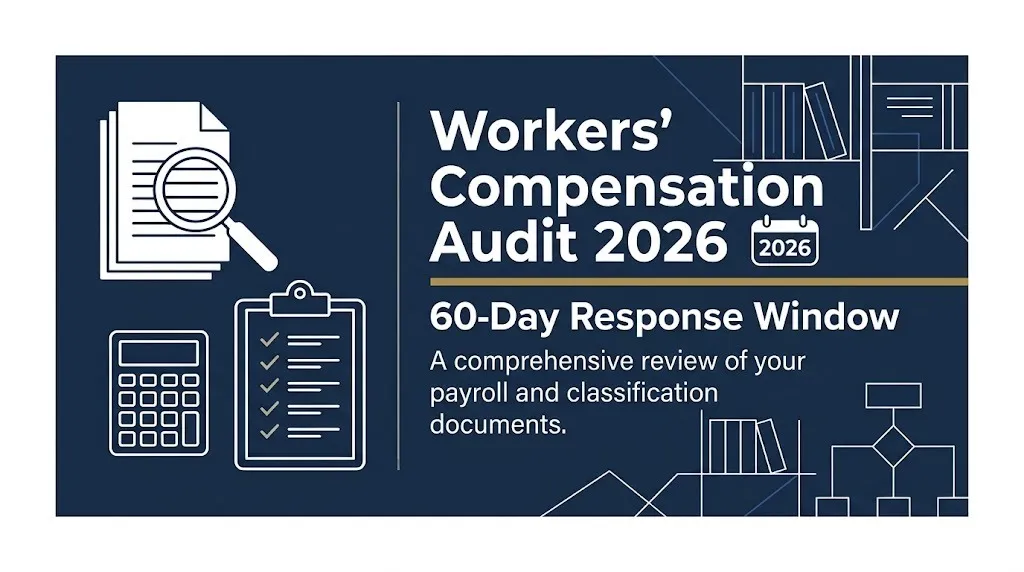
The Florida Office of Insurance Regulation maintains a public list of every authorized workers compensation carrier in the state. Before you sign anything, verify the company’s license status through that office.
Major carriers writing workers compensation in Florida include:
- American Financial Group (Great American Insurance)
- AmTrust NGH Group
- Zurich Insurance Group
- Travelers Group
- Fairfax Financial Group
- FCCI Mutual Insurance Group
- The Hartford
- Berkshire Hathaway Group
- Employers Holdings
Market share data from Florida’s Office of Insurance Regulation shows American Financial Group leading at roughly 11.1% of direct premium written, followed by AmTrust at 10.6% and Zurich at 6%. The spread among carriers demonstrates that no single company dominates the market.
Warning signs of an unlicensed carrier:
- Cannot provide a Florida certificate of authority number.
- Pressure to pay upfront before providing a policy document.
- No listing in the Florida Office of Insurance Regulation database.
- Quotes that are dramatically lower than every other carrier.
If a quote seems too good to be true, it probably is. Workers compensation premiums are based on filed rates. Carriers can discount through experience modification and schedule credits, but they cannot simply ignore the filed loss costs.
Key Takeaway: Verify every carrier through the Florida Office of Insurance Regulation before signing. The market is competitive, but unlicensed sellers exist.
How much does workers compensation insurance in Florida cost in 2026?
Workers compensation insurance in Florida costs about $1.75 per $100 of payroll on average, though rates vary dramatically by industry classification. Office workers may qualify for rates under $0.25 per $100, while roofing contractors can pay $8.00 to $15.00 per $100 or more.
The 6.9% rate decrease effective January 1, 2026 lowered premiums for most employers. But the actual impact on your bill depends on your class code and experience modification rate.
| Industry | Approx. Rate per $100 Payroll |
|---|---|
| Office / Clerical | $0.16 to $0.25 |
| Retail Store | $0.80 to $1.50 |
| Restaurant | $1.50 to $2.50 |
| House Cleaning | $2.50 to $4.00 |
| Electrical Contractor | $3.00 to $5.50 |
| Landscaping (Lawn Care) | $3.50 to $5.00 |
| General Contractor | $4.00 to $7.00 |
| Trucking | $6.00 to $10.00 |
| Roofing Contractor | $8.00 to $15.00+ |
The Hartford reports that average annual workers compensation cost in Florida runs about $989 per year, or roughly $82 per month for small businesses. But that average spans every industry, from software companies to steel erection.
Florida’s pure loss costs rank below the NCCI average for six of the ten largest class codes by exposure, including clerical workers and salespersons. For the ten largest class codes by policy count, Florida’s loss costs exceed the NCCI average in six categories, including restaurants, building management, and store drivers.
The formula every carrier uses is: Class Code Rate × Experience Mod × (Payroll ÷ 100) = Premium.
Key Takeaway: Your industry determines your base rate, but your experience modification rate is the biggest lever you control.
Reality Check
A workers compensation quote is not a binding price until the policy is issued. Carriers quote based on the payroll and class codes you provide. If those numbers are wrong, the audit will catch it and adjust your premium. Understating payroll or misclassifying employees to get a lower quote is fraud, and Florida issues stop-work orders and fines equal to twice the premium you avoided. Get the quote right the first time.
How does the Florida rate approval process work for workers compensation?
Florida’s workers compensation rates are proposed by the National Council on Compensation Insurance (NCCI) and approved by the Florida Insurance Commissioner through a public hearing process. Carriers then file their own rates based on the approved loss costs.
The process follows a predictable annual cycle.
How rates get set in Florida:
- NCCI files proposed rates with the Florida Office of Insurance Regulation, usually in the fall.
- A public rate hearing is held where NCCI presents its case and the public can comment.
- The Insurance Commissioner issues a Final Order approving, modifying, or rejecting the proposal.
- Carriers file their rates based on the approved loss costs, adding their own expenses and profit margins.
- New rates take effect January 1 for new and renewal policies.
The 6.9% decrease for 2026 was proposed by NCCI and approved by Commissioner Mike Yaworsky in November 2025. Only one public commenter spoke at the hearing, a representative from the roofing industry who warned that continued rate cuts are driving carriers out of high-risk classifications.
Florida law requires that rating organization committee meetings discussing Florida rates be held in the state and be open to the public, with advance notice published in the Florida Administrative Register.
Key Takeaway: Rates flow from NCCI’s loss cost filing through the Commissioner’s approval to individual carrier filings. You cannot negotiate around the approved loss costs.
Who needs workers compensation insurance in Florida?
Construction employers need workers compensation coverage with one or more employees, while non-construction employers need it with four or more. Agricultural employers need coverage at six regular or twelve seasonal workers.
Florida draws a hard line between construction and everything else.
Coverage requirements by industry:
| Industry | Threshold |
|---|---|
| Construction | 1 or more employees |
| Non-Construction | 4 or more employees |
| Agricultural | 6 regular or 12 seasonal |
In construction, Florida does not recognize independent contractors. Every person on a job site is either a business owner or an employee. Subcontractors’ uninsured workers become your employees for workers compensation purposes.
That means if you hire an uninsured framing crew, their payroll can be added to your premium base at audit. This is the single most common way construction employers get surprised by a large audit bill.
Corporate officers and LLC members count as employees unless they file for an exemption. Construction industry owners with at least 10% ownership can file for exemption with a $50 fee. Non-construction sole proprietors and partners are not automatically counted as employees.
Key Takeaway: Construction has the strictest rules and the highest audit risk. Verify every subcontractor’s coverage before they set foot on your job site.
What does Florida workers compensation insurance cover?
Florida workers compensation insurance covers medical care, wage replacement, permanent disability benefits, and death benefits for work-related injuries and illnesses. It also protects employers from lawsuits arising from workplace injuries.
The coverage falls into these categories.
Medical benefits: Doctor visits, hospital stays, surgery, prescriptions, physical therapy, and rehabilitation. Florida uses a Managed Care Arrangement system requiring treatment through approved providers.
Wage replacement benefits:
- Temporary Total Disability (TTD): 66 2/3% of average weekly wage for workers who cannot work at all. Maximum weekly benefit for 2026 injuries is $1,358.
- Temporary Partial Disability (TPD): Partial wage replacement for workers who return to limited duty at lower pay.
- Permanent Impairment Benefits (PIB): Ongoing payments based on a doctor’s impairment rating after maximum medical improvement.
- Permanent Total Disability (PTD): Ongoing benefits for workers who cannot return to any job.
Death benefits: Up to $150,000 to qualifying dependents, plus up to $7,500 for funeral expenses.
Employees must report a work injury to their employer within 30 days and file a claim within two years to preserve benefits.
Key Takeaway: Workers compensation is a no-fault system. Employees get benefits regardless of who caused the injury, and employers get protection from most lawsuits.
How do you get a workers compensation insurance quote in Florida?
You can get a workers compensation quote in Florida by contacting carriers directly, working with an independent agent, or using a digital quote platform. The process takes minutes if you have your payroll and class code information ready.
Numbered steps to get your quote:
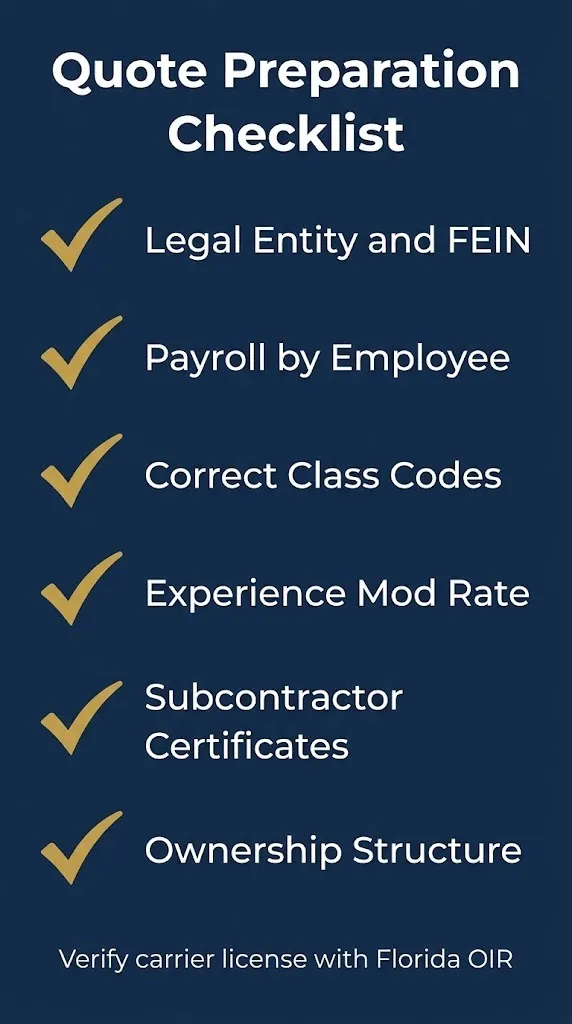
- Gather your business information including legal entity name, FEIN, years in operation, and ownership structure.
- Compile payroll data by employee, including total wages, overtime, and bonuses.
- Identify your class codes based on actual job duties, not just job titles.
- Calculate your experience modification rate if you have three years of claims history.
- Contact multiple carriers or an independent agent who can shop the market for you.
- Compare quotes on both price and coverage terms, including deductible options and payment plans.
- Verify the carrier’s license through the Florida Office of Insurance Regulation.
- Bind coverage and receive your policy documents before any employee starts work.
Independent agents who represent multiple carriers can often find better pricing than going directly to a single company. Some carriers offer discounts for safety programs, pay-as-you-go billing, or membership in trade associations.
Key Takeaway: Shop multiple carriers through an independent agent. No single company has the best rate for every industry.
What is the Florida Workers’ Compensation Joint Underwriting Association?
The Florida Workers’ Compensation Joint Underwriting Association (FWCJUA) is the state’s residual market for employers who cannot obtain coverage in the voluntary market. It is a market of last resort, not a first option.
The size of the FWCJUA is a key indicator of whether the voluntary market is serving employers adequately. When the residual market grows, it signals that carriers are pulling back from certain industries or risk profiles.
Only employers who have been rejected by the voluntary market can apply for FWCJUA coverage. The process requires documentation of at least two declinations from licensed carriers.
For roofing contractors and other high-risk trades, the FWCJUA has become increasingly important as rate cuts have pushed carriers out of those classifications. One industry representative predicted that minimum premiums in the voluntary market could reach $25,000 for roofers, leaving PEOs and the assigned risk pool as the only viable options for small businesses.
Key Takeaway: The FWCJUA is a safety net, not a bargain. If you qualify for voluntary market coverage, you will usually pay less and get better service.
What happens next in the Florida workers compensation market?
Florida’s workers compensation market is expected to remain competitive through 2027, with continued rate stability if claim frequency and severity trends hold. The ninth consecutive year of decreases reflects a long-term trend that began with the 2003 reforms.
Expected timeline:
- January 1, 2026: 6.9% rate decrease took effect for new and renewal policies.
- Fall 2026: NCCI expected to file proposed rates for 2027.
- October 2026: Public rate hearing expected.
- November 2026: Commissioner’s Final Order expected on 2027 rates.
- January 1, 2027: New rates take effect if approved.
The wildcard is the high-risk construction market. If carriers continue exiting those classifications, more employers will be pushed into the FWCJUA. That could eventually create pressure for rate adjustments in those specific classes, even if the overall market continues to soften.
For most employers, the practical advice is simple. Lock in your coverage early, keep your payroll records accurate, and focus on the one number you control: your experience modification rate.
Key Takeaway: Rates are stable and competitive for most industries, but high-risk construction faces availability challenges even as overall rates fall.
Frequently Asked Questions
How many workers compensation insurance companies are in Florida?
Florida has dozens of licensed workers compensation carriers. No single company holds more than about 11% market share, indicating a highly competitive market.
What is the cheapest workers compensation insurance in Florida?
The cheapest carrier depends on your industry and claims history. Office and clerical businesses may find rates under $0.25 per $100 of payroll. You should compare multiple carriers rather than assuming one is always cheapest.
Do I need workers compensation insurance in Florida if I have no employees?
No. If you truly have no employees and no one working for you, you generally do not need coverage. But corporate officers and LLC members count as employees unless exempted.
How much does workers compensation cost for a small business in Florida?
Small business premiums average around $989 per year, or about $82 per month. Your actual cost depends on payroll, industry classification, and experience modification rate.
Can I get workers compensation insurance with a prior claim?
Yes. The voluntary market may decline you, but the Florida Workers’ Compensation Joint Underwriting Association provides coverage as a market of last resort.
What happens if I do not have workers compensation insurance in Florida?
Florida issues stop-work orders and fines equal to twice the premium you would have paid. Ignoring a stop-work order can lead to criminal charges.
How is workers compensation premium calculated in Florida?
Premium equals class code rate times experience modification rate times payroll divided by 100. Your carrier applies the filed rate to your actual payroll.
Does Florida recognize independent contractors for workers compensation?
Florida does not recognize independent contractors in the construction industry. Every worker on a construction site is either a business owner or an employee. Uninsured subcontractors’ payroll can be added to your premium at audit.
Your Next Step
Gather your payroll records and class code information before you request a quote. Contact an independent agent who represents multiple carriers and can compare options for your industry.
The single most important date to remember is January 1, 2026, when the 6.9% rate decrease took effect. If your policy renewed before that date, check your renewal terms to confirm you received the reduction.