Workers Compensation Insurance PA 2026: Rates, Requirements, Claims, and Recent Law Changes
Quick Answer:
- Workers compensation insurance is mandatory in Pennsylvania for almost all employers with at least one employee.
- In 2026, average rates decreased slightly, but misclassification penalties and compliance enforcement have intensified significantly.
- The most important deadlines for injured workers are 120 days to report an injury and 3 years to file a claim petition.
You searched this because you are an employer trying to understand your insurance obligations, or you are a worker who got hurt and needs to know what the system owes you. This is not a topic where you can afford to skim a blog post and hope for the best. Pennsylvania workers compensation is a statutory system. Every deadline, every form, every dollar amount is written into law, and missing a single deadline can cost you thousands or wipe out your claim entirely.
This affects every employer with employees in Pennsylvania, from a Philadelphia restaurant with two servers to a Pittsburgh construction firm with two hundred. It affects every worker who clocks in, from an office assistant who slips on a wet floor to a warehouse loader who throws out a back. The system covers you regardless of fault, but only if you follow the rules.
This article covers Pennsylvania workers compensation in 2026, including insurance requirements, current rates, what benefits injured workers can expect, how to file a claim without getting it denied, recent court decisions that changed the playing field, and the state’s escalated war on independent contractor misclassification. One fact most employers miss: Pennsylvania law presumes a worker is an employee unless you can prove otherwise under a strict two-part test, and getting it wrong now carries fines that start at $2,500 per misclassified worker.
The Facts
| Detail | Information |
|---|---|
| Governing Law | Pennsylvania Workers’ Compensation Act, Act 44 of 1993, as amended |
| Regulatory Body | Pennsylvania Department of Labor & Industry, Bureau of Workers’ Compensation |
| Required For | All employers with at least 1 employee (exceptions: agricultural laborers with under 1 employee, some domestic workers, federal employees) |
| 2026 Average Rate | Approx. $1.10 per $100 of payroll (varies by class code, experience mod) |
| Rate Change 2026 | Slight decrease from 2025 levels, approximately 2 to 4 percent reduction for most class codes |
| Penalty for No Insurance | Up to $3,000 per day of noncompliance, plus criminal prosecution possible |
| Injury Report Deadline | Employee must notify employer within 120 days. Employer must report to insurer within 48 hours for lost-time injuries |
| Claim Filing Deadline | 3 years from injury date (exceptions for occupational disease) |
| Maximum Weekly Benefit (2026) | $1,325.00 per week (tied to statewide average weekly wage) |
| State Fund | No state fund. PA uses private insurance market plus State Workers’ Insurance Fund (SWIF) as carrier of last resort |
Is Workers Compensation Required in Pennsylvania?
Yes, workers compensation insurance is required for almost every employer in Pennsylvania with at least one employee, even if that employee works part-time, is a minor, or is a family member. The Pennsylvania Workers’ Compensation Act mandates coverage for all employers unless specifically exempted. There is no minimum employee count before coverage kicks in. One employee means you need insurance.
The exemptions are narrow. Agricultural laborers who work on a farm with fewer than one full-time equivalent employee may be exempt. Some domestic service workers in private homes are exempt if they work less than 40 hours per week. Federal employees are covered under a different system. Sole proprietors, partners, and certain corporate officers can exclude themselves, but they must file a formal exemption notice. Simply calling yourself self-employed does not remove the requirement to cover your workers.
The penalty for noncompliance is severe. The Bureau of Workers’ Compensation can fine an uninsured employer up to $3,000 per day. Criminal prosecution is possible for willful failure to insure. On top of state penalties, an injured worker can sue an uninsured employer directly in civil court, and the employer loses the standard tort defenses. You cannot argue the worker was negligent or assumed the risk. The worker only needs to prove they were hurt while working. This is the insurance equivalent of playing poker with your cards face up and the other player holding a royal flush.
Key Takeaway: One employee, one hour, one day. If they get hurt and you have no workers compensation insurance, you face daily fines, criminal exposure, and a lawsuit you cannot defend against.
How Much Does Workers Compensation Insurance Cost in PA in 2026?
Pennsylvania workers compensation insurance costs an average of roughly $1.10 per $100 of payroll in 2026, with actual premiums varying dramatically based on your industry classification code, your experience modification rating, and your total payroll dollars. A clerical worker at $40,000 per year might cost $150 annually to cover. A roofer at the same salary might cost $6,000 to $10,000 because the risk of injury is exponentially higher.
Rates in 2026 reflect a modest decrease from 2025. The Pennsylvania Compensation Rating Bureau, which files loss costs on behalf of insurers, recommended an overall reduction of approximately 2 to 4 percent for most class codes. This continues a multi-year trend of flat or declining rates driven by fewer claims and improved workplace safety in many industries. Construction trades and high-hazard classifications still pay far more than office-based class codes, and that spread has not narrowed.
Your premium is calculated by taking your class code rate, multiplying by every $100 of payroll, and then applying your experience modification factor or ex-mod. An ex-mod below 1.00 means your claims history is better than average for your industry, and you pay less. An ex-mod above 1.00 means your history is worse, and you pay more. New businesses start at 1.00. The formula rewards employers who invest in safety and penalizes those who generate frequent claims.
| Industry | Approx. 2026 Rate per $100 Payroll | Annual Cost for $50K Employee |
|---|---|---|
| Clerical / Office | $0.08 to $0.15 | $40 to $75 |
| Restaurant (non-tipped) | $1.50 to $2.50 | $750 to $1,250 |
| Retail Store | $0.80 to $1.50 | $400 to $750 |
| General Construction | $5.00 to $12.00 | $2,500 to $6,000 |
| Roofing | $15.00 to $25.00 | $7,500 to $12,500 |
| Trucking (local delivery) | $3.00 to $6.00 | $1,500 to $3,000 |
Key Takeaway: Your industry class code drives your rate more than any other single factor. Misclassifying employees into a lower-risk code is a form of premium fraud that Pennsylvania regulators actively pursue.
What Are the Workers Compensation Benefits in Pennsylvania?
Pennsylvania workers compensation provides four main categories of benefits: wage-loss benefits, medical benefits, specific loss benefits, and death benefits. Wage-loss benefits replace a percentage of your lost wages when an injury keeps you from working. Medical benefits pay for all reasonable and necessary medical treatment related to the work injury, with no copays and no deductibles for the worker. Specific loss benefits pay a fixed number of weeks for permanent loss of a body part, function, or for serious disfigurement. Death benefits go to dependents when a work injury is fatal.
Wage-loss benefits are divided into total disability and partial disability. Total disability means you cannot work at all. You receive two-thirds of your pre-injury average weekly wage, capped at the statewide maximum of $1,325.00 per week in 2026. Partial disability means you can return to work but at lower earnings. You receive two-thirds of the difference between your pre-injury wage and your current earning capacity, subject to a lower cap of $883.00 per week. Total disability can continue indefinitely in Pennsylvania, unlike many states that impose a hard cap of 400 or 500 weeks.
Medical benefits cover everything from emergency room visits and surgeries to physical therapy, prescription medications, and mileage reimbursement for medical appointments. The employer or its insurer controls the choice of physician for the first 90 days if the employer posted a list of designated providers. After 90 days, you can switch to a doctor of your own choosing with notice to the insurer. The insurer must pay medical bills within 30 days or face penalties. This is a stronger protection than most states offer.
What Is the Maximum Workers Comp Weekly Rate in PA for 2026?
The maximum weekly workers compensation benefit in Pennsylvania for 2026 is $1,325.00 per week for total disability. This cap is set each calendar year by the Department of Labor & Industry based on the statewide average weekly wage. The 2026 rate reflects the annual adjustment published in the Pennsylvania Bulletin in late 2025. The partial disability cap for 2026 is $883.00 per week, which is two-thirds of the total disability cap.
The compensation rate for your specific injury is calculated as two-thirds of your average weekly wage, capped at the $1,325.00 maximum. If you earned $1,200 per week before your injury, you receive $800 per week in benefits. If you earned $2,200 per week, you receive $1,325.00, not $1,466.67, because the statutory cap limits the benefit regardless of actual earnings. High-wage earners in Pennsylvania give up a larger percentage of their income under the cap than low-wage earners do.
These weekly rates are not negotiable. They are set by statute and applied formulaically. If an insurer offers you a settlement, the lump sum must account for the present value of these weekly benefits over the expected duration of your disability, discounted for mortality, return-to-work likelihood, and other factors. You cannot negotiate the underlying weekly rate. You can only negotiate how many weeks the insurer buys out.
Key Takeaway: The $1,325.00 cap in 2026 means high earners recover a smaller share of lost wages. The compensation system is progressive at the bottom and regressive at the top.
How Do I File a Workers Comp Claim in Pennsylvania?
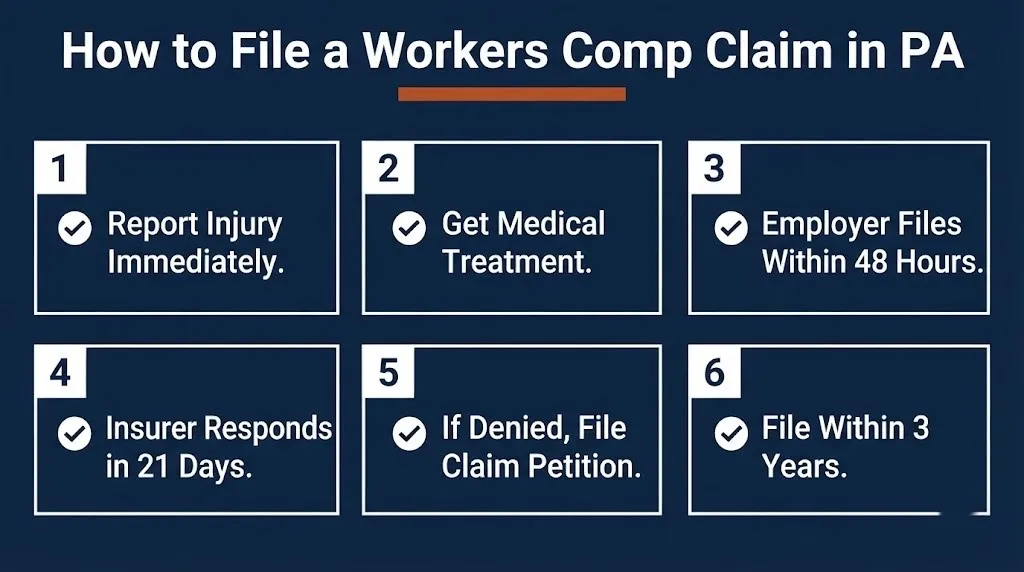
Filing a Pennsylvania workers compensation claim requires immediate action, clear communication with your employer, and documentation that preserves your rights. The system is not forgiving of missed deadlines, and silence can be used against you as evidence that your injury was not serious or did not happen at work. Here is the process, step by step, as required by the Pennsylvania Workers’ Compensation Act in 2026:
- Report your injury to your supervisor or employer immediately, verbally and in writing.
- Confirm the report in writing. Keep a copy with the date.
- Seek medical treatment. Go where your employer directs for the first 90 days if a posted panel exists.
- Tell every medical provider clearly that this is a work-related injury.
- Your employer must file a First Report of Injury with their insurer within 48 hours if you lose a day of work.
- The insurer has 21 days to accept or deny your claim by issuing a Notice of Compensation Payable or a Notice of Denial.
- If denied, file a Claim Petition with the Bureau of Workers’ Compensation within 3 years of the injury date.
- Attend all independent medical exams scheduled by the insurer. Skipping one can result in suspension of benefits.
The 120-day notice rule is the trap that catches the most injured workers. You must notify your employer within 120 days of the injury or within 120 days of when you knew, or should have known, that the injury was work-related. If you wait until day 121, your claim is barred unless the employer had actual knowledge and was not prejudiced by the delay. Do not rely on exceptions. Report the injury now.
What Deadlines Apply to Pennsylvania Workers Comp Claims?
Pennsylvania workers compensation imposes several strict deadlines. The most critical are the 120-day notice period for reporting an injury to your employer, the 21-day period during which the insurer must accept or deny your claim, and the 3-year statute of limitations for filing a claim petition if the insurer denies benefits. Missing any of these can extinguish your right to benefits permanently.
The 120-day clock starts on the date of injury or the date you reasonably should have connected your condition to your work. For a broken bone from a fall, the clock starts the day you fall. For a repetitive-motion injury like carpal tunnel, the clock starts when a doctor tells you the condition is work-related, not necessarily when you first felt symptoms. This distinction matters and is frequently litigated. The safest approach is to report any pain or symptoms to your employer as soon as you associate them with your work activities.
The 3-year statute of limitations is the outer boundary. If the insurer denies your claim, you have three years from the injury date to file a Claim Petition with the Workers’ Compensation Office of Adjudication. For occupational diseases with long latency periods, the three years runs from when you knew or should have known the disease was work-related. Mesothelioma from workplace asbestos exposure is a classic example. The clock does not start until diagnosis, not exposure.
| Deadline | Action | Consequences of Missing |
|---|---|---|
| Within 21 days of injury | Employer reports lost-time injury to insurer | Penalties for employer; no direct penalty to worker |
| Within 120 days of injury | Worker notifies employer | Claim barred unless exception applies |
| Within 21 days of employer notice | Insurer accepts or denies claim | Automatic deemed acceptance if no response (rare) |
| Within 3 years of injury | Worker files Claim Petition if denied | Claim barred permanently |
What Medical Treatment Is Covered Under PA Workers Comp?
Pennsylvania workers compensation covers all reasonable and necessary medical treatment causally related to the work injury. This includes doctor visits, specialist consultations, surgery, hospitalization, physical therapy, chiropractic care, prescription medications, medical equipment, and travel reimbursement for medical appointments. The worker pays nothing out of pocket. No copays. No deductibles. No coinsurance. The employer’s insurer pays the provider directly.
The employer controls medical treatment for the first 90 days if, and only if, the employer posted a written list of at least six designated health care providers in a visible location, provided written notice to the employee, and the provider list meets geographic accessibility requirements. If the employer failed to post a proper panel, the worker can treat with any provider from day one. After 90 days, or if the panel requirements were not met, the worker chooses the provider.
The insurer can require you to attend an independent medical examination or IME with a doctor of its choosing. This is not treatment. This is an evaluation to determine the extent of your disability and whether ongoing treatment remains necessary. You must attend. Skipping an IME can result in a suspension of benefits until you comply. The IME doctor’s opinion is evidence the insurer uses to seek modification, suspension, or termination of your benefits. It is not neutral. It is paid for by the defense.
What Are the Penalties for Not Having Workers Comp in PA?
Pennsylvania imposes stiff penalties on employers who fail to carry workers compensation insurance. The Bureau of Workers’ Compensation can assess a civil penalty of up to $3,000 per day of noncompliance. Criminal penalties, including fines of up to $15,000 and imprisonment for up to 7 years, apply for intentional violations. The state also has the power to issue a stop-work order, shutting down business operations until proof of coverage is provided.
Beyond state sanctions, the uninsured employer faces what is effectively unlimited civil liability. An injured worker can sue an uninsured employer directly in tort. The employer forfeits the defenses of contributory negligence, assumption of risk, and the fellow-servant rule. The worker only needs to prove the injury occurred in the course of employment. Damages are not capped by the workers compensation benefit schedule. The worker can recover full tort damages including pain and suffering, which the workers compensation system does not provide.
This is not a theoretical risk. The Bureau’s Enforcement Division actively investigates tips, cross-references insurance databases, and audits employers. A disgruntled employee, a competitor, or an injured worker can file a complaint that triggers an investigation. In 2025 and 2026, the state has increased enforcement resources and coordinated with the Department of Revenue and Department of Labor & Industry’s misclassification task force to identify uninsured employers, particularly in construction, restaurants, and delivery services.
Reality Check: Paying a worker cash under the table and calling them a contractor does not protect you from workers compensation liability. Pennsylvania uses a two-part test to determine employment status. Unless the worker is free from control and engaged in an independently established trade, they are an employee under the Act. Period. The state has dramatically increased misclassification audits, and fines now start at $2,500 per misclassified worker.
What Is the State Workers’ Insurance Fund (SWIF)?
The State Workers’ Insurance Fund, or SWIF, is Pennsylvania’s carrier of last resort. If a private insurance carrier refuses to write your business because your risk is too high, your claims history is too poor, or your industry is undesirable, you can apply to SWIF for coverage. SWIF must provide a quote. It cannot refuse to insure you the way a private carrier can.
SWIF policies are often more expensive than private-market coverage. The fund is not designed to compete on price. It exists to guarantee that every Pennsylvania employer who needs coverage can get it, preventing the situation where an employer wants to comply with the law but cannot find an insurer willing to write a policy. SWIF also provides a residual market that stabilizes the overall workers compensation system.
If you are shopping for coverage and have been denied by multiple private carriers, SWIF is your next stop. The application process is managed through the Department of Labor & Industry. You can contact SWIF directly or work through an insurance agent familiar with the Pennsylvania market. The fund will quote your coverage based on the same class codes and payroll figures a private carrier uses, but the rates and any applicable surcharges will reflect the higher-risk nature of the SWIF pool.
How Does the Workers Comp Settlement Process Work in PA?
Workers compensation settlements in Pennsylvania are called Compromise and Release agreements. They are voluntary. Neither side can force the other to settle. A C&R permanently resolves the claim in exchange for a lump sum payment. Once approved by a Workers’ Compensation Judge, the settlement is final. You cannot reopen the claim later if your condition worsens.
The settlement amount reflects the present value of future wage-loss benefits, future medical benefits, and any outstanding disputed issues. The insurer calculates what it would likely pay over the remaining life of the claim, discounts that amount for the possibility you might return to work or recover, and offers a lump sum that is typically less than the theoretical maximum. You accept less than full value in exchange for certainty: you get cash now, and the insurer closes the file.
The settlement must be approved by a Workers’ Compensation Judge at a formal hearing. The judge must find the settlement is in your best interest and that you understand the finality of the agreement. The judge will ask you on the record whether you understand you are giving up future medical and wage-loss benefits and whether anyone forced you to settle. Medicare’s interests must be considered if you are a Medicare beneficiary or have a reasonable expectation of becoming one, which can add a Medicare Set-Aside trust requirement to the settlement.
What Changes to PA Workers Comp Law Happened in 2026?
Several regulatory and enforcement changes have taken effect in Pennsylvania workers compensation in 2026. The most significant is the expansion of the state’s independent contractor misclassification enforcement. Act 72 of 2025, which went into full effect in early 2026, created a dedicated misclassification task force within the Department of Labor & Industry with expanded audit authority and increased penalties starting at $2,500 per misclassified worker. The task force coordinates across unemployment compensation, workers compensation, and tax enforcement agencies, meaning a finding of misclassification in one context triggers cross-referrals to the others.
The 2026 weekly benefit maximum of $1,325.00 reflects the annual statutory adjustment. The Bureau of Workers’ Compensation has also updated its electronic filing requirements for insurers and attorneys, moving toward mandatory e-filing for most petitions and documents. For employers, the Penalty Enhancement Act provisions continue to apply: knowing misrepresentation of payroll or class codes can trigger premium fraud charges with restitution and criminal exposure.
Court decisions in 2025 and early 2026 have refined the definition of “injury arising in the course of employment” for remote workers. With remote and hybrid work now a permanent feature of the Pennsylvania labor market, the Commonwealth Court has issued rulings addressing whether an injury at home during work hours is compensable. The general rule emerging is that if the injury occurs while the employee is performing work duties for the employer’s benefit, it is compensable even if it happens in the home office. Trips to the kitchen for coffee remain a gray area and are litigated case by case.
Key Takeaway: The 2026 misclassification enforcement escalation means employers who use independent contractors must document the relationship meticulously or face cross-agency penalties that multiply quickly across multiple workers.
What Happens Next
The Pennsylvania workers compensation system in the remaining months of 2026 and into 2027 will likely see continued enforcement actions and potential legislative proposals. Here is what to watch:
Ongoing 2026: Misclassification task force audits continue across construction, restaurant, delivery, and healthcare staffing industries. Penalties are being assessed.
Expected Q4 2026: Annual loss cost filing by the Pennsylvania Compensation Rating Bureau for 2027 rates, with public comment period to follow.
Early 2027: Publication of the 2027 maximum weekly benefit rate based on statewide average weekly wage calculations.
Potential 2027: Legislative proposals addressing remote-worker injury standards may be introduced if the Commonwealth Court decisions create inconsistent results.
Watch for: Any change to the independent contractor test in Pennsylvania. Courts and the legislature continue to debate whether the strict ABC test used for unemployment should extend to workers compensation.
Frequently Asked Questions
Who Is Exempt From Workers Comp in PA?
Sole proprietors, general partners, and certain corporate officers can exempt themselves by filing a formal notice.
Agricultural workers on small farms and some domestic workers in private homes may be exempt by statute.
All other employees must be covered regardless of hours worked or pay rate.
How Much Does Workers Comp Pay in PA Per Week?
The maximum weekly benefit for total disability in 2026 is $1,325.00 per week.
Your actual benefit is two-thirds of your average weekly wage, capped at that maximum.
Partial disability pays two-thirds of the wage loss, capped at $883.00 per week.
Can I Sue My Employer Instead of Filing Workers Comp in PA?
Generally no. Workers compensation is the exclusive remedy for work injuries in Pennsylvania.
You can sue if your employer failed to carry workers compensation insurance.
You may also have a third-party claim against someone other than your employer who caused your injury.
How Long Does an Employer Have to Report an Injury in PA?
An employer must report a lost-time injury to its insurer within 48 hours of notification by the employee.
The insurer then has 21 days to accept or deny the claim.
The worker must report the injury to the employer within 120 days.
What Happens If My Workers Comp Claim Is Denied in PA?
You receive a Notice of Denial explaining the reason for the denial.
You can file a Claim Petition with the Bureau of Workers’ Compensation within 3 years of the injury.
A Workers’ Compensation Judge will hold hearings and decide whether benefits are owed.
Can I Choose My Own Doctor for a Work Injury in PA?
Your employer can direct your medical care for the first 90 days if they properly posted a designated provider list.
After 90 days, you can switch to a provider of your choice with notice to the insurer.
If no valid panel was posted, you can treat with any provider from day one.
Is Workers Comp Taxable in Pennsylvania?
Workers compensation benefits are generally not subject to Pennsylvania state income tax.
They are also not subject to federal income tax.
Settlement proceeds may have tax implications if structured with interest or allocated to non-medical categories.
What Is an IME in Pennsylvania Workers Comp?
An IME is an independent medical examination requested by the insurer to evaluate your condition.
You must attend or risk suspension of benefits.
The IME doctor provides an opinion on diagnosis, disability level, and whether treatment remains reasonable and necessary.
Your next step depends on your situation. If you are an employer without coverage, fix that today. Contact an insurance agent or SWIF before the Bureau contacts you. If you are an injured worker, report the injury now, not tomorrow. The 120-day clock is running, and silence is the insurer’s best friend. If your claim has been denied, do not wait to file a Claim Petition. The three-year statute of limitations sounds generous, but evidence disappears, witnesses move, and memories fade. The strongest claims are filed while the facts are fresh.
The Pennsylvania workers compensation system in 2026 is stable, well-established, and rule-driven. It rewards prompt action and punishes delay. Whether you are an employer or an injured worker, the system’s message is the same: know the deadlines, meet them, and document everything.