Workers Compensation Insurance Rates and Cost Factors: 2026 Guide
Quick Answer
- Workers compensation rates are set by state-approved classification codes, not by individual carriers.
- Most businesses pay $0.75 to $2.50 per $100 of payroll, with high-risk trades far higher.
- Your claims history, expressed as an experience modifier, can swing rates by 20 to 50 percent.
You’re trying to understand workers compensation insurance rates. Maybe you got a quote that seemed high. Maybe you’re comparing policies. Or maybe an audit bill arrived and you don’t understand the math.
Here’s what the verified data shows. Workers compensation rates are not arbitrary. They’re filed with state regulators, based on industry classification codes, and adjusted by your company’s claims history. The rate you pay is a formula, not a negotiation.
This article covers how rates are set, what factors move them, how to read a rate filing, and what you can do to lower your costs. One surprising detail: many businesses pay the wrong rate because their classification code is incorrect, and fixing it can save thousands per year.
The Facts
| Case | Not a lawsuit; workers compensation insurance rate system |
| Status | Active; rates filed annually with state regulators |
| Fund Size | Not applicable |
| Est. Per Person | $0.75 to $2.50 per $100 of payroll for most businesses |
| Claim Deadline | Not applicable |
| Administrator | State rating bureaus, NCCI, and private carriers |
| Proof Needed | Payroll records, classification codes, loss runs |
What Are Workers Compensation Insurance Rates?
Workers compensation insurance rates are the dollar amounts charged per $100 of payroll for each industry classification code. These rates are filed with state regulators and approved before carriers can use them.
The National Council on Compensation Insurance, or NCCI, develops rate recommendations in most states. Each state then approves, modifies, or rejects those recommendations. In monopolistic states like Ohio and Washington, the state fund sets rates directly.
Your rate is not set by your insurance agent. It’s set by the classification code assigned to your employees’ work activities. The agent plugs your payroll into the approved rate and produces your premium.
Understanding this structure matters because it means your rate is knowable. You can look up your classification code, find the approved rate for your state, and verify that your premium is correct.
How Are Workers Compensation Rates Determined?
Workers compensation rates are determined by a combination of industry injury data, state benefit costs, and regulatory filings. The process starts with NCCI or a state rating bureau analyzing claims data for each classification code.
The analysis looks at injury frequency and severity for each type of work. Roofers have higher rates than clerical workers because roofing injuries are more frequent and more expensive. That’s the core logic.
State benefit levels also affect rates. States with higher maximum weekly benefits or more generous medical coverage tend to have higher rates. The state’s regulatory environment, including whether it allows private carriers or operates a state fund, matters too.
The result is a base rate for each classification code in each state. That base rate is what you multiply by your payroll to get your premium.
Key Takeaway: Workers compensation rates are data-driven, not arbitrary, and they reflect the actual injury history of each industry classification.
What Is the Average Workers Compensation Rate?
The average workers compensation rate across all industries is roughly $1.00 to $1.50 per $100 of payroll, though that figure hides enormous variation by classification. Most small businesses in low-risk industries fall between $0.75 and $2.50 per $100.
A clerical business might pay $0.15 to $0.50 per $100. A restaurant might pay $1.50 to $3.00 per $100. A roofing company might pay $10 to $25 per $100.
The average is useful as a reference point but misleading as a planning tool. Your rate depends entirely on your classification, not on the national average.
If someone quotes you “the average rate,” ask for the rate for your specific classification code in your specific state. That’s the number that matters.
What Factors Affect Workers Compensation Insurance Rates?
Several verified factors affect your workers compensation insurance rate. The most important is your classification code.
- Classification code: the assigned risk category for your work type.
- State rate filing: the approved base rate for your state.
- Experience modifier: your claims history compared to industry average.
- Payroll size: more payroll means more premium, but the rate is per $100.
- Premium discounts: safety programs, drug-free workplace credits.
- Carrier pricing flexibility: some states allow carriers to deviate from filed rates.
The classification code is fixed by your actual work activities. The experience modifier is earned over time through your claims history. The state rate is what regulators approve.
You control some factors more than others. Safety programs can lower your mod. Correct classification can fix an overcharge. Payroll accuracy prevents audit surprises.
What Are Workers Compensation Classification Codes?
Workers compensation classification codes are four-digit numbers that identify specific types of work. Each code has a rate based on the injury risk of that work type. The codes are standardized by NCCI in most states.
Here are common codes and their general rate ranges per $100 of payroll.
| Code | Work Type | Typical Rate Range |
|---|---|---|
| 8810 | Clerical office | $0.15 to $0.50 |
| 8742 | Outside sales | $0.25 to $0.75 |
| 5022 | Masonry | $5 to $12 |
| 5403 | Carpentry | $5 to $12 |
| 5551 | Roofing | $10 to $25 |
| 3632 | Machine shop | $2 to $6 |
These ranges reflect general patterns, not specific state filings. Your state’s approved rate may differ.
The code assigned to your business should match your employees’ actual work. If you run a plumbing business, your installers should be classified under the plumbing code, not a general construction code.
How Does the Experience Modifier Affect Rates?
The experience modification rate, or ex-mod, is a multiplier that adjusts your workers compensation rate based on your claims history. A mod of 1.0 is average. A mod of 0.8 is better than average, so you pay 20 percent less. A mod of 1.3 is worse than average, so you pay 30 percent more.
The mod is calculated by comparing your actual claims to the expected claims for businesses of your size and classification. Frequent or severe claims push your mod up. Clean history pushes it down.
The mod applies to your entire premium, not just the classification base rate. A high mod can add thousands to your annual cost. A low mod can save you thousands.
New businesses typically start with a mod of 1.0. Over time, your mod reflects your actual safety performance.
Key Takeaway: The experience modifier is the one rate factor you directly control through safety and claims prevention, and it can swing your premium by thousands.
What Is the Difference Between Rate and Premium?
The rate is the dollar amount charged per $100 of payroll. The premium is the total dollar amount you pay for your policy. They are different numbers.
The rate is set by classification and state filing. The premium is calculated by multiplying your payroll by the rate and applying your experience modifier.
Here’s the formula.
- Divide your payroll by 100.
- Multiply by the classification rate.
- Apply the experience modifier.
- Add state taxes and assessments.
- Apply any premium discounts.
A rate of $1.50 per $100 on $200,000 of payroll produces a base premium of $3,000. With a mod of 0.9, the premium drops to $2,700. With a mod of 1.2, it rises to $3,600.
How Do State Differences Affect Workers Compensation Rates?
Workers compensation rates vary significantly by state because each state sets its own benefit levels, medical costs, and regulatory structure. A roofer in California may pay a different rate than a roofer in Texas.
States with higher maximum weekly benefits typically have higher rates. States with higher medical costs also have higher rates. Monopolistic states, where the state operates the only workers compensation fund, may have different rate structures than private markets.
The state where your employees work, not where your business is headquartered, controls the rate. If you have employees in multiple states, you need coverage in each and will pay each state’s rates.
When comparing rates across states, compare the same classification code. A clerical rate in one state may be lower or higher than the same code in another state.
How Do I Check My Workers Compensation Rate?
Checking your workers compensation rate requires your classification code, your state’s approved rate filing, and your experience modifier. Here’s how.
- Identify your classification code from your policy or audit.
- Look up the approved rate for your state and code.
- Check your experience modifier on your policy declarations.
- Verify the payroll figures used in the calculation.
- Compare your premium to the formula result.
If the numbers don’t match, ask your agent or carrier for an explanation. Rate errors happen, and they often go unnoticed until an audit.
Reality Check: No legitimate workers compensation quote comes by text message. Real quotes come in writing from a licensed agent or carrier, always after reviewing your payroll, classifications, and loss runs. If someone offers you a rate without that information, walk away.
What Is the Cheapest Workers Compensation Insurance?
The cheapest workers compensation insurance is coverage with the correct classification, accurate payroll, and a clean claims history. It’s not about finding a carrier that magically charges less. It’s about getting the formula right.
Clerical businesses in low-cost states typically pay the lowest rates. High-risk trades in high-cost states pay the most. Your rate is set by your work type and your state, not by how hard you negotiate.
Some carriers offer deviations from filed rates in states that allow pricing flexibility. Those deviations can save a few percentage points. But they’re secondary to correct classification and a clean mod.
If a quote seems dramatically cheaper than others, check the classification. A low quote based on a wrong code will come back as an audit bill.
Can I Lower My Workers Compensation Insurance Rate?
Yes. Several verified strategies can lower your workers compensation rate over time.
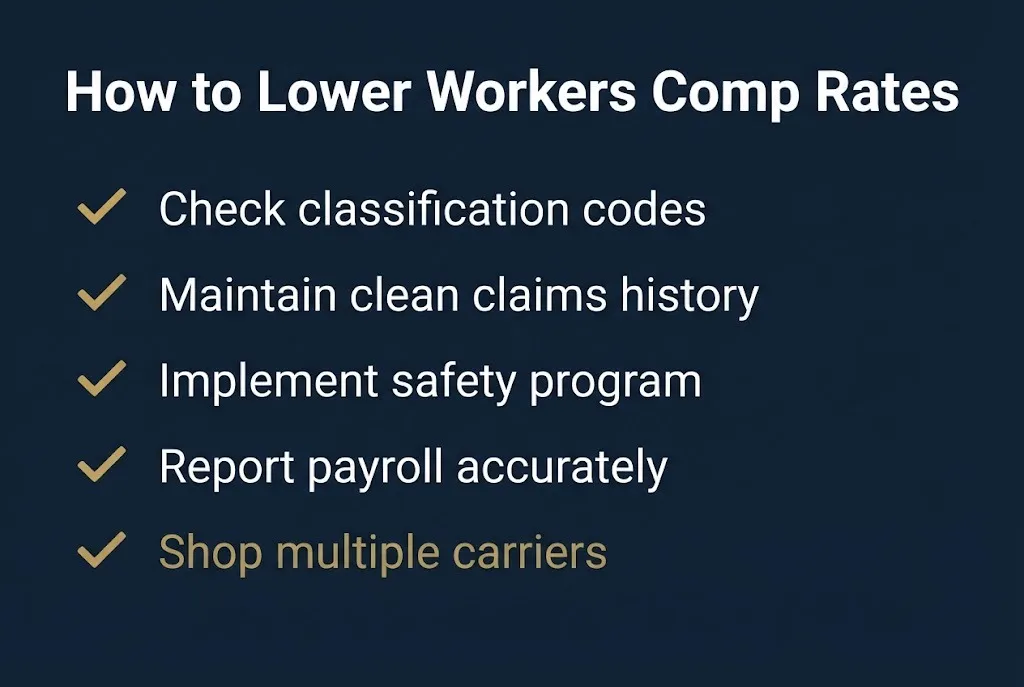
- Maintain a clean claims history to improve your experience modifier.
- Implement a documented safety program.
- Enroll in a drug-free workplace program if your state offers a credit.
- Verify your classification codes are correct.
- Report payroll accurately to avoid audit adjustments.
- Shop quotes through multiple carriers or a broker.
- Ask about premium discounts for small businesses or new ventures.
The most effective long-term strategy is claims prevention. Every avoided injury keeps your mod low. Your rate may not change immediately, but your mod will improve over time, and that’s where the real savings are.
What Happens If My Classification Is Wrong?
If your classification is wrong, you may be overpaying or underpaying your workers compensation premium. Either way, the error will surface at audit.
If you’re overpaying, you may be entitled to a refund. If you’re underpaying, you’ll owe additional premium. The audit process is designed to correct these errors.
Misclassification can happen for legitimate reasons. Employees may perform multiple types of work. Business operations may change. A code assigned years ago may no longer match your current work.
Review your classification annually. If your work has changed, ask your agent to review your codes. An hour of review can save thousands in audit surprises.
Key Takeaway: The classification code is the foundation of your rate, and an incorrect code is the most common source of both overpayment and audit shock.
What Is a Workers Compensation Rate Filing?
A workers compensation rate filing is a formal submission to state regulators proposing changes to base rates for classification codes. NCCI or a state rating bureau prepares the filing, and regulators approve or modify it.
Rate filings happen annually in most states. The filing includes data on injury frequency, severity, medical costs, and benefit changes. Regulators review the data and issue approved rates.
You don’t need to read every rate filing. But understanding that rates are filed and approved reinforces a key point: your rate is not arbitrary and not negotiable. It’s the product of a regulatory process.
If your state approves a rate increase for your classification, your premium will rise even if your payroll and mod stay the same. That’s the system working as designed.
How Often Do Workers Compensation Rates Change?
Workers compensation rates typically change once per year when state regulators approve new rate filings. The timing varies by state, but most rate changes take effect on January 1 or July 1.
Your premium can change more frequently due to payroll changes, audit adjustments, or experience modifier updates. The rate is annual. Your premium is dynamic.
If you receive a mid-year rate change notice, check whether it’s a rate change or a payroll adjustment. Rate changes require regulatory approval. Payroll changes reflect your own reporting.
Frequently Asked Questions
What is the current workers compensation rate?
Rates vary by state and classification code.
Most businesses pay between $0.75 and $2.50 per $100 of payroll.
How is workers compensation rate calculated?
The rate is set by classification code and state filing.
Your premium multiplies that rate by your payroll and applies your mod.
What is a good workers compensation rate?
A good rate is one that correctly matches your classification and reflects a clean mod.
Lower than average is only good if the classification is right.
Can I negotiate workers compensation rates?
No. Rates are filed with state regulators and are not negotiable.
But you can shop carriers for deviations and discounts.
What is the highest workers compensation rate?
High-risk trades like roofing and logging have the highest rates.
Those codes can exceed $25 per $100 of payroll in some states.
Do workers compensation rates include payroll taxes?
No. Workers compensation premium is separate from payroll taxes.
The rate applies to your payroll, but it’s a separate line item.
How do I find my workers compensation classification code?
Check your policy declarations or ask your agent.
The code should match your employees’ actual work activities.
Why did my workers compensation rate go up?
Rate increases come from state filings, claims history, or audit adjustments.
Check which factor changed on your renewal notice.
If you’re reviewing workers compensation insurance rates for 2026, the most important number is your classification code. That single factor determines your rate more than anything else.
Verify your codes, check your mod, and report payroll accurately. The system rewards accuracy and safety. And if a rate seems too low to be true, check the classification before you celebrate. Audit surprises always cost more than correct premiums.