Washington Workers Compensation Insurance in 2026: What Employers and Workers Need to Know
Quick Answer
- Washington workers compensation insurance is mandatory for most employers and is purchased through the state, not private insurers.
- Premium rates for 2026 remain at the same base level as 2025, with the average rate around $1.42 per hour worked.
- The most important deadline is quarterly premium reporting, with due dates at the end of January, April, July, and October.
If you searched for “Washington workers compensation insurance,” you’re likely a business owner trying to figure out if you need coverage, how to get it, and what it costs. Or you’re a worker who got hurt and wants to know if you’re covered.
This article gives you the verified facts as of September 9, 2026. Washington is different from most states. You can’t shop around for private coverage. There’s one system, run by the state.
Here’s the part most articles skip: Washington’s system covers nearly all workers by law, not by choice. Even if your employer never bought coverage, you may still be entitled to benefits through a special state fund.
The Facts
| Item | Detail |
|---|---|
| State Agency | Washington State Department of Labor and Industries |
| System Type | State-run monopoly, no private workers comp market |
| 2026 Base Rate | Approximately $1.42 per hour worked |
| Coverage Requirement | Mandatory for nearly all employers |
| Independent Contractors | New 2026 rules clarify who must be covered |
| Claim Filing Deadline | One year from injury in most cases, with exceptions |
| Special Fund | Uninsured employers covered through state fund |
Is Washington Workers Compensation Insurance Required?
Yes, for nearly every employer in the state. Washington law requires employers to provide workers compensation coverage for all employees, with very few exceptions.
The system is mandatory. If you run a business in Washington and you have employees, you must have coverage through the state’s Department of Labor and Industries, known as L&I.

The requirement applies from the first employee. Unlike some states that exempt very small businesses, Washington does not. A business with one part-time employee is still required to have coverage.
Certain family members working for a family business may be exempt, and some corporate officers can opt out. But the default rule is clear: if someone works for you, they’re covered.
Key Takeaway: Washington’s workers compensation is not optional, and the coverage requirement starts with your first employee.
How Is Washington Workers Compensation Different From Other States?
Washington is one of only four states with a monopolistic state fund. That means private insurance companies don’t sell workers compensation policies here.
In most states, employers can buy coverage from private insurers or compete for better rates. In Washington, you pay premiums directly to the state. The state sets the rates, collects the money, and pays the claims.
The system is run by the Washington State Department of Labor and Industries. It’s been this way since 1911, making it one of the oldest workers compensation systems in the country.
The advantage: rates are stable and predictable. No surprise premium increases from a private carrier. The disadvantage: you have no choice. If you don’t like the rate, there’s no competitor to switch to.
What Does Washington Workers Compensation Cover?
The coverage pays for medical treatment, partial wage replacement, and vocational rehabilitation for workers injured on the job.
Here’s what a covered worker receives:
- Medical care related to the injury or illness
- Time-loss payments for missed work
- Permanent partial disability awards for lasting impairments
- Vocational services if the worker can’t return to their old job
- Pension payments for catastrophic injuries
The wage replacement amount is typically 60% to 75% of the worker’s average wage, depending on marital status and number of dependents.
Unlike some states, Washington’s system covers occupational diseases, not just sudden injuries. If a worker develops a condition from repetitive motion, chemical exposure, or other work-related causes, that’s covered too.
How Much Does Washington Workers Compensation Cost in 2026?
The 2026 base rate is approximately $1.42 per hour worked, holding steady from 2025.
Here’s the cost breakdown by common industries:
| Industry | Typical Rate per Hour |
|---|---|
| Office work | $0.30 to $0.80 |
| Retail | $0.80 to $1.50 |
| Construction | $3.00 to $8.00 |
| Roofing | $8.00 to $15.00 |
| Logging | $10.00 to $20.00+ |
The rate varies by risk class. L&I assigns each business a classification code based on what the business actually does. A roofing company pays far more per hour than an accounting firm because the injury risk is dramatically higher.
The rate is applied to hours worked, not payroll dollars. That’s another Washington quirk. You report hours, not wages.
Key Takeaway: Your premium depends on your risk class and total hours worked, not your total payroll.
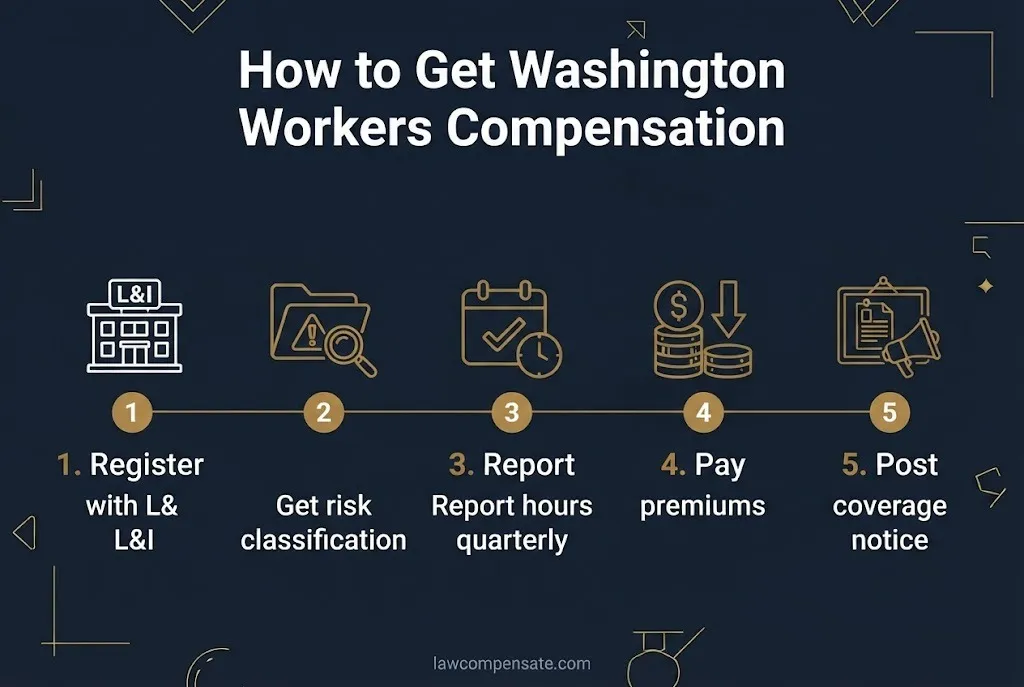
How Do You Get Washington Workers Compensation Insurance?
You don’t buy it. You register with L&I and start paying premiums.
Here’s the process:
- Create an account with the Washington State Department of Labor and Industries.
- Apply for a workers compensation account using your business information.
- Receive your risk classification and base rate.
- Report employee hours quarterly.
- Pay premiums based on those hours.
- Keep your account in good standing.
There’s no application fee. There’s no agent to go through. The process is direct with the state.
The entire process can be completed online through L&I’s portal. Most businesses get their account set up within a few days.
What Are the New 2026 Independent Contractor Rules in Washington?
Washington has tightened the rules for independent contractors, effective in 2026.
The state now applies a stricter test to determine whether someone is truly an independent contractor or an employee who should be covered. The test looks at whether the worker is genuinely in business for themselves or is economically dependent on the hiring business.
The key factors include:
- Whether the worker has their own business license
- Whether they have multiple clients
- Whether they set their own rates and schedule
- Whether they provide their own tools
- Whether they can hire their own help
If the worker fails this test, they’re an employee, and the hiring business must provide workers compensation coverage.
The 2026 changes are primarily enforcement clarifications, not a new law. L&I has issued guidance making clear how it will apply the existing test.
Reality Check: No one calls or texts you about a workers compensation premium refund. L&I communicates through official mail and its secure portal. Filing a claim is always free. Third-party “consultants” who charge to help you register with L&I are unnecessary.
What Happens If an Employer Doesn’t Have Washington Workers Compensation?
The employer faces penalties, and the injured worker may still get benefits.
Washington maintains an uninsured employers fund. If a worker is injured while working for an uninsured employer, the worker can still file a claim and receive medical and wage benefits through this fund.
The state then pursues the employer for repayment. The employer may face fines, penalties, and even criminal charges in some cases.
This is a critical protection for workers. Even if your employer broke the law by not buying coverage, you’re not left without medical care.
For employers, the message is simple: getting caught without coverage is far more expensive than buying it. The penalties often exceed the premiums that would have been owed.
How Do You File a Workers Compensation Claim in Washington?
The claim process starts with reporting the injury to your employer and seeking medical care.
Here’s the step-by-step:
- Report the injury to your employer immediately.
- Seek medical treatment from an L&I-approved provider.
- The provider files a report with L&I.
- L&I assigns a claim number and begins processing.
- You receive a decision on claim acceptance or denial.
- If accepted, benefits begin.
- If denied, you can appeal through the Board of Industrial Insurance Appeals.
The deadline for filing a claim is generally one year from the date of injury for injuries, and two years for occupational diseases. But there are exceptions, so don’t rely on this article alone.
The most important step is reporting the injury immediately. Delays hurt your claim.
What Are the 2026 Premium Due Dates in Washington?
Premiums are due quarterly, and the due dates are consistent every year.
| Quarter | Due Date |
|---|---|
| Q1 (Jan-Mar) | April 30 |
| Q2 (Apr-Jun) | July 31 |
| Q3 (Jul-Sep) | October 31 |
| Q4 (Oct-Dec) | January 31 |
Employers must file quarterly reports showing hours worked for each employee. The premium is calculated from those hours.
Late filing triggers penalties and interest. The state can also estimate your hours if you don’t file, and the estimate is usually higher than your actual hours.
Key Takeaway: The quarterly filing deadlines are fixed and late filing is expensive.
Can You Opt Out of Washington Workers Compensation?
In limited circumstances, yes. Certain corporate officers, partners, and sole proprietors can opt out.
But the opt-out is specific. It applies to business owners, not to employees. You can’t opt your employees out of coverage.
To opt out as a business owner, you file a form with L&I. The exemption applies only to you, not to anyone who works for you.
The opt-out means you’re not covered if you get hurt. That’s a significant risk, especially if you work in a physical trade. Most business owners should think hard before waiving coverage.
How Does Washington Workers Compensation Handle Disputes?
Disputes go through a specific appeals process, not through the regular court system.
The Board of Industrial Insurance Appeals handles disputes over claim decisions, benefit amounts, and premium classifications. It’s an administrative body, not a court.
If a worker’s claim is denied, they can appeal to the Board. If they disagree with the Board’s decision, they can appeal to Superior Court.
The process is designed to be faster and less formal than civil litigation. But it can still take months or years for complex cases.
What Are the Most Common Washington Workers Compensation Claims?
The most common claims reflect Washington’s industries: construction, manufacturing, healthcare, and agriculture.
| Injury Type | Percentage of Claims |
|---|---|
| Strains and sprains | 30% to 40% |
| Cuts and lacerations | 10% to 15% |
| Fractures | 8% to 12% |
| Contusions | 8% to 10% |
| Repetitive motion | 5% to 8% |
| Other | Remaining |
Back injuries are the most common specific claim, especially in construction and warehouse work. Repetitive motion claims are growing in office and healthcare settings.
The injury type matters because it affects both the cost of the claim and the employer’s future premium rates. Claims history follows the employer.
What Happens Next With Washington Workers Compensation?
The system is stable, but a few changes are on the horizon.
- Late 2026: L&I expected to release 2027 rate proposals.
- 2027: Possible rate adjustments based on claim trends and fund balance.
- Ongoing: Independent contractor enforcement continues to tighten.
- Watch: Any legislative changes to benefit levels or eligibility rules.
For employers, the immediate next step is ensuring your account is current and your workers are correctly classified. For workers, the next step is knowing your rights if you get injured.
The most important date for employers is the next quarterly filing deadline. For workers, it’s the date of injury, because that starts your claim clock.
Frequently Asked Questions
Is Washington workers compensation required?
Yes, for nearly all employers.
The requirement starts with the first employee.
There are few exceptions.
How much does Washington workers compensation cost?
About $1.42 per hour on average.
Rates vary by industry risk class.
Construction and logging pay much higher rates.
Can I buy private workers compensation in Washington?
No, the state has a monopoly system.
All coverage goes through L&I.
There’s no private market.
How do I file a workers compensation claim in Washington?
Report the injury to your employer immediately.
Seek care from an L&I-approved provider.
The provider files the claim with L&I.
What if my employer doesn’t have coverage?
You can still file a claim through the uninsured employers fund.
The state provides benefits and pursues your employer.
You’re not left without help.
How long do I have to file a claim?
Generally one year from the injury date.
Two years for occupational diseases.
Exceptions apply, so file as soon as possible.
Can I opt out as a business owner?
Yes, in limited circumstances.
Sole proprietors and certain corporate officers can opt out.
Employees can never be opted out.
What are the premium due dates?
Quarterly: April 30, July 31, October 31, January 31.
Late filing triggers penalties.
Report hours accurately to avoid overpayment.
If you run a business in Washington, check your L&I account today. Make sure your workers are correctly classified and your premiums are current. If you’re a worker, know that coverage is nearly universal, even if your employer broke the rules.
The most important fact: Washington’s system is mandatory, state-run, and designed so that no injured worker falls through the cracks.