Long Island Workers Compensation Lawyer 2026: Full Guide
Quick Answer
- New York runs a no-fault workers’ compensation system, and Long Island claims go through the WCB’s Islandia district office.
- Weekly benefits range from $384.45 to $1,281.50 depending on your wages and date of injury, not a fixed payout.
- You must notify your employer within 30 days and file Form C-3 with the state within 2 years of your injury.
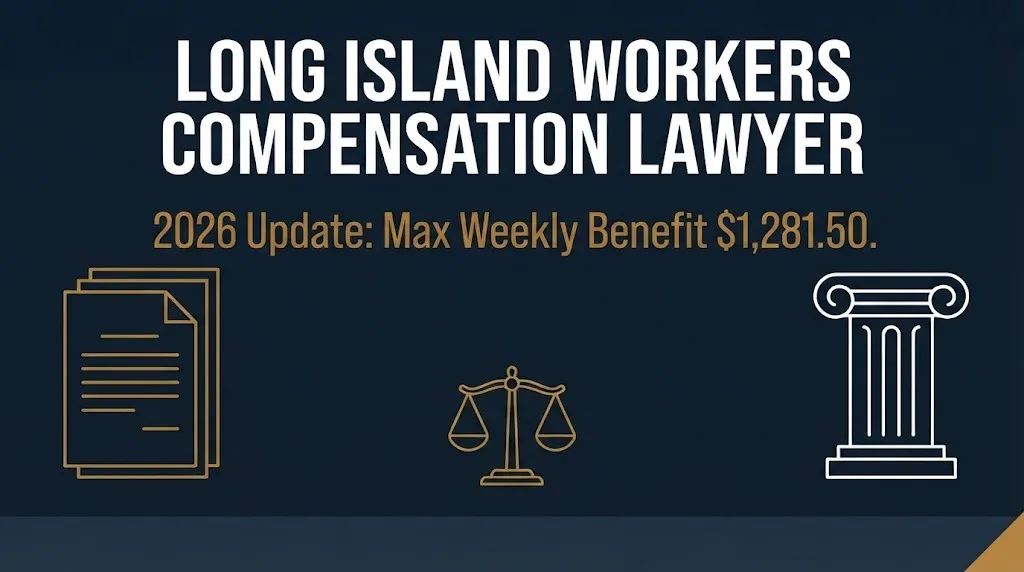
If you’re searching for a Long Island workers’ compensation lawyer, here’s the direct answer: New York’s system is no-fault, meaning you don’t need to prove your employer was careless to receive benefits. The maximum weekly benefit for injuries on or after July 1, 2026, is $1,281.50, set by the state each July.
This affects any Long Island worker hurt on the job, from Nassau warehouses to Suffolk construction sites. The two deadlines that matter most: notify your employer within 30 days, and file your formal claim within two years.
This article covers how the Long Island claims process actually works, what a workers’ comp lawyer can and can’t do for you, and one detail most people miss: your attorney’s fee has to be approved by the state, not negotiated privately.
The Facts
| System | New York State Workers’ Compensation, a no-fault benefit system under WCL |
| Status | Active statewide program, benefit rates updated each July 1 |
| Fund Size | Not applicable, this is not a class action or settlement fund |
| Est. Per Person | $384.45 to $1,281.50 per week, based on wages and date of injury |
| Claim Deadline | Notify employer within 30 days, file Form C-3 within 2 years |
| Administrator | NYS Workers’ Compensation Board, Long Island District Office, Islandia, NY |
| Proof Needed | Form C-3 (your claim), Form C-4 (doctor’s report), Form C-2 (employer’s report) |
Do you need a workers’ compensation lawyer on Long Island?
You don’t legally need one to file a claim, but a lawyer can help if your claim gets disputed or your benefits get cut. Simple, undisputed injuries sometimes move through the system without a lawyer at all.
Where lawyers matter most is when insurance carriers challenge your average weekly wage, dispute whether your injury is work-related, or push back on permanency findings. Attorney fees in these cases must be approved by the Workers’ Compensation Board, so you’re not negotiating fees on your own.
Situations where legal help tends to matter more:
- Your claim was denied or delayed without a clear reason
- Your employer disputes that the injury happened at work
- You’re facing a permanent disability or schedule loss of use determination
- Your benefit rate seems miscalculated compared to your actual wages
Is New York workers’ compensation a no-fault system?
Yes, New York’s system is no-fault, meaning you generally don’t need to prove your employer did anything wrong to receive benefits. You simply need to show the injury happened while performing your job duties.
The tradeoff is that you generally can’t sue your employer directly for a workplace injury, since workers’ compensation is meant to be the exclusive remedy in most cases. That’s different from a personal injury lawsuit, where fault has to be established.
Think of it like an insurance claim after a fender bender: you don’t need to prove intent, just that the accident happened and meets the policy’s terms. New York’s system works on a similar logic for workplace injuries.
Key Takeaway: New York’s no-fault system means you don’t have to prove employer negligence, but it also generally limits you to the workers’ comp process instead of a lawsuit against your employer.
How much does a workers’ compensation lawyer cost on Long Island?
Attorney fees in New York workers’ comp cases must be approved by the Workers’ Compensation Board, not set through a private contract. This is different from many other types of legal cases.
Under New York Workers’ Compensation Law Section 24, any legal fee must be submitted for board approval, with written applications required for fees over $1,000. The board reviews the request, considers your financial situation, and can approve, reduce, or deny it.
How the fee process typically works:
- Fees become a lien on your compensation award, not billed upfront
- Many attorneys work without charging anything unless you receive an award
- Approved fees are deducted from your cash award, not from medical benefits
- Fee amounts vary case by case and are not a fixed statutory percentage
Reality Check: No legitimate workers’ comp attorney can charge whatever they want, since New York law requires board approval for every fee. If someone asks for large upfront payments before doing any work on your claim, that is not how this system operates.
How much can you get from a workers’ compensation claim in New York in 2026?
Amounts vary and depend on your wages, injury type, and date of injury. There’s no flat statewide payout, only a formula applied to your specific case.
The weekly benefit is calculated as two-thirds of your average weekly wage, multiplied by your percentage of disability, then capped at the statutory maximum or floored at the minimum.
| Injury Date Range | Maximum Weekly Benefit | Minimum Weekly Benefit |
|---|---|---|
| January 1 to June 30, 2026 | $1,222.42 | Not indexed to this new formula yet |
| July 1, 2026 to June 30, 2027 | $1,281.50 | $384.45 |
For example, a worker earning $1,500 a week who is found totally disabled would receive two-thirds of that wage, but capped at whichever maximum applies to their injury date. That’s roughly $1,000 a week for wages below the cap, or the statutory maximum if two-thirds of their wage exceeds it.
How do you file a workers’ compensation claim on Long Island?
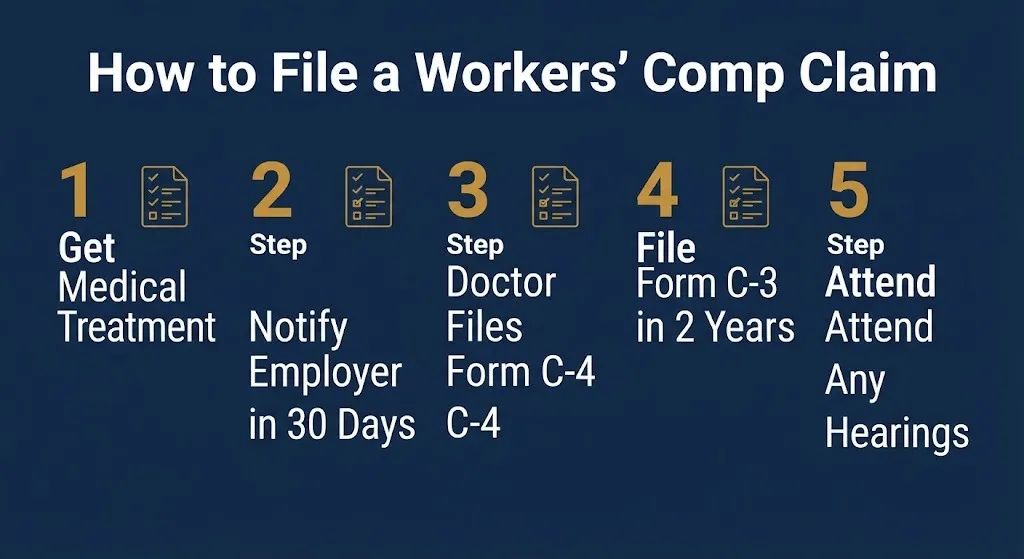
Filing means notifying your employer, getting medical documentation, and submitting a formal claim to the state. Here’s the general sequence:
- Get medical treatment and tell your provider the injury is work-related.
- Notify your employer in writing within 30 days of the injury.
- Ask your treating doctor to file Form C-4 with the Workers’ Compensation Board.
- Confirm your employer files Form C-2 within 10 days of learning about the injury.
- Submit your own Form C-3 claim to the Board within two years.
- Attend any scheduled hearings before a Workers’ Compensation Law Judge.
- Respond promptly to any requests for additional documentation.
Missing the 30-day notice deadline can be excused in some situations, such as if you were physically unable to report the injury. The two-year deadline for filing Form C-3 is stricter and tied directly to your date of injury.
What happens if your workers’ compensation claim is denied?
A denial means the insurance carrier or a judge disputed some part of your claim, but you generally have the right to appeal. This is not the end of the process.
If a Workers’ Compensation Law Judge denies your claim, you typically have 30 days from that decision to request a review by a Board panel. Missing that window can make the decision final.
Common reasons carriers dispute claims:
- Late notice to the employer beyond the 30-day window
- Disagreement over whether the injury is actually work-related
- Disputes about average weekly wage calculations
- Questions about whether a pre-existing condition is involved
Key Takeaway: A denial isn’t automatically final, since New York law provides a formal appeal process with its own 30-day deadline.
How do you choose a workers’ compensation lawyer on Long Island?
Choosing a lawyer means looking at experience with WCB hearings, fee transparency, and familiarity with the Long Island district office process. Not every personal injury lawyer regularly handles workers’ comp specifically.
Questions worth asking before hiring:
- Do you regularly appear before Workers’ Compensation Law Judges on Long Island?
- How do you typically request fee approval from the Board?
- What’s your experience with cases like mine, in terms of injury type?
- Will you handle communication with the insurance carrier directly?
Since fees require board approval regardless of which attorney you choose, cost differences between lawyers tend to come from experience and case handling rather than differing fee structures.
What are the 2026 New York workers’ compensation benefit rates?
The maximum weekly benefit is $1,281.50 for injuries occurring on or after July 1, 2026, through June 30, 2027. The minimum weekly benefit for that same period is $384.45.
These rates come from a formula in Workers’ Compensation Law Sections 2(16) and 15(6): the maximum is two-thirds of the New York State Average Weekly Wage from the prior calendar year. The state’s average weekly wage for 2025 was $1,922.25, which set this year’s new maximum.
Rate history relevant to 2026 claims:
- Injuries from July 1, 2025 to June 30, 2026: maximum benefit of $1,222.42
- Injuries from July 1, 2026 to June 30, 2027: maximum benefit of $1,281.50
Your benefit rate locks in based on your date of injury, not the date you file your claim or the date checks start arriving. Two workers both injured in 2026 can have different maximum rates depending on which side of July 1 their injury falls.
Where is the Long Island Workers’ Compensation Board office located?
The Long Island District Office of the New York State Workers’ Compensation Board is located in Islandia, New York. As of September 24, 2024, it moved from its former Hauppauge location.
Current address on record:
NYS Workers’ Compensation Board, 2929 Expressway Drive North, Suite 200, Islandia, NY 11749.
This office handles hearings and claims administration for workers across Nassau and Suffolk counties. In-person services generally require an appointment, so confirming current hours directly with the Board before visiting is worth doing.
What injuries qualify for workers’ compensation on Long Island?
An injury generally qualifies if it happened while performing your job duties and there’s a direct connection between the work and the injury. This includes both sudden accidents and gradual occupational conditions.
Broad categories that may qualify:
- Sudden accidents, like falls, machinery injuries, or vehicle accidents on the job
- Repetitive stress injuries, such as carpal tunnel from repeated motions
- Occupational diseases from long-term exposure to hazardous conditions
- Aggravation of a pre-existing condition caused by work activities
Injuries caused by intentional self-harm or criminal conduct by the employee generally fall outside the system. Whether a specific injury qualifies always depends on the individual facts of the case.
What is the difference between workers’ compensation and a personal injury lawsuit?
Workers’ compensation is a no-fault benefits system through your employer’s insurance, while a personal injury lawsuit requires proving someone else’s negligence caused your harm. They also usually can’t be pursued against the same party for the same incident.
Key differences:
| Feature | Workers’ Compensation | Personal Injury Lawsuit |
|---|---|---|
| Fault required | No | Yes, negligence must be shown |
| Where filed | NYS Workers’ Compensation Board | State or federal court |
| Pain and suffering | Not included | Can be included |
| Who you can claim against | Your employer’s insurance | Any liable third party |
If a third party, not your employer, contributed to your workplace injury, you may separately be able to pursue a personal injury claim against that third party, alongside your workers’ comp benefits. That’s a distinct legal question outside standard workers’ comp rules.
What happens at a workers’ compensation hearing?
A hearing is where a Workers’ Compensation Law Judge reviews evidence and testimony to decide disputed issues in your claim. Not every claim requires one, especially straightforward, undisputed cases.
Typical hearing topics:
- Whether the injury is work-related
- Your average weekly wage calculation
- The degree of disability and expected duration
- Any disputes over medical treatment or providers
Straightforward traumatic injury claims are often processed within weeks, while occupational disease claims can take longer due to the added investigation needed to link the condition to work exposure.
Can you be fired for filing a workers’ compensation claim on Long Island?
Retaliation for filing a workers’ compensation claim is generally prohibited under New York law. That protection exists specifically because the system depends on workers being willing to report injuries.
If you believe you were fired or otherwise punished for filing a claim, that’s a separate legal issue from your benefits claim itself, and it may involve different reporting requirements or agencies. Documentation of the timeline between your claim and any adverse employment action tends to matter significantly in these situations.
Key Takeaway: New York law protects against retaliation for filing a workers’ comp claim, but proving retaliation is a separate matter from proving your original injury claim.
What if you’re a Long Island worker with an occupational disease claim?
Occupational disease claims follow a different deadline calculation than sudden injuries, since the two-year filing window starts from when you knew, or should have known, the condition was work-related. This can be later than the date symptoms first appeared.
How the timeline differs for occupational diseases:
- The clock starts at diagnosis or reasonable awareness, not necessarily the first symptom
- It can also run from the date of last exposure to the harmful condition
- Conditions like repetitive stress injuries and long-term chemical exposure fall into this category
This distinction matters because many occupational disease claimants don’t realize their condition is work-related until well after it develops. Getting a clear diagnosis connecting the condition to your job is often the key documentation step.
What Happens Next
Within 30 days of injury: You must notify your employer in writing to preserve your right to benefits.
Within 10 days of employer notice: Your employer is required to file Form C-2 reporting the injury.
Within 2 years of injury: You must file Form C-3 with the Workers’ Compensation Board to formally claim benefits.
Expected, if disputed: A hearing before a Workers’ Compensation Law Judge addresses any contested issues in your claim.
If denied: You generally have 30 days from a judge’s decision to request Board review.
Frequently Asked Questions
How much does a workers’ compensation lawyer cost in New York?
Attorney fees must be approved by the Workers’ Compensation Board rather than set privately. Many attorneys don’t charge unless you receive a compensation award, since fees typically come out of that award as a lien.
What is the maximum workers’ compensation benefit in New York in 2026?
The maximum weekly benefit is $1,281.50 for injuries occurring on or after July 1, 2026. For injuries between January 1 and June 30, 2026, the maximum is $1,222.42.
How long do you have to report a workplace injury in New York?
You must notify your employer within 30 days of the injury. Late notice can sometimes be excused, such as when the worker was physically unable to report it sooner.
How long do you have to file a workers’ compensation claim in New York?
You have two years from the date of injury to file Form C-3 with the Workers’ Compensation Board. For occupational diseases, the two years runs from when you knew or should have known the condition was work-related.
Where is the Workers’ Compensation Board office for Long Island?
The Long Island District Office is located at 2929 Expressway Drive North, Suite 200, Islandia, NY 11749. It moved there from Hauppauge in September 2024.
Can you sue your employer instead of filing workers’ compensation?
Generally no, since workers’ compensation is typically the exclusive remedy against your employer for a workplace injury in New York. A separate personal injury claim may be possible only against a third party who contributed to the injury.
What happens if my employer doesn’t report my injury?
Employers are required to file Form C-2 within 10 days of learning about a workplace injury. Failing to do so can trigger penalties against the employer’s insurance carrier under New York law.
Do I need proof to file a workers’ compensation claim?
Yes, your claim relies on your own Form C-3, your doctor’s Form C-4, and your employer’s Form C-2. These three documents together establish the official record the Board reviews.
If you’re dealing with a Long Island workplace injury, the two dates to write down are simple: 30 days to notify your employer, and two years to file your formal claim. Missing either one can put your benefits at risk.
The most important number for anyone hurt on or after July 1, 2026 is the new maximum weekly benefit of $1,281.50.