Workers Compensation Insurance MN in 2026: Employer Rules, the $1,594 Weekly Cap, and What Injured Workers Actually Get
Quick Answer
- Is it required? Yes. Minnesota law requires all employers to purchase workers’ comp insurance or become self-insured .
- How much are benefits? Wage-loss benefits pay two-thirds of your average weekly wage, capped at $1,594.08 per week for injuries after October 1, 2026 .
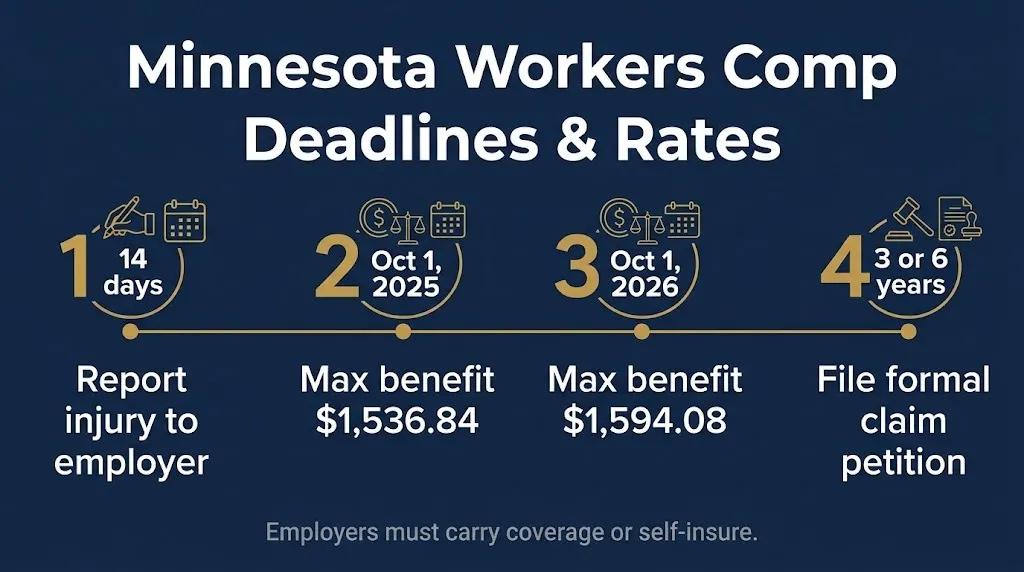
- Most important deadline? Report your injury to your employer within 14 days to protect your benefits, and file a formal claim within three years if a First Report of Injury was filed .
If you’re searching for workers compensation insurance MN, you’re probably on one side of the system. Maybe you own a small business and just hired your first employee. Maybe you got hurt on the job and want to know what the policy actually covers.
Here’s the direct answer. Minnesota runs a no-fault workers’ comp system, and the insurance is mandatory for nearly every employer. The policy pays medical bills and wage-loss benefits, and it protects the employer from most lawsuits.
This article covers the employer rules, the real cost per employee, the benefit caps that reset every October, and the deadlines that decide whether an injured worker gets paid or gets denied.
The Facts
| The Facts | |
|---|---|
| System | Minnesota workers’ compensation, regulated by the Department of Labor and Industry (DLI) |
| Who Must Carry | All employers, with narrow exemptions for certain family members and officers |
| Max Weekly Benefit | $1,594.08 for injuries on or after Oct. 1, 2026 |
| Wage Replacement Rate | 66 2/3 percent of average weekly wage |
| Report Deadline | 14 days to employer for full protection |
| Claim Filing Deadline | 3 years from First Report of Injury, or 6 years from injury if no report |
| Average Cost | Roughly $112 per employee monthly, above the $74 national average |
Do All Minnesota Employers Need Workers Compensation Insurance?
Yes, all Minnesota employers must carry workers’ compensation insurance or qualify as self-insured. The law defines an employer broadly as anyone who hires others to perform services .
The exemptions are narrow. Corporate officers who own at least 25 percent of a closely held corporation with 10 or fewer employees and less than 22,880 hours of payroll in the prior year may be exempt. A spouse, parent, or child of that officer is also exempt. LLC members have similar rules .
Nonprofits are not automatically exempt. A nonprofit that pays more than $1,000 in total salary or wages in a year, including part-time employees, must provide coverage .
The penalty for going without is steep. The state can order you to stop hiring until you secure insurance. It can also fine you up to $1,000 per employee per week you operated without coverage .
How Much Does Workers Compensation Insurance Cost in Minnesota?
The average workers’ comp premium in Minnesota runs about $112 per employee monthly, according to a 2026 analysis, compared with a $74 national average . That figure swings wildly by industry and job classification.
An office-based financial services firm might pay around $15 per month per employee. A construction company could pay $311 per month. Transportation and logistics tops the list at roughly $339 per month .
The premium formula is straightforward: classification rate times experience modification rate times annual payroll divided by $100 . The classification rate reflects the risk of the work. The experience modification rate reflects your company’s claims history, and it only applies once annual premiums reach $5,000.
Minnesota uses its own classification system, not the NCCI database most states rely on . That means rates can differ from what a multi-state employer expects.
If you cannot get coverage in the voluntary market, the Minnesota Workers’ Compensation Assigned Risk Plan is the insurer of last resort. Coverage is arranged through an insurance agent or by contacting the plan directly .
What Does Workers Compensation Insurance Cover in Minnesota?
A Minnesota workers’ comp policy pays for medical care, wage-loss benefits, permanent disability benefits, vocational rehabilitation, and death benefits. The policy responds to injuries and occupational diseases that arise out of and in the course of employment .
Medical benefits cover reasonable and necessary treatment for the work injury. Wage-loss benefits replace part of your lost income. There is a three-calendar-day waiting period before wage-loss benefits begin, and the insurer must start paying within 14 days of the date your employer knew about the injury and lost wages .
Permanent partial disability benefits compensate for permanent damage or loss of function to a body part. Vocational rehabilitation helps if you cannot return to your pre-injury job or employer. Death benefits go to surviving dependents .
What the policy does not cover: injuries caused by intoxication, drug use, or company policy violations. It does not cover wages for a replacement worker or OSHA fines .
Reality Check: No one calls you from the state offering workers’ comp money. The DLI does not charge injured workers a filing fee. If a “claims service” wants payment to unlock your benefits, it’s a scam. Your employer’s insurer pays the claim, and the DLI hotline helps workers for free .
How Much Are Minnesota Workers Compensation Benefits in 2026?
The maximum weekly benefit for injuries occurring on or after October 1, 2026 is $1,594.08. That reflects the new statewide average weekly wage of $1,476.00 .
For injuries between October 1, 2025 and September 30, 2026, the cap was $1,536.84, based on a statewide average weekly wage of $1,423 . The minimum weekly benefit for that period was $307.37, which is 20 percent of the maximum .
Your actual benefit depends on your earnings. Temporary total disability pays 66 2/3 percent of your gross weekly wage at the time of injury, capped at the state maximum. If you earned $900 per week, your benefit is about $600. If you earned $3,000 per week, your benefit is the cap.
| Injury Date | Max Weekly Benefit | Statewide Avg Weekly Wage |
|---|---|---|
| Oct. 1, 2025 to Sept. 30, 2026 | $1,536.84 | $1,423 |
| On or after Oct. 1, 2026 | $1,594.08 | $1,476 |
Benefits adjust annually for injuries on or after October 1, 2013, but increases are limited to a maximum 3 percent per year .
How Do You Report a Work Injury in Minnesota?
You report a work injury by telling your employer within 14 days for full protection, and ideally in writing with a copy kept for yourself. The law gives you up to 180 days to report, but waiting past 14 days gives the insurer an argument to deny benefits .
The DLI is explicit on this. If you tell your employer within 14 days, your notice is on time. If you wait more than 180 days, no benefits are allowed unless you were mentally or physically incapacitated .
Reporting the injury is not the same as filing a formal claim. Telling your supervisor starts the clock on the insurer’s obligation to respond. Filing a Claim Petition is the legal step that protects your rights if the insurer disputes the claim.
The 14-day window is like a store return policy. You can sometimes return an item after 30 days, but the cashier has more discretion to say no. Report immediately and you remove that discretion.
What Is the Deadline to File a Workers Compensation Claim in Minnesota?
The deadline to file a formal claim is three years from the date the First Report of Injury was filed with the DLI, or six years from the injury date if no report was filed .
Those two clocks create a strange incentive. If your employer files the First Report of Injury promptly, your three-year window starts early. If your employer never files, you get six years from the injury date.
The First Report of Injury is the document the employer or insurer submits to the state. The DLI’s own guidance ties the three-year claim deadline to that filing date, not the injury date . An injured worker who assumes the clock starts on the accident date may be wrong.
Occupational diseases follow a different rule. The discovery rule can apply, meaning the clock starts when you discover the disease is work-related, not when you were first exposed .
What Happens If Your Minnesota Workers Comp Claim Is Denied?
A denial is not the end. It means the insurer is refusing to pay voluntarily, and you have the right to challenge that decision through the DLI’s dispute process.
The insurer must send a Notice of Insurer’s Primary Liability Determination explaining the facts and reasons for the denial . That notice should state your appeal rights. If it doesn’t, that is a problem for the insurer.
The first step is usually contacting the DLI. The agency runs a workers’ compensation hotline staffed by specialists who answer questions for free. The Twin Cities and southern Minnesota number is (651) 284-5005 or (800) 342-5354 .
If the dispute continues, you file a Claim Petition with the DLI. A hearing follows. Most denials are fought at this level or resolved through settlement before a formal hearing.
What Happens Next
October 1, 2026 (already effective): The maximum weekly benefit rose to $1,594.08, based on the new statewide average weekly wage of $1,476 .
January 1, 2026 (already effective): A new attestation requirement applies to zero-estimated-exposure policies under HF 3228, affecting employers who report no payroll .
Ongoing: The 14-day reporting window and the three-year or six-year claim deadlines run from your injury and filing dates. Calendar them immediately.
Ongoing: Employers without coverage face fines up to $1,000 per employee per week .
Frequently Asked Questions
Is workers compensation insurance required in Minnesota?
Yes, for nearly all employers.
The law requires every employer to purchase coverage or become self-insured, with narrow exemptions for some officers and family members.
How much does workers comp insurance cost in Minnesota?
The average is about $112 per employee monthly.
Costs range from $15 for office work to over $300 for construction and transportation.
What is the maximum weekly workers comp benefit in Minnesota for 2026?
$1,594.08 for injuries on or after October 1, 2026.
For the prior year, the cap was $1,536.84.
How long do I have to report a work injury in Minnesota?
Fourteen days for full protection.
You have up to 180 days, but waiting past 14 days gives the insurer a denial argument.
How long do I have to file a workers comp claim in Minnesota?
Three years from the First Report of Injury, or six years from the injury if no report was filed.
Those deadlines are set by Minnesota Statutes § 176.141.
Can I sue my employer instead of filing workers comp in Minnesota?
Generally no.
Workers’ comp is the exclusive remedy for most workplace injuries, with narrow exceptions.
What happens if my employer doesn’t have workers comp insurance?
The state can order the employer to stop hiring and fine them up to $1,000 per employee per week.
You can still pursue benefits through the assigned risk plan or the state.
What is the assigned risk plan in Minnesota?
It is the insurer of last resort for employers who cannot get coverage in the voluntary market.
Coverage is arranged through an insurance agent.
The One Thing to Do Now
If you’re an employer, check your policy renewal date and confirm your payroll classification is accurate. A wrong class code is the most common cause of a surprise audit bill.
If you’re an injured worker, write down the injury date and report it to your employer today. The 14-day window is short, and the three-year claim clock follows fast.