How Workers Compensation Works in 2026: Benefits, Payments, and What Employers Must Cover
Quick Answer:
- Workers compensation is a no-fault insurance system that pays medical bills and partial lost wages after work injuries.
- Benefit amounts vary by state, but most replace roughly two-thirds of your average weekly wage.
- You must report your injury to your employer promptly. Missing your state’s deadline can kill your claim.
You got hurt at work. Or someone you love did. Now you are staring at confusing forms and wondering whether this system actually pays.
The short answer: yes, workers compensation works, but only if you follow its rules exactly.
This article explains the machinery behind workers compensation in 2026. You will learn what it covers, how payments are calculated, what your employer must do, and where the system fails ordinary workers.
The most surprising verified fact: most injured workers never appeal a denied claim, even though a significant percentage of appeals succeed. The system favors those who push back.
The Facts
| Detail | Verified Information |
|---|---|
| System | State-mandated workers compensation insurance |
| Governing Law | State statutes, not federal law |
| Benefit Type | Medical coverage plus partial wage replacement |
| Typical Wage Replacement | About two-thirds of average weekly wage |
| Claim Deadline | Varies by state, usually 30 to 90 days to report |
| Administrator | State workers compensation board or commission |
| Proof Needed | Medical records, incident report, wage documentation |
Is workers compensation real and mandatory?
Yes, workers compensation is a real, legally required insurance system in every U.S. state.
Every state except Texas requires most private employers to carry workers compensation insurance. Texas allows employers to opt out, but most still participate. The system has existed for over a century.
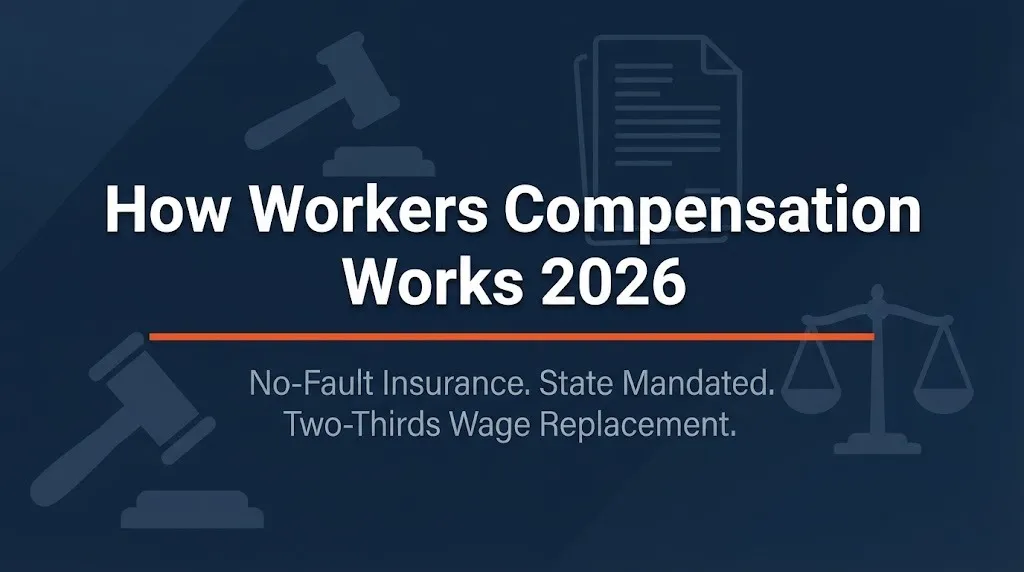
The deal is simple. Workers give up the right to sue their employer for negligence. In exchange, employers pay for medical treatment and a portion of lost wages after any work-related injury, regardless of who caused it.
This is called the no-fault bargain. You do not need to prove your employer was careless. You only need to prove the injury happened at work or was caused by your job.
The tradeoff is that you cannot sue for pain and suffering in most cases. Your benefits are limited to what the state formula provides.
What is workers compensation coverage?
Workers compensation coverage is insurance that pays for medical care and partial wage replacement when an employee is injured or becomes ill because of work.
The coverage applies to a wide range of situations. It is not limited to sudden accidents like falls or equipment failures. It also covers repetitive stress injuries, occupational illnesses, and mental health conditions in some states, though mental health claims are harder to win.
Here is what standard workers compensation coverage includes:
| Covered Benefit | What It Pays |
|---|---|
| Medical treatment | Doctor visits, surgery, medication, physical therapy |
| Temporary disability | Partial wages while you recover |
| Permanent disability | Benefits if you never fully recover |
| Vocational rehabilitation | Job retraining if you cannot return to your old job |
| Death benefits | Payments to dependents if a worker dies |
The specific limits and durations vary by state. No two states have identical workers compensation laws.
What is workers compensation insurance and who pays for it?
Workers compensation insurance is a policy your employer buys to cover work injury claims. You never pay for it.
The premium comes entirely from the employer. It is not deducted from your paycheck. It is not a tax you owe. It is a cost of doing business.
Insurance companies underwrite these policies. The premiums depend on your industry, your employer’s claims history, and your state’s rate structure. High-risk industries like construction pay more than low-risk office work.
Some large employers self-insure, meaning they pay claims directly instead of buying a commercial policy. The rules still apply the same way.
The key point for you: the insurance company is not on your side. It is a for-profit business trying to minimize payouts. That is why denied claims are common and why you need to document everything.
Key Takeaway: Workers compensation insurance is employer-funded, but the insurance company’s financial interest is to pay you as little as possible.
How do workers compensation payments work?
Workers compensation payments replace a portion of your lost wages while you cannot work.
The exact amount depends on your state’s formula. Most states use a percentage of your average weekly wage. The typical figure is about two-thirds, though the precise number ranges from 60 to 72 percent depending on where you live.
Here is how the calculation usually works:
| Wage Component | How It Is Used |
|---|---|
| Average weekly wage | Based on your earnings before the injury |
| State replacement rate | Usually 66.67 percent of that wage |
| Maximum weekly benefit | Capped at a state-set dollar amount |
| Minimum weekly benefit | Floored at a state-set minimum |
| Tax treatment | Workers compensation benefits are not taxable |
For example, if you earned $900 per week and your state uses a two-thirds rate, your temporary disability check would be about $600 per week before any caps apply. The cap matters. High earners often hit the maximum and receive less than two-thirds of their actual wage.
What is workers compensation payments in 2026?
Workers compensation payments in 2026 follow the same structure as prior years, with state-specific maximum and minimum rates adjusted annually.
Each state updates its workers compensation benefit rates periodically. Many states adjust their maximum weekly benefit based on the state average weekly wage. That means the dollar figures change year to year, but the formula stays the same.
Here is the breakdown of payment types:
| Payment Type | When You Receive It |
|---|---|
| Temporary total disability | While completely unable to work |
| Temporary partial disability | While working reduced hours or lighter duty |
| Permanent partial disability | After reaching maximum medical improvement |
| Permanent total disability | If you can never return to any work |
| Death benefits | Paid to surviving dependents |
The duration of payments also varies. Some states cap temporary benefits at a certain number of weeks. Permanent partial disability benefits often use a schedule based on the body part injured.
How much does workers compensation pay per week?
The weekly amount depends on your average weekly wage and your state’s replacement rate, with caps applied.
Most states set the replacement rate at two-thirds of your average weekly wage. But the cap is where many workers get surprised. If your state caps weekly benefits at $1,200 and you earned $2,000 per week, you will receive $1,200, not $1,333.
Here is a simplified example across three wage levels:
| Pre-Injury Weekly Wage | Two-Thirds Rate | Typical Cap | Actual Weekly Benefit |
|---|---|---|---|
| $600 | $400 | $1,200 | $400 |
| $1,200 | $800 | $1,200 | $800 |
| $2,400 | $1,600 | $1,200 | $1,200 |
The cap protects the system from high payouts. It also means higher earners take a bigger financial hit after a work injury.
Reality Check
Workers compensation is not a lottery ticket. It pays a fraction of your wages, not a windfall. And the insurance company has a financial incentive to deny or minimize your claim. If you treat this like a formality, you will likely leave money on the table. Document everything. Report immediately. Push back on denials.
How do I file a workers compensation claim?
Filing a workers compensation claim is a process with strict deadlines. Missing one step can delay or kill your claim.
Here is the sequence, step by step:
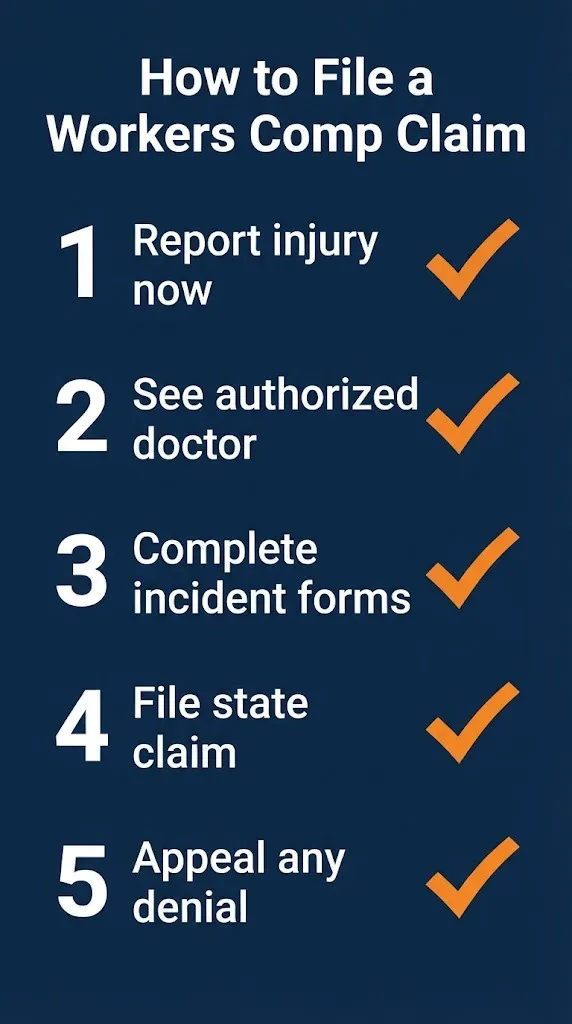
- Report the injury to your employer immediately, preferably in writing.
- Seek medical attention and tell the doctor it was a work injury.
- Complete any employer-required incident report forms.
- File a claim with your state’s workers compensation board if your employer does not.
- Keep copies of every medical record, bill, and wage statement.
- Follow all medical treatment recommendations from your authorized doctor.
- Track every deadline in your state’s workers compensation rules.
- Appeal any denial in writing before your state’s deadline.
The reporting deadline is the one that kills most claims. Many states require written notice within 30 days. Some give you longer. None give you forever.
What injuries does workers compensation cover?
Workers compensation covers any injury or illness that arises out of and in the course of employment.
That phrase is the legal standard in every state. It means two things must be true. First, the injury happened while you were doing your job. Second, the injury was caused by your work.
Here are the categories that typically qualify:
- Sudden accidents, such as falls, equipment injuries, or vehicle crashes on work time.
- Repetitive stress injuries, such as carpal tunnel syndrome or back strain from lifting.
- Occupational illnesses, such as lung disease from chemical exposure.
- Aggravation of pre-existing conditions, if work made the condition worse.
- Mental health conditions, in limited circumstances and only in some states.
Injuries during your commute are usually not covered. Injuries during lunch breaks off-site are usually not covered. Injuries from fighting or intoxication are usually not covered.
Key Takeaway: The phrase “arising out of and in the course of employment” is the gatekeeper. If your injury does not fit that legal standard, it will not be covered.
What does workers compensation not cover?
Workers compensation excludes certain injuries and situations by law.
The exclusions are important because they surprise people after the fact. You may think you are covered, only to find out the state considers your injury outside the system.
Here are the common exclusions:
| Exclusion | Why It Is Not Covered |
|---|---|
| Commuting injuries | Not considered on the job |
| Injuries from intoxication | Employee misconduct |
| Injuries from fighting | Not work-related unless defending against an attack |
| Self-inflicted injuries | Employee intent |
| Off-duty recreational activities | Not within the scope of employment |
| Ordinary diseases of life | Not caused by work |
Some states allow exceptions. A traveling employee may be covered during their commute. A fight may be covered if you were defending yourself. The rules are not always absolute.
What are the workers compensation deadlines in 2026?
Deadlines vary by state, but the most important one is your injury reporting deadline.
Every state has a notice requirement. You must tell your employer about the injury within a certain window. The clock usually starts on the date of injury or the date you reasonably knew the injury was work-related.
Here is a general framework:
| Deadline Type | Typical Range |
|---|---|
| Report to employer | 30 to 90 days |
| File formal claim | 1 to 3 years |
| Appeal a denial | 30 to 60 days |
| Request a hearing | Varies by state |
These are not universal. Your state may have different rules. The only safe move is to report immediately and file immediately. Waiting never helps.
Key Takeaway: The workers compensation system rewards speed. Every day you wait makes your claim harder to prove and easier to deny.
What happens after I file a workers compensation claim?
After you file, the insurance company investigates and decides whether to accept or deny the claim.
The investigation usually includes reviewing your medical records, your employment history, and the circumstances of the injury. The insurer may request an independent medical examination with a doctor they choose.
Here is the typical sequence:
- You report the injury and file the claim.
- The insurer investigates, usually within 14 to 30 days.
- The insurer accepts or denies the claim.
- If accepted, benefits begin and continue during your recovery.
- If denied, you have a limited window to appeal.
- Appeals may go through administrative hearings or mediation.
- A judge or hearing officer issues a decision.
The process can be slow. Even accepted claims can stall if the insurer disputes treatment or disability duration.
Can I see my own doctor for a workers compensation injury?
In many states, no. You must see a doctor chosen by your employer or the insurance company.
This is one of the most misunderstood parts of the system. Workers compensation is not like regular health insurance. You do not get free choice of doctor in most states.
The rules vary. Some states let you choose from a list of approved providers. Some let you see your own doctor after a waiting period. Some give the employer full control.
The practical effect is that the doctor treating you may have a financial relationship with the insurance company. That does not automatically mean the doctor is biased. But it is a structural conflict of interest you should understand.
If you disagree with the authorized doctor’s assessment, many states allow you to request an independent medical examination. That is a second opinion from a doctor not chosen by either side.
What happens if my workers compensation claim is denied?
A denial is not the end of the road. You have the right to appeal, and many appeals succeed.
The most common reasons for denial are missed deadlines, disputes about whether the injury is work-related, and medical evidence that the insurer says does not support the claim.
Here is what to do if you get a denial letter:
- Read the denial letter carefully and note the stated reason.
- Check your state’s appeal deadline. It is often 30 to 60 days.
- Gather additional medical evidence supporting your claim.
- File your appeal in writing with your state’s workers compensation board.
- Consider consulting a workers compensation attorney.
- Prepare for a hearing where you can present your evidence.
The appeal process is not fast. It can take months. But the data shows that workers who appeal have a meaningful chance of reversing the denial, especially with legal representation.
Key Takeaway: A denial is the insurance company’s first offer, not the final word. The system is built for appeals, and most injured workers who fight get at least a partial recovery.
What happens next in workers compensation?
Here is what to expect if you are entering the workers compensation system in 2026:
- Immediately: Report your injury and seek medical care. Do not wait.
- Within 30 days: The insurer should accept or deny your claim in most states.
- During recovery: You may need to attend independent medical examinations.
- After maximum medical improvement: The insurer may assign a permanent disability rating.
- If denied: Your appeal clock starts immediately. File quickly.
These stages are general. Your state’s timeline may differ. The key is to act fast at every step.
Frequently Asked Questions
Is workers compensation mandatory for all employers?
Most private employers must carry workers compensation insurance. Texas is the main exception, allowing employers to opt out.
How long do workers compensation payments last?
It depends on your injury. Temporary benefits last until you recover or reach maximum medical improvement. Permanent benefits follow state schedules.
Are workers compensation benefits taxable?
No, workers compensation benefits are not subject to federal income tax.
Can I be fired for filing a workers compensation claim?
No, firing an employee for filing a claim is illegal retaliation in every state. But proving retaliation can be difficult.
What if my injury was my own fault?
Workers compensation is no-fault. You are covered even if you made a mistake, as long as you were not intoxicated or acting intentionally.
How long do I have to report a work injury?
Most states require notice within 30 to 90 days. Report immediately to protect your rights.
Can I sue my employer instead of filing workers compensation?
Usually no. Workers compensation is your exclusive remedy against your employer, with narrow exceptions for intentional harm.
Do I need a lawyer for workers compensation?
Not always, but a lawyer can help if your claim is denied or if you have a permanent disability.
Closing
The most important rule in workers compensation is speed. Report your injury now. File your claim now. Document everything now.
The system works, but it rewards workers who treat it seriously. The insurance company will. You should too.