Indiana Workers Compensation Attorney 2026: What They Do, What It Costs, and How to File a Claim
Quick Answer
- An Indiana workers compensation attorney helps injured workers get medical care and wage replacement benefits from employers or insurers.
- Most charge a contingency fee of 20% of your settlement, capped by Indiana law and approved by the Board.
- The most important deadline is 30 days to notify your employer, and 2 years to file a claim from the injury date.
You got hurt at work. The medical bills are starting. Your employer or their insurance company is not answering your questions.
An Indiana workers compensation attorney is a lawyer who represents injured workers in claims against employers and insurance carriers under the Indiana Worker’s Compensation Act. That is the direct answer.
This article explains what these attorneys do, what they cost in 2026, how Indiana’s system works, and what to expect if you file a claim.
The Facts
| Topic | Indiana Workers Compensation Attorney |
| Status | Active practice area, no major statutory changes for 2026 |
| Typical Attorney Fee | 20% of settlement, must be approved by the Worker’s Compensation Board |
| First Report Deadline | 30 days from injury or knowledge of injury |
| Claim Filing Deadline | 2 years from injury date |
| Wage Replacement Rate | 66.67% of average weekly wage, subject to state maximum |
| Governing Body | Indiana Worker’s Compensation Board |
Is an Indiana workers compensation attorney worth it?
In many cases, yes. The Indiana workers compensation system is supposed to be straightforward, but insurers have lawyers. You should too.
A good workers compensation attorney levels the playing field. They know what your claim is worth, how to document your injuries, and how to push back when the insurer denies or undervalues your claim.
You do not always need one. Simple, accepted claims with minor injuries may resolve without legal help. But the moment you face a denial, a dispute over medical care, or a push to return to work too soon, an attorney becomes worth the fee.
What does an Indiana workers compensation attorney do?
An Indiana workers compensation attorney handles every part of a work injury claim from the first report to settlement or hearing.
The work includes:
- Filing the claim with the Indiana Worker’s Compensation Board
- Gathering medical records and work restrictions
- Calculating your average weekly wage and benefit rate
- Negotiating with the insurance carrier
- Representing you at a hearing before a Board member
- Reviewing settlement agreements before you sign
The attorney’s job is to protect your right to medical care and wage replacement. They do not work for your employer. They work for you.
How much does a workers compensation attorney cost in Indiana?
Indiana law caps attorney fees in workers compensation cases. The standard fee is 20% of your settlement, and the Worker’s Compensation Board must approve it.
That means you do not pay upfront. You pay nothing out of pocket. The attorney gets paid only if you settle or win benefits.
For a $50,000 settlement, the attorney fee would be $10,000 at 20%. For a $100,000 settlement, it would be $20,000. The fee comes out of your settlement, not out of your pocket.
| Settlement Amount | Attorney Fee at 20% | Your Net Before Costs |
|---|---|---|
| $25,000 | $5,000 | $20,000 |
| $50,000 | $10,000 | $40,000 |
| $100,000 | $20,000 | $80,000 |
Some cases involve hourly fees for specific disputes, but the 20% contingency model is the norm for most injured workers.
Key Takeaway: Indiana workers compensation attorneys work on contingency, take a Board-approved 20% fee, and charge nothing upfront.
What is the deadline to report a work injury in Indiana?
You must report your work injury to your employer within 30 days. The clock starts on the date of the injury or the date you knew the injury was work-related.
If you miss the 30-day deadline, your claim can still proceed, but the delay gives the employer and insurer a defense. They may argue the injury did not happen at work or was not reported promptly.
Report in writing if possible. Text, email, or a signed note all work. Keep a copy. The paper trail protects you later.
What is the deadline to file a workers compensation claim in Indiana?
You have 2 years from the date of the injury to file a claim with the Indiana Worker’s Compensation Board.
For occupational diseases that develop over time, the deadline runs from the date you knew or should have known the condition was work-related.
Missing the 2-year filing deadline usually bars your claim completely. That is the single most important date in your case. Do not wait until the last month.
How much are Indiana workers compensation benefits in 2026?
Indiana pays wage replacement at 66.67% of your average weekly wage, subject to a state maximum that adjusts each year. The maximum weekly benefit is set by the Indiana Worker’s Compensation Board.
For temporary total disability, you receive two-thirds of your gross average weekly wage. The average is calculated from your earnings before the injury.
Medical benefits are paid separately. Your employer or its insurer must pay for reasonable and necessary medical treatment related to your work injury. There is no dollar cap on medical care for accepted claims.
What is a workers compensation settlement in Indiana?
A settlement is an agreement between you and the employer or insurer to close the claim. You receive a lump sum, and in exchange you give up your right to future benefits.
Settlements in Indiana require Board approval. The Board reviews the agreement to ensure it is fair and that you understand your rights.
A settlement may cover permanent impairment, future medical care, or both. The language in the agreement matters. Once you sign and the Board approves, the claim is over. You cannot reopen it later, except in narrow fraud or mistake cases.
Reality Check: No workers compensation attorney can guarantee a specific settlement amount. If a lawyer promises you a number before reviewing your medical records and wage history, walk away. Good attorneys talk ranges and probabilities, not guarantees.
What should you do immediately after a work injury in Indiana?
The first hours and days after a work injury shape the entire claim.
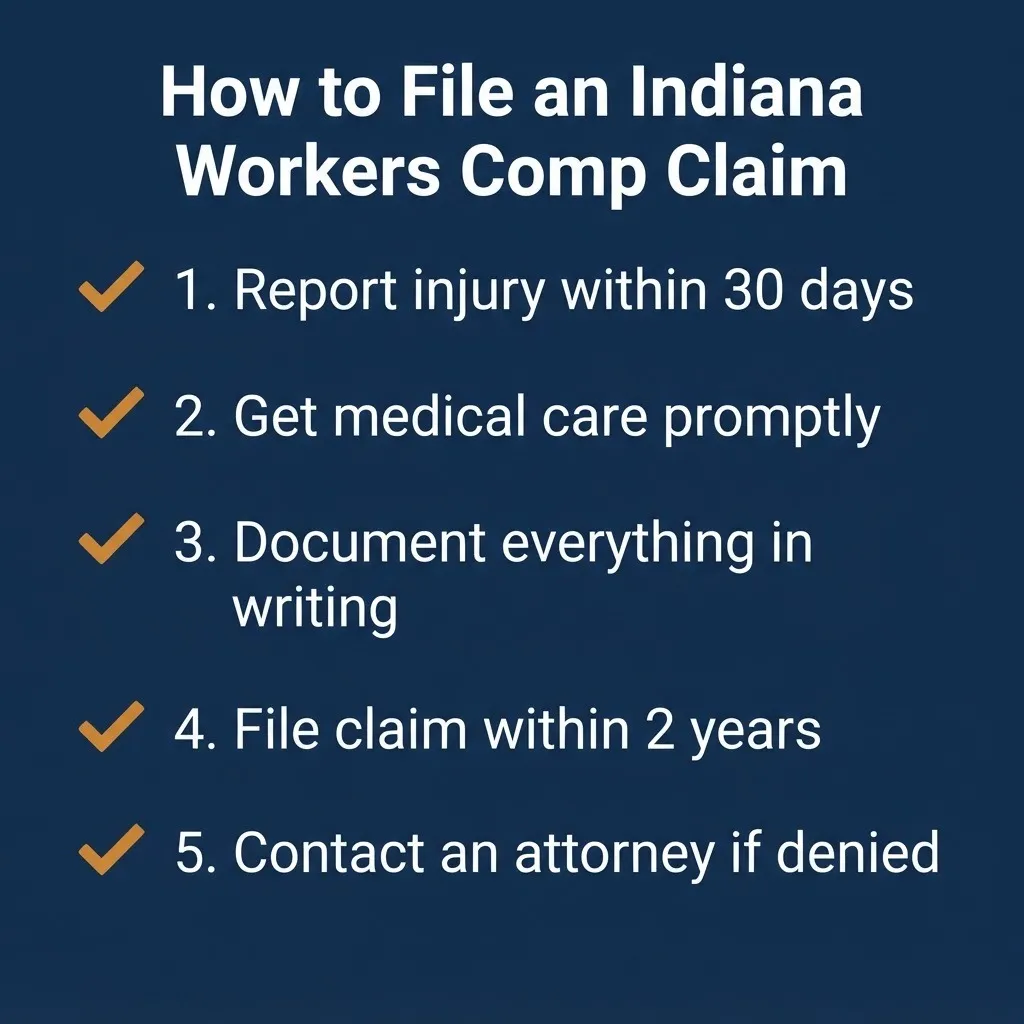
Here are the steps.
- Report the injury to your supervisor immediately.
- Get medical care from an approved provider if your employer designates one.
- Write down what happened, including witnesses and timeline.
- Take photos of the injury and the accident scene.
- Keep every medical record, bill, and work note.
- File a report with your employer in writing within 30 days.
- Contact a workers compensation attorney if the claim is denied or delayed.
The more you document, the harder it is for the insurer to dispute what happened.
What injuries are covered by Indiana workers compensation?
Indiana workers compensation covers almost any injury or illness that arises out of and in the course of your employment.
Covered conditions include:
- Slips, trips, and falls at work
- Repetitive motion injuries like carpal tunnel
- Back and neck injuries from lifting or accidents
- Machinery accidents and crush injuries
- Exposure to toxic substances
- Occupational diseases developing over time
- Mental injuries tied to a physical work injury
Injuries from intoxication or willful self-harm are generally not covered. Horseplay or a purely personal fight at work may also fall outside coverage.
Key Takeaway: Indiana covers nearly all work-related injuries, but the burden is on you to show the injury arose out of your employment.
Can you choose your own doctor in an Indiana workers compensation case?
It depends. Indiana law allows employers to designate a medical provider for treatment.
If your employer has a posted list of approved providers, you generally must treat with one of them. If the employer has not designated a provider, you may choose your own.
Emergency care is always covered. Once you are stable, follow-up care rules apply.
If you need a second opinion or a specialist, your attorney can request a change of provider through the Board. The process exists but can be slow.
What happens if your workers compensation claim is denied?
A denial is not the end. You have the right to request a hearing before the Indiana Worker’s Compensation Board.
The process works like this.
- You receive a denial letter from the insurer.
- Your attorney files an Application for Adjustment of Claim.
- The Board schedules a hearing.
- Both sides present evidence and testimony.
- A Board member issues a decision.
- Either side may appeal the decision.
Many denials are resolved before a hearing through negotiation. But the hearing is your legal right, and the Board exists to resolve disputes.
What is the Indiana Worker’s Compensation Board?
The Indiana Worker’s Compensation Board is the state agency that oversees workers compensation claims. It resolves disputes, approves settlements, and maintains records.
The Board has members appointed by the governor. It holds hearings around the state. Most injured workers never see a hearing. Their claims settle first.
The Board also maintains an ombudsman program for workers without attorneys. You can call the Board directly with questions about your claim.
Key Takeaway: The Indiana Worker’s Compensation Board is the referee. It approves settlements, hears disputes, and sets the rules insurers must follow.
How long does a workers compensation case take in Indiana?
Most workers compensation cases in Indiana resolve within 6 to 18 months. Simple accepted claims may settle faster. Disputed claims can take two years or more.
| Case Stage | Typical Timeframe |
|---|---|
| Injury report | Day 1 to 30 |
| Initial medical treatment | Weeks 1 to 12 |
| Temporary disability payments | Ongoing until maximum medical improvement |
| Settlement talks | 6 to 18 months |
| Board hearing if disputed | 12 to 24 months |
| Board decision after hearing | 18 to 30 months |
The timeline depends on your injury, your recovery, and how hard the insurer fights.
What happens next after you hire an Indiana workers compensation attorney?
Once you hire an attorney, the case moves into a more formal phase.
| Timing | Action |
|---|---|
| Week 1 | Attorney sends a letter of representation to the employer and insurer |
| Weeks 2 to 4 | Attorney gathers medical records and wage documents |
| Month 2 to 6 | Attorney negotiates with the insurance adjuster |
| Month 6 to 12 | Settlement discussions or hearing scheduling |
| Month 12 and beyond | Hearing, decision, and possible appeal |
Your attorney handles the paperwork. You handle your recovery and keep every medical appointment.
Frequently Asked Questions
Is a workers compensation attorney worth it in Indiana?
Yes, for denied or disputed claims.
For simple accepted claims, you may not need one.
How much does a workers compensation attorney charge in Indiana?
Indiana attorneys charge 20% of your settlement.
The Board must approve the fee, and you pay nothing upfront.
What is the deadline to file a workers compensation claim in Indiana?
You must file within 2 years of the injury date.
You must report the injury to your employer within 30 days.
Can I be fired for filing a workers compensation claim in Indiana?
Indiana law prohibits retaliation for filing a claim.
If you are fired for filing, you may have a separate legal claim.
Do I have to use the company doctor?
You must use the employer’s designated provider if one is posted.
If no provider is designated, you can choose your own doctor.
What if my employer does not have workers compensation insurance?
Indiana law requires most employers to carry coverage.
An uninsured employer can face fines, and you may have a civil claim.
Can I settle my Indiana workers compensation case without an attorney?
You can, but the Board reviews settlements for fairness.
An attorney can help you understand what you are giving up.
If you were hurt at work in Indiana, the clock is already running. Report the injury within 30 days. File your claim within 2 years. Do not wait for the insurer to act.
A workers compensation attorney costs nothing upfront and takes a Board-approved 20% fee only if you settle. The most important date in your case is the 2-year filing deadline. Know it. Put it on your calendar. Then make the call.