Workers Compensation Georgia 2026: What You’re Owed, How to File, and the Deadlines That Matter
Quick Answer
- Georgia workers’ compensation is a real, mandatory, state-run insurance system, not a lawsuit or a scam text.
- Weekly wage replacement is two-thirds of your average pay, capped at $800 per week for most injuries since July 1, 2023.
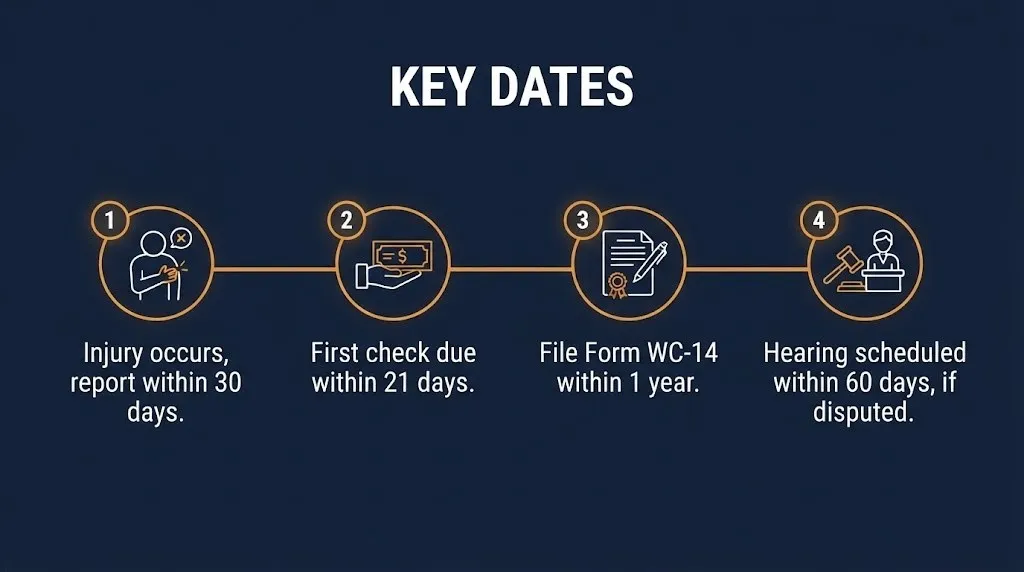
- You must report an injury within 30 days and file Form WC-14 within 1 year of the accident to protect your right to benefits.
If you got hurt on the job in Georgia, you don’t need a class action or a settlement notice to get paid. You need to understand a state law that’s been on the books since 1920, and a filing window that closes fast if you miss it.
This matters most to anyone currently out of work after a job injury, or watching a claim get delayed. The single number to remember is $800, the current weekly benefit ceiling, and the single date to remember is one year from your accident, the hard deadline to file Form WC-14.
This guide covers who’s covered, how much you can actually collect, and how to file. One detail that surprises a lot of workers: Georgia caps a widowed spouse’s death benefit at $320,000 total unless they remarry.
The Facts
| Case | Georgia’s Workers’ Compensation Law, O.C.G.A. Title 34, Chapter 9 |
| Status | Active, ongoing state benefit system (not a lawsuit or settlement) |
| Fund Size | Not applicable, each employer or insurer pays its own claims |
| Est. Per Person | Two-thirds of average weekly wage, capped at $800/week (TTD) or $533/week (TPD) |
| Claim Deadline | Report to employer within 30 days; file Form WC-14 within 1 year of the accident |
| Administrator | Georgia State Board of Workers’ Compensation |
| Proof Needed | Form WC-14, plus records from an authorized treating physician |
Is Workers Compensation in Georgia Legit and Mandatory?
Workers compensation in Georgia is a real, legally required insurance program, not a marketing pitch. Any private employer with three or more employees, including regular part-timers, must carry it by law.
The system is run by a state agency, the State Board of Workers’ Compensation, established in 1920. It’s not tied to any recent lawsuit or class action headline you may have seen elsewhere.

You’re covered starting your very first day on the job. That surprises a lot of new hires who assume there’s a waiting period before an injury counts.
Key checks before you trust anything you’re told about a claim:
- Confirm your employer actually carries coverage through the Board’s online lookup tool.
- Get the name of the insurance carrier in writing from HR.
- Save every text, letter, or email about your claim.
What Is the Georgia State Board of Workers’ Compensation?
The State Board of Workers’ Compensation is the state agency that oversees every workers comp claim filed in Georgia. It sits at 270 Peachtree Street NW in Atlanta and serves over a quarter million employers statewide.
It isn’t an insurance company and it doesn’t pay claims directly in most cases. It writes the rules, hears disputes, and enforces the law when an employer refuses coverage.
The Board runs several divisions people actually deal with: Claims and Documents Processing, the Trial Division for hearings, and Enforcement for fraud or uninsured employers. You can reach the main office at (404) 656-3818 in metro Atlanta or 1-800-533-0682 statewide.
Key Takeaway: Georgia’s workers’ compensation system is a mandatory state-run insurance program, not a lawsuit, and it’s overseen by a single state agency you can call directly.
How Much Does Workers Compensation Pay in Georgia?
Georgia pays two-thirds of your average weekly wage for time missed after a job injury, up to a state maximum. That maximum is $800 per week for accidents occurring on or after July 1, 2023, per the Board’s own published guidance.
Benefits start once you’ve missed more than 7 days of work. If you’re out 21 or more consecutive days, that first week gets paid retroactively.
Your first check is supposed to arrive within 21 days of your first missed day. Multiple third-party sites claim the cap has since risen to $850 or even $875 for 2026, but the Board’s current official FAQ still lists $800 as the controlling figure, so treat any higher number as not yet confirmed.
| Benefit Type | Rate | Weekly Cap |
|---|---|---|
| Temporary Total Disability (TTD) | 66.67% of average weekly wage | $800/week |
| Temporary Partial Disability (TPD) | 66.67% of wage difference | $533/week |
What Is the Maximum Weekly Benefit in Georgia Workers Compensation Insurance?
The maximum weekly benefit for total disability in Georgia is $800, and it applies to any accident on or after July 1, 2023. That figure comes straight from the State Board’s official law FAQ page.
This cap applies no matter how high your actual wages were before the injury. A worker earning $2,000 a week and one earning $1,200 a week both max out at the same $800 ceiling.
Some private legal-marketing sites list different 2026 figures, ranging from $675 to $875. None of those numbers appear on the Board’s own site as of this writing, so treat them as unverified until the Board publishes an updated rate.
Reality Check: Nobody legitimate will text you out of nowhere offering to “process” your Georgia workers comp check for a fee. Filing with the State Board is free, and a paid “claim helper” contacting you first is a red flag, not a shortcut.
What If I Return to Work at a Lower-Paying Job?
If your injury forces you into a lower-paying job, Georgia pays temporary partial disability, or TPD, to cover part of the gap. You get two-thirds of the difference between your old and new wages.
That benefit is capped at $533 per week for accidents on or after July 1, 2023. It can run for up to 350 weeks from your date of injury.
This only kicks in once you’ve actually returned to work in some capacity. It doesn’t apply while you’re still fully out on TTD.
What Happens If I Lose a Body Part or Suffer Permanent Disability?
Permanent disability benefits in Georgia are paid according to a fixed schedule tied to the body part affected. Losing an arm or a leg, for example, pays out 225 weeks of benefits at your compensation rate.
An authorized treating physician assigns your impairment rating using the AMA’s Guides to the Evaluation of Permanent Impairment, fifth edition. That rating drives how many weeks you’re owed.
Sample scheduled injury weeks:
- Arm or leg: 225 weeks
- Hand: 160 weeks
- Foot: 135 weeks
- Eye: 150 weeks
Loss of use, not just physical loss, can also qualify. If you lose function in a body part without losing it outright, you can still be compensated based on the extent of that loss.
What Benefits Do My Dependents Get If I Die From a Workplace Accident?
If a worker dies from a job-related accident, Georgia pays dependents two-thirds of the worker’s average weekly wage, capped at $800 per week. Dependents include a surviving spouse, children, or dependent stepchildren.
A widowed spouse with no children is capped at a $320,000 total lifetime payout, unless they remarry or enter a new cohabiting relationship, in which case the payments stop. That cap is one of the more surprising limits in the whole system.
Key Takeaway: Georgia’s benefit formula is consistent across injury types: two-thirds of average wage, capped at $800 a week, with fixed schedules for permanent losses and a hard $320,000 ceiling for a childless widowed spouse.
How Do I File a Workers Compensation Claim in Georgia?
You file a Georgia workers comp claim by submitting Form WC-14 to the State Board of Workers’ Compensation. This is the official document that protects your legal right to benefits.
Filing itself is simple, but timing is everything. Miss the window and you can lose your claim entirely, even if the injury is completely legitimate.
Steps to file:
- Report the injury to your employer immediately, never wait past 30 days.
- Get treatment from a physician on your employer’s posted panel.
- Request Form WC-14 from the Board or download it from sbwc.georgia.gov.
- Complete and submit the form to the State Board.
- Keep a copy of everything you send.
- If benefits stop or are denied, request a hearing through the same form.
- Track the deadline: 1 year from your date of accident.
What Proof or Documentation Do I Need?
You need medical records from an authorized treating physician and a completed Form WC-14 to support a Georgia workers comp claim. Documentation is what separates a paid claim from a disputed one.
Your employer must post a panel of at least six physicians, including one orthopedic doctor and no more than two industrial clinics. You choose from that list and can make one change without your employer’s permission.
What insurers typically want to see:
- Authorized doctor’s diagnosis and treatment notes
- Documentation of missed work days
- Wage records to calculate your average weekly wage
- The completed WC-14 form itself
How Long Do I Have to File a Workers Compensation Claim in Georgia?
You have one year from your date of accident to file Form WC-14 with the State Board of Workers’ Compensation. Miss it and you can permanently lose your right to benefits.
There’s a separate, shorter clock too. You must report the accident to your employer within 30 days, or you risk losing benefits even before the one-year filing deadline arrives.
Think of it like a warranty claim on a major appliance. Report the problem right away, then file the paperwork before the coverage window closes, or you’re on your own.
What If My Claim Is Denied or My Employer Disputes It?
If your employer or their insurer disputes your claim, you can request a hearing before an Administrative Law Judge through the State Board. That hearing works much like a trial, with both sides presenting evidence.
Hearings are generally scheduled within 60 days of the judge receiving your WC-14 form. They’re held in or near the county where the injury happened.
You’re allowed to represent yourself, but your employer’s insurer will likely bring a lawyer. That imbalance is exactly why many workers choose to hire their own attorney once a dispute starts.
How Long Does It Take to Get Paid After Filing?
Your first weekly benefit check is supposed to arrive within 21 days of your first missed day of work, according to the Board’s own FAQ. That’s the baseline timeline for an uncontested claim.
If your claim gets disputed, payment can stretch out much longer, sometimes well past a year, according to attorney-published estimates. Those extended timelines aren’t officially tracked by the Board and should be treated as anecdotal, not guaranteed.
Key Takeaway: Filing on time only gets you halfway there. Documentation and a clean medical record are what actually move a claim toward payment inside that 21-day window.
Do I Need a Lawyer for My Georgia Workers Comp Claim?
You’re not legally required to hire a lawyer to file or pursue a Georgia workers comp claim. The State Board processes claims from unrepresented workers every day.
That said, your employer’s insurer can and often does bring legal representation to a hearing. If a claim gets denied, delayed, or your benefit calculation looks wrong, legal help evens the odds.
Attorney fees in Georgia are capped by law. No fee greater than 25% of your weekly benefit award or settlement can be approved by the Board, and any fee over $100 needs Board approval first.
Which Employers Must Carry Workers Compensation Insurance in Georgia?
Any private employer in Georgia with three or more employees, including regular part-time staff, must carry workers compensation insurance. That threshold is higher than in many other states.
Some categories fall outside mandatory coverage, including sole proprietors, independent contractors, and certain agricultural and domestic workers, though exceptions and exclusions vary by situation. You can verify a specific employer’s coverage directly through the Board’s website lookup tool.
Employers who skip required coverage face real penalties. The Board can assess civil fines between $500 and $5,000 per violation for failing to carry coverage.
What Injuries and Situations Are Not Covered Under Georgia Workers Compensation?
Georgia workers compensation does not cover injuries caused by an employee’s own willful misconduct. That exclusion is written directly into the law and gets tested often in disputed claims.
Coverage generally excludes situations tied to intoxication or a knowing failure to use provided safety equipment, though how that plays out depends heavily on the specific facts of a claim. This is one area where the difference between a covered claim and a denied one often comes down to documentation, not the injury itself.
Common exclusions cited by legal sources (not exhaustive, verify specifics with the Board):
- Injuries from willful misconduct
- Intoxication-related incidents
- Refusal to use provided safety gear
What’s Changing in Georgia Workers Compensation Law in 2026?
As of this writing, the State Board’s own published FAQ still lists $800 as the maximum weekly benefit, with no confirmed statutory increase for 2026. Several private legal-marketing sites report a pending increase or new reporting rules, but none of those claims appear on the Board’s official pages.
Some sites reference a “Senate Bill 452” reporting-window change or a construction-industry contractor exclusion for 2026. Those claims are not yet confirmed through the Board or Georgia General Assembly records checked for this article, so treat them as unverified until the Board updates its own guidance.
Key Takeaway: The safest number to plan around right now is still $800 a week, straight from the Board’s own FAQ, not the higher figures circulating on third-party legal-marketing sites.
What Happens Next
Ongoing: The $800 weekly maximum benefit remains in effect for injuries on or after July 1, 2023, with no official increase confirmed for 2026.
Within 30 days of any injury: Report the accident to your employer immediately to preserve your rights.
Within 1 year of any injury: File Form WC-14 with the State Board to lock in your claim.
Expected, ongoing: The Board continues to monitor for a possible rate adjustment; check sbwc.georgia.gov directly for any confirmed 2026 change.
Frequently Asked Questions
Is Georgia workers compensation a scam or a real program?
It’s a real, state-mandated insurance system run by the State Board of Workers’ Compensation.
It’s not connected to any lawsuit settlement text or email you may have received.
How much does workers comp pay per week in Georgia?
You get two-thirds of your average weekly wage, capped at $800 per week for most 2023-and-later injuries.
Some third-party sites cite higher 2026 figures, but those aren’t confirmed on the Board’s own page.
How long do I have to file a workers comp claim in Georgia?
You must file Form WC-14 within one year of your accident date.
You also need to report the injury to your employer within 30 days to avoid losing benefits earlier.
Do all Georgia employers have to carry workers comp insurance?
Employers with three or more employees, including part-timers, are required to carry coverage.
Some categories like sole proprietors and independent contractors may fall outside that requirement.
What if my employer doesn’t have workers comp insurance?
You can still pursue a claim, and uninsured employers face civil penalties from the Board.
Report suspected uninsured employers to the Board’s Enforcement Division.
Can I choose my own doctor for a work injury in Georgia?
You generally choose from a posted panel of at least six physicians your employer provides.
You’re allowed one change to another doctor on that same list without needing employer approval.
What if my workers comp claim gets denied?
You can request a hearing before an Administrative Law Judge through the State Board.
Hearings are typically scheduled within 60 days of the judge receiving your WC-14 form.
Do I need a lawyer to file a Georgia workers comp claim?
No, you can file and pursue a claim on your own without an attorney.
Attorney fees, when used, are capped at 25% of your award or settlement by law.
Check your accident date against the one-year filing clock today, since that single deadline decides whether your claim gets heard at all. Keep every medical record and form copy in one place, and confirm any number you read online against the Board’s own FAQ before you rely on it.