Workers Compensation Insurance for Sole Proprietors 2026: What You Actually Need
Quick Answer
- Sole proprietors can usually opt out of workers comp for themselves, but state rules vary and some states mandate coverage.
- Clients and general contractors often require proof of coverage before you can work.
- Coverage costs depend on your state, industry, and payroll, with minimum premiums often starting under $500 annually.
Workers compensation insurance for sole proprietors is not a lawsuit or a settlement. It is a coverage decision that affects your business every day. The rules are not uniform. They change by state and by contract.
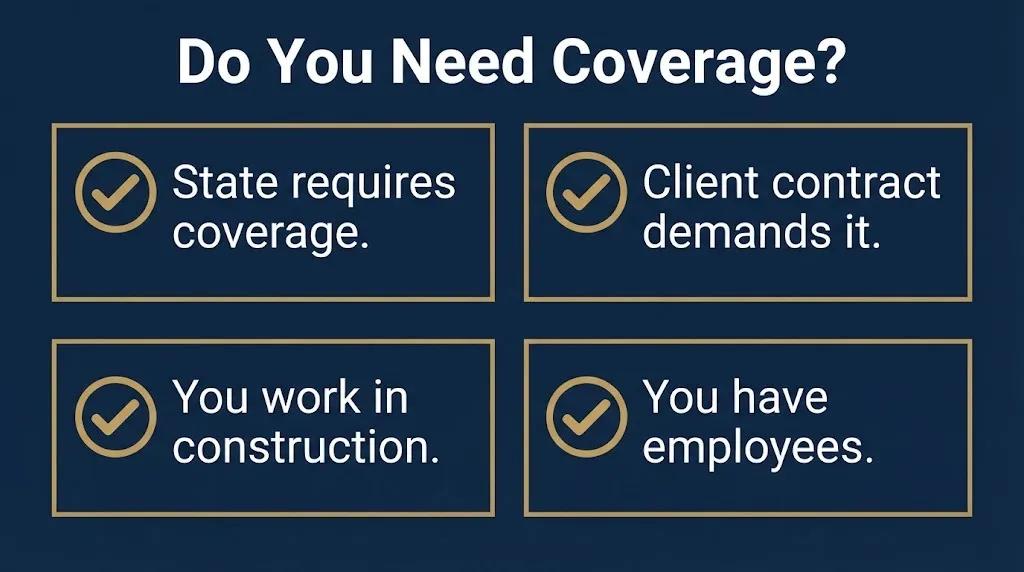
You might not need coverage by law. You might still need it to get hired. The gap between legal requirement and practical requirement confuses thousands of independent contractors every year.
This article explains what sole proprietors need to know in 2026. It covers who must carry coverage, what it costs, and what happens if you skip it.
The Facts
| Fact | Detail |
|---|---|
| General Rule | Sole proprietors with no employees can usually opt out |
| State Exceptions | Some states require coverage regardless |
| Common Requirement | Client and general contractor contracts |
| Cost Range | Minimum premiums vary, often $250 to $750 annually |
| Coverage | Medical, wage replacement, disability |
| Key Entity | State workers compensation boards |
Is Workers Comp Required for Sole Proprietors in 2026?
The general answer is no, but the practical answer is often yes.
Most states allow sole proprietors with no employees to exempt themselves from workers compensation coverage. You are not legally required to insure yourself against your own workplace injury.

The exception is states with mandatory coverage rules. A few states require coverage even for sole proprietors in certain industries. Construction is the most common example.
Even where the law says no, your clients may say yes. Many general contractors and large companies require proof of workers comp from anyone working on their projects. They do this to avoid liability if you get hurt. Your coverage protects them.
Key Takeaway: The legal requirement for sole proprietor workers comp is state-specific, but contract requirements often make coverage a practical necessity.
What Does Workers Comp Cover for a Sole Proprietor?
Workers compensation covers three main things when you are injured on the job.
Medical expenses come first. The policy pays for doctor visits, surgery, hospital stays, and prescription drugs tied to your workplace injury.
Wage replacement comes second. If your injury keeps you from working, the policy pays a portion of your lost income. The percentage and duration vary by state.
Disability benefits come third. If your injury causes permanent impairment, the policy pays based on the severity and your average wage.
The coverage applies only to work-related injuries. A car accident on the way to the grocery store is not covered. A fall at a job site is.
How Much Does Workers Comp Cost for a Sole Proprietor?
The cost depends on your state, your industry classification, and your payroll.
Workers comp premiums are calculated as a rate per $100 of payroll. Your industry class code determines the rate. Roofers pay more than accountants. The risk is different.
Sole proprietors typically choose a minimum payroll amount because they have no employees. The insurer assigns a standard payroll figure, often between $20,000 and $50,000, depending on the state and class code.
The result is a minimum premium. In many states, that minimum falls between $250 and $750 annually for low-risk industries. Higher-risk trades can see minimums above $1,000.
| Industry Class | Typical Annual Minimum |
|---|---|
| Clerical / Office | $250 to $500 |
| Carpentry | $500 to $1,000 |
| Roofing | $1,000 to $2,500 |
| Electrical | $500 to $1,200 |
| Landscaping | $500 to $1,500 |
These ranges are general. Your exact premium depends on your state and insurer.
How Do You Get Workers Comp as a Sole Proprietor?
Getting coverage is a process, but it is not complicated.
Step 1: Determine whether your state allows self-exemption or requires coverage.
Step 2: Check your client contracts for workers comp requirements.
Step 3: Identify your industry class code. Your insurer can help.
Step 4: Request quotes from at least two insurers or a broker.
Step 5: Choose a payroll basis for your policy. Minimum payroll is common.
Step 6: Pay the premium and receive your certificate of insurance.
Step 7: Provide the certificate to clients who require proof.
Step 8: Renew or adjust the policy annually as your business changes.
Can a Sole Proprietor Opt Out of Workers Comp?
In most states, yes. The opt-out process involves filing a form with your state workers compensation board.
The form declares that you are a sole proprietor with no employees and that you waive coverage for yourself. The waiver means you cannot claim workers comp benefits if you are injured.
Some states allow the waiver. Some do not. Some allow it for certain industries but not others. Construction is often excluded from the opt-out option because the risk is high and the public interest in coverage is strong.
If you opt out and later hire an employee, the waiver no longer applies. You must then carry coverage for your employee, and you may want to add yourself back onto the policy.
What Happens If a Sole Proprietor Skips Workers Comp?
The consequences depend on whether you were required to have coverage.
If your state does not require it and your clients do not ask, skipping coverage means you carry the risk yourself. If you are injured, you pay your own medical bills. You have no wage replacement. You have no disability benefits.
If your state requires coverage and you skip it, the consequences are serious. You may face fines, stop-work orders, and personal liability for your own injury costs. In some states, you cannot bid on public contracts without proof of coverage.
If a client requires coverage and you skip it, you lose the work. The client cannot legally allow you on site without proof of insurance in many cases.
Reality Check: Workers comp is not a scam and not a tax. It is a risk transfer. Skipping it saves money until an injury happens, then the savings disappear in one hospital bill.
Is Workers Comp the Same as General Liability Insurance?
No. They cover different things and are often sold separately.
Workers comp covers your own workplace injuries. It pays your medical bills and lost wages. It does not cover damage you cause to someone else’s property.
General liability covers damage you cause to third parties. If you knock over a client’s expensive equipment, general liability pays. It does not cover your own injury.
Many sole proprietors buy both. Clients often require both. A workers comp policy and a general liability policy together form the basic insurance package for independent contractors.
Key Takeaway: Workers comp and general liability cover different risks, and most contractors need both to satisfy client requirements.
Do Independent Contractors Need Workers Comp in 2026?
The answer is the same as for sole proprietors. It depends on state law and client contracts.
Independent contractors are often classified as sole proprietors for insurance purposes. The same opt-out rules apply. The same client requirements apply.
The complication is misclassification. If a worker is called an independent contractor but functions like an employee, the hiring company may be required to provide workers comp coverage. Courts and state agencies look at the actual working relationship, not just the label.
If you are truly independent, you are responsible for your own coverage. If you are misclassified, you may be entitled to coverage from the company that hires you.
What States Require Workers Comp for Sole Proprietors?
The map is not uniform. Some states make coverage mandatory for all sole proprietors. Others allow broad opt-out. Most fall somewhere in between.
States with stricter rules often target construction and high-risk industries. Even in states where sole proprietors can generally opt out, construction work frequently requires coverage by law or by contract.
The best source for your state’s current rule is your state workers compensation board. Rules change. What applied in 2024 may not apply in 2026.
Do not rely on a national blog or a forum post for this. Check the state agency that enforces the law.
How Do Clients Verify Your Workers Comp Coverage?
Clients ask for a certificate of insurance. The certificate is a standard form issued by your insurer.
It shows your name, your policy number, your coverage dates, and your policy limits. It proves you have coverage without revealing what you paid.
You can usually get a certificate from your insurer within a day of purchasing coverage. Some insurers let you generate certificates online through a portal.
Keep your certificate current. If your policy lapses, the certificate is no longer valid. Clients who verify coverage will catch the lapse.
What Is the Penalty for Not Having Workers Comp When Required?
Penalties vary by state but can be severe.
Common penalties include fines that accrue per day of noncompliance, stop-work orders that shut down your business until you get coverage, and personal liability for injury costs that would have been covered.
In some states, operating without required workers comp is a criminal offense. That is rare but possible for repeat violations.
The financial risk of the penalty usually exceeds the cost of the premium. Paying $500 for coverage is cheaper than paying $5,000 in fines plus your own medical bills.
Should a Sole Proprietor Buy Workers Comp Even If Not Required?
The decision depends on your risk and your contracts.
If you work alone in a low-risk occupation and no client requires coverage, you might reasonably skip it. Your own health insurance covers medical bills. Your emergency fund covers lost income.
If you work in construction, roofing, electrical, or any physical trade, the risk changes. One fall can end your income for months. Workers comp provides wage replacement that health insurance does not.
If your clients require it, the decision is made for you. You either buy coverage or lose the work.
Key Takeaway: The decision to buy workers comp as a sole proprietor balances legal requirements, contract demands, and personal risk tolerance.
What Are the Most Common Mistakes Sole Proprietors Make With Workers Comp?
The mistakes are predictable and avoidable.
- Assuming workers comp is never required for sole proprietors
- Skipping coverage to save money, then losing a contract that requires it
- Failing to update coverage when hiring a first employee
- Confusing workers comp with general liability
- Relying on outdated state rules
- Not getting a certificate of insurance before the client asks
- Misclassifying employees as independent contractors to avoid coverage
Each mistake has a cost. The cost is usually higher than the premium that would have prevented it.
What Does the Future Hold for Sole Proprietor Workers Comp?
The trend is toward more coverage requirements, not fewer.
States are tightening rules around worker classification. More workers are being reclassified as employees, which triggers mandatory coverage. Clients are requiring proof of coverage more often as liability concerns grow.
The gig economy complicates the picture. Platforms classify workers as independent contractors, but states are pushing back. The outcome of those disputes affects whether gig workers need coverage and who pays for it.
Expect continued state-by-state variation. No federal law is likely to standardize sole proprietor workers comp in the near term.
What Should You Do Right Now?
Check your state’s rules. Visit your state workers compensation board website and find the sole proprietor requirements. Do not guess.
Then check your client contracts. If any of them require workers comp, get coverage before you lose the work.
The single most important fact: most states allow sole proprietors to opt out, but your clients may not.
Key Takeaway: Workers comp for sole proprietors is a state-specific, contract-driven decision. Verify your state rules and your client requirements before deciding.
Frequently Asked Questions
Is workers comp required for sole proprietors?
Usually not, but some states require it for certain industries like construction.
Client contracts often require it even when state law does not.
How much does workers comp cost for a sole proprietor?
Minimum premiums often range from $250 to $750 annually for low-risk industries.
Higher-risk trades pay more, sometimes over $1,000 annually.
Can a sole proprietor opt out of workers comp?
In most states, yes, by filing a waiver with the state workers compensation board.
Some states and industries do not allow the opt-out.
What does workers comp cover for self-employed people?
It covers medical expenses, wage replacement, and disability for work-related injuries.
It does not cover non-work injuries or general liability claims.
Do independent contractors need workers comp?
The same rules apply to independent contractors as to sole proprietors.
State law and client contracts determine the requirement.
What happens if I do not have workers comp and get hurt?
You pay your own medical bills and lose your income with no wage replacement.
If coverage was required, you may also face fines and penalties.
Is workers comp the same as general liability?
No, workers comp covers your own injuries, while general liability covers damage to others.
Most contractors need both types of coverage.
How do I prove I have workers comp to a client?
Your insurer issues a certificate of insurance.
The certificate shows your coverage dates and policy limits.
What You Should Remember
Workers comp for sole proprietors is not one-size-fits-all. Your state rules and your client contracts decide whether you need coverage.
Check both before you decide. The cost of coverage is usually less than the cost of an uncovered injury or a lost contract.
The single most important action: verify your state requirements today, then check every contract you have signed or plan to sign.