Worker Compensation Quote 2026: California Costs, Rules, and How to Buy
Quick Answer
- California requires nearly every employer with at least one employee to carry workers’ compensation insurance, no exceptions by size.
- Cost is not one fixed number. The statewide average benchmark is $1.65 per $100 of payroll starting September 2026.
- There is no purchase deadline tied to a date. Coverage must be active before you hire your first employee.
If you’re searching for a worker compensation quote, here’s the direct answer: in California, you need one the moment you hire your first employee, full stop. California Labor Code Section 3700 makes this mandatory, with no small-business carve-out.
This affects sole proprietors adding their first hire just as much as it affects contractors and larger companies. The single most important number right now is the state’s new advisory rate of $1.65 per $100 of payroll, approved by Insurance Commissioner Ricardo Lara and effective September 1, 2026.
This article breaks down what actually drives your quote price, how to shop for coverage, and which requirements are genuinely changing this year. One detail that surprises a lot of business owners: California’s rate just jumped for the second year running, up 6.6% from 2025.
The Facts
| Category | Detail |
|---|---|
| Topic | Workers’ compensation insurance quotes for California employers |
| Requirement | Mandatory under California Labor Code Section 3700 for any employer with one or more employees |
| Statewide Average Rate | $1.65 per $100 of payroll, effective September 1, 2026 (California Department of Insurance) |
| Estimated Cost Range | Not a fixed figure. Class code rates run roughly $0.28 to $87.83 per $100 of payroll |
| Contractor Deadline | Full SB 216 enforcement delayed from January 2026 to January 1, 2028 under SB 1455 |
| Key Insurer | State Compensation Insurance Fund (State Fund), alongside private carriers |
| Proof Needed to Buy | Payroll totals, employee count, class codes, and prior claims history |
Is a Workers Compensation Quote Required in California?
Yes, if you have even one employee, California requires you to carry workers’ compensation insurance or qualify for state-approved self-insurance. California Labor Code Section 3700 sets this rule, and it applies from your very first hire.
There’s no employee-count threshold like some states use. One part-time worker, one seasonal hire, or one family member on payroll triggers the requirement immediately.
The only real exceptions involve business owners who qualify for narrow carve-outs, such as certain corporate officers who own at least 15% of company stock and elect to exclude themselves. True independent contractors, correctly classified, generally fall outside the requirement too, though misclassification is a common and costly mistake.
Key Takeaway: California has no small-business exemption, so a workers’ compensation quote becomes necessary the day you sign your first employee’s paperwork.
How Much Does Workers Compensation Insurance Cost in California?
Not a single number. California’s cost depends on your industry class code, total payroll, and claims history, not a flat statewide fee.
The state’s official benchmark, called the advisory pure premium rate, climbed to $1.65 per $100 of payroll effective September 1, 2026. That’s a 6.6% increase over the 2025 approved rate, according to the California Department of Insurance.
Individual class codes vary far more widely than that average suggests.
| Cost Metric | Verified Figure |
|---|---|
| Statewide average (2026, effective Sept 1) | $1.65 per $100 of payroll |
| Prior year average (2025 filing) | $1.52 per $100 of payroll |
| Lowest tracked class code rate | Around $0.28 per $100 of payroll |
| Highest tracked class code rate | Around $87.83 per $100 of payroll |
A low-risk clerical job and a high-risk roofing job in the same company can carry wildly different rates. That’s why two businesses with identical payroll totals can pay very different premiums.
What Determines Your Workers Compensation Insurance Quote Price?
Your quote price comes down to four main factors: your class code, your payroll, your experience modification rating, and your chosen insurer. Each one moves the number independently.
Class codes assign a rate based on job duties, not job titles. California’s WCIRB, the state’s own rating bureau, classifies businesses rather than individual roles.
Your experience modification rating, often shortened to EMR, reflects your claims history compared to similar businesses. A clean claims record can push your rate below the class code average. A history of frequent claims pushes it higher.
- Class code: tied to the type of work performed, not the employee’s title
- Total payroll: rate applies per $100 of payroll, so higher payroll means higher premium
- Experience modification rating: reflects past claims relative to industry peers
- Carrier choice: private insurers and the State Fund can price the same risk differently
Reality Check: No legitimate insurer or broker can promise an exact price before reviewing your payroll and class codes, and any “instant guaranteed quote” that skips those questions deserves a second look.
How Do You Purchase Workers Compensation Insurance in California?
You purchase coverage by gathering your business details, getting quotes from multiple carriers, and choosing a policy before your first employee starts work. The process typically takes days, not weeks, once your paperwork is ready.
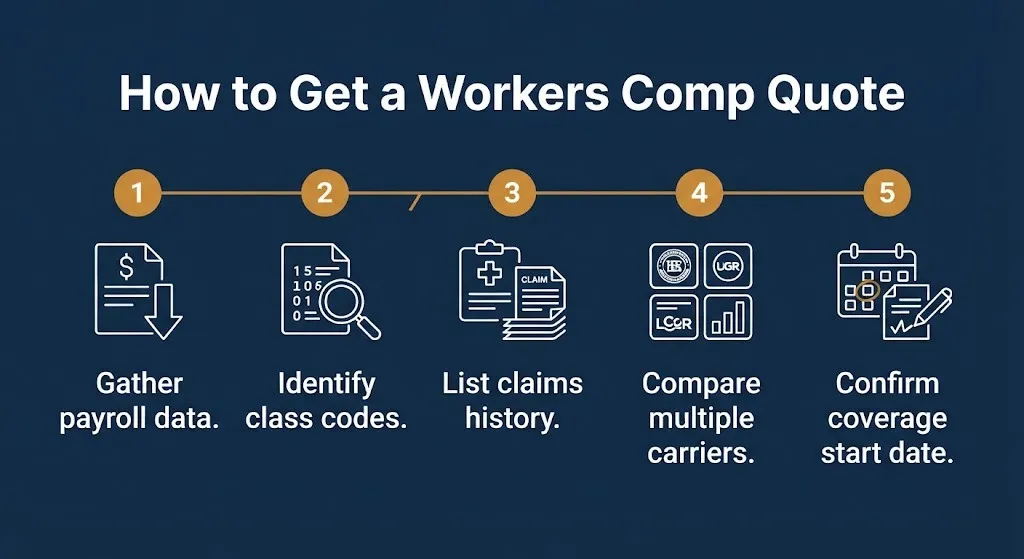
- Gather payroll totals, employee counts, and job duties for every role.
- Identify your class codes, since accuracy here affects your final price.
- Note any prior workers’ comp claims from the last several years.
- Request quotes from the State Fund and at least two or three private carriers.
- Compare not just price, but claims handling reputation and policy terms.
- Confirm your certificate of insurance before your first employee’s start date.
- Keep proof of coverage accessible for audits, licensing boards, and client requests.
Working with a licensed broker can speed this up, since brokers can shop the State Fund and multiple private carriers at once instead of you contacting each one individually.
How Do You Get an Affordable Workers Compensation Insurance Quote?
You get a more affordable quote by classifying jobs accurately, maintaining a clean claims record, and comparing multiple carriers instead of accepting the first offer. Small errors in classification often cost more than shopping around saves.
Think of class code accuracy like filing your taxes correctly. Misclassifying a desk job as a warehouse job overpays your premium, just like overstating income overpays your tax bill.
Practical ways to lower your quote:
- Double check that every role is classified under the correct WCIRB class code
- Ask your broker to shop the State Fund alongside at least two private carriers
- Maintain a safety program that can help reduce future claims and your experience rating
- Bundle payroll reporting accurately, since underreporting can trigger costly audits later
Key Takeaway: Accurate class codes and a clean claims history do more to lower your quote than switching carriers alone.
What Is a Ghost Policy and Do You Need One?
A ghost policy is a workers’ compensation policy that provides proof of coverage for a business owner with no employees, typically without covering the owner personally. Some California licensing boards require it even when you work solo.
This matters most for licensed contractors. Certain contractor categories in California have needed proof of workers’ comp coverage even without employees, and that requirement is expanding under state law.
If you’re a sole owner-operator bidding on contracts or holding a license that requires proof of coverage, ask your broker directly whether a ghost policy applies to your situation. Skipping this step can disqualify you from bidding on jobs even if you never technically needed employee coverage.
What Information Do You Need for a Workman’s Compensation Insurance Quote?
You need payroll figures, job classifications, and claims history before any carrier can generate an accurate quote. Skipping details here usually means a rougher, less reliable estimate.
Carriers and brokers typically ask for:
- Total annual payroll, broken out by employee or role
- Job duties for every position, used to assign class codes
- Number of employees, including part-time and seasonal workers
- Prior claims history, generally covering the past three to five years
- Business entity type, since sole proprietors, LLCs, and corporations are treated differently
Having this ready before you request quotes speeds up the comparison process and avoids repeat back-and-forth with each carrier.
What Is the Current 2026 Workers Compensation Rate Update in California?
California’s advisory pure premium rate rose to $1.65 per $100 of payroll, effective September 1, 2026, following approval from Insurance Commissioner Ricardo Lara. That’s the state’s official benchmark rate, not an individual policy price.
This marks the second consecutive annual increase. The September 2025 filing had already pushed the average to $1.52 per $100 of payroll, itself 8.7% above the 2024 level.
Commissioner Lara said the state must keep guiding the market with data to protect injured workers and support businesses. The increase reflects rising claims costs tracked by the WCIRB, California’s independent workers’ comp rating bureau.
Key Takeaway: California’s official benchmark rate has now risen for two years straight, so expect your renewal quote to run higher than last year’s, even with an unchanged claims record.
Are California Contractor Workers Comp Rules Changing in 2026?
Yes, but the toughest new requirement has been delayed. Senate Bill 216 originally required all licensed contractors, even those without employees, to carry workers’ compensation insurance starting January 1, 2026.
Senate Bill 1455 pushed full enforcement of that requirement to January 1, 2028 instead. The Contractors State License Board is building a verification system for legitimate no-employee exemptions in the meantime.
Until the 2028 deadline, proof of coverage is still required for contractor categories already covered under prior rules, including roofing contractors without employees, along with any licensee that has employees.
| Milestone | Verified Date |
|---|---|
| Original SB 216 full enforcement | January 1, 2026 (superseded) |
| SB 1455 delayed enforcement date | January 1, 2028 |
| Roofing contractors (C-39), no employees | Already required before SB 216 |
What Is the List of Workers Compensation Insurance Companies in California?
California employers can buy coverage from the State Compensation Insurance Fund or from numerous licensed private carriers competing in the state. There is no single official “approved list,” since any properly licensed carrier can write policies here.
Commonly cited carriers writing workers’ compensation business in California include:
- State Compensation Insurance Fund (State Fund), the state’s own nonprofit insurer
- The Hartford
- Travelers
- Liberty Mutual
- Employers Holdings
- Chubb
- Zurich
- ERGO NEXT (formerly Next Insurance)
- Pie Insurance
- Coverdash
Always confirm any carrier’s current California license status directly with the California Department of Insurance before buying, since carrier lineups and licensing shift over time.
What Is the State Compensation Insurance Fund and Should You Use It?
The State Compensation Insurance Fund, known as State Fund, is California’s state-created workers’ compensation insurer that competes directly with private carriers. It’s not a government mandate. You’re free to buy from private insurers instead.
State Fund is often worth including in your comparison because it generally accepts most employers without the restrictive underwriting some private carriers apply to higher-risk industries. That makes it a practical option if you’ve been declined or quoted unusually high elsewhere.
It doesn’t automatically mean State Fund is the cheapest option for your business. Rates still depend on your class codes and claims history, so compare it against private quotes rather than assuming it wins by default.
What Happens if You Don’t Carry Workers Compensation Insurance in California?
You face fines, potential criminal misdemeanor charges, and a state-ordered stop-work order if you operate without required coverage. California treats this as a serious compliance failure, not a paperwork technicality.
Reported penalty ranges vary by source, generally spanning roughly $10,000 to $100,000 depending on business size and how long the business went uninsured. The Division of Labor Standards Enforcement can also halt your operations entirely until you obtain coverage.
Beyond fines, an uninsured employer can become personally liable for a workplace injury’s full medical costs and lost wages, without the protections a policy would normally provide.
What Does a Workers Compensation Policy Actually Cover?
A workers’ compensation policy covers medical expenses, a portion of lost wages, and rehabilitation costs for employees injured or made ill on the job. It also protects employers from most direct lawsuits over those same injuries.
California’s temporary disability benefit runs between 60% and 70% of an injured worker’s pre-injury average weekly earnings, depending on wage level, under a two-tier formula. The state also offers a Supplemental Job Displacement Benefit voucher for certain injured workers who can’t return to their prior role.
Always verify current minimum and maximum weekly benefit amounts directly against the California Division of Workers’ Compensation, since these figures adjust periodically.
What Happens Next for California’s Workers Comp Market?
- September 1, 2025: Prior advisory rate filing took effect at $1.52 per $100 of payroll.
- April 17, 2026: WCIRB Governing Committee authorized a new rate filing proposing a further increase.
- September 1, 2026: New advisory rate of $1.65 per $100 of payroll takes effect statewide.
- January 1, 2028: Full SB 216 contractor coverage requirement becomes enforceable.
- Expected: Continued annual rate reviews as claims costs are tracked by the WCIRB and Department of Insurance.
Frequently Asked Questions
Do I need a workers compensation quote if I have one part-time employee?
Yes, California requires coverage from your very first hire, regardless of hours worked.
There is no part-time or seasonal exemption under state law.
How much is an average workers compensation insurance quote in California?
There is no single average price, since it depends on your class code, payroll, and claims history.
The statewide benchmark rate is $1.65 per $100 of payroll, effective September 1, 2026.
Is the State Compensation Insurance Fund cheaper than private insurance?
Not automatically. State Fund tends to accept more employers without strict underwriting, but pricing still varies by class code and claims record.
Comparing State Fund against private quotes is the only reliable way to know.
Do independent contractors need a workers compensation policy?
Properly classified independent contractors generally don’t require your business to cover them.
Misclassification is a common and costly mistake, so confirm status carefully before assuming an exemption applies.
What happens if my business gets audited for workers comp compliance?
The Division of Workers’ Compensation conducts random audits and responds to employee complaints.
Missing coverage, even briefly, can trigger fines, a stop-work order, or criminal charges.
Do contractors without employees need workers comp insurance in 2026?
Full enforcement of that requirement under SB 216 was delayed to January 1, 2028 by SB 1455.
Some contractor categories, like roofing without employees, were already required to carry coverage before this delay.
Can I get a workers compensation quote without giving payroll details?
You can get a rough estimate, but an accurate quote requires payroll totals, job classifications, and claims history.
Skipping these details usually produces a less reliable number that changes once you formally apply.
Where can I verify current California workers comp rates myself?
The California Department of Insurance and the WCIRB both publish current advisory rate filings directly.
These are the most reliable sources for confirming the latest statewide benchmark.
The number to remember is $1.65 per $100 of payroll, California’s new statewide benchmark effective September 1, 2026. Your actual quote will differ based on your class codes and claims history.
Gather your payroll and employee details now, and request quotes from the State Fund alongside at least two private carriers before your coverage renews or your first employee starts.