New Jersey Workers Compensation Lawyer in 2026: Costs, Rates, and How to Find the Right One
Quick Answer
- A New Jersey workers compensation lawyer represents injured workers before the Division of Workers’ Compensation, and fees are capped by statute, not negotiated freely like other legal work.
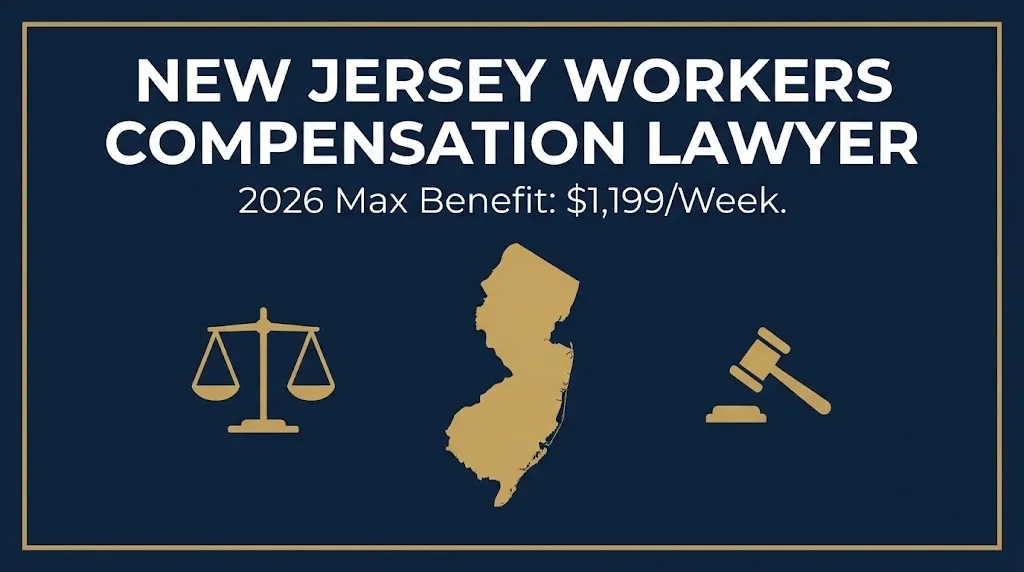
- The 2026 maximum weekly benefit is $1,199, and attorney fees are capped at 25% of the award, split between the employer’s carrier and the injured worker as the judge determines.
- You generally have 2 years from your injury date, or your last compensation payment, to file a formal Claim Petition in New Jersey.
You got hurt on the job in New Jersey and someone told you to “get a lawyer,” but you’re not sure what that actually costs or changes. Here’s the direct answer: New Jersey caps what a workers’ comp attorney can charge you by law, so the fee isn’t a mystery the way it can be in other legal matters.
This matters immediately if you’re facing a denied claim, a disputed injury, or a permanent disability rating you don’t trust. The single number worth knowing: the 2026 maximum weekly benefit is $1,199, a figure that caps what even a full wage-replacement claim can pay you per week, regardless of your actual salary.
This guide breaks down what a New Jersey workers’ comp lawyer actually does, what they’re legally allowed to charge, current 2026 benefit rates, and the filing deadlines that can end your claim if missed. One detail most searches skip: the 25% attorney fee cap must be approved by a judge before a dollar changes hands, it isn’t something a law firm sets on its own.
The Facts
| Category | What’s Verified for 2026 |
|---|---|
| Governing agency | New Jersey Division of Workers’ Compensation (DWC), under the NJ Department of Labor and Workforce Development |
| 2026 maximum weekly benefit | $1,199 (up from $1,159 in 2025), effective January 1, 2026 |
| 2026 minimum weekly benefit | $320, per NJDOL benefit rate schedule |
| Wage replacement rate | 70% of average weekly wage, subject to the maximum and minimum |
| Attorney fee cap | 25% of the award, raised from 20% under N.J.S.A. 34:15-64 (effective August 22, 2024) |
| Fee approval | Must be approved by a judge of compensation before payment |
| Employer notice deadline | 14 days ideal, 90 days absolute cutoff, under N.J.S.A. 34:15-17 |
| Claim filing deadline | 2 years from injury date or last compensation payment, under N.J.S.A. 34:15-51 |
Not every case moves through this system the same way. Whether you need a formal hearing, a motion for medical benefits, or a negotiated settlement depends entirely on how your employer’s insurance carrier responds to your claim.
What does a New Jersey workers compensation lawyer do?
A New Jersey workers compensation lawyer represents injured employees before the Division of Workers’ Compensation, handling everything from filing a Claim Petition to arguing disputed permanent disability ratings. Their role is narrower and more specialized than general personal injury work.
Because New Jersey workers’ comp claims go through an administrative court system rather than civil court, a lawyer in this specific practice area needs familiarity with DWC procedures, judges of compensation, and the statutory disability schedules that set award amounts.
Core tasks a NJ workers comp attorney typically handles:
- Filing a formal Claim Petition with the Division of Workers’ Compensation
- Filing motions for medical treatment or temporary disability benefits when a carrier delays or denies
- Negotiating settlements, including Section 20 dismissals
- Representing you at hearings before a judge of compensation
- Disputing an unfair permanent disability impairment rating
Unlike a personal injury case, a workers’ comp claim in New Jersey is no-fault, meaning you don’t need to prove your employer was negligent to receive benefits, only that the injury was work-related.
Do you need a workers compensation attorney in New Jersey?
Not every claim requires an attorney, but disputed, denied, or complex injury claims generally benefit from legal representation given the fee structure. Straightforward, undisputed claims with prompt medical treatment and full benefits sometimes resolve without one.
Situations where hiring an attorney is more commonly worth it:
- Your claim was denied or your employer disputes it’s work-related
- The insurance carrier is delaying or refusing authorized medical treatment
- You’ve reached maximum medical improvement and disagree with your impairment rating
- Your employer retaliated against you for filing a claim
- Your case is heading toward a settlement and you want the value reviewed
Situations where a claim sometimes proceeds without a lawyer:
- The injury is minor with quick, full recovery
- Your employer and their carrier accept the claim without dispute
- Medical treatment and benefits are being paid promptly and correctly
Since attorney fees in New Jersey workers’ comp are capped by statute rather than freely negotiated, the cost consideration is different from most other legal matters, where fee structures vary widely between firms.
How much does a New Jersey workers compensation lawyer cost?
New Jersey law caps workers’ compensation attorney fees at 25% of the judgment or award, a limit set by N.J.S.A. 34:15-64 and raised from 20% in August 2024. This cap applies regardless of which firm you hire, unlike most legal fee arrangements.
How the fee cap works in practice:
| Element | What’s Verified |
|---|---|
| Maximum fee | 25% of the total award or judgment |
| Prior cap | 20%, in effect from 1927 until August 22, 2024 |
| Fee approval | Must be approved by a judge of compensation before disbursement |
| Payment split | Divided between the employer’s carrier and the petitioner, as determined by the judge |
| Effective date of change | August 22, 2024, applies to all claims pending on or after that date |
In a documented example from a Section 20 settlement, a $100,000 award generated a $26,400 attorney fee under the new 25% structure, split between the employer’s carrier paying $15,840 and the petitioner paying $10,560. On a Section 20 settlement specifically, the petitioner is responsible for 100% of the fee.
Key Takeaway: Unlike most legal fees, a New Jersey workers’ comp attorney cannot charge you more than the statutory cap, and a judge must sign off on the fee before it’s paid.
How much can workers comp benefits pay in New Jersey in 2026?
New Jersey workers’ comp generally pays 70% of your average weekly wage, subject to a 2026 maximum of $1,199 and a minimum of $320 per week. This formula applies across temporary disability, permanent total disability, permanent partial disability, and dependency benefits.
2026 benefit rate table:
| Benefit Component | 2026 Rate |
|---|---|
| Wage replacement rate | 70% of average weekly wage |
| Maximum weekly benefit | $1,199 |
| Minimum weekly benefit | $320 |
| 2025 comparison maximum | $1,159 |
| Basis for calculation | New Jersey statewide average weekly wage, recalculated annually |
The 2026 rate reflects a statewide average weekly wage of $1,598.66 for 2024, a 3.4% increase from the prior year’s figure. Rates recalculate every January based on wage data from two years prior.
Reality Check: No workers’ comp claim in New Jersey requires you to pay any fee upfront to a lawyer, since fees are contingent, capped by statute, and only paid after a judge approves an award. If anyone asks for money before a case resolves, that request itself is the warning sign.
What’s the maximum weekly workers comp benefit in New Jersey for 2026?
The 2026 maximum weekly benefit is $1,199, effective for claims dated January 1, 2026 and later, an increase from $1,159 in 2025. This cap applies whether you’re receiving temporary disability, permanent total disability, permanent partial disability, or dependency benefits.
Recent rate history:
| Year | Maximum Weekly Benefit |
|---|---|
| 2022 | $1,065 |
| 2023 | $1,099 |
| 2024 | $1,131 |
| 2025 | $1,159 |
| 2026 | $1,199 |
Higher earners feel this cap the most. If 70% of your actual average weekly wage exceeds $1,199, the cap still applies, meaning your real wage loss can run higher than what the benefit actually replaces.
Key Takeaway: The 2026 benefit ceiling of $1,199 a week caps every income benefit type in New Jersey’s system, regardless of how high your pre-injury salary was.
Is attorney fee taken out of your workers comp settlement in NJ?
Yes, the attorney fee is deducted from your award, but New Jersey law splits that cost between you and the employer’s insurance carrier rather than putting the full burden on you alone. The exact split depends on the type of resolution and the judge’s determination.
How fee responsibility typically breaks down:
- Standard awards: The judge allocates the 25% fee between petitioner and respondent.
- Section 20 settlements: The petitioner is generally responsible for the full fee.
- Motions for medical or temporary disability benefits: Fees up to 25% can be awarded on benefits obtained through a successful motion.
This is different from many personal injury cases, where the client’s attorney fee comes entirely out of the client’s recovery. New Jersey’s structure shares that burden by design.
How do you find a workers compensation lawyer near you in New Jersey?
Start by confirming any attorney’s active license through the New Jersey State Bar Association, then narrow your search to workers’ compensation as a specific practice area. General practice attorneys don’t always handle DWC procedure regularly.
Steps to find a legitimate NJ workers comp attorney:
- Search the New Jersey State Bar Association’s lawyer referral service.
- Filter specifically for workers’ compensation practice, not general injury law.
- Confirm the attorney’s license is active, not suspended.
- Ask directly how many cases they’ve handled before the Division of Workers’ Compensation.
- Confirm they understand the current 25% fee cap and how it applies to your case type.
- Schedule a free consultation, common across most firms in this practice area.
- Get a written explanation of how any fee will be split between you and the carrier.
Since fees are capped by state law, comparing firms on price alone is less useful than comparing experience specifically with DWC hearings and settlements.
How do you file a workers compensation claim in New Jersey?
You file a New Jersey workers’ comp claim by notifying your employer promptly, then submitting a formal Claim Petition to the Division of Workers’ Compensation within the statutory deadline. Missing either step can jeopardize your right to benefits.
Steps to file a claim in New Jersey:
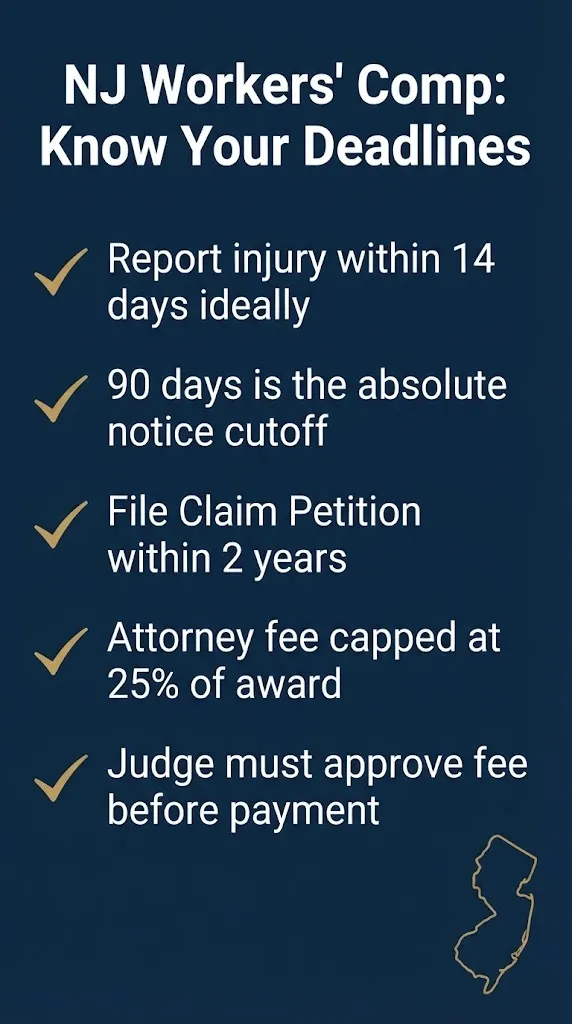
- Notify your employer of the injury, ideally within 14 days.
- Seek medical treatment, using a provider selected by your employer initially.
- Confirm your employer or their insurer has filed a First Report of Injury.
- Track your temporary disability eligibility, which begins after a 7-day waiting period.
- File a formal Claim Petition with the DWC within 2 years of the injury date.
- Request a Designated Doctor or independent evaluation if you dispute an impairment rating.
- Contact the Division of Workers’ Compensation directly if disputes arise.
Think of the notice requirement the way you’d think of a warranty claim deadline: reporting quickly protects your rights, while waiting too long can void them entirely.
What’s the deadline to file a workers comp claim in New Jersey?
You must notify your employer within 90 days of the injury at the absolute latest, and file a formal Claim Petition within 2 years of the injury date or your last compensation payment, whichever is later. These are two separate deadlines under two different statutes.
Notice deadline structure under N.J.S.A. 34:15-17:
| Timeframe | What Happens |
|---|---|
| Within 14 days | Benefits generally allowed without issue |
| Within 30 days | Minor notice defects don’t bar compensation unless the employer proves prejudice |
| Within 90 days | Compensation may still be allowed with a reasonable excuse for the delay |
| After 90 days | No compensation allowed under the statute |
Formal claim filing deadline under N.J.S.A. 34:15-51:
- 2 years from the date of injury, or from the date of the last compensation payment, whichever is later.
- Occupational illness claims, like hearing loss or repetitive motion injuries, generally run 2 years from when you first became aware the condition was work-related.
Key Takeaway: Reporting your injury within 90 days protects your eligibility, but the real filing clock is the 2-year deadline to submit a formal Claim Petition with the Division.
What happens if your New Jersey workers comp claim is denied?
A denied claim can be challenged by filing a formal Claim Petition with the Division of Workers’ Compensation, which schedules the dispute before a judge of compensation. Denial isn’t the final word, it’s the start of a formal dispute process.
General path after a denial:
- File or amend your formal Claim Petition with the DWC.
- Attend case management or pretrial conferences as scheduled.
- Present medical evidence supporting the work-related nature of your injury.
- Argue the dispute before a judge of compensation if it doesn’t resolve informally.
- Appeal through the Appellate Division if you disagree with the judge’s ruling.
Carriers dispute claims for various reasons, from questioning whether the injury is truly work-related to disputing the extent of disability. A documented medical record from the start of your treatment becomes critical evidence in any dispute.
What should you ask before hiring a NJ workers compensation attorney?
Ask how many DWC cases they’ve handled, whether they understand the current 25% fee cap, and how they typically approach disputed impairment ratings. These questions filter out attorneys without specific New Jersey workers’ comp experience.
A short vetting checklist:
- Confirm active New Jersey State Bar license status.
- Ask about specific experience before the Division of Workers’ Compensation.
- Confirm understanding of the 25% statutory fee cap and how it applies to your claim type.
- Ask how disputed permanent disability ratings are typically handled.
- Get a written explanation of how fee responsibility splits between you and the carrier.
What types of workers comp benefits exist in New Jersey?
New Jersey workers’ comp offers medical benefits, temporary disability, permanent partial disability, permanent total disability, and dependency benefits for fatal work injuries. Each category serves a different stage of recovery or outcome.
| Benefit Type | What It Covers |
|---|---|
| Medical Benefits | All reasonable and necessary treatment to cure or relieve the injury |
| Temporary Disability | Wage replacement while unable to work, beginning after a 7-day waiting period |
| Permanent Partial Disability | Compensation for lasting impairment that doesn’t fully prevent work |
| Permanent Total Disability | Ongoing benefits when the worker can’t return to gainful employment |
| Dependency Benefits | Paid to surviving family members in fatal workplace injury cases |
All of these income benefit categories share the same 2026 maximum of $1,199 and minimum of $320 per week, with the specific award amount depending on wage history and disability extent.
Can your employer fire you for filing a workers comp claim in NJ?
No, retaliation against an employee for filing a workers’ compensation claim is illegal under N.J.S.A. 34:15-39.1, which provides specific legal remedies for unlawful termination or discrimination. This protection covers firing, demotion, reduced hours, and hostile treatment tied to the claim.
If you believe you were retaliated against for filing a claim, that’s a separate legal issue from your workers’ comp benefits themselves, and it may warrant its own legal action alongside your comp claim.
What is a Section 20 settlement in New Jersey workers comp?
A Section 20 settlement is a lump-sum final resolution of a workers’ comp claim that results in dismissal of the case, under N.J.S.A. 34:15-20. This type of settlement closes out the claim entirely rather than leaving it open for future medical or disability disputes.
Because a Section 20 settlement dismisses the claim, the petitioner bears the full cost of attorney fees on that settlement type, unlike other award structures where the fee splits between petitioner and respondent. This distinction affects how settlement demands get calculated and negotiated.
Are New Jersey workers comp benefits taxable?
No, New Jersey workers’ compensation benefits are generally excluded from both federal and state income tax, consistent with the federal exclusion under IRC Section 104(a)(1). This applies whether you receive weekly payments or a lump-sum settlement.
The one narrow exception applies to workers who also receive Social Security Disability Insurance, where a workers’ comp settlement can trigger an SSDI offset, and that offset amount can become taxable. This situation only affects workers drawing both benefits simultaneously.
What’s changing with New Jersey workers compensation in 2026?
The two most direct 2026 changes are the annual benefit rate increase to $1,199 per week and the continued application of the 25% attorney fee cap enacted in August 2024. Both changes affect every active and new claim in the system.
Not yet confirmed: whether any further legislative changes to the fee structure or benefit calculation method are under serious consideration beyond what has already passed, since no additional major statutory change has been enacted as of this writing.
The rate increase happens automatically each January based on New Jersey’s statewide average weekly wage from two years prior, a mechanism that has produced steady annual increases since 2015.
What happens next
January 1, 2026 (in effect now): The $1,199 maximum and $320 minimum weekly benefit apply to current claims.
Within 90 days of any new injury: Report the injury to your employer to preserve eligibility.
Within 2 years of injury or last payment: File a formal Claim Petition with the DWC before the deadline expires.
January 2027 (expected): The NJDOL recalculates benefit rates again based on updated statewide wage data.
Frequently Asked Questions
How much does a workers comp lawyer cost in New Jersey?
New Jersey caps workers’ comp attorney fees at 25% of the award under N.J.S.A. 34:15-64.
That fee is typically split between you and the employer’s insurance carrier, as determined by a judge.
A judge of compensation must approve the fee before it’s paid.
What is the maximum workers comp payment in New Jersey for 2026?
The 2026 maximum weekly benefit is $1,199, up from $1,159 in 2025.
This cap applies to temporary disability, permanent disability, and dependency benefits alike.
The rate took effect January 1, 2026, based on New Jersey’s statewide average weekly wage.
How long do I have to file a workers comp claim in New Jersey?
You generally have 2 years from your injury date, or your last compensation payment, to file a formal Claim Petition.
You must also notify your employer, ideally within 14 days and no later than 90 days.
Missing the 2-year deadline generally bars you from future benefits.
Do I need a lawyer for a workers comp claim in New Jersey?
Not always, straightforward accepted claims sometimes resolve without one.
Denied claims, disputed impairment ratings, or delayed treatment often benefit from legal representation.
Since fees are capped by statute, the cost consideration differs from other legal matters.
Can my employer fire me for filing a workers comp claim in NJ?
No, retaliation for filing a workers’ compensation claim is illegal under N.J.S.A. 34:15-39.1.
This includes termination, demotion, reduced hours, or a hostile work environment tied to the claim.
Retaliation claims are handled separately from your underlying workers’ comp benefits.
Are New Jersey workers comp benefits taxed?
No, workers’ compensation benefits are generally excluded from federal and state income tax.
This applies to both weekly benefits and lump-sum settlements.
An SSDI offset is the one narrow exception that can create a taxable portion.
What is a Section 20 settlement in New Jersey?
A Section 20 settlement is a lump-sum resolution that dismisses your workers’ comp claim entirely.
The petitioner is responsible for the full attorney fee on this type of settlement.
It closes the case rather than leaving it open for future medical or disability claims.
How much of my paycheck does workers comp replace in New Jersey?
Generally 70% of your average weekly wage, subject to the 2026 cap of $1,199 and floor of $320.
If your actual wage replacement would exceed the cap, the maximum still applies.
The specific amount depends on your wage history and the type of disability benefit.
Confirm your notice and filing deadlines immediately after any workplace injury, since missing either one can end your claim before it starts. The number to remember for 2026: the maximum weekly benefit is $1,199, and you generally have 2 years to file a formal Claim Petition.