Employers Liability Insurance vs Workers Compensation 2026: What Each Covers and Why You Need Both
Quick Answer:
- Workers compensation pays employee medical bills and lost wages after work injuries, regardless of fault.
- Employers liability insurance protects the employer from lawsuits related to work injuries that fall outside workers compensation.
- The two coverages are usually sold together as part of a workers compensation insurance policy.
You are an employer trying to understand your insurance obligations. Or you are a worker trying to figure out what coverage actually protects you. Either way, the distinction matters.
The short answer: workers compensation and employers liability insurance are not the same thing. They are two parts of the same insurance package, and they serve different purposes.
This article breaks down exactly what each coverage does, what it costs, what it protects against, and why most businesses carry both without realizing it.
The most surprising verified fact: employers liability insurance is almost never sold as a standalone policy. It comes bundled inside your workers compensation policy as Part Two of the standard form.
The Facts
| Detail | Verified Information |
|---|---|
| Workers Compensation | Covers employee injury benefits, no-fault system |
| Employers Liability | Covers employer legal defense and damages from work injury lawsuits |
| Policy Structure | Both coverages bundled in standard workers compensation policy |
| Workers Compensation Required | Yes, in most states |
| Employers Liability Required | Yes, as part of the same policy |
| Typical Employers Liability Limit | $100,000 to $1 million per occurrence |
| Who Pays Premium | Employer only, never the employee |
Is employers liability insurance the same as workers compensation?
No, employers liability insurance is not the same as workers compensation, though the two are almost always bundled together in one policy.
The confusion is understandable. Both coverages appear in the same insurance document. Both deal with workplace injuries. Both are paid for by the employer. But they protect different parties against different risks.
Workers compensation is a no-fault system. It pays medical bills and a portion of lost wages to injured employees. The employee does not need to prove the employer was negligent. The employer receives immunity from most lawsuits in exchange.
Employers liability insurance protects the employer when that immunity breaks down. It covers the employer’s legal defense costs and any damages if an employee or a third party sues the employer over a work injury in circumstances where workers compensation immunity does not apply.
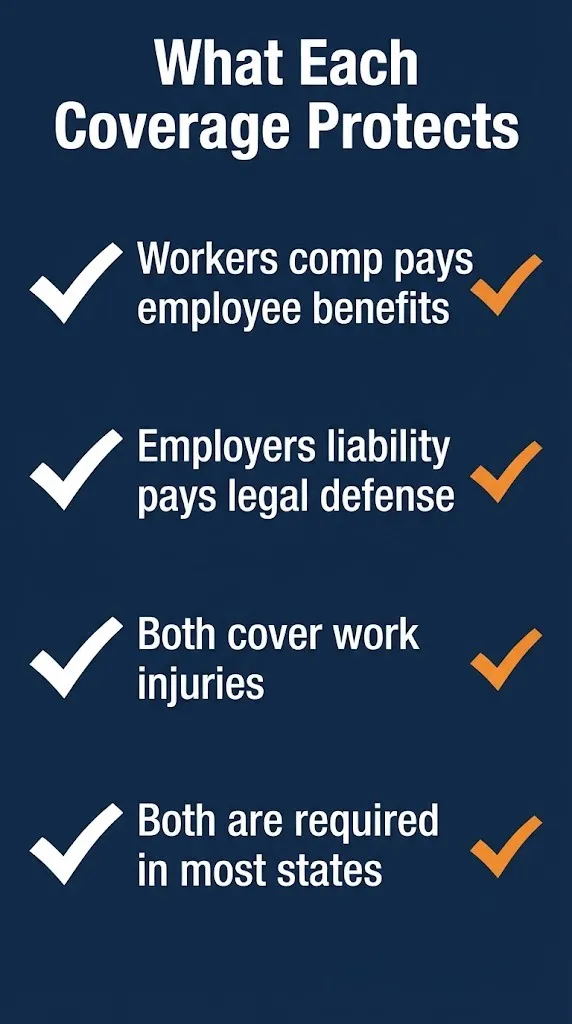
Think of it this way: workers compensation is the shield for the employee. Employers liability is the shield for the employer.
What is workers compensation coverage?
Workers compensation coverage pays for employee medical treatment and partial wage replacement after a work-related injury or illness.
The system is state-mandated. Every state except Texas requires most employers to carry workers compensation insurance. The coverage is no-fault, meaning the employee receives benefits regardless of who caused the injury.
Here is what workers compensation covers:
| Benefit Type | What It Pays |
|---|---|
| Medical treatment | Doctor visits, surgery, medication, therapy |
| Temporary disability | Partial wages while the employee recovers |
| Permanent disability | Benefits for lasting impairments |
| Vocational rehabilitation | Job retraining if the employee cannot return |
| Death benefits | Payments to surviving dependents |
The specific benefit amounts and durations vary by state. But the core principle is the same everywhere: employees give up the right to sue their employer for negligence, and in exchange they receive guaranteed benefits without proving fault.
What is employers liability coverage?
Employers liability coverage protects the employer from lawsuits arising out of work injuries when workers compensation immunity does not apply.
Workers compensation immunity is broad but not absolute. There are situations where an injured employee or a third party can sue the employer. Employers liability insurance covers the employer in those situations.
Here are the most common scenarios where employers liability coverage kicks in:
| Scenario | What Happens |
|---|---|
| Third-party lawsuit | A manufacturer sues the employer after an injured employee sues the manufacturer |
| Loss of consortium | A spouse sues for loss of companionship |
| Dual capacity claims | The employer is sued in a different role, such as property owner |
| Consequential injury | A family member is injured by the employee’s injury |
| Gross negligence | Rare cases where the employer’s conduct was extreme |
These situations are not covered by workers compensation because they are lawsuits, not benefit claims. Employers liability insurance covers the employer’s legal defense and any damages awarded.
Key Takeaway: Workers compensation pays benefits to employees. Employers liability insurance pays legal costs and damages when the employer gets sued over a work injury.
What is the difference between workers compensation and employers liability?
The difference comes down to who is protected and against what.
Workers compensation protects employees by guaranteeing benefits without proof of fault. Employers liability protects employers by covering lawsuits that fall outside workers compensation immunity.
Here is the side-by-side comparison:
| Feature | Workers Compensation | Employers Liability |
|---|---|---|
| Who is protected | Employee | Employer |
| What is covered | Medical bills, lost wages | Legal defense, lawsuit damages |
| Fault required | No, it is no-fault | Yes, usually requires negligence |
| State mandated | Yes, in most states | Yes, as part of same policy |
| Policy structure | Part One of standard form | Part Two of standard form |
| Claim type | Benefit claim | Lawsuit |
The two coverages are inseparable in practice. You cannot buy workers compensation without also getting employers liability coverage. The standard policy form includes both.
How does workers compensation employers liability work?
Workers compensation and employers liability work together as a two-part insurance policy.
The standard workers compensation policy, used in most states, has two main coverage parts. Part One is workers compensation. Part Two is employers liability.
Here is how the policy structure works:
| Policy Part | Coverage | What It Pays |
|---|---|---|
| Part One | Workers compensation | Employee benefits required by state law |
| Part Two | Employers liability | Employer legal defense and damages from lawsuits |
When an employee is injured, Part One responds first. The employee files a claim and receives benefits according to state law. In most cases, that is the end of the matter.
Part Two responds only if the employer is sued. The lawsuit must be related to the work injury and must fall outside workers compensation immunity. Part Two covers the employer’s defense costs and any settlement or judgment.
The two parts work sequentially, not simultaneously. Part One handles the routine benefit claim. Part Two handles the rare lawsuit.
Is employers liability insurance required by law?
Employers liability insurance is required in most states, but only as part of the workers compensation policy.
You cannot comply with state workers compensation laws without also carrying employers liability coverage. The two are bundled. When you buy a workers compensation policy, the employers liability coverage comes with it.
Here is what the law requires:
| Requirement | Detail |
|---|---|
| Workers compensation | Required in every state except Texas |
| Employers liability | Included automatically with workers compensation |
| Minimum limits | Vary by state, often set by statute |
| Self-insured employers | Must meet state financial requirements |
The practical takeaway: if you have workers compensation insurance, you have employers liability insurance. You may not know it. You may not have asked for it. But it is there, built into the policy.
What are typical employers liability insurance limits?
Employers liability insurance limits typically range from $100,000 to $1 million per occurrence, depending on the policy and state requirements.
The limits are structured differently from workers compensation. Workers compensation benefits are statutory and unlimited in most states. Employers liability coverage has specific dollar limits.
Here is the standard structure:
| Limit Component | Typical Range |
|---|---|
| Per occurrence | $100,000 to $1 million |
| Per employee | $100,000 to $1 million |
| Aggregate | $500,000 to $5 million |
The limits apply only to Part Two claims. Part One workers compensation benefits have no dollar limit because they are set by state law and continue as long as the employee qualifies.
Reality Check
Many employers do not realize they have employers liability insurance until they need it. The coverage is buried in the standard workers compensation policy form. But it is there, and it matters. A single third-party lawsuit after a serious work injury can cost more than the business makes in a year. The employers liability coverage is the only thing standing between the employer and that financial hit.
How much does employers liability insurance cost?
Employers liability insurance does not have a separate premium. It is included in the workers compensation premium.
The premium calculation is based on the employer’s industry classification, payroll size, and claims history. The employers liability portion is a small fraction of the total premium.
Here is how the premium breaks down:
| Premium Component | What Drives It |
|---|---|
| Workers compensation | Payroll, industry risk, claims history |
| Employers liability | Included in the same premium |
| Experience modification | Adjusts premium based on past claims |
| State assessments | Taxes and fees added to premium |
The employer pays the entire premium. Employees do not contribute. That is true for both parts of the policy.
What happens if an employer has workers compensation but not employers liability?
This situation cannot occur. Employers liability coverage is bundled with workers compensation.
Every standard workers compensation policy includes Part Two employers liability coverage. You cannot opt out of it. You cannot buy workers compensation without it.
The only exception is self-insured employers. They do not buy an insurance policy at all. They pay claims directly from their own funds. In that case, the employer assumes the risk that employers liability insurance would otherwise cover.
What happens when an employee sues an employer over a work injury?
When an employee sues an employer over a work injury, employers liability insurance covers the employer’s defense and damages, but only in limited circumstances.
Workers compensation immunity bars most employee lawsuits against their own employer. The employee cannot sue for negligence in most cases. They are limited to workers compensation benefits.
But exceptions exist. Here are the situations where an employee lawsuit may proceed:
| Exception | What It Means |
|---|---|
| Third-party claims | The employee sues someone other than the employer |
| Employer as property owner | Dual capacity liability |
| Intentional harm | The employer deliberately caused the injury |
| Loss of consortium | A spouse sues for relationship damages |
| Gross negligence | The employer’s conduct was extreme |
In these situations, Part Two employers liability coverage responds. The insurance company hires defense lawyers and pays any settlement or judgment up to the policy limits.
Key Takeaway: Employees rarely sue their own employer. But when they do, employers liability insurance is the coverage that pays.
What is the standard workers compensation and employers liability policy?
The standard policy is a contract that combines workers compensation and employers liability coverage in one document.
Most states use a version of the National Council on Compensation Insurance standard policy form. The form has two main parts and several endorsements.
Here is the structure:
| Policy Section | Coverage |
|---|---|
| Part One | Workers compensation benefits |
| Part Two | Employers liability |
| Part Three | Other states insurance |
| Endorsements | State-specific modifications |
The policy is written on an occurrence basis. It covers injuries that occur during the policy period, regardless of when the claim is filed.
What happens next with workers compensation and employers liability?
Here is what to expect in 2026 if you are an employer reviewing your coverage:
- Immediately: Review your current workers compensation policy to confirm employers liability limits.
- Within weeks: Discuss limit adequacy with your insurance agent or broker.
- At renewal: Evaluate whether your limits match your business risk.
- After any serious injury: Notify your insurer immediately and preserve evidence.
- Ongoing: Maintain a safe workplace to reduce both workers compensation claims and employers liability exposure.
These stages are practical steps, not legal requirements. The key is understanding what your policy covers before you need it.
Frequently Asked Questions
Is employers liability insurance the same as workers compensation?
No, they are two different coverages bundled in the same policy. Workers compensation pays employee benefits. Employers liability pays employer legal costs.
Do I need employers liability insurance if I have workers compensation?
You already have it. Employers liability coverage comes automatically with every standard workers compensation policy.
Can an employee sue me even if I have workers compensation?
Yes, in limited situations. Employers liability insurance covers you in those rare cases.
How much employers liability coverage do I need?
Most states set minimum limits. Many employers buy higher limits. Discuss your exposure with an insurance professional.
Does employers liability insurance cover third-party lawsuits?
Yes, Part Two employers liability coverage responds when a third party sues the employer over a work injury.
Is workers compensation required in all states?
No. Texas allows employers to opt out. Every other state requires it for most employers.
Who pays for workers compensation and employers liability insurance?
The employer pays the entire premium. Employees do not contribute.
What is the standard employers liability limit?
Most policies provide $100,000 to $1 million per occurrence. Higher limits are available.
Closing
The distinction is simple: workers compensation protects employees, and employers liability protects employers, but both come in the same policy.
Check your policy today. Know your limits. Understand what you have before you need it.