Vermont Workers’ Compensation Settlement 2026: How Payouts Work, What You Can Expect, and Why No Two Cases Are Alike
Quick Answer
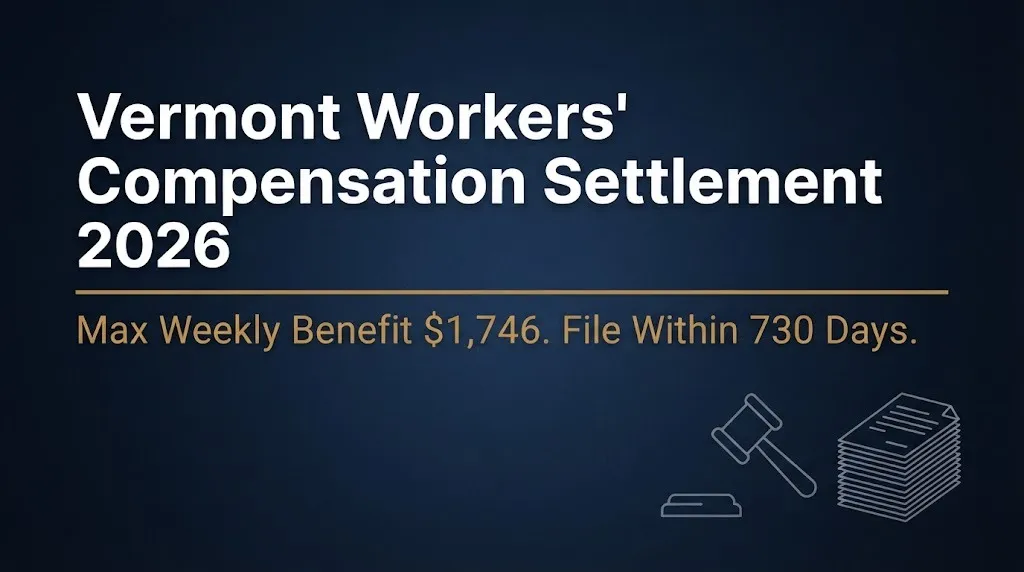
- No standard settlement exists. Vermont workers’ comp pays 66.7% of your average weekly wage, capped at $1,746 per week in 2026. Lump-sum settlements are negotiated case by case.
- You must file within 730 days of your injury. Missing that deadline usually bars your claim entirely.
- Permanent partial disability awards are calculated using a whole-person impairment system, not a fixed schedule of body parts.
Vermont workers’ compensation settlement amounts are not published in a public table. There is no state-run settlement fund, no claim form you can download, and no deadline for a “claim” in the class action sense. What exists instead is a no-fault insurance system where your employer’s carrier pays medical bills and a portion of lost wages while you recover. If your injury leaves permanent effects, you may negotiate a lump-sum settlement. That settlement has to be approved by the Vermont Department of Labor.
The number that matters most is your average weekly wage. Vermont pays 66.7% of that figure, up to $1,746 per week in 2026. The state average weekly wage is $1,164. If you earn below that, you may hit the minimum of $349 per week.
This guide explains how settlements are calculated, what deadlines apply, how to file a claim, and what the state’s rules actually say. No guesses. No invented averages.
The Facts
| Item | Detail |
|---|---|
| Case Type | State-administered workers’ compensation insurance system |
| Jurisdiction | Vermont Department of Labor, Workers’ Compensation Division |
| Maximum Weekly Benefit | $1,746 (2026) |
| Minimum Weekly Benefit | $349 (2026) |
| Benefit Rate | 66.7% of average weekly wage |
| Filing Deadline | 730 days (2 years) from injury |
| Waiting Period | 3 days, retroactive after 10 days |
| Max Duration (TTD) | 330 weeks |
| Administrator | Vermont Commissioner of Labor approves compromise agreements |
| Proof Needed | Medical records, wage statements, Form 16 for settlement |
Is a Vermont workers’ compensation settlement legit or a scam?
A Vermont workers’ compensation settlement is legitimate, but only when approved by the state. There is no private “settlement program” you sign up for online. Anyone promising a guaranteed payout from a Vermont workers’ comp fund is not describing how the system works.
The system is no-fault. That means you do not have to prove your employer did anything wrong to receive medical benefits and wage replacement. You just have to show the injury arose out of and in the course of your employment. Vermont law covers virtually all private-sector workers and most public employees.
What makes a settlement “real” is Form 16, the Compromise Agreement. Under Vermont Rule 13.1500, any settlement must be filed with and approved by the Commissioner of Labor. If a settlement is not approved, it does not bind the parties.
Reality Check: No one will call you offering a Vermont workers’ comp settlement. There is no state fund that pays out lump sums automatically. If someone asks for a fee to “process” your Vermont claim, they are not part of the official system. Filing a claim with the Department of Labor is free.
How much can you get from a Vermont workers’ comp settlement?
There is no standard payout amount. Vermont does not publish average settlement figures. The final number depends on your injury, your wage, your impairment rating, and what future medical care you are giving up.
What the state does publish is the weekly benefit rate. In 2026, that rate is 66.7% of your average weekly wage, capped at $1,746 per week and floored at $349 per week. Those caps are the outer limits of what the system can pay on a weekly basis.
For a rough sense of scale, one calculator tool estimates a sample permanent partial disability award at $22,011, with a negotiated settlement range of $13,207 to $18,709 for that hypothetical case. That is not an average. It is an illustration of how a discount applies when future medical costs are bought out.
| Injury Type | Avg Medical Cost | Avg Lost Wages | Typical Total |
|---|---|---|---|
| Back / Spine | $16,084 | $23,281 | $39,365 |
| Shoulder | $13,121 | $17,073 | $30,194 |
| Knee | $11,428 | $13,969 | $25,397 |
| Carpal Tunnel | $5,926 | $8,536 | $14,462 |
| Head / Concussion | $14,603 | $18,625 | $33,228 |
Those injury estimates come from one calculator source, not from Vermont state data. Treat them as rough context, not as promises.
Key Takeaway: Vermont sets the weekly rate. It does not set the settlement. Your impairment rating and future medical needs drive the final lump sum.
Who may qualify for Vermont workers’ compensation benefits?
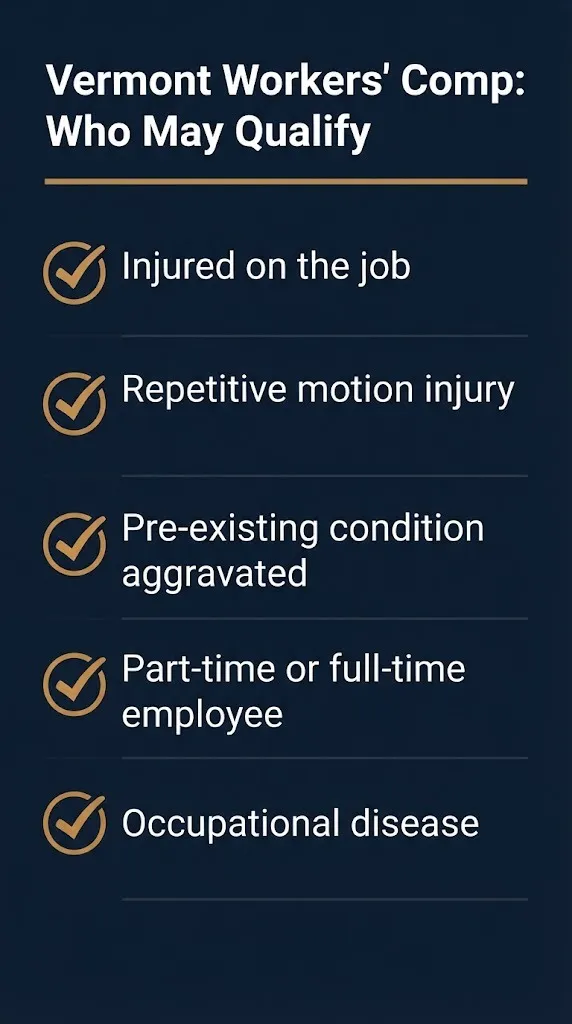
You may qualify if you were injured on the job, or if you developed a work-related condition over time. Vermont covers repetitive motion injuries and occupational diseases, not just single accidents.
The key legal test is whether the injury arises out of and in the course of employment. Pre-existing conditions do not automatically disqualify you. If work activity aggravated a condition and caused symptoms requiring treatment, it may still be covered.
Coverage generally extends to:
- Full-time and part-time employees
- Most private-sector workers
- State and municipal employees
- Agricultural workers in many situations
- Independent contractors who meet the employee test under Vermont law
Some workers are excluded unless they opt in. Sole proprietors and certain volunteers are not automatically covered. Corporate officers and LLC managers can file for exclusion under specific rules, but that removes their own coverage.
How do you file a Vermont workers’ compensation claim?
Filing is a sequence, not a single form. Vermont Rule 3.2200 gives the employer or insurer 21 days to determine whether compensation is due. You start the clock by giving notice.
- Report the injury to your employer as soon as practicable. Do not wait.
- Seek medical treatment. Tell the provider the injury is work-related.
- File a claim for compensation within six months of the injury date.
- Provide a medical authorization when the insurer requests it. Refusing without good cause can lead to denial.
- Wait for the insurer’s decision within 21 days, or 42 days if an extension is filed.
- File Form 6 (Notice and Application for Hearing) if the claim is denied or benefits are discontinued.
- Negotiate through informal dispute resolution before a formal hearing.
- Submit Form 16 for any compromise agreement, which the Commissioner must approve.
The 730-day filing deadline is the hard outer limit. The six-month claim requirement is separate and stricter for the initial claim.
What is the deadline to file a Vermont workers’ comp claim?
The deadline is 730 days from the date of injury for a contested claim, but you must give notice and file an initial claim much sooner. Vermont law requires notice as soon as practicable and a written claim within six months of the injury date.
For occupational disease, the clock starts when you reasonably discover the condition and its connection to your work. If that date comes after you have stopped working, you may still get medical treatment and permanent disability compensation based on your last work-related wage.
Miss the six-month claim window and you generally lose the right to proceed, unless the employer made voluntary payments. If payments were made and then denied, you have six months from the denial date to file.
How is a Vermont workers’ comp settlement calculated?
Vermont uses a whole-person impairment system, not a scheduled list of body parts with fixed week values. That is different from many states.
Under 21 V.S.A. § 648, permanent partial disability weeks are calculated by applying your whole-person impairment percentage to a base number of weeks. For spine injuries, the base is 330 weeks. For non-spine injuries, the statute’s formula points to 330 weeks, though some practice guides cite 405 weeks for non-spine cases. That discrepancy is worth confirming with the Department of Labor before you rely on either number.
The formula looks like this:
PPD Award = (Impairment % × Base Weeks) × Weekly Rate
Your weekly rate for PPD can be up to $1,836 per week in 2026, which is slightly higher than the temporary disability maximum. The impairment percentage comes from an evaluation using the AMA Guides, 5th Edition.
A lump-sum settlement typically bundles the PPD award with future medical care, then applies a discount. That discount reflects the time value of money and the risk of disputed issues. That is why the negotiated range can sit below the gross value.
Does Vermont workers’ comp pay pain and suffering?
No. Vermont workers’ compensation does not pay damages for pain and suffering. The system pays medical care, a portion of lost wages, and a permanent disability award based on your impairment rating.
That trade-off is built into the no-fault design. You get benefits without proving fault. You give up the right to sue your employer for emotional distress or punitive damages in most cases.
There is one exception: third-party liability. If someone other than your employer caused the injury, you may pursue a separate civil claim while still receiving workers’ comp benefits. That claim can include damages not available in the workers’ comp system. Any recovery from the third party first reimburses the workers’ comp carrier for benefits paid, then the balance goes to you.
What happens if your employer does not have workers’ comp insurance?
If your employer failed to carry coverage, the people behind the business can be held personally liable for your benefits. Vermont law makes corporate officers, majority stockholders, partners, and controlling parties personally responsible when coverage is missing.
The state also imposes penalties. Under 21 V.S.A. § 692, failure to maintain coverage carries penalties of up to $100 per day for the first seven days and up to $150 per day after that. One Vermont decision found a company liable for 543 days of non-coverage.
You can also file a lien against the employer’s property or the personal property of those responsible. The remedies are in addition to any other penalties available.
What happens next in a Vermont workers’ comp case?
Within 21 days of notice: The insurer must pay, deny, or request an extension.
Within 6 months of injury: You must file your claim for compensation.
Within 730 days of injury: You must commence proceedings for a contested claim.
After maximum medical improvement: An impairment rating is assigned using the AMA Guides.
After rating: Either side may propose a lump-sum settlement using Form 16.
After agreement: The Commissioner reviews and approves or rejects the compromise agreement.
Expected 2026 to 2027: No legislative changes to the core benefit rates have been announced. The 2026 maximum of $1,746 remains in effect.
Key Takeaway: Vermont’s system is more generous than many states on weekly maximums and duration, but it still requires you to act fast. The six-month claim window and two-year filing deadline are strict.
Frequently Asked Questions
How much is the average Vermont workers’ comp settlement?
No official average settlement figure exists. The state publishes benefit rates, not settlement averages. Your payout depends on your wage, impairment rating, and future medical needs.
What is the maximum weekly benefit in Vermont for 2026?
The maximum weekly benefit is $1,746. The minimum is $349. Both figures apply to temporary total disability benefits.
How long do I have to file a Vermont workers’ comp claim?
You have six months from the injury date to file the initial claim. For contested proceedings, the deadline is 730 days from the injury.
Can I get a lump-sum settlement in Vermont workers’ comp?
Yes, through a Compromise Agreement (Form 16) approved by the Commissioner. Not every case settles this way, and approval is not automatic.
Does Vermont workers’ comp cover repetitive motion injuries?
Yes. Repetitive motion injuries and occupational diseases are covered if they arise out of employment and meet the discovery rules for when the clock starts.
What if my employer did not have workers’ comp insurance?
The business owners can be personally liable for benefits. The state can also impose daily penalties on the employer for non-coverage.
Do I need a lawyer for a Vermont workers’ comp claim?
You are not required to have one. But an attorney can review a proposed settlement for missing benefits, incorrect impairment ratings, or unpaid medical bills before you sign.
How is permanent partial disability calculated in Vermont?
Vermont uses a whole-person impairment percentage multiplied by a base number of weeks (330 for spine, 330 or 405 for non-spine). The result is paid at up to $1,836 per week.
Closing
Start by reporting your injury and filing your claim within six months. That deadline is the one most likely to end a case before it begins. Gather your medical records and wage statements now.
The single most important number for 2026 is the $1,746 weekly maximum. Everything else, including your settlement, is negotiated from there.