Florida Workers’ Compensation Rules 2026: What Changed, What You’re Owed, and How to File
Quick Answer
- Florida workers’ compensation is a no-fault system covering medical care and lost wages for job injuries.
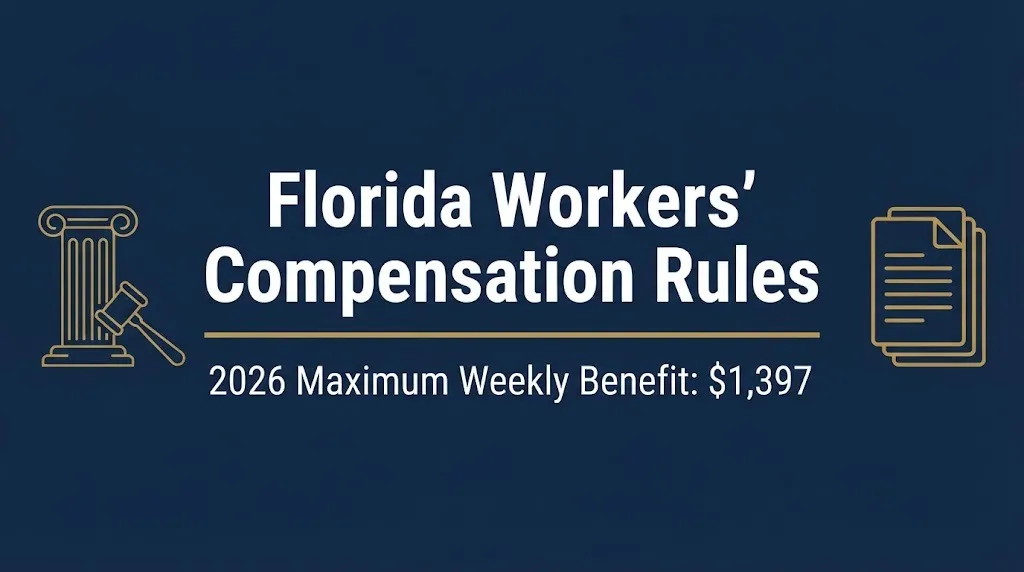
- Maximum weekly wage replacement in 2026 is $1,397, based on the state’s average weekly wage calculation.
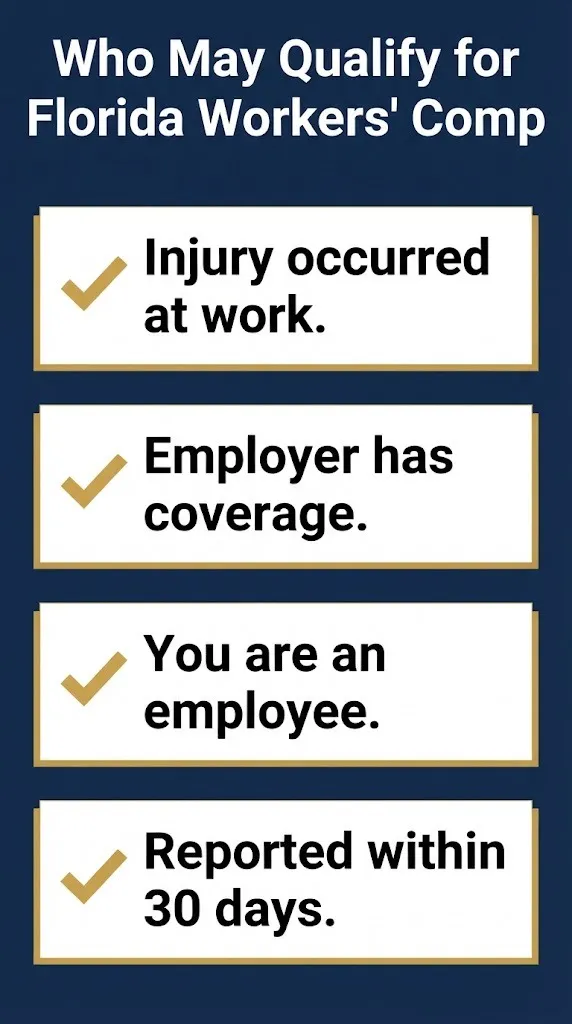
- Injured workers must report injuries within 30 days to protect their right to benefits.
If you got hurt on the job in Florida, the workers’ compensation rules determine what you’re owed. The system is designed to pay for your medical treatment and part of your lost wages. It does not pay for pain and suffering. That is the trade-off baked into Florida law.
The 2026 rate change matters more than most years. The state’s average weekly wage rose enough to push the maximum compensation rate to $1,397 per week. That’s a 7 percent jump from 2025. For injured workers earning more than about $2,095 per week, that new cap changes the math on every check.
Here’s what’s verified for 2026: the rate increase, the reporting deadlines, the employer coverage thresholds, and the most common mistakes that cause claims to stall or get denied.
The Facts
| Item | Detail |
|---|---|
| Governing Law | Chapter 440, Florida Statutes |
| Regulator | Florida Division of Workers’ Compensation |
| 2026 Max Weekly Benefit | $1,397 (verified) |
| 2025 Max Weekly Benefit | $1,305 (verified) |
| Reporting Deadline | 30 days from injury or manifestation |
| Claim Filing Deadline | 2 years from injury date (generally) |
| Employer Coverage Threshold | 4 or more employees (construction: 1 or more) |
| Waiting Period | 7 days before wage benefits begin |
| Retroactive Pay | Yes, if disability exceeds 21 days |
Are Florida Workers’ Compensation Rules Legit or a Scam?
Florida workers’ compensation rules are legitimate state law, not a scam. They are codified in Chapter 440 of the Florida Statutes and enforced by the Florida Division of Workers’ Compensation. Employers are required by law to carry coverage if they meet the employee threshold.
That said, scam risks exist around the edges. Some companies offer “workers’ comp claim helpers” who charge upfront fees to file paperwork that is free through the state. Others sell unnecessary medical equipment or bill for services that were never provided. The core system is real. The people trying to exploit it are not.
If someone calls you offering to “expedite” your Florida workers’ comp benefits for a fee, hang up. The state does not charge you to file a claim. Your employer’s insurance carrier is required to process claims under state deadlines. Anyone asking for money to “unlock” benefits is running a scam.
Key Takeaway: Florida’s workers’ comp system is a real state-run program. No legitimate claim requires a fee to file.
How Much Does Florida Workers’ Compensation Pay in 2026?
Florida workers’ compensation pays two-thirds of your average weekly wage, up to a maximum of $1,397 per week in 2026. That maximum applies to temporary total disability, temporary partial disability, and permanent total disability benefits.
The state calculates this rate using your gross earnings for the 13 weeks before your injury. If you worked less than 13 weeks, the calculation uses the wages of a similar employee in the same type of work. Your average weekly wage determines your compensation rate. The formula is: average weekly wage times 66.67 percent, capped at the state maximum.
Here’s how the math works at different wage levels:
| Your Average Weekly Wage | Benefit Rate (66.67%) | 2026 Cap Applied |
|---|---|---|
| $600 | $400 | $400 |
| $1,000 | $667 | $667 |
| $1,500 | $1,000 | $1,000 |
| $2,100 | $1,400 | $1,397 (capped) |
| $3,000 | $2,000 | $1,397 (capped) |
These numbers reflect the 2026 maximum. The state announces the new rate each year based on the statewide average weekly wage. Check the Florida Division of Workers’ Compensation website for the official annual notice.
What Are the Key Workers Compensation Laws in Florida?
The key workers compensation laws in Florida establish a no-fault system. You do not have to prove your employer was negligent. You only have to show the injury happened at work and arose out of your employment. In exchange, you give up the right to sue your employer in most cases.
Chapter 440 covers nearly every aspect: which employers must carry coverage, what injuries count, how benefits are calculated, what deadlines apply, and what happens when disputes arise. The law also creates the Office of the Judges of Compensation Claims, which handles contested cases.
Florida’s system is notable for excluding mental-psychiatric injuries unless they accompany a physical injury. Stress-related claims without physical injury are generally not compensable. That restriction has been in place for years and remains unchanged in 2026.
What Is the Florida Workers’ Compensation Reporting Deadline?
The Florida workers’ compensation reporting deadline is 30 days from the date of injury or from when you first knew the injury was work-related. Report it to your employer immediately. Waiting past 30 days can bar your claim entirely.
The law is strict here. If you do not report within 30 days, your claim may be denied unless you can show the employer was not prejudiced by the delay. That exception is narrow and hard to prove. The practical rule is: report the injury the day it happens, even if it seems minor.
Your employer then has 7 days to report the injury to its insurance carrier. The carrier must either begin paying benefits or file a denial within 14 days of receiving the report. If the carrier does not deny within 14 days, it may be required to pay under the state’s “pay and investigate” rules.
Key Takeaway: The 30-day reporting deadline is the single most important date in a Florida workers’ comp claim.
How Do You File a Workers’ Compensation Claim in Florida?
Filing a workers’ compensation claim in Florida follows a defined sequence. Here are the steps:
- Report your injury to your supervisor immediately.
- Seek medical treatment from an authorized provider if your employer directs one.
- Complete any injury report form your employer provides.
- Keep copies of all medical records, bills, and work status notes.
- Track your pay stubs to verify your average weekly wage calculation.
- If the carrier denies your claim, file a petition with the Office of the Judges of Compensation Claims.
- Attend all medical appointments and follow work restrictions.
- Contact the Florida Division of Workers’ Compensation Employee Assistance Office if you need help.
Your employer cannot charge you a fee to file. The claim process itself is free for injured workers. You do not need a lawyer to file, though many workers hire one if the claim is denied or benefits stop.
How Long Do Florida Workers’ Compensation Benefits Last?
Florida workers’ compensation benefits last until you reach maximum medical improvement or, for temporary benefits, up to 104 weeks. That 104-week limit applies to temporary total and temporary partial disability benefits.
Permanent total disability benefits can last longer. If you are permanently and totally disabled, you may receive benefits until age 75, subject to certain offsets like Social Security. Permanent impairment benefits are paid on a schedule based on the body part and impairment rating.
The duration question depends on your medical situation. Your authorized treating physician determines when you reach maximum medical improvement. At that point, temporary benefits end and any permanent benefits are calculated.
Key Takeaway: Temporary benefits cap at 104 weeks. Permanent benefits depend on your impairment rating and disability status.
What Does Florida Workers’ Compensation Cover?
Florida workers’ compensation covers medically necessary care related to your work injury. That includes doctor visits, hospital stays, surgery, prescriptions, physical therapy, and mileage to appointments. It also covers a portion of lost wages.
The law requires the insurance carrier to provide an authorized treating physician. You must generally treat with that doctor. If you see your own doctor without authorization, the carrier may not pay. Emergency care is the exception. You can seek emergency treatment from any provider.
Here is what is covered versus not covered:
| Covered | Not Covered |
|---|---|
| Authorized medical treatment | Unauthorized treatment (except emergencies) |
| Temporary wage benefits | Pain and suffering |
| Permanent impairment benefits | Punitive damages |
| Mileage reimbursement | Emotional distress without physical injury |
| Vocational retraining (in some cases) | Wages above the weekly cap |
What Are the 2026 Changes to Florida Workers’ Compensation?
The main 2026 change is the maximum weekly benefit rate. It increased to $1,397 from $1,305 in 2025. The state recalculates this figure annually using the statewide average weekly wage. The 2026 increase is one of the larger jumps in recent years.
No major statutory overhaul passed in the 2025 legislative session affecting workers’ compensation rates or eligibility. Several bills were filed but none reached the governor’s desk with substantive changes. That means the 2026 rules largely mirror 2025, with the rate adjustment as the headline item.
Attorneys who practice in this area note that the rate increase helps higher-wage earners most. A worker earning $2,100 per week gains $92 per week compared to 2025. A worker earning $900 per week sees no change because their benefit rate stays below the cap.
Key Takeaway: The 2026 rate increase only affects workers whose two-thirds benefit would exceed $1,305 per week.
Does Florida Workers’ Compensation Cover Independent Contractors?
Florida workers’ compensation generally does not cover true independent contractors. Only “employees” are covered under Chapter 440. That distinction matters enormously in construction, where misclassification is common.
Florida uses a multi-factor test to determine employee status. The key question is control: does the employer direct how, when, and where the work is done? If so, the worker is likely an employee regardless of what the contract says. A 1099 label does not by itself make you an independent contractor.
Construction is treated differently. Florida law presumes that workers on a construction site are employees unless they meet specific independent contractor criteria. That presumption makes it harder for construction companies to avoid coverage.
If you were injured and your employer says you are an independent contractor, get legal advice. The classification may be wrong. A judge of compensation claims can decide the issue.
How Do You Check Your Florida Workers’ Compensation Claim Status?
You can check your Florida workers’ compensation claim status by contacting the insurance carrier directly. Your employer must give you the carrier’s name and contact information after your injury. You can also call the Florida Division of Workers’ Compensation Employee Assistance Office.
The state does not have a public online portal where you enter your name and see your claim details. The carrier’s adjuster is your main contact. Ask for the claim number, adjuster name, and direct phone number. Keep a log of every call.
If you cannot get answers, file a written request. Carriers in Florida must respond to certain inquiries within specified timeframes. If they do not, the Division of Workers’ Compensation can step in.
Reality Check: No one from the state will text you to ask for your Social Security number to process workers’ comp benefits. Filing is free. Third-party companies that charge to “help” with a claim are unnecessary. The Division of Workers’ Compensation will never call demanding payment.
What Happens If Your Florida Workers’ Compensation Claim Is Denied?
If your Florida workers’ compensation claim is denied, you have the right to challenge the denial. The carrier must state the reason for denial in writing. You can then file a petition for benefits with the Office of the Judges of Compensation Claims.
The petition process is free to file. You do not need a lawyer to file a petition. You can get the forms from the Office of the Judges of Compensation Claims website. The process leads to a hearing before a judge of compensation claims.
Most disputes resolve before a final hearing through mediation. A mediator helps both sides reach an agreement. If mediation fails, the judge hears the evidence and issues an order. Either side can appeal to the First District Court of Appeal.
Key Takeaway: A denial is not the end of your claim. You can challenge it through the free petition process.
How Do Florida Workers’ Compensation Settlements Work?
Florida workers’ compensation settlements are final and require approval from a judge of compensation claims. Most settlements are “lump sum” or “full and final” settlements. You give up future benefits in exchange for a one-time payment.
Settlement amounts vary widely based on your medical condition, future care needs, wage loss, and the carrier’s risk assessment. No two cases settle for the same amount. The judge must find the settlement is in your best interest before approving it.
Once approved, a settlement is almost impossible to undo. You cannot come back later and ask for more money if your condition worsens. That finality is the main risk. Review the settlement carefully with a lawyer before signing.
| Settlement Type | What It Means | Key Risk |
|---|---|---|
| Full and final | Ends all future benefits | No reopening for worsening condition |
| Medical-only | Settles future medical care only | Wage benefits may continue separately |
| Indemnity-only | Settles wage benefits only | Medical care may continue separately |
What Happens Next?
Florida’s workers’ compensation system will keep operating under Chapter 440 through 2026. Here is the expected timeline:
- February 2026: 2026 maximum weekly benefit rate of $1,397 is in effect for injuries on or after January 1, 2026.
- July 2026: Florida’s fiscal year begins, with any legislative changes from the 2026 session taking effect.
- October 2026: The state typically releases preliminary data on the next year’s average weekly wage.
- January 2027: The 2027 maximum weekly benefit rate is announced and takes effect.
- Ongoing: The Division of Workers’ Compensation continues compliance enforcement and employer audits.
Watch the Florida Division of Workers’ Compensation website for annual rate notices and any legislative updates.
Frequently Asked Questions
What is the Florida workers’ compensation maximum rate for 2026?
The Florida workers’ compensation maximum rate for 2026 is $1,397 per week. It applies to temporary total, temporary partial, and permanent total disability benefits.
How long do you have to report a work injury in Florida?
You have 30 days to report a work injury in Florida. Report it immediately to protect your claim.
Does Florida workers’ compensation pay full wages?
No. Florida workers’ compensation pays two-thirds of your average weekly wage, up to the state maximum. You do not receive your full paycheck.
Can you sue your employer in Florida for a work injury?
Generally no. Florida’s workers’ compensation system is the exclusive remedy for work injuries. You can sue third parties in limited cases, such as defective product claims.
Do you need a lawyer for Florida workers’ compensation?
You do not need a lawyer to file a claim. Many workers hire one if the claim is denied, benefits stop, or a settlement is offered.
What is the waiting period for Florida workers’ compensation?
The waiting period is 7 days. Wage benefits begin on day 8. If your disability lasts more than 21 days, the waiting period is paid retroactively.
Does Florida workers’ compensation cover mental health injuries?
Mental-psychiatric injuries are only covered if they accompany a physical injury. Standalone stress claims are generally not compensable.
How long do Florida workers’ compensation benefits last?
Temporary benefits last up to 104 weeks. Permanent total disability benefits can last until age 75, subject to offsets.