Allentown Workers Compensation Lawyer 2026: Fees, Settlements, and Who Actually Qualifies
Quick Answer
- Workers’ comp in Allentown is an individual insurance claim, not a class action settlement. No fund exists to claim from.
- Weekly benefits in Pennsylvania are capped at $1,394 per week in 2026 for total disability.
- You must report a work injury to your employer within 120 days. Miss it and you likely get nothing.
Do You Need an Allentown Workers Compensation Lawyer?
You don’t always need a lawyer for a Pennsylvania workers’ comp claim. But the moment your employer denies your claim or disputes how much you’re owed, hiring one changes the math significantly. A 2024 study by the Workers Compensation Research Institute analyzed over 950,000 claims and found workers with attorney representation received benefit increases between $7,700 and $12,400 compared to those who went it alone.
That’s not a sales pitch. It’s a data point from an independent research group.
The reason is simple. Insurance carriers employ teams of adjusters trained to minimize payouts. You are one injured person recovering from an injury, trying to understand a 500-week benefit schedule. The playing field isn’t level, and pretending otherwise doesn’t help you.
How Much Does an Allentown Workers Compensation Lawyer Cost?
Pennsylvania workers’ compensation attorneys work on contingency. You pay nothing up front, and the fee comes out of your recovery only if your case succeeds. State law regulates these fees, and they typically run 15% to 20% of your wage-loss benefits, not the 33% to 40% you might see in personal injury cases.
Here’s the part most people don’t know: medical benefits are usually not reduced by attorney fees. If your lawyer gets your surgery approved, that recovery doesn’t get docked.
The fee structure works like this:
- No upfront cost. No retainer, no hourly billing.
- Contingency fee: Typically 15% to 20% of indemnity (wage-loss) benefits.
- Medical benefits: Generally paid at 100%, with no attorney fee deduction.
- Case expenses: Medical records, expert evaluations, and filing fees are typically advanced by the firm and only reimbursed if you recover.
- Fee shifting: If your employer contested your claim without reasonable cause, they may be ordered to pay your attorney fees directly. You keep 100% of your benefits.
One more thing. Your employer can’t fire you for filing a workers’ compensation claim in Pennsylvania. That’s illegal retaliation, and it doesn’t affect your right to benefits.
Key Takeaway: Workers’ comp attorneys in Allentown cost you nothing unless you recover, and the fee is regulated by state law at roughly 15% to 20% of wage-loss benefits, not a third of your total recovery.
What Is the Average Workers Compensation Settlement in Pennsylvania?
The commonly cited average workers’ comp settlement in Pennsylvania is around $42,008, but that number is misleading. It blends minor strains with catastrophic injuries into one figure that describes almost nobody’s actual case.
Settlement values in Pennsylvania range from $2,000 for minor injuries to well over $200,000 for surgical cases with permanent impairment. A herniated disc that requires surgery and leaves you unable to return to your old job looks nothing like a sprained ankle that heals in six weeks.
Here are typical ranges by injury type, based on Pennsylvania data:
| Injury Type | Typical Settlement Range |
|---|---|
| Minor sprain or strain | $5,000 to $20,000 |
| Back or spine injury (non-surgical) | $25,000 to $75,000 |
| Back or spine injury (surgical) | $75,000 to $200,000+ |
| Shoulder injury | $20,000 to $60,000 |
| Knee injury | $25,000 to $70,000 |
| Carpal tunnel / wrist | $15,000 to $40,000 |
| Fracture (arm or leg) | $20,000 to $60,000 |
These are estimates, not promises. The actual value depends on your average weekly wage, the severity of your injury, whether you have permanent restrictions, and how aggressively the insurance carrier fights. A lawyer who handles Allentown cases regularly will know which adjusters and which judges tend to produce which outcomes.
How Is a Workers Compensation Settlement Calculated in Pennsylvania?
Your settlement is built on two numbers: your average weekly wage and your impairment rating. Everything else flows from those.
Pennsylvania law sets wage-loss benefits at approximately two-thirds of your average weekly wage, subject to a statewide cap. For injuries occurring on or after January 1, 2026, that maximum is $1,394.00 per week. So even if you earned $120,000 a year, your weekly benefit tops out at $1,394.
Your average weekly wage includes overtime, bonuses, tips you reported to the IRS, and vacation pay. It’s not just your base salary. If you worked two jobs at the time of your injury, both count.
For permanent injuries, Pennsylvania uses a scheduled loss system. The total loss of a hand equals 335 weeks of benefits. An arm equals 410 weeks. A foot equals 250 weeks. If you lose 50% of the use of your arm, you get half of that 410-week period.
That’s why a good attorney fights hard over impairment ratings. A 10% difference in impairment can mean tens of thousands of dollars over the life of a claim.
Key Takeaway: Pennsylvania caps weekly workers’ comp benefits at $1,394 in 2026, and permanent injuries are valued using a state schedule that assigns specific week counts to each body part.
Reality Check: No one texts you settlement money first. Workers’ comp claims are filed through your employer and their insurance carrier, not through a third-party website or a cold caller. If someone contacts you claiming they can “unlock” workers’ comp funds for a fee, that’s a scam. Filing is free, and legitimate attorneys don’t charge upfront.
Workers Compensation Attorney Allentown PA: How to File a Claim Step by Step
Filing a workers’ comp claim in Pennsylvania is not like filing a class action claim form. There’s no settlement administrator, no online portal, and no claim number you can check on a website. The process runs through your employer and the Pennsylvania Bureau of Workers’ Compensation.
Here are the steps:
- Report the injury to your employer in writing. Do this immediately, and keep a copy. Written notice beats oral every time.
- Seek medical treatment. If your employer posted a valid panel of six or more providers, you must treat within that panel for the first 90 days. After that, you can choose your own doctor.
- Your employer files a First Report of Injury. This happens if you miss more than three days of work.
- The insurance carrier has 21 days to accept or deny. They’ll issue a Notice of Compensation Payable if accepted, or a Notice of Compensation Denial if disputed.
- If denied, file a Claim Petition. This goes to the Pennsylvania Workers’ Compensation Appeal Board, which assigns your case to a Workers’ Compensation Judge.
- Attend hearings. Your attorney presents evidence, including medical records and expert testimony.
- The judge issues a decision. If you win, benefits are ordered. If you lose, you can appeal to the Appeal Board, then the Commonwealth Court.
- Consider a Compromise and Release. A lump-sum settlement closes out future wage-loss and medical benefits. Only sign one after your injury has stabilized and you understand the long-term consequences.
What Are the 2026 Pennsylvania Workers Compensation Rates?
The maximum weekly benefit for 2026 is $1,394.00. That’s the ceiling, not the floor. Your actual benefit is two-thirds of your average weekly wage, capped at that number.
Here’s how it breaks down:
- Total disability: You can’t work at all. You receive two-thirds of your average weekly wage, up to $1,394 per week.
- Partial disability: You can work but earn less than before. Benefits are proportional to the wage loss, capped at 500 weeks.
- Specific loss: Permanent damage to a body part triggers a scheduled number of weeks, calculated separately.
- Medical benefits: Unlimited in dollar amount and duration, as long as treatment is reasonable and necessary.
Your employer’s insurance carrier pays these benefits, not the state. Pennsylvania doesn’t have a state fund that pays workers’ comp directly to employees.
Who May Qualify for Workers Compensation in Allentown?
You may qualify if you were an employee at the time of your injury, covered by workers’ comp insurance, and hurt while performing your job duties. Independent contractors generally don’t qualify, but misclassification is common in warehousing and logistics, and it’s worth investigating if your job looks like employment in practice.
The injury doesn’t have to happen on your employer’s property. Workers injured while driving for work, making deliveries, or working off-site can still have valid claims.
You do not qualify if the injury happened during your normal commute, if it was self-inflicted, or if it happened while you were violating a clear company policy or under the influence.
Allentown’s workforce includes major distribution centers along Interstate 78, Lehigh Valley Health Network with over 8,000 employees, and a substantial manufacturing sector. Warehouse workers face forklift accidents, falls, and repetitive motion injuries. Healthcare workers face lifting injuries. The industries change the injury types, but the legal rules are the same.
How Long Do You Have to Report a Work Injury in Pennsylvania?
You have 120 days from the date you knew or should have known about the injury to give notice to your employer. Miss that window and your claim is forever barred.
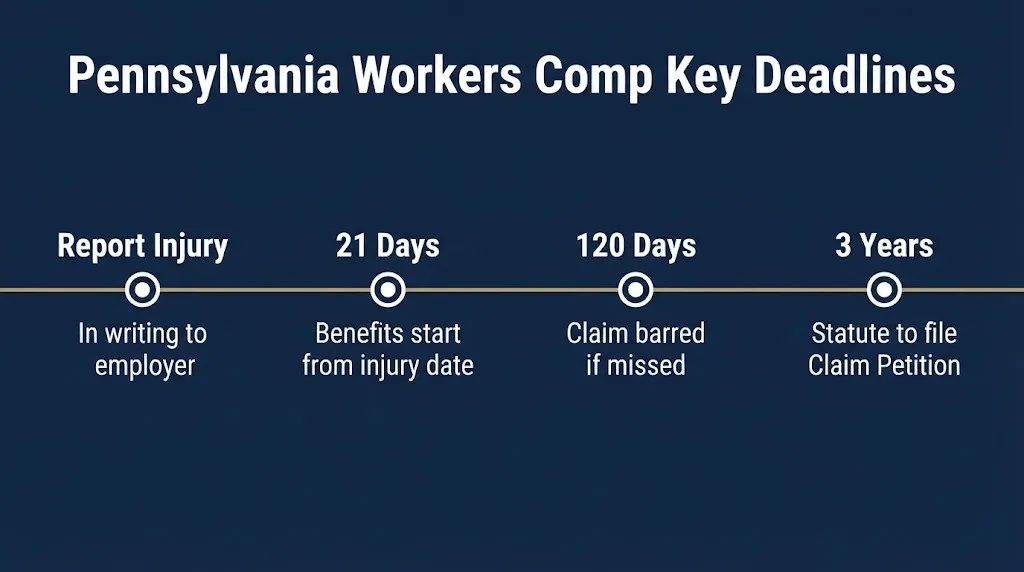
But here’s the trap. If you report within 21 days, your wage-loss benefits are calculated from the date of injury. If you wait longer than 21 days but still report within 120 days, your benefits start from the date you reported, not the date you got hurt.
That gap can cost you weeks of benefits. For a repetitive trauma injury like carpal tunnel, the rules get more complicated because each day of work can count as a new injury. An attorney can sometimes revive a claim that looks barred on its face.
The statute of limitations to file a Claim Petition is three years from the date of injury. But don’t wait. Evidence disappears, witnesses forget, and insurance carriers get more confident in their denial the longer you sit on it.
What Happens If Your Employer Denies Your Claim?
A denial is not the end. It’s the start of a different process. If the insurance carrier issues a Notice of Compensation Denial, you have the right to file a Claim Petition with the Workers’ Compensation Appeal Board. Your case gets assigned to a judge, and you get a hearing.
Most denials happen for one of three reasons: the employer disputes that the injury happened at work, disputes the severity, or claims you can return to work. A workers’ comp judge reviews the evidence and decides.
Having an attorney at this stage matters. Insurance carriers count on injured workers not knowing how to respond to a denial. A Claim Petition filed by an attorney forces the carrier to present its case to a judge, and that changes the settlement calculus almost immediately.
Key Takeaway: The 21-day rule controls when your benefits start, and the 120-day rule controls whether you get them at all. Report in writing immediately, and keep a copy.
Workers Compensation Attorney Allentown: Who Is the Best Fit for Your Case?
The best attorney for your workers’ comp case is one who regularly appears before the Workers’ Compensation Judges in Allentown and Lehigh County. Local procedural familiarity matters. Judges have preferences, and attorneys who know those preferences can move cases more efficiently.
Look for board certification. The Pennsylvania Bar Association certifies workers’ compensation specialists, and that designation means the attorney has passed a rigorous exam and demonstrated substantial experience in the field. Caroline Munley at Munley Law is a certified specialist who handles Allentown cases. Martin Law has maintained an Allentown office since 1979 and focuses exclusively on workers’ rights.
The Allentown workers’ comp bar is small enough that reputations are known. Ask about specific case results before the local judges. Ask whether the firm advances case expenses. And ask who will actually handle your file, not just who signs the intake form.
What Happens Next in Your Allentown Workers Compensation Case?
Workers’ comp cases in Pennsylvania typically take between 6 and 12 months to resolve, depending on whether the claim is disputed. Here’s the likely timeline:
Immediately: Report the injury in writing. Seek medical treatment. Keep every document.
Within 21 days: The insurance carrier must accept or deny your claim. If accepted, benefits begin.
If denied: Your attorney files a Claim Petition. A Workers’ Compensation Judge is assigned.
Months 2 to 6: Hearings, medical evidence, and expert reports. Settlement negotiations often happen during this window.
Months 6 to 12: If no settlement, the judge issues a decision. Either side can appeal.
Settlement (if reached): A Compromise and Release closes out future benefits. Review it carefully with your attorney before signing.
Frequently Asked Questions
Is an Allentown workers compensation lawyer worth the fee?
Yes, if your claim is disputed or your injury caused permanent damage. Workers with attorney representation receive $7,700 to $12,400 more on average, according to a 2024 WCRI study, which typically exceeds the 15% to 20% contingency fee.
How much does a workers comp lawyer charge in Allentown?
Most charge a contingency fee of 15% to 20% of your wage-loss benefits, regulated by Pennsylvania law. You pay nothing upfront. Medical benefits usually aren’t reduced by attorney fees.
Can I get workers comp if I was partially at fault for my injury?
Pennsylvania workers’ compensation is no-fault. You can receive benefits even if you contributed to your own injury, as long as you weren’t violating a clear company policy or under the influence.
How long does a workers comp settlement take in Allentown?
Cases typically resolve in 6 to 12 months if disputed. Uncontested claims can pay benefits within weeks. Settlements require a judge’s approval and usually take several months from negotiation to payment.
What happens if I miss the 120-day reporting deadline?
Your claim is likely barred entirely. The 120-day notice rule is strict. There are narrow exceptions, but you need an attorney to evaluate whether any apply to your facts.
Can my employer fire me for filing a workers comp claim?
No. It’s illegal to terminate an employee for filing a workers’ comp claim in Pennsylvania. If you’re fired while receiving benefits, your benefits should continue.
Do I need a lawyer if my workers comp claim was approved?
Not always. If benefits are flowing, medical care is covered, and you’re healing, you may not need one. You should consult an attorney before signing any settlement that closes out future benefits, because once you sign a Compromise and Release, you can’t reopen the claim.
How much is the maximum workers comp benefit in 2026?
The maximum weekly benefit in Pennsylvania for 2026 is $1,394.00 for total disability. Your actual benefit is two-thirds of your average weekly wage, capped at that amount.
What Should You Do Right Now?
If you were hurt at work in Allentown, the clock is already running. Report the injury in writing today, keep a copy, and get medical treatment. Those two steps protect your claim more than anything else you can do.
Calendar the 21-day mark from your injury date. That’s when your benefits calculation window closes. If your claim gets denied, don’t wait to see if the insurance company changes its mind.