Workers Compensation Insurance Colorado 2026: Employer Requirements, Rates, and Employee Benefits
Quick Answer
- Colorado requires nearly all employers to carry workers’ compensation insurance. Sole proprietors, corporate officers, and LLC members may be exempt.
- Injured workers can receive up to $1,314 per week in temporary disability benefits under 2026 rates.
- Employers must report workplace injuries within 10 days. Employees should notify their employer in writing within 4 working days.
If you’re an employer in Colorado, you need workers’ compensation insurance. If you’re an injured worker, you need to know what benefits you’re entitled to and how to claim them.
The system is mandatory, but the rules aren’t always clear. Rates change every year. Deadlines are strict. And the difference between filing correctly and missing a step can cost you thousands.
This article breaks down exactly how workers’ compensation insurance works in Colorado in 2026. You’ll see current rates, filing deadlines, benefit maximums, and the new laws that took effect this year.
The Facts
| Case | Colorado Workers’ Compensation System |
|---|---|
| Jurisdiction | Colorado Division of Workers’ Compensation (CDWC) |
| Status | Active. New laws effective May 29 and August 12, 2026 |
| Fund Size | No single fund. Benefits paid by employer’s insurance carrier |
| Est. Per Person | Up to $1,314/week for temporary disability |
| Claim Deadline | Report injury within 4 working days. File WC-15 within 2 years |
| Administrator | Colorado Division of Workers’ Compensation |
| Proof Needed | Medical records, wage statements, Employer’s First Report of Injury |
Is workers compensation insurance required in Colorado?
Yes, Colorado law requires nearly all employers to carry workers’ compensation insurance. The requirement applies whether you have one employee or one hundred.
There are narrow exceptions. Sole proprietors, general working partners, corporate officers, and LLC members may be exempt from coverage requirements . But those exemptions don’t apply if you have other employees.
If you’re an employer without coverage, you face serious penalties. The state can fine you, and you can be sued directly by an injured worker. That lawsuit would have no damage caps, meaning you could lose everything.
The Division of Insurance doesn’t handle individual claims. That’s the Division of Workers’ Compensation’s job . The DOI monitors insurance company finances and approves the annual loss cost filing.
Key Takeaway: Workers’ compensation insurance is mandatory for nearly all Colorado employers. Exemptions exist for certain business owners, but having any employees typically triggers the requirement.
How much does workers compensation insurance cost in Colorado?
Workers’ compensation insurance rates in Colorado dropped 6.9% for 2026, the 12th consecutive year of decreases . The cumulative reduction since 2015 is 56.8%.
The approved loss cost is the base rate. Your actual premium depends on your industry, payroll, and claims history. Each insurer adds its own expenses to the NCCI loss cost to determine what you pay .
Here are estimated rates per $100 of payroll by job category for 2026:
| Job Category | Rate per $100 Payroll |
|---|---|
| Office / Clerical | $0.25 |
| Restaurant / Food Service | $1.50 |
| Healthcare / Nursing | $1.75 |
| Manufacturing | $2.50 |
| Trucking / Delivery | $4.50 |
| Construction (General) | $6.50 |
| Roofing | $12.00 |
These are estimates. Your specific rate depends on your experience modification factor and classification codes .
The state’s declining rates reflect fewer workplace injuries and improved safety across Colorado industries. Insurance Commissioner Michael Conway credited employers for working to prevent injuries .
Reality Check: No one calls you to offer cheap workers’ comp insurance for a fee. If someone says they can get you covered for less without asking about your payroll and classification, that’s a red flag. Real insurance requires real underwriting.
What are the 2026 workers compensation benefit rates in Colorado?
For 2026, the maximum weekly benefit for temporary total disability is $1,314 per week. The minimum is $263 per week .
Colorado pays temporary disability at 66.67% of your average weekly wage. If your average weekly wage is $1,200, your benefit would be $800 per week.
Here’s how the math works:
| Your Weekly Wage | 66.67% of Wage | Actual Benefit (Capped) |
|---|---|---|
| $500 | $333 | $333 |
| $1,000 | $667 | $667 |
| $1,500 | $1,000 | $1,000 |
| $2,000 | $1,333 | $1,314 (capped) |
| $3,000 | $2,000 | $1,314 (capped) |
The cap matters for high earners. If you make $3,000 per week, you receive $1,314, not $2,000. That’s a loss of nearly $700 per week .
Temporary total disability benefits can last up to 104 weeks in Colorado .
There’s a 3-day waiting period before benefits begin. If your disability lasts longer than 14 days, those first 3 days are paid retroactively.
How do you file a workers compensation claim in Colorado?
You must notify your employer in writing within 4 working days of the injury. You have 2 years to file a formal claim with the Division of Workers’ Compensation .
The steps are specific. Missing one can jeopardize your claim.
Steps to file your claim:
- Seek medical attention immediately
- Notify your employer in writing within 4 days
- Get a list of designated providers from your employer
- Complete the WC-15 form and file it with the Division
- Document everything: medical records, witness names, photos
- Keep a daily journal of pain and work restrictions
Your employer must file an Employer’s First Report of Injury with the Division within 10 days of learning about the injury .
If your claim is denied, you can file an Application for Hearing with the Office of Administrative Courts. Hearings typically happen 120 to 180 days after filing .
Missing the reporting deadline is like missing the return window on a defective product. The store says no, and you lose your leverage.
What new Colorado workers compensation laws took effect in 2026?
Two new laws changed Colorado workers’ compensation rules in 2026. Both affect how employers and insurers handle coverage and claims.
SB 26-093: Coverage Verification
This law requires applicants for building and construction permits over $1 million to file a signed declaration confirming workers’ compensation coverage . The declaration is filed under penalty of perjury with the permitting agency.
The law took effect May 29, 2026. It’s designed to reduce uninsured construction work and protect workers.
SB 26-186: Electronic Filing Updates
This law updates the Workers’ Compensation Act to allow electronic filing and mailing of documents . It also redirects certain penalties and death benefits to the Colorado Uninsured Employer Fund.
The law took effect August 12, 2026. It aligns state statutes with the Division’s technology upgrades.
Key Takeaway: Colorado’s 2026 laws tighten coverage verification for construction projects and modernize the claims filing system to allow electronic submission.
What happens if your employer doesn’t have workers compensation insurance?
If your employer doesn’t have workers’ compensation insurance, you can still file a claim. The Colorado Uninsured Employer Fund may pay your benefits.
You file the same WC-15 form with the Division of Workers’ Compensation. The Division identifies the employer’s coverage status from its records .
If the employer is uninsured, the case proceeds against the Uninsured Employer Fund. That fund was created to protect workers when employers break the law.
Employers without coverage face penalties. They can be fined, and they lose the liability protections that workers’ compensation provides. An injured worker can sue them directly in civil court.
What is the appeals process for a denied workers compensation claim in Colorado?
If your claim is denied, you have the right to appeal. The process starts with an Application for Hearing at the Office of Administrative Courts.
An Administrative Law Judge (ALJ) hears the case. The ALJ focuses on the specific issues listed in your application, such as the right to ongoing disability payments or the accuracy of your impairment rating .
If you disagree with the ALJ’s decision, you can appeal to the Industrial Claim Appeals Office (ICAO). A panel of Administrative Law Judges reviews the case .
The panel does not hold new hearings. It reviews the evidence presented to the ALJ. The panel can affirm, reverse, or remand the decision.
Final appeals go to the Colorado Court of Appeals .
What are the deadlines for workers compensation claims in Colorado?
Deadlines in Colorado workers’ compensation are strict. Missing them can cost you benefits permanently.
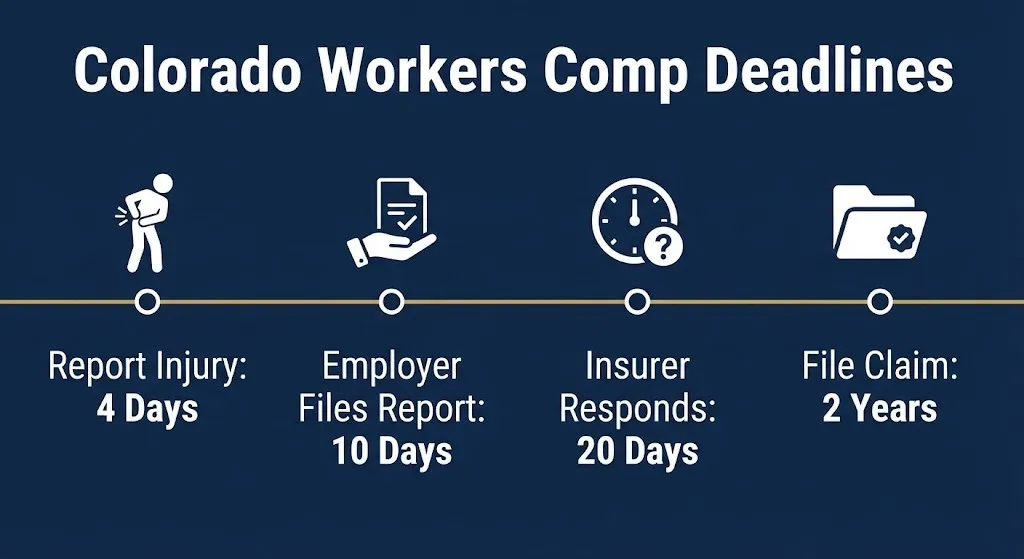
Critical deadlines:
| Action | Deadline |
|---|---|
| Employee reports injury to employer | 4 working days |
| Employer files First Report of Injury | 10 days |
| Employer/insurer files position statement | 20 days |
| Employee files WC-15 claim form | 2 years from injury |
| Filing deadline (statute of limitations) | 730 days |
The 4-day reporting rule is the most important. If you miss it without good cause, your employer can deny the claim for late reporting .
The 2-year deadline for filing the formal claim is absolute in most cases. Once it passes, you lose the right to benefits.
What benefits can you receive from Colorado workers compensation?
Colorado workers’ compensation covers medical care, wage replacement, and permanent disability benefits. The system is no-fault, meaning you don’t have to prove your employer was negligent.
Available benefits include:
- Emergency medical care
- Surgery and stabilization
- Follow-up care and rehabilitation
- Medications and medical supplies
- Temporary total disability payments (up to 104 weeks)
- Permanent disability benefits based on impairment rating
- Mileage reimbursement for medical travel
For permanent disability, Colorado uses a “whole person” formula for back injuries and other non-scheduled conditions. The payout depends on your impairment rating and age.
There’s a significant “cliff” at 20% impairment. For ratings under 19%, the cap is $192,996.79. For ratings of 20% or higher, the cap jumps to $312,967.77 .
That single percentage point can mean tens of thousands of dollars.
What happens next in your Colorado workers compensation case?
The next steps depend on where you are in the process. Here’s what to expect.
Expected timeline:
- Immediate: Report injury and seek medical care
- Within 10 days: Employer files First Report of Injury
- Within 20 days: Insurer files position statement
- Within 2 years: File WC-15 claim form
- 120 to 180 days after filing: Hearing date if claim is disputed
- After hearing: ALJ decision, then possible appeals
The system moves slowly. An uncontested claim may pay within weeks. A disputed claim can take a year or more.
If you’re an employer, make sure your coverage is active and your payroll classifications are accurate. The 6.9% rate decrease for 2026 is good news, but only if your policy is in place .
Frequently Asked Questions
Is workers compensation insurance required in Colorado?
Yes. Nearly all employers must carry coverage. Exemptions exist for sole proprietors, corporate officers, and LLC members, but having employees typically triggers the requirement.
How much does workers comp insurance cost in Colorado?
Rates vary by industry and payroll. Office workers pay around $0.25 per $100 of payroll. Roofers pay around $12.00 per $100. The state approved a 6.9% decrease for 2026.
What is the maximum workers comp benefit in Colorado for 2026?
The maximum weekly benefit is $1,314. The minimum is $263. Benefits are paid at 66.67% of your average weekly wage.
How long do I have to report a work injury in Colorado?
You must notify your employer in writing within 4 working days. You have 2 years to file a formal claim with the Division of Workers’ Compensation.
Can I sue my employer for a work injury in Colorado?
Generally, no. Workers’ compensation is the exclusive remedy against your employer. You can sue third parties if they caused the injury.
What happens if my employer doesn’t have workers comp insurance?
You can still file a claim. The Colorado Uninsured Employer Fund may pay your benefits. Your employer faces penalties.
How long do workers comp benefits last in Colorado?
Temporary total disability can last up to 104 weeks. Permanent disability benefits depend on your impairment rating.
What is the 20% cliff in Colorado workers comp?
For permanent disability ratings under 19%, the cap is $192,996.79. For ratings of 20% or higher, the cap jumps to $312,967.77.