Workman’s Compensation Lawyers 2026: What They Do, What They Cost, and When You Need One
Quick Answer:
- Workers compensation lawyers are real, licensed professionals who help injured workers get medical care and wage replacement benefits.
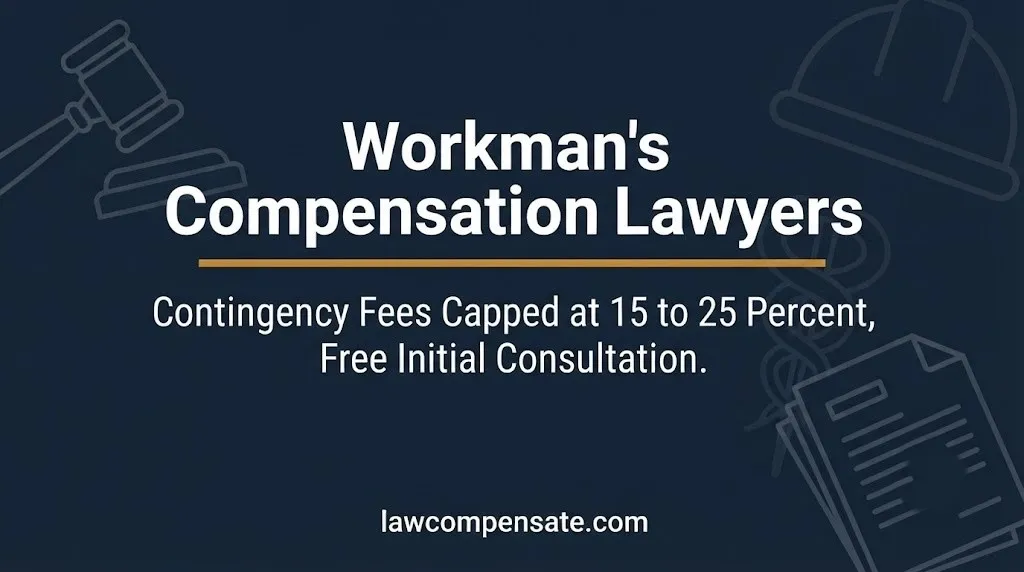
- Attorney fees are contingency-based and capped by state law, usually 15 to 25 percent of recovered benefits.
- Most states require you to report a work injury within 30 days, but deadlines vary, so act immediately.
You got hurt at work. The pain is real. The bills are starting to arrive. You reported the injury to your supervisor, but now the insurer is denying your claim, delaying your medical treatment, or offering a settlement that feels far too low. You are searching for a workers compensation attorney because you sense, correctly, that the system is not designed to help you without a fight.
This guide covers every verified fact about workers compensation lawyers in 2026. What they do. What they cost. When hiring one is worth it. When it is not. The questions to ask before signing a retainer. And the traps that turn a straightforward claim into a denied one.
One fact most people do not realize: roughly 70 percent of unrepresented workers get less than full benefits on their initial claim, according to data from the National Academy of Social Insurance. Attorney-represented claims close faster and with higher total benefits, even after the attorney fee is subtracted.
The Facts
| Detail | Value |
|---|---|
| System | State-mandated no-fault workers compensation insurance |
| Coverage | 49 states and D.C. require coverage; Texas exempts most private employers |
| Attorney Fee Structure | Contingency, typically 15 to 25 percent of recovered benefits |
| Fee Cap | Set by each state’s workers compensation board or commission |
| Initial Consultation | Free from almost all workers comp attorneys |
| Report Deadline | Varies by state, typically 30 days from injury or knowledge of injury |
| Claim Filing Deadline | Typically 1 to 3 years from date of injury, varies widely by state |
| Benefits Covered | Medical treatment, temporary disability, permanent disability, vocational rehab |
| Denial Rate | Varies, but roughly 7 to 10 percent of claims are initially denied per BLS data |
Is a Workers Comp Lawyer Worth It or a Waste of Money?
A workers compensation lawyer is worth the fee in cases involving denied claims, serious injuries, permanent disability, or settlement offers that seem low. In a straightforward claim where the insurer accepts liability, authorizes treatment promptly, and you return to work quickly, you may not need one. The difference between the two scenarios is not always obvious at the start.
The workers compensation system was designed to eliminate the need for lawsuits. You do not sue your employer. You file a claim with the employer’s insurance carrier, which is required by law to pay for medical treatment and a portion of your lost wages. In theory, that should happen automatically. In practice, insurers have financial incentives to minimize payouts. They employ adjusters, nurses, and attorneys whose job is to reduce the cost of every claim. You are navigating that system alone unless you hire a lawyer.
The math supports hiring an attorney for disputed claims. A 2021 study published by the Workers Compensation Research Institute found that attorney-represented workers received higher permanent partial disability settlements than unrepresented workers, even after accounting for the attorney’s fee. The gap was most pronounced for claims involving back injuries, spinal surgeries, and disputed causation. If your claim involves a significant injury or any pushback from the insurer, the fee you pay a lawyer is often returned several times over in additional benefits.
When You Probably Do Not Need a Lawyer
A minor injury with a single medical visit, no lost time from work, and an insurer that pays the bill promptly is a scenario where hiring an attorney may cost you more than you gain. The contingency fee would come out of a small recovery and leave you with less than if you handled it yourself. Most workers comp attorneys will tell you this during a free consultation. The honest ones will tell you to handle the claim yourself if it is small and uncontested.
Key Takeaway: You do not need a lawyer for every claim. You need one when the insurer denies, delays, or undervalues your claim. The more serious the injury, the more a lawyer matters.
How Much Does a Workers Comp Lawyer Cost in 2026?
Workers compensation attorneys work on contingency. You pay nothing upfront. The attorney receives a percentage of the benefits they recover for you, and only if they recover something. If you lose, you owe no attorney fee. This structure is regulated by each state’s workers compensation board, which sets maximum fee percentages.
The typical fee range is 15 to 25 percent of the recovered amount, depending on the state and the stage of the case. Some states cap the fee at 15 percent for settlements and 20 percent for trials. Others allow up to 25 percent. In most states, the fee must be approved by a workers compensation judge or board as part of the settlement or award. This judicial oversight prevents attorneys from charging excessive fees.
Some costs are separate from the attorney fee. These include the cost of obtaining medical records, expert witness fees, deposition transcripts, and court filing fees. Most attorneys advance these costs and deduct them from your recovery. Always ask during your initial consultation what costs you may be responsible for and whether the attorney advances them or expects you to pay as the case progresses.
Fee Comparison by State
| State | Typical Attorney Fee Cap |
|---|---|
| California | 15% of settlement or award |
| Florida | 20% of first $5,000, 15% of next $5,000, 10% of remainder |
| New York | 15% of award, subject to judge approval |
| Texas | 25% of recovery (Texas is optional for employers) |
| Illinois | 20% of recovery |
| Pennsylvania | 20% of contested claims |
| Ohio | 33.3% of first $2,500, graduated down for higher amounts |
This table is a sample. Your state’s fee schedule may differ. Ask the attorney to show you the applicable fee regulation in writing before you sign anything.
Key Takeaway: The fee comes out of recovery, not your pocket upfront. The net amount you receive, even after the fee, is typically higher than what unrepresented workers recover.
What Does a Workers Compensation Attorney Actually Do?
A workers comp lawyer does more than fill out forms. The attorney investigates your claim, gathers medical evidence, negotiates with the insurance adjuster, represents you at hearings, and structures settlements to protect your future rights. The work breaks down into specific tasks at each stage of the claim.
At the start, the attorney files the claim correctly. Procedural errors are a common reason for initial denials. The attorney ensures the notice of injury, claim form, and medical authorization are complete and filed within statutory deadlines. Missing a filing deadline can bar your claim permanently. An attorney knows the deadlines for your specific state and injury type.
Once the claim is filed, the attorney manages the medical evidence. Workers comp disputes often turn on medical opinions. The insurer may send you to an independent medical examination with a doctor who routinely testifies for insurance companies. Your attorney can challenge that opinion, depose the doctor, and present competing medical evidence from your treating physician. This advocacy changes outcomes.
At settlement, the attorney negotiates the total value of your claim, including future medical care. This is the stage where unrepresented workers leave the most money on the table. An insurer may offer a lump sum that seems generous but does not account for the surgery you will need in five years or the permanent restrictions that will limit your earning capacity. An attorney values future medical exposure and future lost earning capacity and demands a settlement that reflects those costs.
What a Workers Comp Lawyer Cannot Do
A workers comp attorney cannot sue your employer in most circumstances. The workers compensation system is an exclusive remedy, meaning you give up the right to sue your employer in exchange for guaranteed no-fault benefits. There are narrow exceptions for intentional harm and for third-party claims against entities other than your employer, such as a subcontractor or equipment manufacturer.
How to Find a Good Workers Comp Lawyer Near You
Finding a competent workers comp attorney is not about picking the firm with the most billboards. It is about verifying experience, reputation, and communication style before you sign a retainer agreement. Here is the step-by-step process.
- Search your state bar association’s attorney directory. Filter by workers compensation certification if your state offers board certification in workers comp law. Board-certified attorneys have passed an exam and demonstrated substantial experience in the field.
- Read client reviews on independent platforms, not just the attorney’s own website. Look for patterns. Do multiple clients mention poor communication or surprise fees? Cross those firms off your list.
- Schedule free consultations with two or three attorneys. Most workers comp lawyers offer free initial meetings. Use them. Ask the same questions to each attorney and compare the answers.
- Ask how many workers comp cases the attorney handles at one time. A high-volume practice with hundreds of cases per attorney may mean less personal attention. A lower-volume practice may mean more availability when you have questions.
- Ask who will handle your case day to day. The attorney you meet may not be the one answering your calls. Find out if you will work with a paralegal, an associate, or the named partner.
- Ask about the attorney’s trial experience. Most cases settle, but if yours does not, you want an attorney who has tried workers comp cases and won.
- Trust your gut on communication. If the attorney rushes through your consultation, dismisses your questions, or makes promises that sound too good to be true, walk away.
Red Flags to Avoid
Any attorney who guarantees a specific dollar amount before reviewing your medical records is lying. Any attorney who asks for upfront payment for a workers comp case is violating the standard contingency fee model. Any attorney who pressures you to sign a retainer agreement on the spot without giving you time to think is not acting in your best interest.
Key Takeaway: The best workers comp attorneys are board-certified specialists with trial experience, transparent fee structures, and references you can verify. The best ones also tell you when your case is small enough to handle without them.
When Should You Report a Work Injury and File a Claim?
Report the injury to your employer immediately. Do not wait. Every state imposes a deadline for reporting work injuries. In most states, the deadline is 30 days from the date of the injury or from the date you reasonably should have known the injury was work-related. Missing the reporting deadline can result in denial of all benefits.
The reporting requirement is not the same as the claim filing deadline. The claim filing deadline, sometimes called the statute of limitations, is the deadline to file a formal claim with the state workers compensation board. This deadline is typically one to three years from the date of injury, but it varies significantly by state. Some states set shorter deadlines for occupational diseases than for traumatic injuries. Some states toll the deadline if the employer provides medical treatment without filing the injury with the board.
Your employer may tell you the injury is minor and not worth reporting. Report it anyway. Injuries that seem minor at first can develop into chronic conditions. A twinge in your back today can become a herniated disc requiring surgery in six months. If you never reported the initial injury, the insurer will argue the herniated disc is not work-related, and you will have a difficult time proving otherwise.
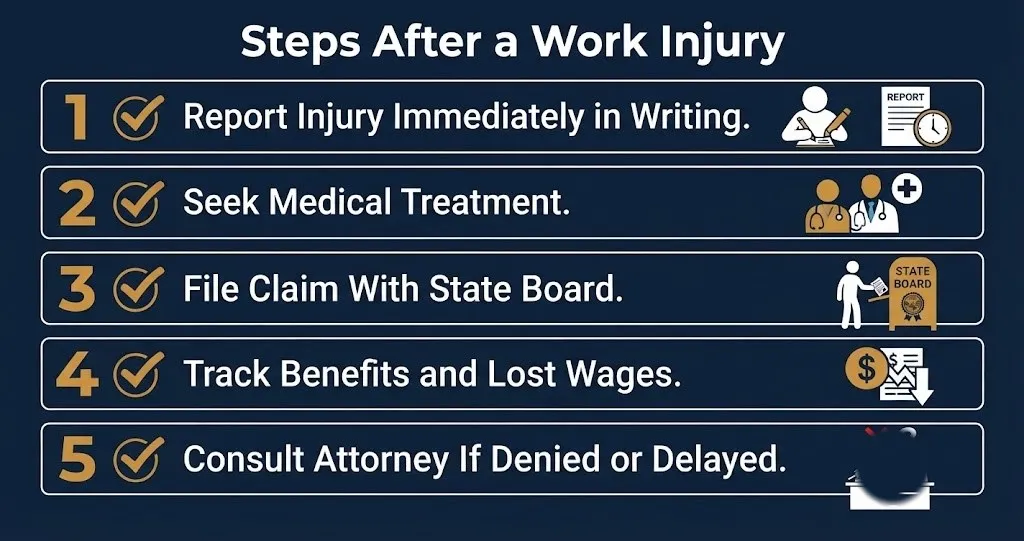
Reporting Checklist
- Report the injury verbally to your supervisor immediately.
- Follow up with a written report or email so there is a record.
- Note the date, time, and person you reported to.
- Request a copy of the incident report or acknowledgment.
- Seek medical attention promptly and tell the provider the injury is work-related.
- File a formal claim with your state’s workers compensation board if the employer or insurer does not do so.
What Benefits Does Workers Comp Pay in 2026?
Workers compensation provides specific categories of benefits, and the amounts are set by state law. There is no negotiation on the weekly rate. It is calculated from your average weekly wage using a statutory formula. What an attorney negotiates is whether you receive the correct classification and duration of benefits, not the dollar amount per week.
Medical benefits cover all reasonable and necessary treatment related to the work injury. This includes emergency care, surgery, hospitalization, medication, physical therapy, and medical devices. In most states, the insurer chooses the treating physician for an initial period, after which you may be able to switch to a doctor of your choice. Medical benefits have no dollar cap in most states, but insurers may dispute whether specific treatments are necessary.
Temporary total disability replaces a portion of your wages while you are completely unable to work. The amount is typically two-thirds of your average weekly wage, subject to a state maximum. As of 2026, maximum weekly TTD rates range from roughly $800 in lower-benefit states to over $1,500 in higher-benefit states. Benefits continue until you return to work or reach maximum medical improvement.
Temporary partial disability pays a portion of the difference when you can return to light-duty work at reduced pay. Permanent partial disability compensates you for permanent impairment after you reach maximum medical improvement. The amount depends on the body part, the impairment rating, and your state’s schedule of benefits. Permanent total disability pays ongoing benefits if you can never return to any gainful employment.
Benefit Type Table
| Benefit Type | What It Covers | Duration |
|---|---|---|
| Medical Benefits | All reasonable treatment for the work injury | Until MMI or ongoing if needed |
| Temporary Total Disability | Two-thirds of average weekly wage | Until return to work or MMI |
| Temporary Partial Disability | Difference between pre-injury and light-duty wages | Until return to full duty or MMI |
| Permanent Partial Disability | Permanent impairment rating | Based on state schedule |
| Permanent Total Disability | Ongoing wage replacement if totally disabled | Potentially lifetime |
| Vocational Rehabilitation | Job retraining if you cannot return to prior work | Varies by state |
| Death Benefits | Payments to dependents of a worker killed on the job | Varies by state |
Reality Check: The workers comp benefit formula is set by state law. An attorney does not increase the weekly rate. An attorney ensures you receive the correct classification, duration, and medical treatment, and that the settlement accounts for future needs. That is where the value comes from.
Should You Accept a Workers Comp Settlement Offer?
Do not accept a settlement offer without understanding what you are giving up. A workers comp settlement typically ends your right to future medical treatment and future disability benefits in exchange for a lump sum. If your injury worsens after settlement, you cannot go back and ask for more. That is a significant risk for injuries with uncertain long-term trajectories.
A settlement may be structured as a full and final release, closing all aspects of the claim, or a partial settlement leaving medical benefits open. A full settlement pays you a lump sum and closes the file. The insurer is off the risk. A settlement leaving medical open pays a lump sum for the disability component but keeps the insurer responsible for future medical treatment related to the injury. This structure is common in cases with anticipated future surgeries or degenerative conditions.
The insurer’s first settlement offer is rarely its best. Insurers make initial offers based on formulas and internal guidelines, not on the unique facts of your case. An attorney who has valued hundreds of similar claims knows what your case is worth. That knowledge is the difference between accepting $15,000 and countering with a demand for $45,000 backed by evidence.
When a Settlement May Not Be in Your Interest
If you have a permanent injury that will require ongoing medical care, a full settlement may leave you paying out of pocket for future treatment. If you are near retirement age and Medicare will become your primary insurance, a settlement that does not include a Medicare Set-Aside arrangement can jeopardize your future Medicare benefits. An attorney structures the settlement to protect Medicare’s interests and your own. These are not details an unrepresented worker typically knows to address.
What Happens Next: The Workers Comp Claim Timeline
- Day 1: Report the injury to your employer. Seek medical treatment. The employer or insurer should file the claim with the state board.
- Days 1 to 14: The insurer investigates. In most states, the insurer has 14 to 21 days to accept or deny the claim.
- Weeks 2 to 12: If the claim is accepted, medical treatment proceeds. Temporary disability payments begin. If denied, you have the right to a hearing.
- Months 3 to 12: You reach maximum medical improvement or continue treatment. If MMI is reached, a permanent impairment rating is assigned.
- Months 12 to 24: Settlement negotiations occur if permanent disability exists. A hearing may be scheduled for disputed issues.
- At Any Point: Consult an attorney, especially if the claim is denied, benefits are delayed, or a settlement offer is made.
Frequently Asked Questions
Do I need a workers comp lawyer for a minor injury?
Not necessarily. If the insurer pays medical bills promptly and you miss no work, you may not need one.
If the claim is denied or you have any lost time, consult an attorney for a free evaluation.
The consultation costs nothing and tells you whether representation is worth the fee.
What if my employer says I cannot file a claim?
Your employer cannot legally prevent you from filing a workers compensation claim.
Retaliation for filing a claim is illegal in every state.
If your employer threatens or retaliates, an attorney can bring a separate claim for retaliation damages.
How long after a work injury can I file a claim?
The deadline varies by state, typically one to three years from the date of injury.
Some states have shorter notice requirements, often 30 days.
Report the injury immediately and file the claim as soon as possible.
What if the injury was my fault?
Workers compensation is a no-fault system. Your own negligence does not bar your claim.
There are narrow exceptions for intoxication, horseplay, and self-inflicted injuries.
In most cases, even if you made a mistake, you are still covered.
Can I see my own doctor for a work injury?
It depends on your state and how long your employer’s medical control period lasts.
Some states allow you to choose your own doctor from the start.
Others require you to see the employer’s designated physician for an initial period, typically 30 to 90 days.
What if my workers comp claim is denied?
You have the right to a hearing before a workers compensation judge.
Most states require you to request the hearing within a specific timeframe after denial.
An attorney significantly improves your odds at hearing, which functions like a mini-trial.
Can I get workers comp and sue my employer?
Generally no. Workers comp is the exclusive remedy for workplace injuries.
You cannot sue your employer for negligence.
You may be able to sue a third party, such as a subcontractor or equipment manufacturer, in a separate personal injury lawsuit.
How long does a workers comp settlement take?
Straightforward cases may settle within weeks of reaching maximum medical improvement.
Disputed cases can take a year or more if hearings and appeals are required.
The timeline depends on the complexity of the medical issues and the willingness of the insurer to negotiate.
A workers compensation lawyer is not necessary for every claim. A clean claim with minor injuries, prompt medical treatment, and no wage loss may need nothing more than your own diligence. But the moment the insurer pushes back, delays treatment, denies the claim, or offers a settlement that feels low, the math shifts.
The single most important action you can take after a work injury, beyond getting medical care, is reporting it immediately and in writing. That report creates the record that protects your rights. If the system works, you may never need a lawyer. If it does not, the lawyer is there, and the free consultation costs nothing.