Workers Compensation Insurance Missouri 2026: Employer Rules, Benefits, and Claim Deadlines
Quick Answer
- Missouri workers’ comp is mandatory insurance for most employers with five or more workers, or one or more in construction.
- The maximum weekly wage benefit for injuries on or after July 1, 2026 is $1,294.71 .
- You must report a work injury to your employer within 30 days, and file a formal claim within two years .
You searched “workers compensation insurance missouri” because you own a business, manage employees, or got hurt on a job in Missouri and need to know what the law actually requires. The answer depends on which side of the paycheck you sit.
Missouri’s system is a trade-off. Employers must buy coverage or face civil lawsuits. Workers get medical care and wage replacement without proving fault. But the deadlines are strict, and missing the 30-day report window can sink a legitimate claim before it starts.
This article breaks down the employer mandate, the 2026 benefit rates, the filing steps, and the traps that cost people money. The surprising part for many readers: the maximum weekly benefit jumped on July 1, and a lot of outdated pages still show the old number.
The Facts
| Case | Missouri workers’ compensation system (insurance requirement, not a lawsuit) |
|---|---|
| Status | Active state insurance mandate enforced by the Missouri Division of Workers’ Compensation |
| Fund Size | Not applicable (no settlement fund) |
| Est. Per Person | Medical bills covered plus wage benefits up to $1,294.71 per week for injuries on or after July 1, 2026 |
| Claim Deadline | Report injury to employer within 30 days; file formal claim within 2 years (3 years if employer failed to report) |
| Administrator | Missouri Division of Workers’ Compensation, part of the Department of Labor and Industrial Relations |
| Proof Needed | Written injury report to employer, medical records linking injury to work, wage verification |
Is Workers Compensation Insurance Required in Missouri?
Yes, Missouri requires most employers to carry workers’ compensation insurance. The threshold is five or more employees for general employers . That count includes part-time, casual, and family-member employees. Members of an LLC and corporate officers count toward the total. Sole proprietors and partners do not, unless they elect coverage .
Construction is the big exception. If your business erects, demolishes, alters, or repairs improvements, you need coverage with one or more employees . That means a small roofing crew or a two-person remodeling outfit cannot skip the policy.
Exempt employers who choose not to buy coverage keep a hidden risk. They remain exposed to civil lawsuits from injured workers . The insurance requirement disappears, but the liability does not.
Certain workers fall outside the state system entirely. Railroad, postal, and maritime workers are covered by federal law . Farm labor, domestic servants in private homes, and qualified real estate agents are also exempt from the state mandate .
How Much Does Missouri Workers Compensation Pay in 2026?
The maximum weekly benefit for injuries occurring between July 1, 2026 and June 30, 2027 is $1,294.71 . That figure applies to temporary total disability benefits. The minimum weekly rate remains $40.00, and the burial benefit stays at $5,000.00 .
Missouri pays wage-loss benefits at 66.7% of your average weekly wage, subject to the state maximum . If your average weekly wage is high enough, you hit the cap. If it is low, the minimum rate may set the floor.
Here is the rate picture for recent injury dates:
| Injury Date | Temporary Total Maximum |
|---|---|
| July 1, 2026 to June 30, 2027 | $1,294.71 |
| Before July 1, 2026 | Lower maximum, check the injury-date schedule |
Some third-party calculators still list $974 per week as the 2026 maximum . That figure is outdated for injuries after July 1, 2026. The Division of Workers’ Compensation adjusts the State Average Weekly Wage every July, and the new rate reflects that increase . If an insurer quotes you $974 for a July injury, ask them to show the injury-date rate table.
Permanent partial disability benefits have a separate cap of $678.18 per week for the 2026 to 2027 period . That is lower than the temporary total cap because the two benefit types are calculated differently. Death benefits for dependents use the temporary total maximum.
Key Takeaway: Missouri’s maximum weekly benefit rose to $1,294.71 on July 1, 2026, and any page still quoting $974 for new injuries is working from an old rate table.
Who Counts as an Employee for Missouri Workers Compensation?
The label on your paycheck does not decide coverage. Missouri looks at the actual working relationship, and the employee count includes part-timers, casual laborers, and family members you pay .
If you own an LLC, you are presumed covered unless you opt out with the insurer . Corporate officers count toward the employee threshold and are covered unless they file an exemption. Sole proprietors and partners are not covered automatically, but they can elect coverage through their insurer.
Construction subcontractors create a trap for general contractors. If an uninsured sub gets hurt on your job, the state may treat you as the employer and hold you liable. That is why smart contractors collect certificates of insurance before anyone swings a hammer.
Exempt categories exist, but they are narrow. Farm labor, domestic servants in a private home, and qualified real estate agents are outside the mandate . Volunteers for tax-exempt organizations are exempt if they receive no wages and work purely for charitable purposes .
Reality Check: No one from the state calls you demanding a fee to activate your workers’ comp coverage. Buying a policy goes through a licensed insurance agent or the assigned risk pool. The Division of Workers’ Compensation does not sell insurance, and any caller demanding upfront payment for “claim processing” is not part of the official system.
How Do You File a Workers Compensation Claim in Missouri?
Filing starts with a written report to your employer, not with a state form. Missouri gives you 30 days from the injury to deliver written notice that includes your name, the date and place of injury, and the nature of the injury .
Here are the steps, following the Division of Workers’ Compensation process :
- Tell your employer in writing. Include the date, time, place, and nature of the injury. Keep a copy.
- Get medical treatment. Tell the provider the injury is work-related.
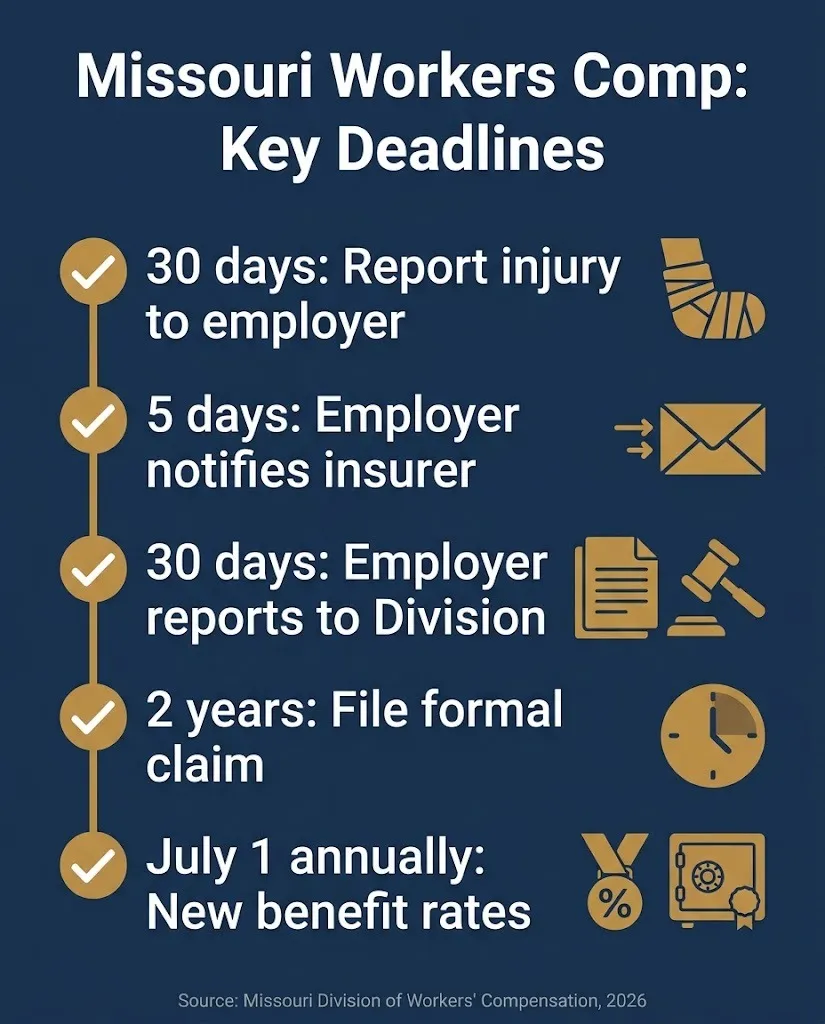
- Confirm your employer reports it. Your employer must notify its insurer within five days and the Division within 30 days for injuries involving more than first aid .
- Watch for the insurer’s response. The insurer investigates and either pays or denies.
- File a Claim for Compensation if benefits are denied or unpaid. Mail the form to the Division; this starts a contested case .
- Request mediation or a pre-hearing if there is a dispute. The Division offers informal dispute resolution .
- Attend an evidentiary hearing if the case does not settle. An administrative law judge decides the issues.
- Appeal an unfavorable decision if needed. You have 20 days to seek review from the Labor and Industrial Relations Commission .
The formal claim deadline is two years from the injury date or the last benefit payment . If your employer failed to file a Report of Injury with the Division, you get three years . Do not confuse the 30-day report with the two-year claim. The report preserves your rights; the claim starts the legal case.
What Happens If Your Missouri Workers Comp Claim Is Denied?
A denial letter is not the final word. Missouri has a structured appeal path, and many denials get reversed or settled once a claim is formally filed .
The most common reasons for denial include disputes over whether the injury was work-related, pre-existing conditions, missed reporting deadlines, and Independent Medical Examination reports that conflict with your treating doctor . Insurers also deny claims when they believe treatment was not medically necessary or when paperwork is incomplete.
If you receive a denial, request the written reason. Document your symptoms and work restrictions. Track your mileage and out-of-pocket costs. Attend every medical appointment your authorized doctor schedules.
The appeal sequence starts with a pre-hearing conference or mediation before an administrative law judge . If that fails, an evidentiary hearing follows. The judge issues an award, and either side can appeal to the Labor and Industrial Relations Commission within 20 days . From there, appeals go to the Missouri Court of Appeals and, rarely, the Missouri Supreme Court.
Key Takeaway: The 30-day reporting deadline is the most common self-inflicted wound in Missouri workers’ comp. Put the injury in writing immediately, even if you think it is minor.
How Much Does Workers Compensation Insurance Cost in Missouri?
Missouri employers saw a small rate increase for 2026. The National Council on Compensation Insurance proposed a 1.3% increase in loss costs, only the second increase in six years . The long-term trend is downward because workplace injuries are less frequent.
The increase varies by industry. Manufacturing faces a 2.9% increase, office and clerical 2.1%, contracting 0.3%, and goods and services 0.4% . Your actual premium depends on your payroll, your classification code, and your claims history.
Small employers sometimes land in the assigned risk pool if they cannot find voluntary coverage. The pool typically serves employers with premiums under $10,000 who have trouble in the standard market . It is not a penalty. It is a backup option.
Self-insurance is an alternative for financially strong employers. The Division’s Insurance Unit must approve the application, and the employer must prove it can cover its own injury obligations . Most small businesses do not qualify.
What Are the Exemptions from Missouri Workers Compensation?
Several categories of workers sit outside the state mandate. Knowing them matters because an exemption does not always protect the employer from a lawsuit.
The state law does not apply to farm labor, domestic servants in a private home, occasional labor for a private household, qualified real estate agents, and direct sellers . Volunteers for 501(c)(3) or 501(c)(19) organizations are exempt if they are unpaid. Certain inmates and patients of state or county institutions are also excluded .
Sole proprietors and partners are not employees of their own businesses for coverage purposes, but they can elect in . Their employees, including family members, are covered unless the employees opt out.
The dangerous part of an exemption is the civil lawsuit exposure. An exempt employer that does not buy coverage remains open to a negligence suit from an injured worker . Workers’ comp normally blocks those suits. Without the policy, the shield is gone.
What Happens Next: Key Dates and Stages for 2026
The timeline below covers the stages that matter for a new Missouri claim or policy year. Dates are based on the Division of Workers’ Compensation and Department of Commerce and Insurance releases.
- July 1, 2026: New benefit rates took effect. Maximum temporary total disability is $1,294.71 per week .
- Within 30 days of injury: You must give your employer written notice of the injury .
- Within five days of notice: Your employer must tell its insurer .
- Within 30 days of knowledge: Your employer or insurer must report the injury to the Division for lost-time claims .
- Within two years of injury: You must file a Claim for Compensation if benefits are disputed or unpaid .
- Ongoing: The Division adjusts the State Average Weekly Wage each July 1 .
Frequently Asked Questions
How many employees do you need for workers comp in Missouri?
Five or more employees for most businesses, but construction employers need coverage with just one employee .
What is the maximum weekly workers comp benefit in Missouri for 2026?
$1,294.71 for injuries on or after July 1, 2026 . The minimum is $40.00.
How long do you have to report a work injury in Missouri?
You have 30 days to give your employer written notice with the date, time, place, and nature of the injury .
Can you sue your employer in Missouri if they have workers comp?
Generally no. Workers’ comp is the exclusive remedy for covered injuries. If your employer was uninsured, you may have a civil lawsuit option .
Does Missouri workers comp cover part-time employees?
Yes. Part-time, casual, and family-member employees count toward the coverage threshold and are covered .
What if your employer does not have workers comp insurance?
You may still have a claim through the state system, and your employer faces penalties and civil exposure. Report the situation to the Division of Workers’ Compensation.
Do you need a lawyer for a Missouri workers comp claim?
Not always. Simple claims with accepted liability can proceed without one. Disputes, denials, and cases involving Medicare or Social Security often need a lawyer. Most attorneys offer free consultations and work on contingency .
What is the filing deadline for a Missouri workers comp claim?
Two years from the injury or last benefit payment, or three years if your employer failed to report the injury to the Division .
Your Next Step
If you were hurt at work in Missouri, put the injury in writing to your employer today. The 30-day clock is the one deadline that ends claims before they start. Keep a copy of that notice and every medical record.
If you employ workers in Missouri, confirm your policy is active and your employee count does not push you over the threshold. The maximum weekly benefit for new injuries is $1,294.71, and the reporting rules have not changed. The cost of missing either one is higher than the premium.