Federal Workers Compensation Attorney in 2026: What They Cost, When You Need One, and How the FECA Claims Process Actually Works
Quick Answer
- Federal workers compensation is a legal benefit under FECA, not a lawsuit. It’s administered by OWCP, not the courts.
- Wage-loss pay is set by law: two-thirds of your prior wages, or three-fourths if you have a dependent.
- The hard deadline to file for compensation is 3 years from your date of injury, with a separate 30-day window for continuation of pay.
If you searched “federal workers compensation attorney,” you’re likely dealing with an on-the-job injury or illness as a federal employee, and the process already feels harder than you expected. You’re not imagining that. Federal employees don’t file state workers’ comp claims. They fall under a completely different federal law, with its own forms, deadlines, and appeals board.
The single number that matters most right now is three: three years to file a compensation claim, and 180 days to appeal a denial. Miss either one, and your options shrink fast.
This article covers what a federal workers comp attorney actually does, what they’re legally allowed to charge, and why 2026 has been an especially rough year to get a claim through on your own. One detail most sites skip: attorneys handling FECA cases cannot charge contingency fees the way personal injury lawyers do. Every dollar they collect has to be approved first, by OWCP or by the appeals board.
The Facts
| Case | Not applicable. FECA is a federal benefits law (5 U.S.C. Chapter 81), not a lawsuit or class action. |
| Status | Ongoing federal compensation program, actively processing claims in 2026. |
| Fund Size | Not applicable. Benefits are paid claim by claim through OWCP, not from a shared settlement fund. |
| Est. Per Person | Set by law: two-thirds of prior wages, or three-fourths with at least one dependent. |
| Claim Deadline | 3 years from date of injury for compensation; 30 days for continuation of pay after a traumatic injury. |
| Administrator | Office of Workers’ Compensation Programs (OWCP), U.S. Department of Labor. |
| Proof Needed | Medical evidence connecting your diagnosis to a specific work event or exposure, filed on Form CA-1 or CA-2. |
Do I Need a Federal Workers Compensation Attorney?
You don’t legally need one to file a FECA claim, but the system is built in a way that rewards representation once a claim gets complicated.
Federal employees and their advocates have described the OWCP claims process as convoluted, with approvals for basic medical scans sometimes taking weeks or months. A federal attorney who has handled these cases for years noted that even after a claim is accepted, private insurers often still refuse to pay for treatment without a fight.
You can absolutely file a simple, undisputed CA-1 claim yourself. Where attorneys earn their keep is denials, disputed causation, schedule award calculations, and appeals to the Employees’ Compensation Appeals Board (ECAB).
Key Takeaway: A federal workers comp attorney is optional for a clean claim, but often decisive once OWCP pushes back or denies you.
Is a Federal Workers Comp Lawyer Different From a State Workers’ Comp Lawyer?
Yes, and the difference matters more than most people expect.
Federal employees are covered by FECA, not by state workers’ compensation law. A lawyer who normally handles state-level car accident or workers’ comp cases may not understand OWCP’s specific regulations, forms, and medical evidence standards.
What makes federal cases distinct:
- Governed by 5 U.S.C. Chapter 81, not state statute
- Administered by OWCP under the U.S. Department of Labor, not a state agency
- Appeals go to the Employees’ Compensation Appeals Board, not a state workers’ comp court
- Uses the AMA Guides to the Evaluation of Permanent Partial Impairment, 6th Edition, for schedule awards
Hiring a generalist here is a real risk. The forms alone (CA-1, CA-2, CA-7) don’t exist in most state systems.
How Much Does a Federal Workers Compensation Attorney Cost?
Federal workers comp attorneys cannot charge contingency fees before OWCP or the appeals board. Every fee must be approved first.
In cases before the Employees’ Compensation Appeals Board, no claim for a fee is valid unless the Board approves it, and contracts for contingent or stipulated fees are not allowed. Collecting a fee without approval can be treated as a misdemeanor under federal law.
How fees typically work in practice:
| Stage | Fee Structure |
|---|---|
| Before OWCP | Hourly rate, must be deemed “fair and reasonable” and approved by OWCP |
| Before ECAB (appeals) | Hourly rate only, Board must formally approve amount and hours |
| Contingency fees | Not permitted at either level |
Real approved fee amounts from Board decisions have ranged from roughly $1,400 to several thousand dollars, based on hours worked and complexity, not a percentage of your award. Not yet determined is the honest answer for what any individual case will cost, since it depends entirely on hours billed and what OWCP or the Board approves.
What Is the FECA Compensation Rate in 2026?
Your wage-loss compensation rate is fixed by statute at two-thirds of your prior wages, rising to three-fourths if you have at least one eligible dependent.
This rate hasn’t changed and applies uniformly across the federal workforce, regardless of your agency. Periodic wage-loss payments are calculated this way, whether paid weekly for short-term claims or every 28 days for long-term ones.
Example structure (illustrative math, not a guaranteed payout):
- No dependents: 66.67% of your average weekly wage
- One or more dependents: 75% of your average weekly wage
- Payments continue as long as disability and entitlement remain documented
Key Takeaway: Your wage-loss rate is fixed by law at two-thirds or three-fourths of your prior pay, but your actual payout depends entirely on your accepted wage base and medical documentation.
What Is a Schedule Award and How Much Is It Worth?
A schedule award compensates permanent impairment to a specific body part, separate from wage-loss compensation, and it’s not yet determined until your impairment is formally rated.
The award is calculated using your compensation rate, your impairment percentage under the AMA Guides 6th Edition, and the number of weeks FECA assigns to that body part under 5 U.S.C. 8107. As one published example illustrates: a worker with 50% impairment of a leg (which carries 288 weeks for total loss), a $40 hourly wage, and a dependent, could see an award calculated at roughly 144 weeks times the applicable weekly compensation rate.
That math is case-specific and only an example, not a guarantee of what any individual will receive.
Reality Check: No one from OWCP or a law firm will contact you out of the blue promising a guaranteed schedule award amount before your medical evidence is even reviewed. Filing a FECA claim is free. Legitimate attorney fees require government approval before any money changes hands, so be wary of anyone demanding payment upfront to “start” your claim.
How Do I File a Federal Workers Compensation Claim?
You file a FECA claim by submitting the correct form (CA-1 for a specific incident, CA-2 for a condition that developed over time) through your agency to OWCP.
- Report the injury or illness to your supervisor immediately.
- Complete Form CA-1 (traumatic injury) or CA-2 (occupational disease) in ECOMP.
- Have your agency complete and submit its portion of the form.
- Seek treatment from a qualified physician of your choice.
- Ask your doctor to document a clear, written causal connection to your job duties.
- Keep copies of every form and communication for your own records.
- Wait for OWCP to assign a claim number and begin adjudication.
- Respond promptly to any OWCP development letter requesting more evidence.
Key Takeaway: OWCP is evidence-driven. A doctor’s note that says only “patient reports pain” is rarely enough; the record needs a specific, dated connection between the work event and the diagnosis.
Which Form Do I Need, CA-1 or CA-2?
Use Form CA-1 for a single traumatic event and Form CA-2 for a condition that built up gradually over time.
A traumatic injury means one event on one day, like slipping on a wet floor and breaking your wrist. An occupational disease builds over months or years, like carpal tunnel from repetitive typing. Picking the wrong form can slow your claim down significantly.
What Is the Deadline to File a Federal Workers Comp Claim?
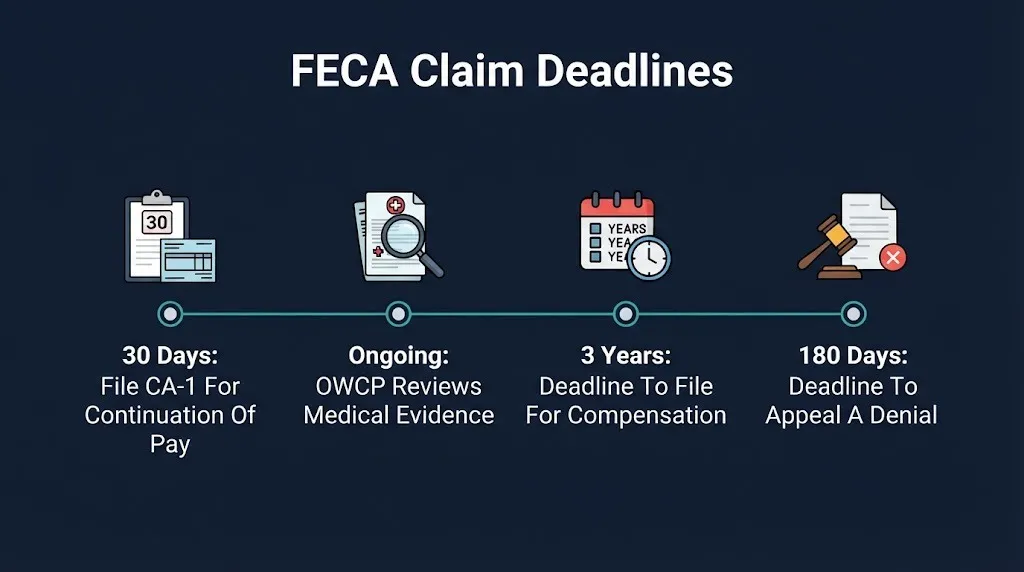
You generally have 3 years from your date of injury to file a claim for compensation under FECA.
For a traumatic injury, that clock starts on the date of injury. For an occupational illness caused by ongoing exposure, the clock starts on the date you knew, or reasonably should have known, that the condition was job-related.
Two separate deadlines to track:
- 30 days: to file for continuation of pay (COP) after a traumatic injury, using Form CA-1
- 3 years: to file for general compensation benefits
Missing the 3-year window doesn’t automatically end your claim. Compensation may still be payable if written notice was given within 30 days of the injury, or if your employer had actual knowledge of it within that same window. Timeliness is ultimately decided by OWCP as part of adjudication, not by you guessing in advance.
How Do I Appeal a Denied OWCP Claim?
You have 180 days from the date of an adverse OWCP decision to file an appeal with the Employees’ Compensation Appeals Board.
That 180-day window is strict. In one Board decision, an appeal filed just 19 days past the deadline was dismissed for lack of jurisdiction, with no exception made.
Your main appeal options after a denial:
- Request reconsideration directly with OWCP
- Request an oral hearing or review of the written record
- Appeal to the Employees’ Compensation Appeals Board within 180 days
This is a bit like disputing a denied insurance claim: the paperwork window is real, and missing it can end your case regardless of how strong the underlying facts are.
When Should I Hire a Federal Workers Compensation Attorney?
The clearest signal to hire an attorney is a denial, a disputed causation finding, or a fight over a schedule award calculation.
Before you navigate the appeals process or face resistance from your agency, consulting a specialized attorney can protect a claim that’s starting to slip. Attorneys who focus on FECA claims know the specific medical evidence needed to overturn a denial and how to communicate with claims examiners.
Situations where representation tends to matter most:
- OWCP has denied your initial claim
- Your agency disputes that the injury happened “in the performance of duty”
- You’re heading into a schedule award dispute
- You’re filing an appeal with the Employees’ Compensation Appeals Board
- OWCP has flagged a potential overpayment against you
Why Are Federal Workers Compensation Claims Taking So Long in 2026?
Federal workers comp claims are facing real delays in 2026 due to a documented mix of low staffing and rising claim volume.
Federal employees have reported that treatable injuries risk becoming permanent disabilities because the system is clogged by low staffing, complicated processes, and increasing claims. FECA claims filed nationally rose 62% between 2013 and 2022, and the Labor Department has responded by hiring more claims examiners and medical adjudicators, though backlogs remain a documented complaint.
Key Takeaway: The delays aren’t just individual bad luck. They’re a documented, system-wide capacity problem that a knowledgeable attorney can sometimes help push through faster with better-prepared evidence.
Are 2026 Federal Layoffs and RIFs Increasing OWCP Claims?
Yes, in a broader sense. Widespread federal workforce reductions throughout 2025 and 2026 have added significant strain to related federal benefits systems.
Roughly 300,000 federal workers were expected to leave government service by the end of 2025 under workforce reduction efforts, with a large share involuntary. Separately, OPM’s retirement claims backlog peaked at 65,237 cases in February 2026, its highest level in over a decade, driven partly by the wave of departures.
Not yet confirmed: a direct, published OWCP figure tying this specific wave of layoffs to a corresponding spike in FECA injury claims. The connection is logical given overall federal workforce turmoil, but no official OWCP data was found confirming the exact scale of that link as of this writing.
What Is FECA and Who Administers It?
FECA, the Federal Employees’ Compensation Act, is the federal law that provides wage-loss, medical, and vocational benefits to civilian federal employees injured on the job.
It’s administered by the Office of Workers’ Compensation Programs, part of the U.S. Department of Labor, and covers work-related injuries or illnesses “sustained while in the performance of duty.” It generally applies to civilian employees, not military service members.
FECA benefits generally include:
- Medical care at no direct cost for accepted conditions
- Mileage or transportation reimbursement for treatment
- Wage-loss compensation during periods of disability
- Schedule awards for permanent impairment
- Vocational rehabilitation services
What Injuries Are Covered Under Federal Workers Compensation?
FECA covers both sudden traumatic injuries and illnesses that develop gradually from job duties, as long as they’re properly documented and connected to your work.
To be accepted, a claim generally needs to satisfy several core elements at once.
What OWCP typically requires to accept a claim:
- You were a federal employee at the time of injury
- You developed the specific condition claimed
- You were in the performance of duty when it occurred
- Medical evidence rationally connects the condition to that event or exposure
A simple diagnosis alone is not enough. OWCP applies what’s sometimes called a “three-prong” causal relationship standard, requiring a doctor’s opinion that specifically links the medical finding to the claimed work event, not just a general statement that pain exists.
What Happens After OWCP Accepts My Claim?
Once OWCP accepts your claim, you become eligible for medical coverage tied to the accepted condition, and wage-loss compensation if your disability continues.
If you’re still losing wages after any continuation of pay period ends, you’ll need to file Form CA-7 for ongoing compensation. If you eventually reach maximum medical improvement with lasting impairment to a scheduled body part, you can request a schedule award rated under the AMA Guides 6th Edition.
Acceptance is not the finish line. Claims can still be reopened, disputed, or reduced later if OWCP determines your wage-earning capacity has changed, which is another point where legal help often becomes valuable.
What Happens Next
Now (2026): Federal workforce reductions and staffing-related OWCP delays continue to affect claim processing times nationwide.
Within 30 days of a traumatic injury: File Form CA-1 to preserve continuation of pay eligibility.
Within 3 years of injury or discovery: File for general FECA compensation benefits before the statutory deadline closes.
Within 180 days of a denial: File an appeal with the Employees’ Compensation Appeals Board if OWCP rules against you.
Ongoing: Any attorney fee at any stage must go through OWCP or Board approval before it becomes valid.
Frequently Asked Questions
Can a lawyer guarantee I’ll win my FECA claim?
No legitimate attorney can guarantee the outcome of a federal workers compensation claim.
OWCP and the Employees’ Compensation Appeals Board make the final decisions based on submitted medical evidence.
Do federal workers comp attorneys work on contingency?
No. Contingency fee arrangements are not permitted in FECA cases before OWCP or the appeals board.
Fees are typically hourly and must be formally approved as fair and reasonable before they’re valid.
What’s the difference between CA-1 and CA-7?
CA-1 reports a traumatic injury and starts your claim; CA-7 requests ongoing wage-loss compensation once you’re in leave-without-pay status for an accepted condition.
They serve different stages of the same claim.
Is FECA the same as state workers’ compensation?
No. FECA is a separate federal law that applies only to eligible federal employees, not state employees or private-sector workers.
State workers’ comp attorneys may not be familiar with its specific rules.
How long does an OWCP claim take to get approved?
There’s no single guaranteed timeline, and 2026 reporting confirms real delays tied to staffing shortages and rising claim volume nationwide.
Some employees have waited months for approval of basic procedures like MRIs.
Can I still get benefits if I missed the 3-year deadline?
Possibly, in limited circumstances. Compensation may still be payable if written notice was given within 30 days of injury, or if your employer had actual knowledge within that window.
OWCP determines timeliness case by case during adjudication.
What is a schedule award and is it separate from wage-loss pay?
A schedule award compensates permanent impairment to a specific body part and is generally not paid at the same time as ongoing wage-loss compensation for that same injury.
The amount depends on your impairment rating, compensation rate, and the number of weeks FECA assigns to that body part.
If you’re dealing with a denied claim, a disputed schedule award, or an approaching deadline, the most useful next step is pulling your CA-1 or CA-2 paperwork and confirming exactly which date starts your clock. That 3-year filing window, and the separate 180-day appeal deadline, are the two dates that actually control what happens to your claim.