Texas Workers Compensation Law in 2026: What Injured Workers Must Know
Quick Answer
- Texas allows private employers to opt out of workers compensation coverage entirely.
- Workers for non-subscribing employers can sue for negligence but must prove fault.
- The deadline to report an injury is 30 days, and the deadline to file a claim is one year.
If you got hurt on the job in Texas, the first question is not how much you will get. It is whether your employer even carries workers compensation insurance. Texas is the only state that lets private employers opt out.
That fact changes everything. In other states, workers compensation is automatic. In Texas, your rights depend on whether your employer subscribes to the state system or chose to go without it. One surprising detail: roughly one in five Texas workers has no workers compensation coverage at all.
The Facts
| Fact | Details |
|---|---|
| Case | No single lawsuit, state statutory system |
| Status | Ongoing, governed by Texas Labor Code |
| Fund Size | No fixed fund, benefits paid per claim |
| Est. Per Person | Varies by wage and impairment rating |
| Claim Deadline | 30 days to report, 1 year to file |
| Administrator | Texas Department of Insurance, Division of Workers’ Compensation |
| Proof Needed | Medical records, incident report, wage records |
Is Texas Workers Compensation Required by Law?
Texas workers compensation is not required for most private employers. Texas is the only state that allows private employers to opt out of the workers compensation system entirely.
Public employers, including cities, counties, and state agencies, must provide workers compensation. Private employers can choose. Many do subscribe because it protects them from negligence lawsuits.

When an employer subscribes, workers compensation becomes the exclusive remedy. The injured worker cannot sue the employer for negligence. When an employer opts out, the worker can sue but must prove fault.
Key Takeaway: Your rights in Texas depend entirely on whether your employer bought workers compensation insurance.
What Is a Non-Subscriber in Texas Workers Compensation?
A non-subscriber is a Texas employer that chose not to carry workers compensation insurance. These employers lose certain legal defenses if an injured worker sues.
Non-subscribers cannot argue that the worker was contributorily negligent, that a fellow employee caused the injury, or that the worker assumed the risk. Those defenses are stripped away.
That makes negligence lawsuits against non-subscribers easier for workers to win than ordinary personal injury cases. But the worker still must prove the employer did something wrong.
How Much Does Texas Workers Compensation Pay?
Texas workers compensation pays income benefits based on your average weekly wage and your impairment rating. The state sets maximum and minimum benefit amounts each year.
For 2025, the maximum weekly income benefit was $1,132. The 2026 figure is set annually by the Texas Department of Insurance and is expected to be similar but not yet confirmed.
Here is how the benefit calculation works:
| Benefit Type | Amount |
|---|---|
| Temporary income benefits | 70 percent of average weekly wage, up to cap |
| Impairment income benefits | 70 percent, paid for weeks based on rating |
| Supplemental income benefits | For workers with high impairment and low wages |
| Lifetime income benefits | For catastrophic injuries |
These percentages are set by the Texas Labor Code, not negotiable.
Key Takeaway: Texas pays 70 percent of your average weekly wage, which is lower than many workers expect.
How Do You File a Workers Compensation Claim in Texas?
You file a Texas workers compensation claim by reporting the injury to your employer and then filing a claim with the Division of Workers’ Compensation.
Here are the steps:
- Report the injury to your employer within 30 days.
- Get medical treatment from an approved doctor.
- Your employer files a report with the Division of Workers’ Compensation.
- File a claim form with the Division if benefits are denied.
- Attend any required benefit review conferences.
- Request a contested case hearing if the dispute continues.
The process is administrative, not a court lawsuit. Disputes go through the Division’s dispute resolution system.
What Is the Deadline to Report a Texas Work Injury?
You have 30 days to report a Texas work injury to your employer. Failing to report within 30 days may not kill your claim, but it gives the insurer a reason to deny it.
The one-year deadline to file a formal claim is separate. That clock starts from the date of injury or the date you knew the injury was work-related.
Missing the one-year filing deadline bars your claim permanently. There are limited exceptions for occupational diseases that develop over time.
Key Takeaway: Report immediately, file formally within one year, and never trust an employer’s verbal promise that “it’s handled.”
What Is the Difference Between a Subscriber and Non-Subscriber Claim?
A subscriber claim goes through the administrative workers compensation system. You receive scheduled benefits without proving fault. You cannot sue your employer.
A non-subscriber claim goes through the civil court system. You must prove the employer was negligent. You can recover damages not available in workers compensation, including full lost wages and pain and suffering.
| Feature | Subscriber Claim | Non-Subscriber Lawsuit |
|---|---|---|
| Fault required | No | Yes |
| Benefit amount | Scheduled by law | Jury decides |
| Pain and suffering | Not available | Available |
| Time to resolve | Months | Years |
| Legal defenses | Exclusive remedy | Employer defenses limited |
Can You Sue Your Employer in Texas for a Work Injury?
You can sue your employer in Texas only if the employer is a non-subscriber. If your employer carries workers compensation, that system is your exclusive remedy.
A non-subscriber lawsuit allows recovery of damages that workers compensation does not pay. Those damages include full lost wages, medical costs, pain and suffering, and mental anguish.
The tradeoff is time and proof. A lawsuit takes years and requires evidence of negligence. Workers compensation pays on a schedule regardless of fault.
What Is a Texas Workers Compensation Impairment Rating?
A Texas workers compensation impairment rating is a percentage assigned by a doctor to measure permanent damage from your injury. The rating determines how many weeks of impairment income benefits you receive.
The rating comes from an impairment rating exam. You reach maximum medical improvement first, meaning your condition has stabilized.
The higher the rating, the more weeks of benefits you receive. A 10 percent rating means 30 weeks of impairment income benefits.
Reality Check: No one calls you first to offer workers compensation money. Filing is free through the Texas Department of Insurance. Any third party charging a fee to “help” you file is selling something you can do yourself online in minutes.
What Injuries Qualify for Texas Workers Compensation?
Texas workers compensation covers injuries that arise out of and in the course of employment. That includes sudden accidents, repetitive motion injuries, and occupational diseases.
Pre-existing conditions are covered if the work aggravated them. Mental health claims are more limited. Texas requires a diagnosable mental condition tied to a physical injury for most mental health claims.
Here are the categories:
- Traumatic injuries: falls, equipment accidents, vehicle crashes.
- Repetitive injuries: carpal tunnel, back strain from lifting.
- Occupational diseases: illnesses caused by workplace exposure.
- Aggravations: work makes a pre-existing condition worse.
What Is the Texas Workers Compensation Dispute Process?
The Texas workers compensation dispute process is administrative, not a traditional court case. Disputes go through benefit review conferences and contested case hearings.
The Division of Workers’ Compensation runs the process. A hearing officer decides disputes about benefits, medical treatment, and impairment ratings.
Decisions can be appealed to the Division’s appeals panel and then to state court. The process is designed to be faster and cheaper than litigation.
How Long Does a Texas Workers Comp Claim Take?
A Texas workers comp claim can take weeks or years, depending on the dispute.
An accepted claim with no disputes pays temporary income benefits within days of approval. A disputed claim requiring a contested case hearing can take 6 to 12 months.
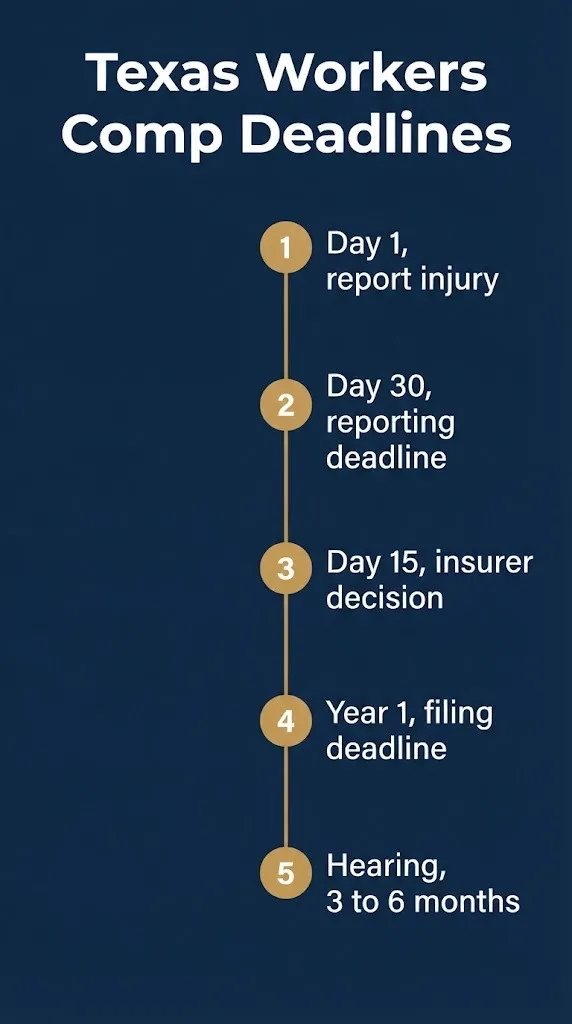
Here is a typical timeline:
| Stage | Duration |
|---|---|
| Injury report | Day 1 to 30 |
| Insurer decision | Within 15 days of notice |
| Benefit review conference | 60 to 90 days if disputed |
| Contested case hearing | 3 to 6 months |
| Appeals panel | 3 to 6 more months |
What Happens Next
If you were injured at work in Texas, your next steps depend on whether your employer subscribes to workers compensation.
- Immediately: Report the injury in writing and keep a copy.
- Within 30 days: Confirm whether your employer carries workers compensation.
- Within 1 year: File a formal claim with the Division of Workers’ Compensation.
- If denied: Request a benefit review conference.
- If non-subscriber: Consult a personal injury lawyer about a negligence lawsuit.
The single most important fact is your employer’s subscriber status. Everything else flows from that.
Frequently Asked Questions
Is workers compensation required in Texas?
No. Private employers can opt out of workers compensation in Texas.
Public employers must provide coverage.
Texas is the only state with this opt-out rule.
How much does Texas workers compensation pay?
Texas pays 70 percent of your average weekly wage, up to a state cap.
The 2026 cap has not yet been confirmed.
The 2025 cap was $1,132 per week.
Can I sue my employer for a work injury in Texas?
You can sue only if your employer is a non-subscriber.
Subscribers are protected by the exclusive remedy rule.
Non-subscriber lawsuits can recover pain and suffering.
What is the deadline to file a Texas workers comp claim?
You have 30 days to report the injury to your employer.
You have one year to file a formal claim.
Missing the one-year deadline bars your claim.
What is a non-subscriber in Texas?
A non-subscriber is an employer that opted out of workers compensation.
These employers can be sued for negligence.
They lose certain legal defenses in those lawsuits.
Do I need a lawyer for a Texas workers comp claim?
You need a lawyer if your claim is denied or if your employer is a non-subscriber.
Simple accepted claims can be handled without one.
Lawyers in workers comp cases work on contingency.
What is an impairment rating in Texas?
An impairment rating is a percentage of permanent damage from your injury.
It determines how many weeks of impairment benefits you receive.
A doctor assigns the rating at maximum medical improvement.
Can I be fired for filing a workers comp claim in Texas?
Texas law prohibits retaliation for filing a workers comp claim.
If you are fired, you may have a separate wrongful termination claim.
Document everything and contact a lawyer.