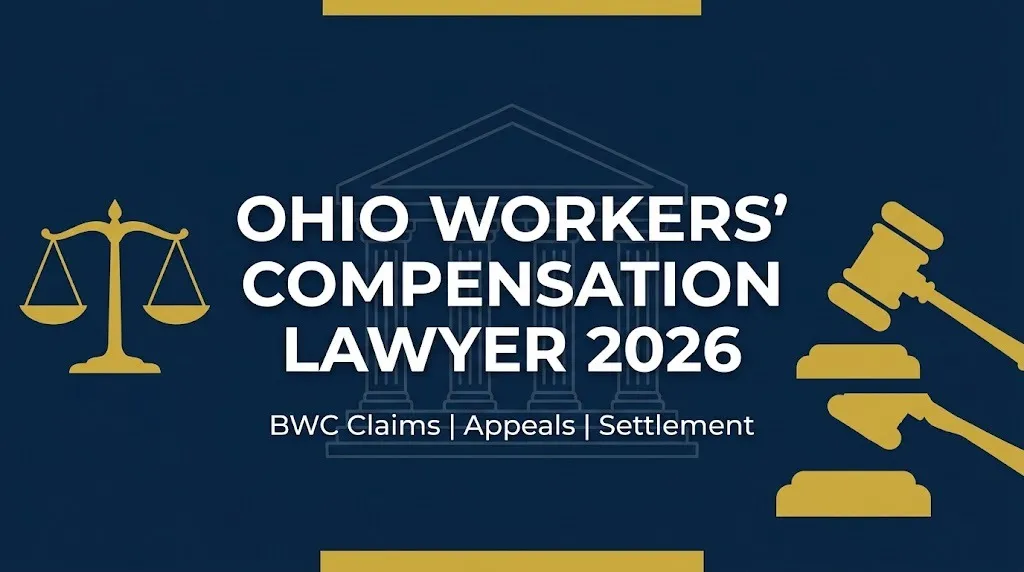
Ohio Workers Compensation Lawyer 2026: When You Need One, What They Cost, and How to File
Quick Answer
- Ohio workers’ compensation lawyers handle BWC claims, appeals, and settlement negotiations on a contingency fee basis.
- Attorney fees in Ohio are regulated by state law and capped at 30% of the first $5,000 recovered.
- The most critical deadline is 14 days to appeal a claim denial using the IC-12 form.
Ohio doesn’t work like most states when it comes to workplace injuries. The state runs its own insurance fund, and the Bureau of Workers’ Compensation decides your claim before you ever see a courtroom. That system creates real deadlines and real risks for injured workers who try to go it alone.
If you were hurt on the job in Ohio, you can file a claim without a lawyer. Many people do. But the system was built with employers and their representatives in mind, and the denial rates for certain claim types reflect that.
This article covers what an Ohio workers’ compensation lawyer actually does, how they get paid, the deadlines that can kill your claim, and what to expect if you hire one. Every number and date here comes from Ohio law or BWC official guidance, not from law firm marketing copy.
The Facts
| System Type | State-run, managed by Ohio BWC |
| Attorney Fees | Regulated by state law, contingency basis |
| Fee Cap | 30% of first $5,000, 25% of next $10,000, 20% over $15,000 |
| Claim Filing Deadline | 1 year from injury date |
| Appeal Deadline | 14 days from receipt of BWC order |
| BWC Decision Timeline | 28 days from claim filing |
| Free Consultations | Standard practice among Ohio workers’ comp attorneys |
Is an Ohio workers compensation lawyer legit or a scam?
Ohio workers’ compensation lawyers are legitimate licensed attorneys regulated by the Ohio Supreme Court and the Ohio State Bar Association. The practice area is real, the fee structure is set by state law, and the lawyers who focus on this work are subject to the same professional conduct rules as any other attorney in Ohio.
That said, the internet has no shortage of operations that look like law firms but aren’t. Some are “claim assistance” services that charge fees for things you can do yourself for free. Others promise settlements before a claim is even filed. Those are red flags.
A legitimate Ohio workers’ compensation attorney will give you a free consultation, explain the contingency fee structure upfront, and never ask for money before they recover benefits for you. The Ohio State Bar Association maintains a list of certified specialists in workers’ compensation law . That certification requires passing an exam and demonstrating substantial experience in the field.
If someone contacts you first about a workers’ comp claim you didn’t file, that’s not how legitimate representation works. Real attorneys don’t cold-call injured workers.
How much does an Ohio workers compensation lawyer cost?
Ohio workers’ compensation attorneys work on contingency, meaning you pay nothing upfront and they get paid only if they recover benefits or a settlement for you. The fee percentages are regulated by Ohio law, not set by the individual firm.
The fee structure works like this:
| Recovery Amount | Maximum Attorney Fee |
|---|---|
| First $5,000 | 30% |
| Next $10,000 | 25% |
| Amount over $15,000 | 20% |
That means if your attorney recovers $7,500 for you, the maximum fee is $2,500, and you keep $5,000 . On a $15,000 recovery, the fee would be $4,000, and you’d receive $11,000.
The fee typically applies only to benefits that wouldn’t have been paid without legal intervention. If you were already receiving temporary total disability payments before hiring an attorney, those established benefits usually aren’t subject to the fee.
Some attorneys advertise 33 1/3% as their rate, which is standard in personal injury cases . For Ohio workers’ comp specifically, the statutory caps apply. If a lawyer tells you they charge a flat 33% on everything, ask them to explain how that squares with the state fee schedule.
Case expenses are separate from attorney fees. Medical record retrieval, expert witnesses, and deposition costs may be your responsibility regardless of outcome, though many firms advance these costs and deduct them from your recovery .
Key Takeaway: Ohio law caps workers’ compensation attorney fees, so any lawyer charging more than the statutory percentages is either mistaken or not being straight with you.
How do you file a workers compensation claim in Ohio?
You file an Ohio workers’ compensation claim by submitting a First Report of Injury (FROI) to the Bureau of Workers’ Compensation within one year of your injury. The FROI can be filed online, by mail, by fax, or by phone, and your employer is required to assist you with the process .
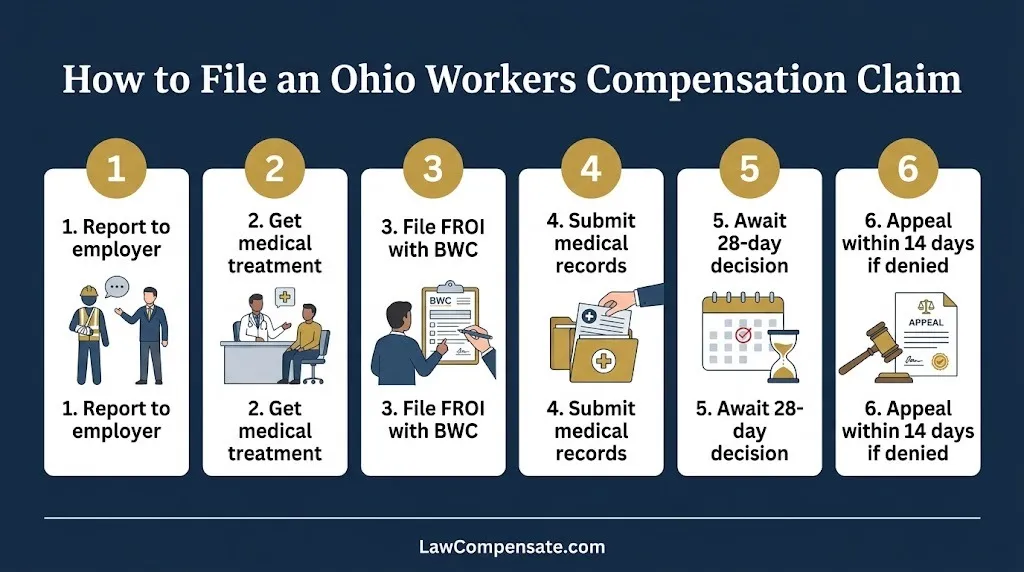
Here are the steps:
- Report the injury to your employer immediately. Ohio law doesn’t require a specific timeframe for reporting to your boss, but delays create problems.
- Get medical treatment. Tell the provider this is a work injury so they document it correctly.
- Complete the FROI. You can file online through the BWC website, print and mail the form, fax it, or call the BWC directly .
- Submit medical documentation. The claim needs evidence that the injury is work-related.
- Wait for the BWC decision. The bureau completes its initial investigation within 28 days .
- Respond to any requests. If the BWC asks for more information, provide it quickly.
- If denied, appeal within 14 days. File an IC-12 appeal with the Ohio Industrial Commission .
The FROI requires your personal information, your employer’s information, details about how the injury happened, and medical treatment records . Incomplete forms slow down processing and increase denial risk.
If your employer is self-insured rather than state-fund, you file the FROI directly with your employer’s workers’ compensation department, not the BWC .
What is the deadline to appeal a denied Ohio workers compensation claim?
You have 14 days from the date you receive a BWC order to file an appeal with the Ohio Industrial Commission. Missing that window means you lose the right to challenge the denial through the administrative process .
The appeal is filed using the IC-12 form. Once filed, your case goes to a District Hearing Officer for a formal hearing. In fiscal year 2024, these hearings averaged 38 days from filing to hearing, and 42 days from filing to mailing of the decision .
If you disagree with the District Hearing Officer’s decision, you can appeal to a Staff Hearing Officer. Those appeals averaged 37 days from filing to hearing in FY 2024 . Further appeals to the full Industrial Commission are discretionary.
This is where an attorney earns their fee. The appeal process involves formal hearings where employers typically have representation. You’re presenting medical evidence and legal arguments to a hearing officer who is also an attorney. Without counsel, you’re at a structural disadvantage.
Reality Check: No legitimate attorney or claims service will contact you first about a workers’ comp settlement. If someone calls or texts you saying you’re owed money from a workers’ compensation claim you never filed, that’s a scam. Real claims start with you reporting an injury to your employer and filing with the BWC or your self-insured employer.
What benefits can you receive in an Ohio workers compensation claim?
Ohio workers’ compensation provides medical benefits, wage replacement, and compensation for permanent impairment. The specific benefits available depend on the severity of your injury and whether you can return to work.
The main benefit types are:
- Medical benefits: Coverage for doctor visits, hospital care, prescriptions, physical therapy, and medical equipment related to the work injury.
- Temporary Total Disability (TTD): Wage replacement if your doctor confirms you can’t work at all while recovering.
- Permanent Partial Disability (PPD): Compensation for permanent impairment after you reach maximum medical improvement.
- Wage loss benefits: Payments if you return to work but earn less because of injury-related restrictions.
- Permanent Total Disability (PTD): Lifetime benefits if your injury prevents any sustained gainful employment.
- Death benefits: Compensation for surviving dependents if a work injury or occupational disease causes death.
- Lump sum settlements: An option to resolve some or all aspects of your claim with a single payment .
Living maintenance wage loss is a specific type of benefit for injured workers who complete an approved vocational rehabilitation plan and then return to work at lower pay because of their injury limitations. The payment is 66 and two-thirds percent of the difference between your pre-injury wage and your current earnings .
Funeral expenses are covered up to $7,500 if a work injury or occupational disease results in death .
How long does it take to get a workers compensation decision in Ohio?
The BWC completes its initial claim investigation within 28 days of your filing date. You’ll receive a written order stating whether the claim is allowed, denied, or dismissed .
If the claim is allowed, payments should begin relatively quickly, though the exact timing depends on the type of benefit. Temporary total disability payments, for example, have specific rules about when they start and what withholding applies .
If the claim is denied, the 14-day appeal clock starts when you receive the order. From there, the hearing process adds weeks or months. District Hearing Officer decisions averaged 42 days from filing to mailing in FY 2024, and Staff Hearing Officer appeals averaged 37 days from filing to hearing .
Permanent total disability claims take longer. The entire PTD process averaged 198 days during FY 2024 . Those claims involve more medical evidence and often require vocational experts.
Key Takeaway: The BWC’s 28-day decision window is just the first step. If your claim is denied and appealed, you’re looking at weeks to months before a final administrative decision.
Do you need a lawyer for an Ohio workers compensation claim?
You don’t need a lawyer to file an initial Ohio workers’ compensation claim, but you may need one if your claim is denied, if your employer disputes the injury, or if you’re pursuing permanent disability benefits. The system allows self-representation, and many simple medical-only claims get approved without legal help.
The calculus changes in several situations:
- Your claim was denied. The 14-day appeal deadline is unforgiving, and hearings are formal proceedings.
- Your employer disputes that the injury happened at work. You’ll need evidence and argument to overcome that.
- You’re seeking permanent partial or permanent total disability. These claims face higher denial rates because they represent significant costs to the system .
- You’re offered a lump sum settlement. An attorney can evaluate whether the offer is fair and negotiate for more.
- You face retaliation after filing. Ohio law prohibits firing or demoting you for filing a workers’ comp claim, and a lawyer can pursue those claims.
Many Ohio workers’ comp attorneys offer free consultations . That’s a no-risk way to find out whether you have a case worth pursuing. If the attorney says you don’t need them, that’s a good sign they’re being honest rather than trying to sign you up for a fee.
What happens next in your Ohio workers compensation case?
Here’s the timeline of what to expect:
Immediately: Report your injury to your employer and get medical treatment. Tell the provider it’s a work injury.
Within one year: File your FROI with the BWC or your self-insured employer.
Within 28 days of filing: The BWC issues its initial decision.
Within 14 days of a denial: File your IC-12 appeal with the Industrial Commission.
Within 45 days of appeal filing: A District Hearing Officer hears your case.
If appealed further: A Staff Hearing Officer reviews the case, then potentially the full Commission.
After claim approval: Benefits begin, though the specific start date depends on the benefit type.
Frequently Asked Questions
Is Ohio a workers’ compensation state?
Yes. Ohio operates a state-run workers’ compensation system through the Bureau of Workers’ Compensation. Most employers are state-fund, meaning they pay premiums to the BWC rather than buying private insurance.
What is the statute of limitations for an Ohio workers compensation claim?
You must file a notice of injury with the BWC or the Industrial Commission within one year of the injury date for claims occurring on or after September 29, 2017. Occupational disease claims have different timelines depending on when the disease occurred .
Can I get fired for filing a workers compensation claim in Ohio?
No. Ohio law prohibits employers from retaliating against workers who file workers’ compensation claims. Firing, demoting, or reducing pay because of a claim is illegal, and you can pursue legal action if it happens .
How do I check the status of my Ohio workers compensation claim?
You can check your claim status through the BWC’s online portal or by calling the BWC directly at 800-644-6292. You’ll receive notification letters when decisions are made .
What if my employer doesn’t have workers compensation insurance?
Ohio law requires most employers to carry workers’ compensation coverage. If your employer is illegally uninsured, you may still have a claim against the state fund or a personal injury lawsuit against your employer.
How long do I have to file a workers compensation appeal in Ohio?
Fourteen days from the date you receive the BWC’s order. This deadline is strict. Missing it means losing your appeal rights .
What is a lump sum settlement in Ohio workers compensation?
A lump sum settlement resolves part or all of your claim with a single payment rather than ongoing benefits. You give up future rights to those benefits in exchange for money now. An attorney can help you evaluate whether the offer is fair .
Do I need a lawyer if my claim is approved?
Not necessarily. If your claim is approved and you’re receiving appropriate benefits, you may not need representation. A lawyer becomes more valuable if your claim is denied, if you’re seeking permanent disability, or if you’re considering a settlement offer.
The Bottom Line
Ohio’s workers’ compensation system is a state-run process with real deadlines and real consequences. The one-year filing deadline and the 14-day appeal window are the two dates that matter most. Miss either one, and you may lose your benefits entirely.
An Ohio workers’ compensation lawyer can help at any stage, but they become essential if your claim is denied or your employer disputes the injury. The contingency fee structure means there’s no upfront cost to find out whether you have a case. Most offer free consultations.