California Workers’ Compensation Law: 2026 Benefits, Deadlines, and Filing Rules
Quick Answer
- California workers’ compensation is a no-fault insurance system. Every employer with one or more employees must carry coverage.
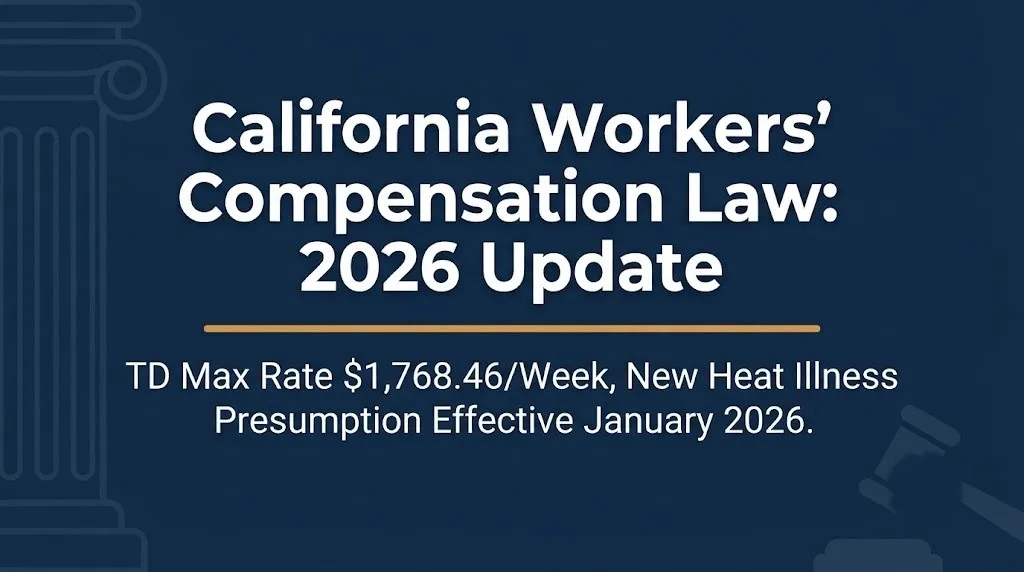
- Weekly disability benefits in 2026 range from a minimum of $294.74 to a maximum of $1,768.46 for temporary total disability.
- You must report your injury within 30 days and file a DWC-1 claim form with your employer to start a claim.
If you got hurt on the job in California, you are likely covered. But the system is dense, deadlines are tight, and insurers do not make filing easy. This guide is built from the actual 2026 statutes, permanent disability schedules, and Department of Industrial Relations releases, not recycled SEO filler from law firm blogs that have not been updated since 2023.
What this article covers: every verified 2026 benefit rate, filing deadline, permanent disability calculation rule, settlement option, and appeal right in the California workers’ compensation system. One verified detail most articles miss: the 2026 minimum weekly TD rate of $294.74 actually exceeds full-time minimum wage in 17 other states. The system is more generous than it gets credit for, but you have to file correctly to access it.
The Facts
| System | California Workers’ Compensation, Labor Code Sections 3200-6002 |
| Governing Agency | California Department of Industrial Relations, Division of Workers’ Compensation (DWC) |
| Coverage Requirement | All employers with 1+ employees; no exceptions for part-time or family workers |
| 2026 TD Max Rate | $1,768.46 per week |
| 2026 TD Min Rate | $294.74 per week |
| Injury Reporting Deadline | 30 days from date of injury or date you knew it was work-related |
| Claim Filing Deadline | 1 year from injury date (with exceptions for latent conditions) |
| Settlement Options | Stipulated findings and award, compromise and release, or trial |
What Is California Workers’ Compensation Law and Who Does It Cover?
California workers’ compensation law is a mandatory no-fault insurance system codified in the California Labor Code. It requires virtually every employer in the state to provide medical treatment, temporary disability payments, permanent disability compensation, and supplemental job displacement benefits to employees injured on the job. The system is no-fault, meaning you do not have to prove your employer was negligent. You only have to prove the injury happened at work or was caused by work.
Coverage extends to nearly all workers. The law covers full-time employees, part-time workers, undocumented workers, minors, and in most cases independent contractors who are misclassified and later determined to be employees under the ABC test adopted in Dynamex Operations West, Inc. v. Superior Court. Sole proprietors, LLC members, and corporate officers can opt out of coverage for themselves but must still carry coverage for their employees.
As of 2026, California remains one of the strictest states for employer compliance. Operating without workers’ compensation insurance is a criminal misdemeanor under Labor Code Section 3700.5. The Uninsured Employers Benefits Trust Fund, administered by the DWC, provides a safety net for workers whose employers illegally failed to carry coverage.
The system is administered by the Division of Workers’ Compensation, which operates 24 district offices across the state. Disputes are resolved by workers’ compensation administrative law judges at the Workers’ Compensation Appeals Board. The system is entirely administrative: you do not file in civil court unless an extremely narrow exception applies, such as an intentional tort by an employer.
Key Takeaway: California workers’ compensation covers almost every worker in the state. You are likely covered even if your employer says you are not, and you can verify coverage through the DWC website.
How Much Are Workers’ Compensation Benefits in California for 2026?
California workers’ compensation benefits fall into five main categories, each with 2026 rates set by the Division of Workers’ Compensation. Understanding what each one pays, and for how long, is the difference between accepting a lowball offer and getting what the law says you are owed.
Temporary total disability benefits, known as TD, are paid when your doctor says you cannot work at all while recovering. The 2026 TD rate is two-thirds of your average weekly wage, capped at a maximum of $1,768.46 per week. The minimum TD rate is $294.74 per week for workers whose two-thirds calculation falls below that floor. TD benefits are paid until you return to work or your condition stabilizes at maximum medical improvement, up to a limit of 104 weeks within five years of the injury date for most injuries.
Temporary partial disability, or TPD, is paid when you can return to work with restrictions and earn less than your pre-injury wage. TPD pays two-thirds of the difference between your pre-injury and post-injury earnings.
Permanent disability benefits kick in once you reach maximum medical improvement and your doctor rates your permanent impairment. The 2026 permanent disability schedule assigns a percentage rating to each impairment, which converts to a dollar amount. The value of a 1 percent PD rating ranges from roughly $2,000 to $4,000 depending on your average weekly wage and the rating’s placement on the schedule. Serious ratings, such as 50 percent or higher, can exceed $100,000 in total PD payments.
Here is the 2026 weekly benefit breakdown.
| Benefit Type | Rate | Duration Cap |
|---|---|---|
| Temporary Total Disability (TD) | 2/3 of average weekly wage, max $1,768.46/week, min $294.74/week | 104 weeks within 5 years |
| Temporary Partial Disability (TPD) | 2/3 of wage loss | 104 weeks within 5 years |
| Permanent Disability (PD) | Based on impairment rating and wage | Varies by rating; paid in weekly installments |
| Supplemental Job Displacement Benefit | $6,000 voucher for retraining | Paid when employer cannot offer modified work |
| Death Benefits | Up to $320,000 to dependents depending on number and relationship | Paid in installments |
Medical treatment is covered separately with no dollar cap. All treatment reasonably required to cure or relieve the effects of the injury is covered, subject to utilization review and the Medical Treatment Utilization Schedule.
Key Takeaway: Your average weekly wage determines everything. A worker earning $1,200 a week gets $800 a week in TD. A worker earning $3,000 a week gets the $1,768.46 max. Calculate your AWW carefully before you accept any offer.
What Is the California Workers’ Compensation Permanent Disability Rating Schedule?
The Permanent Disability Rating Schedule, often called the PDRS, is the mathematical formula that converts a doctor’s impairment rating into a dollar amount. It is updated periodically by the DWC. The 2026 schedule became effective January 1, 2025, and remains current through 2026.
The process starts with a medical evaluation. A qualified medical evaluator or agreed medical evaluator assigns a Whole Person Impairment percentage using the American Medical Association Guides to the Evaluation of Permanent Impairment, Fifth Edition. That WPI is then adjusted for your occupation, age, and diminished future earning capacity.
The adjusted rating converts to a number of weeks of PD payments at your PD weekly rate. The PD weekly rate is two-thirds of your average weekly wage, subject to the same statutory minimum and maximum as TD benefits. For 2026, the PD weekly rate maximum is $290 per week, and the minimum is $160 per week.
Here is how the math works for three different ratings.
| Whole Person Impairment | Adjusted PD Rating | Approx. PD Weeks | Weekly PD Rate | Total PD Value (Approx.) |
|---|---|---|---|---|
| 5% WPI | 7% PD | 56 weeks | $160-$290 | $8,960-$16,240 |
| 15% WPI | 22% PD | 176 weeks | $160-$290 | $28,160-$51,040 |
| 30% WPI | 45% PD | 382.5 weeks | $160-$290 | $61,200-$110,925 |
These are approximations. The actual calculation involves the specific occupation code, age on the injury date, and the exact DFEC adjustment factor. The PDRS runs hundreds of pages. Your attorney or a disability evaluator can run the precise calculation.
PD is paid in weekly installments unless you settle via a compromise and release, which can pay a lump sum. The schedule is complex enough that accepting an adjuster’s first rating without an independent medical evaluation is often a mistake.
Reality Check: Insurance adjusters have an incentive to push your PD rating as low as the medical evidence allows. Their physician network typically produces lower impairment ratings than independent evaluators. Getting a second opinion from a qualified medical evaluator in your specialty is not a confrontational move. It is how you verify the number that will define your financial recovery.
How Do I File a Workers’ Compensation Claim in California?
Filing a claim in California follows a defined sequence. Missing any step or deadline can delay benefits by weeks or result in a denial that takes months to appeal.
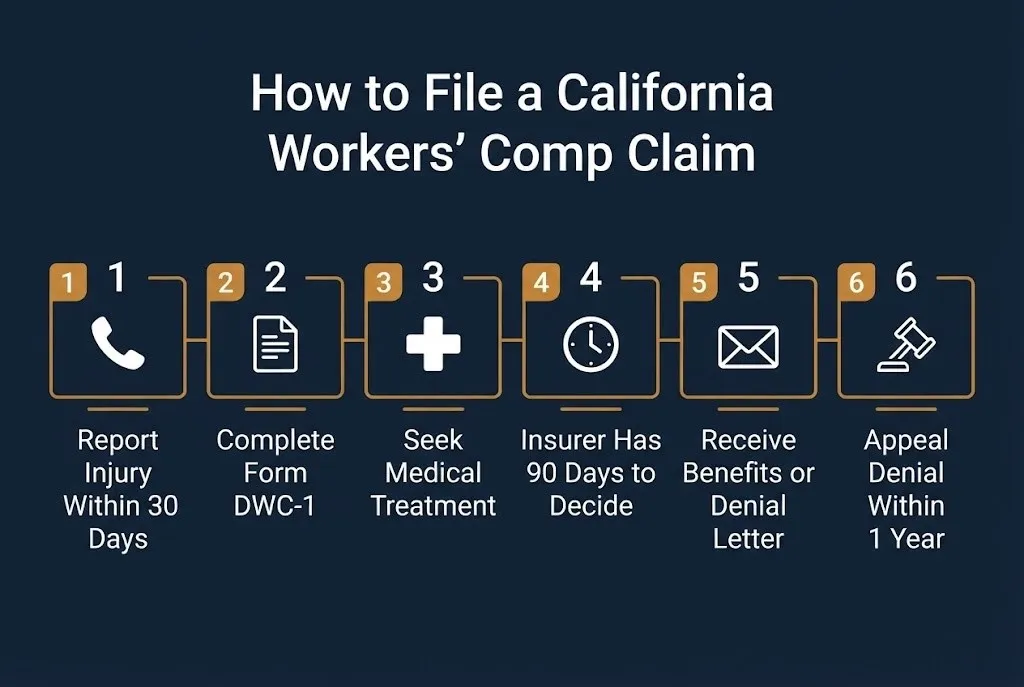
Here are the steps for filing a California workers’ compensation claim in 2026.
- Report the injury to your supervisor immediately. You have 30 days from the date of injury or the date you knew it was work-related. Verbal notice counts, but written notice is better.
- Complete and sign Form DWC-1, the official claim form. Your employer must provide this form within one working day of learning of the injury.
- Return the completed DWC-1 to your employer. Keep a copy for your records. The employer must then forward it to their claims administrator.
- Seek medical treatment. In the first 30 days, your employer can direct you to their Medical Provider Network. If you pre-designated a personal physician before the injury, you can see that doctor from day one.
- The claims administrator has 90 days to accept or deny the claim. If they fail to act within 90 days, the injury is presumed compensable under Labor Code Section 5402.
- If the claim is accepted, the insurer must begin paying TD benefits within 14 days of receiving the doctor’s work status report.
- If the claim is denied, you will receive a denial letter explaining the reason. You then have one year to file an Application for Adjudication of Claim with the WCAB.
The 90-day rule is one of the most important protections in the system. If 90 days pass from the date the claims administrator received your DWC-1 and you have received no denial letter, your injury is presumed covered. Insurers know this and rarely miss the deadline, but when they do, it changes the burden of proof in your favor.
Key Takeaway: Report immediately, file the DWC-1 the same day if possible, and document every communication. The timeline is rigid. Delays on your side are harder to fix than delays on the insurer’s side.
What Are the California Workers’ Compensation Deadlines in 2026?
Deadlines in workers’ compensation are absolute. Miss one, and you can lose the right to benefits even if your injury is undisputed. Here are the deadlines that matter in 2026.
The injury reporting deadline is 30 days from the date of injury. If you report after 30 days, your claim is not automatically barred, but it raises a rebuttable presumption that the injury is not work-related. This shifts the burden to you to prove the connection.
The claim filing deadline is one year from the date of injury, the date you knew or should have known the injury was work-related, or the date of last receipt of benefits, whichever is later. For cumulative trauma injuries, such as carpal tunnel syndrome or back strain from repetitive motion, the one-year clock starts from the date you knew or should have known the condition was caused by work.
The Application for Adjudication must be filed within one year of a claim denial. If you receive a denial letter dated June 1, 2026, you have until June 1, 2027, to file with the WCAB. This deadline is strictly enforced.
The statute of limitations for death benefits is one year from the date of death for a work-related fatality, and 240 weeks from the date of injury for death that occurs later but is causally related.
Here is the critical deadline summary.
| Event | Deadline |
|---|---|
| Report injury to employer | 30 days from date of injury or knowledge |
| Employer provides DWC-1 form | 1 working day from notice of injury |
| Claims administrator decision | 90 days from receipt of DWC-1 |
| File Application for Adjudication after denial | 1 year from denial date |
| Claim TD benefits | 14 days from insurer receipt of work status report |
| Cumulative trauma filing | 1 year from date you knew condition was work-related |
| Death benefit claim | 1 year from date of death |
A plain-life comparison: missing the one-year filing deadline is like discovering you bought a defective product but the warranty expired last month. The defect is real, the receipt is in your hand, but the legal right to a remedy has evaporated. Calendar these dates.
What Medical Treatment Am I Entitled To Under California Workers’ Comp?
Medical treatment under California workers’ compensation covers all care reasonably required to cure or relieve the effects of the work injury. There is no dollar cap and no copay. The standard is medical necessity as defined by the Medical Treatment Utilization Schedule, or MTUS, adopted by the DWC.
Covered treatment includes emergency care, hospital stays, surgeries, prescription medications, physical therapy, chiropractic care limited to 24 visits per injury, psychological treatment for compensable mental health conditions, and medical equipment such as wheelchairs or prosthetics. The MTUS guidelines are evidence-based and updated periodically. Treatment that falls outside MTUS guidelines requires a request for authorization submitted by your physician.
In the first 30 days after injury, you must treat within the employer’s Medical Provider Network if one exists and you did not pre-designate a personal physician. After 30 days, you can switch to any physician within the MPN, or if the MPN is inadequate or you face unreasonable delays, you can petition to treat outside it.
Pre-designation is an underused right. If you have a regular personal physician or medical group that you trust, and you pre-designate them in writing before an injury occurs, you can treat with them from day one. This requires your physician to agree in advance and to maintain your medical records. It costs nothing and takes one form. Very few workers do it, and those who do consistently report better outcomes.
Utilization review is the process by which the insurer reviews treatment requests. The insurer has 5 working days to approve or deny routine treatment, and 72 hours for urgent requests. If treatment is denied, you can appeal through independent medical review, a process administered by the DWC’s Independent Medical Review program. IMR decisions are binding on both parties.
Key Takeaway: You have the right to all medically necessary treatment without paying a dime. The MTUS and MPN systems impose guardrails, but independent medical review provides a check on insurer denials that actually works about 40 percent of the time in overturning or modifying denials, per DWC data.
How Are Workers’ Compensation Settlements Structured in California?
California workers’ compensation cases resolve in one of two ways: a stipulated findings and award, or a compromise and release. Understanding the difference is essential before you sign anything.
A stipulated findings and award, often called a stip, resolves the disputed parts of a claim while leaving medical treatment open. The parties agree on the permanent disability rating, the dollar amount of PD owed, and any back TD benefits. The insurer pays the agreed amount in weekly installments, and future medical care remains the insurer’s responsibility. This structure works well when you have ongoing medical needs that the insurer does not seriously dispute.
A compromise and release, or C&R, is a full buyout. You receive a lump sum payment, and in exchange, you close every aspect of the claim permanently, including future medical treatment. The C&R must be approved by a workers’ compensation judge, who will review it to ensure the settlement is adequate and voluntary. Once approved, the case is closed forever. You cannot reopen it if your condition worsens.
The C&R amount typically includes the present value of your permanent disability award plus an estimate of future medical costs. The future medical estimate is often the largest variable and the most contested. Insurers discount future medical aggressively. Your attorney should push back with specific treatment projections from your treating physician.
Here is how the two settlement types compare.
| Feature | Stipulated Findings & Award | Compromise & Release |
|---|---|---|
| Payment | Weekly PD installments | Lump sum |
| Future medical | Remains open, paid by insurer | Closed, your responsibility |
| Reopen right | Yes, within 5 years for new/aggravated condition | No, fully final |
| Judge approval | Required | Required |
| Medicare set-aside | Usually not required | May be required if Medicare-eligible |
Workers with serious, chronic injuries often do better keeping medical open. Workers with stable conditions who want finality may prefer a C&R. There is no universally correct choice. It depends on your medical outlook, your age, and your tolerance for ongoing interaction with the insurer.
What If My California Workers’ Comp Claim Is Denied?
A denial is not the end of the road. It is the beginning of a process that leads to a hearing before a workers’ compensation administrative law judge. Insurers deny claims for reasons that range from legitimate to frivolous, and a surprising number of denials are reversed.
The denial letter must state the specific reason for denial. Common reasons include the injury was not witnessed, you delayed reporting, the medical evidence does not establish a work-related cause, you had a pre-existing condition, or the claim was filed after the statute of limitations. Each of these can be challenged with evidence.
To appeal, you file an Application for Adjudication of Claim with the WCAB. Your attorney will request a panel of qualified medical evaluators if the dispute involves medical causation. The QME will examine you and issue a report. That report carries substantial weight with the judge.
A mandatory settlement conference, or MSC, is scheduled before any trial. At the MSC, the parties discuss settlement with a judge. Many cases resolve here. If not, the case proceeds to trial, which in workers’ compensation is less formal than civil court but still involves testimony, medical evidence, and a written decision.
The entire process from application to trial typically takes 12 to 18 months depending on the district office’s docket. Los Angeles and Orange County offices run heavier backlogs. Less populated districts move faster.
If you lose at trial, you can petition for reconsideration by the WCAB. If reconsideration is denied, you can seek review by the California Court of Appeal. These appellate steps are rare and reserved for cases with significant legal issues, not factual disputes about what the doctor said.
Key Takeaway: A denial is a starting line, not a dead end. But you need a QME report and an attorney who tries cases, not one who only settles. Ask any lawyer you consult how many trials they have done in the last year. If the answer is zero, keep looking.
How Does the 2026 Heat Illness Presumption Work in California?
Effective January 1, 2026, California Labor Code Section 3212.15 establishes a rebuttable presumption that certain heat-related injuries are compensable for outdoor workers. This is one of the most significant changes to California workers’ compensation law in recent years.
The presumption applies to agricultural workers, construction workers, landscapers, and any employee required to work outdoors where the temperature exceeds 90 degrees Fahrenheit. Covered injuries include heat stroke, heat exhaustion, rhabdomyolysis, and acute kidney injury caused by heat exposure.
If the outdoor temperature exceeded 90 degrees on the date of injury and the worker was performing outdoor work, the injury is presumed compensable. The employer can rebut the presumption only by presenting clear and convincing evidence that the heat exposure was not a contributing cause of the injury. This is a higher burden than the usual preponderance standard.
The presumption also applies to first responders and firefighters regardless of outdoor temperature, extending existing presumptions that already cover cancer, hernia, and heart conditions. The 2026 legislation consolidates and expands heat protections that were previously scattered across emergency regulations and Cal/OSHA standards.
For workers, the practical effect is that a heat-related injury claim filed with a doctor’s diagnosis and evidence of outdoor work above 90 degrees should be accepted without the usual causation battle. Insurers are still adjusting to the new standard, and some denials are expected while the case law develops.
Key Takeaway: If you work outdoors in California and suffer a heat-related illness, the 2026 presumption law makes your claim significantly easier to prove. Report the injury immediately and confirm the outdoor temperature was documented.
How Does California Workers’ Comp Handle COVID-19 Claims in 2026?
The COVID-19 presumption for workers’ compensation ended on January 1, 2024, for most workers, but claims filed during the presumption period remain active, and some employer-specific outbreak presumptions still apply in 2026.
The original presumption, codified in Executive Order N-62-20 and later Labor Code Section 3212.88, covered employees who worked outside their home and tested positive during the state of emergency. For claims filed between March 19, 2020, and January 1, 2024, the presumption shifted the burden to the employer to prove the infection was not work-related. Those claims continue to be processed and litigated as of 2026.
For infections occurring after January 1, 2024, there is no statutory presumption. The worker must prove the infection was work-related under the ordinary causation standard. This is difficult for a virus as widespread as COVID-19. Outbreak clusters, such as multiple confirmed cases in a single workplace within a short period, remain the strongest evidence.
Long COVID claims present a separate challenge. Post-COVID conditions affecting the respiratory system, cardiovascular function, or cognitive capacity can be the basis for permanent disability if the underlying COVID-19 infection was work-related. These cases require extensive medical documentation and are among the most actively litigated claim types in the 2026 WCAB system.
Key Takeaway: If you contracted COVID-19 at work before 2024, your claim may still be open under the presumption. After 2024, proving workplace causation without an outbreak cluster is an uphill battle. Document everything and consult an attorney.
What Happens Next: Key 2026 and 2027 California Workers’ Comp Changes
Below are the changes and events that will affect California workers’ compensation in the coming year.
- September 2026: DWC expected to release the 2027 Physician and Non-Physician Practitioner Fee Schedule updates, which adjust reimbursement rates for medical services.
- January 1, 2027: Annual TD and PD rate adjustments take effect. The 2027 rates will be published by the DWC in November 2026 based on the state average weekly wage.
- Early 2027: The Commission on Health and Safety and Workers’ Compensation is expected to release its annual report on system performance, including claim volume, denial rates, and benefit adequacy findings.
- 2027 Legislative Session: Several bills are expected to address the gig economy worker classification and its intersection with workers’ compensation coverage, following the 2024 election and potential federal regulatory shifts.
- Ongoing: The WCAB continues to address its post-pandemic case backlog. Some district offices have reduced wait times to 6 to 9 months for a mandatory settlement conference. Others remain at 12 to 14 months.
Frequently Asked Questions
How long does workers’ comp take to pay in California?
TD benefits must begin within 14 days of the insurer receiving the doctor’s work status report.
If the insurer delays beyond 14 days without good cause, a 10 percent penalty applies under Labor Code Section 5814.
Can I see my own doctor for a workers’ comp injury in California?
You can if you pre-designated your personal physician in writing before the injury occurred.
After 30 days, you can switch to any doctor within the employer’s MPN. If the MPN is inadequate, you can petition to treat outside it.
What is the maximum workers’ comp settlement in California?
There is no statutory maximum on settlements. The value depends on the PD rating and estimated future medical costs.
A C&R settlement for a catastrophic injury can exceed $500,000, but most cases settle for far less based on the PD schedule.
Can I sue my employer instead of filing workers’ comp?
Almost never. Workers’ compensation is the exclusive remedy for workplace injuries under California law.
Exceptions exist for intentional torts, such as an employer physically assaulting you, but these are extremely rare.
What happens if my employer doesn’t have workers’ comp insurance?
You can file a claim with the Uninsured Employers Benefits Trust Fund administered by the DWC.
The employer faces criminal penalties including fines up to $100,000 and potential jail time.
Can I work another job while on workers’ comp TD?
Generally no. If your doctor says you are temporarily totally disabled, working any job contradicts that finding.
Working while receiving TD benefits can result in benefit termination and fraud allegations.
How much does a workers’ comp attorney cost in California?
Attorneys work on contingency, typically 15 percent of the settlement or award amount.
The fee is capped by statute and must be approved by a WCAB judge. No upfront payment is required.
Does workers’ comp cover mental health injuries in California?
Yes, but the standard is higher than for physical injuries. You must prove at least 6 months of employment and that the actual events of employment were the predominant cause.
Stress claims are among the most frequently denied and require strong medical documentation.
California workers’ compensation is not designed to be easy to navigate. It is designed to provide defined benefits within a closed administrative system that keeps disputes out of civil court. The benefits are real, the deadlines are rigid, and the difference between a fair outcome and a bad one often comes down to whether you had the right information at the right time.
If you are injured at work, your first 48 hours matter most. Report the injury, get the DWC-1 form, see a doctor, and document every conversation. If the claim is denied, get an attorney who tries cases. The 2026 rate sheets, the permanent disability schedule, and the WCAB are all on your side if you follow the process.