Pennsylvania Workers Compensation: 2026 Guide to Claims, Benefits, and Deadlines
Quick Answer
- Pennsylvania workers compensation is mandatory, employer-paid insurance covering work-related injuries and illnesses.
- Weekly benefits can reach $1,325.00 in 2026, calculated as two-thirds of your average weekly wage up to the state cap.
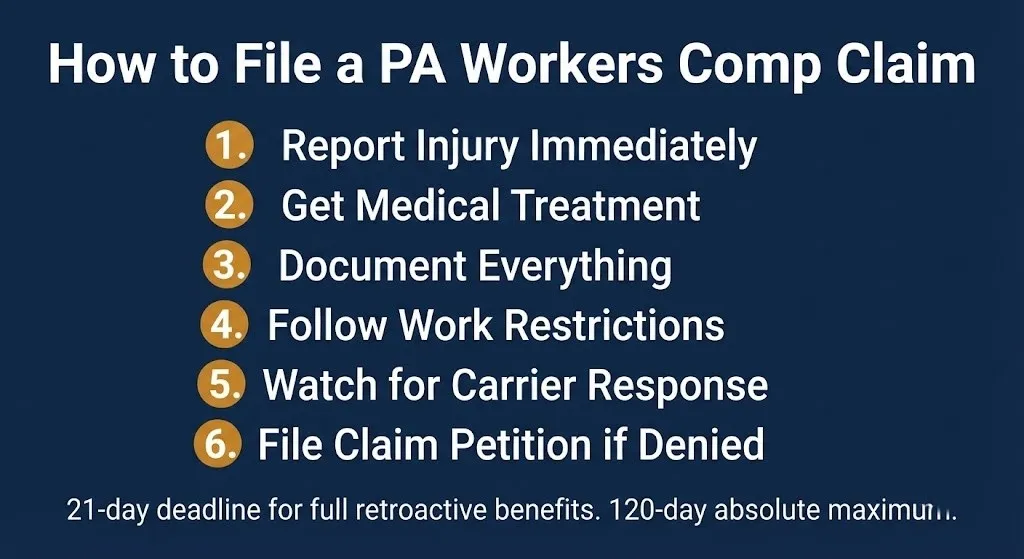
- You must report an injury to your employer within 21 days for full retroactive benefits or within 120 days maximum.
You got hurt at work in Pennsylvania. Or you got sick from something on the job. Now you are searching for how to get paid while you recover, how much the checks will be, and whether your employer or their insurance company can say no.
Pennsylvania workers compensation is a state-mandated insurance program. It pays medical bills and a portion of lost wages when a job causes an injury or illness. You do not sue your employer. You file a claim. You do not have to prove anyone was at fault. But you do have to follow strict deadlines and procedures, and the insurance carrier is not on your side.
This guide covers every stage: what counts as a work injury, how benefits are calculated, what the 2026 rates are, how to file, what to do if your claim is denied, and how settlements work in Pennsylvania. The benefit rates are public. The deadlines are statutory. The strategies that get claims paid are the ones insurance carriers hope you do not know.
The Facts
| Detail | Verified Value |
|---|---|
| Program | Pennsylvania Workers’ Compensation Act |
| Governing Agency | Pennsylvania Department of Labor and Industry, Bureau of Workers’ Compensation |
| 2026 Max Weekly Rate | $1,325.00 |
| Employer Coverage Requirement | Most employers with one or more employees |
| Employee Cost | Zero (employer pays all premiums) |
| Injury Report Deadline | 21 days for full benefits, 120 days maximum |
| Claim Filing Deadline | 3 years from injury date or last benefit payment |
| Waiting Period | 7 days (retroactive if disability exceeds 14 days) |
What Is Workers Compensation in Pennsylvania
Workers compensation in Pennsylvania is a state-regulated insurance system that pays medical expenses and partial wage replacement when an employee suffers a work-related injury or occupational disease. It is a no-fault system. You do not need to prove your employer caused the injury. You only need to show the injury happened at work or because of work.
The Pennsylvania Workers’ Compensation Act created this system. It covers nearly all employees in the state. Employers pay for the insurance. Employees pay nothing. In exchange for guaranteed benefits, employees generally give up the right to sue their employer for workplace injuries.
The system is administered by the Bureau of Workers’ Compensation within the state Department of Labor and Industry. Workers’ compensation judges resolve disputes between injured workers and insurance carriers. The process is designed to be faster than civil litigation. Whether it actually is faster depends on whether your claim is accepted or denied.
Who Is Covered by Pennsylvania Workers Compensation
Most Pennsylvania employees are covered from the first day of employment. The law requires employers with one or more employees to carry workers compensation insurance. There are narrow exceptions for certain agricultural workers, domestic workers, and some independent contractors.
The coverage requirement applies regardless of full-time or part-time status. If you receive a paycheck and taxes are withheld, you are almost certainly covered. Undocumented workers are covered under Pennsylvania law. Your immigration status does not bar a claim.
Independent contractors are generally not covered. But the label your employer puts on you does not control. Pennsylvania uses a multi-factor test to determine whether someone is an employee or an independent contractor. The key factors include who controls your work, who provides tools, whether you can work for others, and how you are paid.
If you are uncertain about your status, here are the factors Pennsylvania courts examine:
- The degree of control the employer exercises over your work
- Whether you are engaged in a distinct occupation or business
- Whether the work is typically done under employer supervision
- The skill required for the work
- Who supplies the tools and the place of work
- The length of the working relationship
- Whether payment is by time or by the job
- Whether the work is part of the employer’s regular business
Key Takeaway: Most Pennsylvania workers are covered. Your employer’s classification of you as a contractor does not override the legal test. If you control little and depend on one employer, you may be an employee entitled to benefits.
How to File a Workers Compensation Claim in Pennsylvania
Filing a claim starts with reporting your injury to your employer. That step triggers the legal timeline. It also starts the clock on your right to benefits. The reporting requirement is strict. Miss it, and your claim can be denied even if your injury is real.
You must report a work injury to your employer within 21 days to receive benefits retroactive to the date of injury. You have a maximum of 120 days to report. If you report after 120 days, your claim is barred. The clock starts from the date you knew or should have known the injury was work-related.
The report does not need to be in writing, but written notice is always better. It creates a record. Tell your supervisor directly. Follow up with an email or written note. Keep a copy. If your employer has a designated workers compensation coordinator or HR contact, notify them too.
Once you report the injury, your employer must notify their insurance carrier. The carrier has 21 days to accept or deny the claim by issuing a Notice of Compensation Payable, a Notice of Temporary Compensation Payable, or a Notice of Workers’ Compensation Denial.
Here is the step-by-step filing process:
- Report the injury to your employer immediately, in writing if possible.
- Seek medical treatment and tell the provider the injury is work-related.
- Provide a list of all body parts affected and how the injury occurred.
- Follow your employer’s instructions for seeking treatment if they have a posted panel of providers.
- Keep copies of all medical records, work restrictions, and correspondence.
- If your claim is denied, file a Claim Petition with the Bureau of Workers’ Compensation.
- Consult a certified workers compensation attorney if the denial is not quickly reversed.
How Much Does Pennsylvania Workers Compensation Pay in 2026
Pennsylvania workers compensation pays two-thirds of your average weekly wage, up to the state maximum. For injuries occurring in 2026, the maximum weekly benefit is $1,325.00. That figure is set annually by the Department of Labor and Industry based on the statewide average weekly wage.
The calculation uses your gross wages, not your take-home pay. Your average weekly wage is determined by looking at your earnings in the highest three of the last four calendar quarters before your injury. If you worked less than a full quarter, different calculation methods apply.
Here are the 2026 benefit rates:
| Wage Level | Weekly Benefit Calculation |
|---|---|
| Average weekly wage of $800 | $533.33 per week |
| Average weekly wage of $1,200 | $800.00 per week |
| Average weekly wage of $1,987.50 or above | $1,325.00 per week (max) |
| Average weekly wage of $480 or below | 90% of average weekly wage |
Workers earning below a threshold receive 90 percent of their average weekly wage instead of two-thirds. That threshold changes annually. For 2026, it applies to workers earning roughly $555 or less per week.
There is a seven-day waiting period before wage-loss benefits begin. You do not receive payment for those first seven days unless your disability lasts more than 14 days. If it does, the waiting period becomes payable retroactively.
Key Takeaway: Your benefit check is a fraction of your gross pay. Budget for that gap. The maximum is $1,325 per week regardless of how much you earned.
What Injuries Qualify for Workers Compensation in Pennsylvania
Any injury, illness, or medical condition that arises in the course of employment and is related to employment qualifies. That includes sudden accidents, like a fall or a machine injury. It includes repetitive stress injuries, like carpal tunnel syndrome. It includes occupational diseases, like lung conditions from chemical exposure.
The injury does not need to happen at your workplace. If you are traveling for work and get injured, that may be covered. If you are at a company event or running a work errand, that may be covered. The test is whether you were furthering the employer’s interests at the time of the injury.
Pre-existing conditions that are aggravated by work are covered. If you have a bad back and lifting at work makes it worse, that is a work injury. The employer takes you as they find you. The insurance carrier may dispute whether the aggravation is work-related, but the law covers aggravation of pre-existing conditions.
Mental health injuries are harder to prove but can be covered. Pennsylvania recognizes psychic injuries when they result from abnormal working conditions. The standard is high. A mental health claim requires proof that the work conditions causing the injury were unusual or extraordinary compared to the normal conditions of that type of employment.
Reality Check: Insurance carriers routinely deny claims by arguing the injury is not work-related or is a pre-existing condition. A denial is not the final word. You have the right to a hearing before a workers compensation judge. Many claims initially denied are later approved.
How Does the Pennsylvania Workers Compensation Settlement Process Work
A workers compensation settlement in Pennsylvania is called a Compromise and Release Agreement. It ends your right to future wage-loss and medical benefits in exchange for a lump-sum payment. Settlements are voluntary. Neither side can force the other to settle.
The settlement value depends on several factors. The insurance carrier calculates its exposure: how much future wage-loss benefits and medical care it expects to pay. Your age, your injury severity, your average weekly wage, your work restrictions, and your ability to return to any job all factor into the calculation.
Settlements require approval from a workers compensation judge. The judge reviews the agreement to ensure you understand what you are giving up. You must testify at a settlement hearing. The judge will ask if you understand the terms and if you are entering the agreement voluntarily.
Typical settlement ranges for Pennsylvania workers compensation claims:
| Injury Severity | Typical Settlement Range |
|---|---|
| Minor (sprains, strains, full recovery expected) | $5,000 to $25,000 |
| Moderate (surgery, some permanent restrictions) | $25,000 to $100,000 |
| Severe (multiple surgeries, significant disability) | $100,000 to $300,000 |
| Catastrophic (permanent total disability) | $300,000 and above |
These ranges are estimates. Your specific settlement may fall outside them based on your wage rate, medical evidence, and the insurance carrier’s evaluation.
What Is the Illinois Workers Compensation Commission
The Illinois Workers’ Compensation Commission is the state agency that administers workers compensation in Illinois. It resolves disputes between injured workers and employers or their insurance carriers. It is not relevant to a Pennsylvania claim, but many people searching for information about one state system encounter information about another.
Illinois operates under its own workers compensation statute with different benefit rates, deadlines, and procedures. The Illinois commission functions similarly to Pennsylvania’s Bureau of Workers’ Compensation. Both are state agencies that oversee the claims process and provide a forum for resolving disputes.
If you were injured in Pennsylvania, the Illinois system has no jurisdiction over your claim. Each state’s workers compensation law applies to injuries that occur within that state. Some exceptions exist for employees who travel across state lines or who were hired in one state and injured in another. Those situations require legal analysis of which state’s law applies.
How Does Workers Compensation in Colorado Compare
Colorado has a separate workers compensation system with different rules. Colorado uses a different maximum benefit rate, different filing deadlines, and different dispute resolution procedures than Pennsylvania. The Colorado Division of Workers’ Compensation administers claims there.
The Colorado maximum weekly benefit for 2026 differs from Pennsylvania’s $1,325.00. Colorado calculates its rate based on a different formula tied to the state’s own average weekly wage. If you were injured in Colorado, Pennsylvania rules do not apply. If you were injured in Pennsylvania, Colorado rules are irrelevant.
Some workers travel between states. If that describes your situation, the controlling law is generally the law of the state where the injury occurred or where the employment relationship is centered. This determination can be complex. Both states’ workers compensation agencies can provide guidance on jurisdiction questions.
Key Takeaway: Workers compensation is state-specific. Rates, deadlines, and procedures from one state do not carry over to another. Check the rules for the state where your injury occurred.
How Kansas Workers Compensation Differs From Pennsylvania
Kansas administers workers compensation through the Kansas Department of Labor Division of Workers Compensation. Kansas has its own benefit schedule, its own maximum weekly rate, and its own claim procedures. The Kansas maximum rate differs from Pennsylvania’s $1,325.00.
Kansas uses a different formula for calculating benefits. It applies a percentage to the state average weekly wage and adjusts annually. The filing deadlines in Kansas also differ. In Kansas, you must report an injury to your employer within 30 days for full benefits, compared to 21 days in Pennsylvania.
If you are comparing state systems because you have claims in multiple states, you need state-specific advice for each claim. A Pennsylvania workers compensation attorney may not practice in Kansas. Each state requires its own filing, its own medical evidence, and its own adjudication.
How Much Does Workers Compensation Insurance Cost Employers
Employers pay workers compensation insurance premiums. Employees pay nothing. The cost depends on the employer’s industry classification, payroll size, and claims history. High-risk industries like construction and manufacturing pay higher rates. Low-risk industries like office work pay lower rates.
Pennsylvania uses a classification system developed by the Pennsylvania Compensation Rating Bureau. Each job classification has a base rate per $100 of payroll. The employer’s experience modification factor adjusts that rate based on the employer’s own claims history relative to other employers in the same industry.
Payroll-based premium calculation is standard. Employers report payroll by classification code. The insurer multiplies payroll by the rate for each classification to determine premium. Some employers choose a deductible plan or a retroactive rating plan to manage costs.
Self-insurance is permitted for large employers who can demonstrate the financial ability to pay claims directly. Self-insured employers administer claims directly or through a third-party administrator rather than through an insurance carrier.
How Are Workers Compensation Claims Processed
After you report an injury, your employer files a First Report of Injury with the Bureau of Workers’ Compensation. The insurance carrier receives the report and investigates. The carrier has 21 days to issue one of three documents.
A Notice of Compensation Payable accepts the claim and starts benefits. A Notice of Temporary Compensation Payable starts benefits for up to 90 days while the carrier investigates. A Notice of Workers’ Compensation Denial rejects the claim. If a denial is issued, you must file a Claim Petition to pursue benefits.
Medical treatment during the first 90 days after an injury must be with a provider from your employer’s posted panel of providers. If your employer does not have a properly posted panel, you can treat with any provider. After 90 days, you can choose your own provider.
The insurance carrier can request an Independent Medical Examination at any time. This is a defense medical exam, not an independent one. The doctor is chosen and paid by the carrier. Failure to attend an IME can result in suspension of benefits.
Key Takeaway: The 21-day period after you report an injury is critical. Pay attention to what document the carrier issues. A Notice of Temporary Compensation Payable is not a final acceptance. The carrier can later deny the claim.
What to Do if Your Pennsylvania Workers Compensation Claim Is Denied
A denial is not the end of the road. It is the start of the litigation phase. You have the right to file a Claim Petition with the Bureau of Workers’ Compensation. The petition initiates a proceeding before a workers compensation judge.
The judge will schedule hearings. Both sides present evidence. You testify about your injury and your work restrictions. Your medical records and any expert medical opinions are submitted. The insurance carrier presents its defense. The judge decides whether the injury is work-related and what benefits are owed.
Here is what to do after a denial:
- Do not quit your job or resign.
- Obtain a copy of the denial notice from your employer or the carrier.
- Contact a certified Pennsylvania workers compensation attorney immediately.
- Continue treating with your doctor and follow all medical advice.
- File a Claim Petition within three years of the injury date.
- Keep a journal documenting your symptoms, restrictions, and interactions with your employer.
- Do not post about your injury or activities on social media.
- Attend all scheduled hearings and independent medical examinations.
The denial process can take months. If the judge awards benefits, they are retroactive to the date of injury. The wait is frustrating. The process is adversarial. But a denial is not the final answer.
What Happens Next With Your Pennsylvania Workers Compensation Claim
Every claim follows a general timeline. The specifics depend on whether your claim is accepted, whether you need ongoing treatment, and whether you reach maximum medical improvement. Here is the typical progression.
- Day 0: Injury occurs. Report it immediately.
- Within 21 days: Carrier accepts or denies the claim.
- Day 7: Waiting period ends. Benefits begin if disability continues.
- Day 14: Waiting period becomes payable if disability persisted.
- 90 days: You may choose your own treating provider.
- Months 3 to 12: Medical treatment, possible IMEs, possible return to work.
- Month 12+: If you do not fully recover, settlement discussions may begin.
- Within 3 years: Claim Petition deadline if denied.
- At maximum medical improvement: Impairment rating evaluation if applicable.
Every case is different. Some workers recover fully in weeks. Some never return to their pre-injury job. Your timeline depends on your injury, your treatment, and whether the carrier disputes your claim.
Frequently Asked Questions
How long do I have to report a work injury in Pennsylvania
You must report within 21 days for full retroactive benefits.
The absolute maximum is 120 days from the date of injury or knowledge of injury.
After 120 days, your claim is barred.
How much does workers comp pay in Pennsylvania in 2026
The maximum weekly benefit is $1,325.00.
Most workers receive two-thirds of their average weekly wage up to that cap.
Low-wage workers receive 90 percent of their average weekly wage.
Who pays for workers compensation in Pennsylvania
Your employer pays the full cost of workers compensation insurance.
Employees pay nothing toward premiums or benefits.
The cost cannot be deducted from your wages.
Can I sue my employer for a work injury in Pennsylvania
Generally no.
Workers compensation is the exclusive remedy for work injuries.
Exceptions exist for intentional acts, but these are rare and hard to prove.
What if my employer does not have workers comp insurance
You can file a claim with the Uninsured Employers Guaranty Fund.
Your employer faces criminal penalties and civil liability.
You may sue an uninsured employer directly for damages.
How do I check my workers comp claim status in Pennsylvania
Contact your employer or their insurance carrier for claim status.
Use the Bureau of Workers’ Compensation online case search at the state website.
Your attorney can access the WCAIS system for real-time claim updates.
Can I get workers comp for a repetitive stress injury
Yes.
Carpal tunnel, tendinitis, and other repetitive injuries are covered.
These claims often require medical evidence linking the condition to work activities.
What is a Compromise and Release settlement
It is a lump-sum payment that closes your claim permanently.
You give up future wage-loss and medical benefits for the injury.
The settlement must be approved by a workers compensation judge.
Pennsylvania workers compensation is a system with rules that favor workers who know them and carriers that exploit those who do not. Report your injury today. Document everything. If your claim is denied, get legal help. The deadlines are unforgiving, and the gap between what the law promises and what the insurance carrier offers is where most claims get lost.