Workers Compensation Insurance Oregon 2026: Rates, Requirements, and What Employers Must Know
Quick Answer
- Is it required? Yes. Oregon requires coverage for employers with one or more subject workers.
- How much does it cost? Average small business premium runs about $60 per month, or $715 annually.
- Most important deadline? Workers must report injuries within 90 days. Employers must file claims within five days.
What Is Workers Compensation Insurance in Oregon?
Workers compensation insurance in Oregon is a no-fault system that provides medical treatment and wage replacement for workers injured on the job. The employer buys the policy. The worker gives up the right to sue the employer for negligence in exchange for guaranteed benefits.
Oregon law requires coverage for nearly every employer with at least one subject worker. The system is administered by the Oregon Workers’ Compensation Division (WCD), part of the Department of Consumer and Business Services. Oregon has a competitive market with more than 300 companies writing workers’ compensation policies .

If you run a business in Oregon and you have anyone working for you, this coverage is not optional. Oregon’s system is one of the most stable in the country, with rates declining for over a decade.
The Facts
| Topic | Oregon Workers Compensation Insurance |
| Status | Active. 2026 rates in effect since January 1, 2026. |
| Pure Premium Rate Change | -3.3% average decrease for 2026 (13th straight year) |
| Premium Assessment | 9.8% of premiums for insured employers |
| Workers’ Benefit Fund | 1.8 cents per hour worked (down from 2.0 cents) |
| Est. Cost | Average $60/month or $715/year for small business |
| Claim Filing Deadline | 90 days for injury notice, one year for occupational disease |
| Administrator | Oregon Workers’ Compensation Division (WCD) |
| Proof Needed | Form 801, medical records, payroll documentation |
Is Workers Compensation Insurance Required in Oregon?
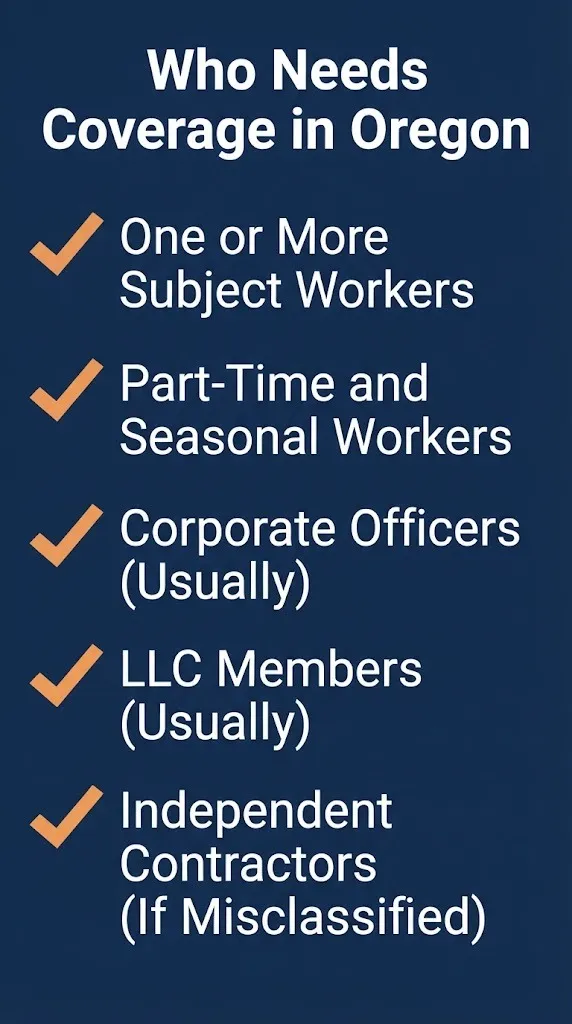
Yes. Oregon requires workers compensation coverage for all employers with one or more subject workers. The law applies to corporations, LLCs, partnerships, and sole proprietorships that have any worker receiving remuneration.
The requirement is broad. Part-time workers count. Seasonal workers count. Family members working for the business generally count. If you pay someone to work and you have the right to direct and control how the work is done, that worker is probably your employee .
Corporate officers are usually not required to have coverage if they serve on the board and own at least 10% of the stock in the company. A construction company can have no more than two exempt officers unless it is a family-run business .
LLC members are generally exempt from Oregon workers’ compensation requirements. They follow the same rules and exemptions as corporate officers .
Independent contractors are exempt only if they truly meet the legal definition under ORS 670.600. Oregon changed the law in 2022 to redefine who counts as a worker. Some people who were previously not subject workers are now covered .
Key Takeaway: If you have anyone working for you in Oregon, assume you need coverage. The exceptions are narrow and the penalties for non-compliance are real.
How Much Does Workers Compensation Insurance Cost in Oregon?
The average cost of workers compensation in Oregon is about $60 per month, or $715 annually, based on policy data from small business insurers . That average hides a wide range. A clerical office pays far less than a construction company.
Oregon’s average pure premium rate dropped 3.3% for 2026, continuing a 13-year trend of decreases. The state has the 14th lowest workers’ compensation costs in the U.S. .
Premiums depend on four main factors:
- Your payroll by employee classification code
- The classification rate for each type of work performed
- Your experience modification rate (EMR), which reflects your claims history
- Credits or debits applied by the insurer
Oregon relies on the National Council on Compensation Insurance (NCCI) database for classification rates. The formula is: Classification rate × Experience mod × (Annual payroll ÷ $100) .
The EMR only comes into play for annual workers’ comp premiums of at least $5,000. For many small business owners, it is not a factor .
How Are Oregon Workers Comp Premiums Calculated?
Oregon workers comp premiums are calculated using a three-factor formula that starts with your payroll by classification. The state uses NCCI classification codes to assign risk levels to different types of work.
Step 1: Determine your employee classifications. Each type of work has a classification code. Office workers have low rates. Roofers and tree trimmers have high rates .
Step 2: Calculate your payroll by classification. The premium formula uses payroll divided by $100, so accurate payroll numbers matter.
Step 3: Apply your experience modification rate. If your annual premium is above the threshold, NCCI calculates an EMR based on your loss history. A mod below 1.0 saves money. A mod above 1.0 costs more.
The premium assessment adds 9.8% to your premium for 2026. This assessment funds the Workers’ Compensation Division and Oregon OSHA .
The Workers’ Benefit Fund assessment dropped to 1.8 cents per hour worked in 2026, down from 2.0 cents. Employers and employees split this cost, with employers paying at least 0.9 cents per hour .
Who Is Exempt from Workers Compensation in Oregon?
Oregon has roughly 30 exceptions to workers compensation coverage under ORS 656.027. Most workers are subject workers unless they fall into one of those narrow categories.
Sole proprietors with no employees are not required to cover themselves. Partners in a partnership are generally excluded unless they elect coverage. LLC members follow the same rules as corporate officers and are generally exempt .
Corporate officers can be exempt if they serve on the board and own at least 10% of the stock. Construction companies can have no more than two exempt officers unless it is a family-run business .
Independent contractors are exempt only if they meet the legal definition under ORS 670.600. If you control their work or they are economically dependent on your business, they may be reclassified as employees .
“If any” policies are available for employers with no employees. These policies fulfill contract requirements and provide peace of mind if you hire someone unexpectedly. You can purchase an “if any” policy only through the assigned risk pool .
How Do You Get Workers Compensation Insurance in Oregon?
Getting coverage in Oregon is straightforward because the state has a competitive market with more than 300 carriers. You have several options for purchasing a policy.
- Contact your insurance agent. Often, the agent who handles your other business insurance can also help with workers’ compensation .
- Contact an insurance company directly. Some carriers deal directly with employers, and a few offer coverage through business associations.
- Contact the Small Business Ombudsman. The DCBS has an advocate for small business who can discuss options. Call 503-378-4209 .
- Apply to the Assigned Risk Plan if denied. If an insurer denies you coverage, you can apply to the Oregon Workers’ Compensation Insurance Plan, administered by NCCI. Call 800-622-4123, ext. 6240 .
- Consider self-insurance. Employers who meet requirements can apply to DCBS for self-insurance status .
What Are the Penalties for Not Having Oregon Workers Comp?
Failing to carry required workers compensation coverage in Oregon triggers civil penalties and direct liability. If an employee gets hurt while you are uninsured, your business is responsible for all claims costs plus administration fees .
The costs add up quickly. Medical bills, disability payments, and administrative fees can severely affect your business. Oregon also assesses civil penalties for non-compliance.
The state can also issue stop-work orders, shutting down operations until coverage is in place. The Workers’ Compensation Division actively enforces coverage laws to ensure employers maintain coverage for their subject workers .
Reality Check: “If Any” Policies and the Coverage Gap
An “if any” policy is for employers with no employees. It fulfills contract requirements and provides protection if you hire someone. But it does not cover actual workers. If you have employees and only carry an “if any” policy, you are uninsured in the eyes of the law. Make sure your policy matches your actual workforce.
What Are the 2026 Oregon Workers Comp Benefit Rates?
Oregon workers compensation benefits for 2026 include updated rates for temporary disability, permanent total disability, and fatal injury benefits. The maximum benefit is 133% of the state average weekly wage (SAWW).
For injuries on or after July 1, 2026, fatal injury benefits include:
| Benefit Type | Amount |
|---|---|
| Unpaid balance to estate | $29,224.20 |
| Monthly benefit to spouse | $4,237.72 |
| Combined maximum | $8,474.81 per month |
| Children (up to age 19) | $1,589.07 per month |
| Other dependents | 50% of average monthly support |
Temporary disability benefits are paid at 66 2/3% of the worker’s gross weekly wage. The minimum payment is 90% of wages a week, or $50, whichever is less .
SB 1519, passed in 2026, changes how temporary disability and permanent total disability benefits are calculated. The changes apply to injuries on or after January 1, 2027, and are not retroactive .
What Is the Deadline to File an Oregon Workers Comp Claim?
Oregon has strict deadlines for reporting injuries and filing claims. Missing them can bar your claim entirely.
For injuries: You must give notice to your employer within 90 days of the accident. If the employer knew of the injury, or if you have good cause for the delay, the claim must be filed within one year after the accident .
For occupational disease: You must file within one year from the date you first discovered the disease, or one year from when you became disabled or were informed by a physician that you have an occupational disease .
Your employer must send your claim (Form 801) to its insurer within five days of being notified of your injury. Medical providers must report work-related injuries to the insurer within three business days .
What Happens Next in Your Oregon Workers Comp Case?
Within 90 days of injury: Report to your employer. Request Form 801.
Within 5 days: Employer must file Form 801 with the insurer.
Within 60 days: Insurer must accept or deny the claim.
After acceptance: Medical treatment and temporary disability benefits begin.
At maximum medical improvement: Doctor assigns impairment rating.
Expected 6 to 12 months after filing: Settlement conference or mediation if the case is disputed.
TBD: If the case goes to hearing, the timeline depends on the Workers’ Compensation Board docket.
Frequently Asked Questions
Who needs workers comp insurance in Oregon?
Nearly every employer with one or more subject workers. This includes corporations, LLCs, partnerships, and sole proprietors with any worker receiving remuneration. Part-time and seasonal workers count .
How much does workers comp cost in Oregon?
The average small business policy runs about $60 per month, or $715 yearly. Your actual premium depends on payroll, classification codes, and claims history. Rates dropped 3.3% for 2026 .
What happens if I don’t have workers comp in Oregon?
You may be subject to civil penalties. If an employee gets hurt, your business is responsible for all claims costs plus administration fees. The costs can severely affect your business .
Are independent contractors covered in Oregon?
Only if they truly meet the legal definition under ORS 670.600. If you control their work or they are economically dependent on your business, they may be reclassified as employees .
Can I exclude myself as a corporate officer in Oregon?
Yes, if you serve on the board and own at least 10% of the stock. Construction companies can have no more than two exempt officers unless it is a family-run business .
What is the deadline to report a work injury in Oregon?
You must give notice to your employer within 90 days of the accident. If the employer knew of the injury or you have good cause, the claim must be filed within one year .
What is the Workers’ Benefit Fund assessment?
It funds return-to-work programs and benefits for permanently disabled workers and families of workers who die from workplace injuries. The 2026 rate is 1.8 cents per hour worked .
What You Should Do Right Now
If you employ anyone in Oregon, verify your coverage is active and your classifications are correct. Gather your payroll records by class code. Check your experience modification rate.
The single most important number to remember for 2026: 9.8% premium assessment on top of your base premium. Make sure your coverage is in place before someone gets hurt.