Payout for Workers Compensation 2026: State Caps, Body Part Charts, and How Much You Actually Get
Quick Answer
- Workers’ comp pays wage replacement, medical care, and permanent impairment benefits, but amounts depend on your state, injury, and pre-injury wage.
- Texas caps weekly Temporary Income Benefits at $1,271.05 for 2026, while New Jersey’s maximum is $1,598.66 per week.
- You typically must miss more than 7 days of work to qualify for wage-loss benefits in most states.
How Much Does Workers Compensation Pay?
Workers’ compensation pay depends on your state’s formula, your average weekly wage, and the severity of your injury. There’s no single national rate.
Most states replace about two-thirds of your lost wages while you’re unable to work. That’s your temporary disability benefit. Once you reach maximum medical improvement, the calculation shifts to permanent impairment, which is based on a rating assigned by a doctor .
Your pre-injury wage sets the baseline. If you earned $1,200 per week, a two-thirds replacement rate means roughly $800 per week in benefits. But that number gets capped. High earners often hit the state maximum and collect less than their actual wage loss .
Medical care is separate. Workers’ comp pays for doctor visits, surgery, therapy, and prescriptions related to the accepted injury. In most states, medical benefits continue for life, regardless of how the wage replacement is calculated .
What Is the Maximum Weekly Workers Compensation Payout in 2026?
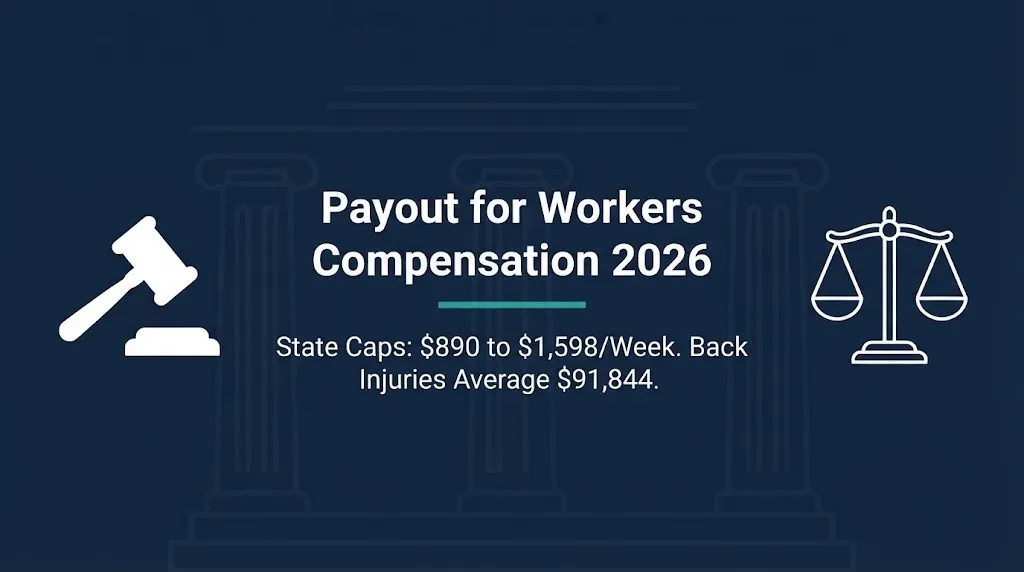
The maximum weekly workers’ comp payout in 2026 ranges from $890 in Texas for impairment benefits to $1,598.66 in New Jersey for wage-loss benefits. These caps are set annually based on each state’s average weekly wage.
| State | Benefit Type | 2026 Maximum | 2026 Minimum |
|---|---|---|---|
| Texas | Temporary Income Benefits | $1,271.05/week | $191.00/week |
| Texas | Impairment Income Benefits | $890.00/week | N/A |
| New Jersey | Wage Loss | $1,598.66/week | $320.00/week |
| Pennsylvania | Wage Loss | $1,394.00/week | Variable |
| New York | Lost Wage | State AWW based | $384.45/week |
Texas rates change on October 1 each year based on the date of injury . A worker injured in September 2025 gets the 2025 rates. One injured in October 2025 falls under the 2026 schedule.
New Jersey’s maximum jumped to $1,598.66 per week for 2026, with a minimum of $320.00 . Pennsylvania’s maximum is $1,394.00 per week, reflecting a 3.5% increase from last year .
New York’s minimum benefit rose to $384.45 per week as of July 1, 2026, indexed to one-fifth of the state’s average weekly wage .
Key Takeaway: The state where you were injured and the date of your injury determine which rates apply, and high earners often collect far less than their actual wage loss because of statutory caps.
What Is the Average Workers Compensation Settlement by Body Part?
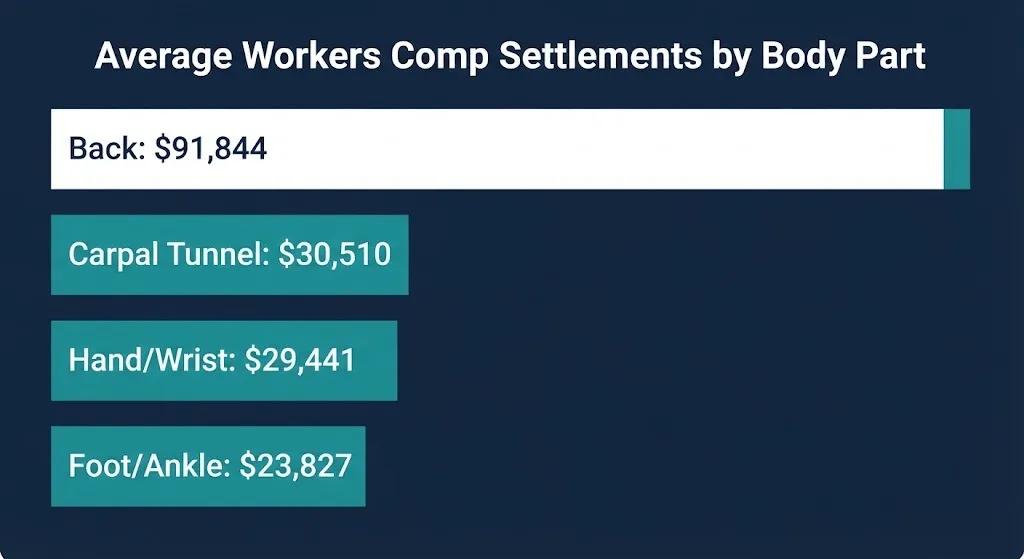
The average workers’ comp settlement for a back injury is $91,844, the highest among common injury categories. Carpal tunnel averages $30,510, and foot or ankle injuries average $23,827.
| Body Part | Average Settlement | Typical Range |
|---|---|---|
| Back | $91,844 | $15,000 to $300,000+ |
| Shoulder | $27,391 to $51,750 | $10,000 to $100,000+ |
| Foot/Ankle | $23,827 | $8,000 to $150,000 |
| Hand/Wrist | $29,441 | $10,000 to $100,000+ |
| Carpal Tunnel | $30,510 | $8,000 to $180,000 |
Surgical cases average two to four times non-surgical outcomes . A herniated disc requiring surgery settles between $80,000 and $180,000. Spinal fusion cases reach $150,000 to $350,000. Spinal cord injuries can exceed $500,000 .
Carpal tunnel settlements break down by severity. Mild cases without surgery settle for $8,000 to $20,000. Surgical release cases reach $35,000 to $75,000. Bilateral or failed surgeries push into $60,000 to $140,000 .
What Is the Texas Workers Compensation Payout in 2026?
Texas workers’ comp pays four types of income benefits, and the 2026 maximum for Temporary Income Benefits is $1,271.05 per week. The state has no traditional lump-sum settlement system for most claims.
Texas operates differently from most states. The 1989 reforms eliminated lump-sum settlements except in narrow circumstances. Workers receive structured benefits instead .
Temporary Income Benefits (TIBs) replace wages while you can’t work. You get 70% of your average weekly wage for the first 26 weeks, then 75% thereafter. Benefits cap at $1,271.05 per week and end 104 weeks after the injury .
Impairment Income Benefits (IIBs) start after you reach maximum medical improvement. A doctor assigns an impairment rating, and you receive three weeks of benefits per percentage point. A 15% rating means 45 weeks of payments. The IIB rate is 70% of your average weekly wage, with a maximum of $890.00 per week for 2026 .
Supplemental Income Benefits (SIBs) are for workers with impairment ratings of 15% or higher who can’t return to substantially equivalent work. Paid quarterly.
Lifetime Income Benefits (LIBs) cover catastrophic injuries like total blindness, loss of two limbs, or severe brain injury. Pays 75% of your average weekly wage for life, with 3% annual increases .
How Is a Workers Compensation Payout Calculated?
A workers’ comp payout is calculated from four components: lost wages, permanent impairment, medical expenses, and loss of earning capacity. Each state weights them differently.
The standard wage replacement formula is 66.67% of your average weekly wage, or two-thirds of what you earned before the injury . Some states use 70%. A few use 80% for lower-wage workers.
Permanent impairment is the biggest variable. After you reach maximum medical improvement, a doctor assigns a rating from 0% to 100%. That rating gets multiplied by your state’s scheduled number of weeks for the injured body part. A higher rating means more weeks of benefits .
Medical expenses are typically paid separately and don’t count against your wage replacement cap. Future medical care is sometimes capitalized into a lump-sum settlement if one is available in your state.
Loss of earning capacity matters if you can’t return to your old job at the same wage. The difference between your old wage and your new earning capacity can be added to the settlement value .
How Do You File a Workers Compensation Claim?
Filing a workers’ comp claim starts with reporting your injury to your employer, usually within 30 days. Missing that deadline can bar your claim entirely.
- Report the injury to your employer. Do it in writing and keep a copy. Tell your supervisor the same day if possible.
- Get medical treatment. Go to an approved provider if your state requires it. Document everything.
- File the claim form with your state agency. Deadlines vary, but most are 1 to 2 years from the injury or diagnosis.
- Notify your employer’s insurance carrier. The carrier will assign an adjuster to your case.
- Attend all medical appointments. Missing appointments can hurt your claim.
- Get an impairment rating at maximum medical improvement. This drives your permanent disability payout.
- Negotiate or dispute the settlement. Most states allow you to challenge a low offer through mediation or a hearing.
Reality Check: No one calls you offering workers’ comp money. Your employer’s insurance carrier isn’t looking out for your best interest. Adjusters often open with offers at 50% to 70% of true case value. Represented workers historically recover three to five times what unrepresented claimants accept. You don’t pay upfront for an attorney, as most work on contingency.
How Much Does Workers Compensation Pay for Carpal Tunnel?
Carpal tunnel workers’ comp settlements average $30,510, but the range stretches from $8,000 to $180,000 depending on severity and whether surgery is needed.
The severity tiers break down like this:
| Severity | Typical Range |
|---|---|
| Mild (No Surgery) | $8,000 to $20,000 |
| Moderate (Conservative + Injections) | $18,000 to $40,000 |
| Surgical Release | $35,000 to $75,000 |
| Bilateral / Failed Surgery | $60,000 to $140,000 |
| Cubital + Carpal Tunnel | $80,000 to $180,000 |
Carpal tunnel is one of the harder claims to prove. The condition is common in the general population, so you need solid documentation linking it to repetitive job tasks. Vibration, awkward postures, and repetitive gripping all strengthen the case .
If you had surgery and still have grip strength loss or fine motor limitations, the settlement value rises. Bilateral cases, where both hands are affected, push into the higher tiers .
What Happens Next After You File a Workers Compensation Claim
Within 30 days: Report the injury. This is your most important deadline.
Within 1 to 2 years: File the formal claim with your state agency. The clock varies by state.
3 to 6 months: Attend medical treatment and work with your doctor toward maximum medical improvement.
6 to 12 months: Get an impairment rating. This determines your permanent disability payout.
12 to 24 months: Negotiate a settlement or attend a hearing if the carrier disputes your claim.
After settlement: Medical benefits may continue separately, depending on your state and the terms of your agreement.
Frequently Asked Questions
How much does workers compensation pay per week?
Most states pay about two-thirds of your average weekly wage, capped at a state maximum. Texas caps Temporary Income Benefits at $1,271.05 per week for 2026, while New Jersey’s maximum is $1,598.66.
What is the average workers comp settlement for a back injury?
The average back injury settlement is $91,844 nationwide. Herniated disc cases without surgery range from $40,000 to $80,000, while surgical cases reach $80,000 to $180,000 or more.
How long do you have to file a workers compensation claim?
Deadlines vary by state, but most give you one to two years from the injury or diagnosis. You should report the injury to your employer within 30 days.
Do I need a lawyer for a workers compensation claim?
You don’t need one, but represented workers historically recover three to five times more than unrepresented claimants. Most workers’ comp attorneys work on contingency, so you pay nothing unless you win.
How much does workers comp pay for carpal tunnel?
Carpal tunnel settlements average $30,510. Mild cases settle for $8,000 to $20,000, surgical cases reach $35,000 to $75,000, and bilateral or failed surgeries can reach $140,000.
Can I get a lump sum settlement for workers compensation?
It depends on your state. Texas eliminated most lump-sum settlements in 1989, while other states allow them. Some states allow lump-sum conversion of impairment benefits if you’ve returned to work at 80% of your pre-injury wage.
What happens if my employer doesn’t have workers compensation insurance?
In most states, you can sue the employer directly in civil court for full damages, not just the limited workers’ comp benefits. This is called a non-subscriber case in Texas.