Workers Compensation Insurance Certificate 2026: How to Verify Coverage, Avoid Fraud, and Understand Your Rights
Quick Answer
- A workers compensation insurance certificate is a real document proving an employer carries required coverage.
- There is no payout tied to a certificate. It is proof of insurance, not a claim or settlement.
- The key deadline is coverage verification. Check certificates before work starts, not after an injury.
If you are a contractor, a business owner, or an injured worker, you have probably seen a workers compensation insurance certificate. You may have been asked to provide one. Or you may have asked someone else for one.
This article explains what the certificate actually proves, what it does not prove, the state rules that govern it, and the legal trouble that follows when a certificate is fake, lapsed, or misread.
One verified detail most guides miss: at least 30 states now use online verification databases. A paper certificate can be outdated within hours. The database is the only real check.
The Facts
| Case | No single case; multiple state enforcement actions |
| Status | State-level enforcement ongoing |
| Fund Size | Not applicable; no settlement fund |
| Est. Per Person | Not applicable; no payout tied to certificates |
| Claim Deadline | No claim deadline; coverage must be verified continuously |
| Administrator | State workers compensation boards or divisions |
| Proof Needed | Certificate, policy number, insurer contact, state database lookup |
Is a Workers Compensation Insurance Certificate Real or a Scam?
The certificate itself is a real document. The scam risk comes from fake certificates.
A legitimate certificate lists the employer, the insurer, the policy number, the coverage dates, and the states where coverage applies. It is typically issued on a standard form called the ACORD 25 form.
Fraud happens when someone creates a certificate for a policy that does not exist. Or when someone alters a real certificate to change dates or add coverage that was never purchased.
If you are hiring a contractor, accept no certificate at face value. Call the insurer listed on the form. Use the state’s online verification database if one exists.
A real certificate is a snapshot of coverage on the day it was issued. It is not a guarantee that coverage remains active today.
What Does a Workers Compensation Certificate of Insurance Actually Prove?
A workers compensation certificate of insurance proves one thing: the named employer had a workers compensation policy in force on the date the certificate was issued.
It does not prove current coverage. It does not prove the policy covers the specific work being done. It does not prove the employer paid the premium in full.
The certificate lists the policy number, the insurer name, the effective and expiration dates, and the states where coverage is written. It also shows the certificate holder, the person or business requesting proof.
When you receive a certificate, compare the policy dates to the project dates. If the project runs beyond the expiration date, require a renewal certificate.
Think of a certificate like a car registration. It proves the vehicle was registered at issuance. It does not prove the registration is still valid today.
What Is the ACORD 25 Form in Workers Compensation?
The ACORD 25 form is the standard certificate of liability insurance used across the United States.
ACORD stands for the Association for Cooperative Operations Research and Development. It is an insurance industry body that sets standard forms.
The ACORD 25 shows liability coverage, including workers compensation where applicable. It is a summary. It is not the policy itself.
A certificate holder receives the ACORD 25 as evidence that coverage exists. The certificate holder does not receive a copy of the full policy unless the insurer or employer chooses to provide one.
The form includes boxes for insurer name, policy number, effective date, expiration date, and a description of operations. If any of these boxes are blank, the certificate is incomplete and should not be accepted.
How Much Does a Workers Compensation Insurance Certificate Cost?
A certificate costs nothing to the certificate holder.
The employer pays for the workers compensation policy. The certificate is simply proof of that policy. Insurers issue certificates at no extra charge.
If someone charges you a fee to “issue” or “verify” a workers compensation certificate, that is a red flag. Certificates come from the insurer or the employer’s insurance agent.
The cost of the underlying policy varies by state, industry, and payroll. Rates are set by state-approved rating bureaus and vary widely.
A high-risk industry like roofing pays more per hundred dollars of payroll than a low-risk office job. But the certificate itself adds no charge.
Key Takeaway: A certificate is free proof of an employer’s insurance policy, but it is a snapshot, not a live guarantee of current coverage.
How Do You Verify a Workers Compensation Certificate of Insurance?
Verification is the step most people skip. And it is the step that matters most.
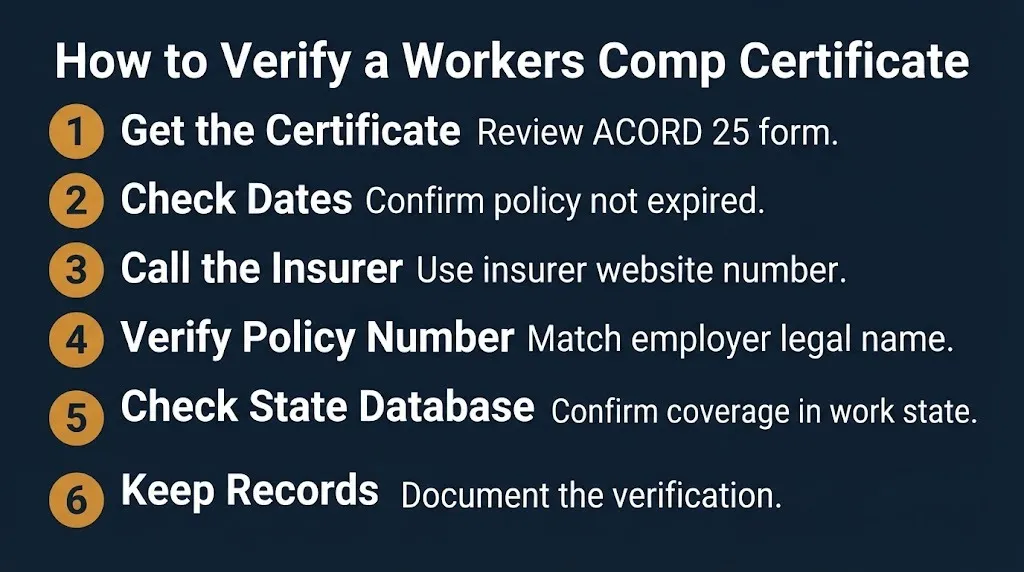
- Look at the insurer name on the certificate.
- Find the insurer’s direct phone number from the insurer’s website, not from the certificate itself.
- Call the insurer and ask to verify the policy number is active.
- Give the policy number and the employer name exactly as they appear on the certificate.
- Ask whether the policy covers workers compensation in the state where the work will happen.
- Check the state workers compensation board’s online verification database if available.
- Keep a written record of the verification call and database check.
- Re-verify before each new project phase or if the project runs past the expiration date.
Some states make this easier. New York, Florida, and California all have public or semi-public databases for workers compensation coverage verification.
What Happens If an Employer Has No Workers Compensation Insurance?
The consequences are serious for the employer. And they matter for you if you are a worker.
In most states, employers above a certain size must carry workers compensation insurance. The threshold varies. Some states require it for any employee, including part-time.
An employer without coverage faces fines, stop-work orders, and personal liability for workplace injuries. In some states, criminal penalties apply.
For an injured worker, the absence of coverage means the normal workers compensation claim path is closed. The worker may need to sue the employer directly in civil court.
That path is slower and harder. It requires proving the employer was negligent, which workers compensation normally does not require.
If you are injured and your employer has no coverage, check your state’s uninsured employers fund. Many states have a backup fund for exactly this situation.
Can You Sue for a Fake Workers Compensation Certificate?
Yes. A fake certificate creates legal exposure for whoever produced or used it.
The injured worker may sue the employer directly if coverage was misrepresented. The person or business that relied on the fake certificate may sue for fraud or negligent misrepresentation.
State insurance departments also pursue enforcement. Producing a fake certificate can lead to license revocation, fines, and criminal charges.
A contractor who shows a fake certificate to a general contractor or property owner can face contract termination and legal claims for any resulting losses.
If you discover a certificate is fake, report it to your state’s workers compensation board or insurance department. Keep the document and any related communications.
What Is a Certificate of Workers Compensation for Contractors?
For contractors, the certificate serves as proof they meet state coverage requirements and the requirements of the general contractor or property owner.
Many construction contracts require subcontractors to provide a certificate before starting work. The general contractor is often liable if a subcontractor lacks coverage and a worker is injured.
This creates a chain of verification. Each level should verify the level below. If any link fails, the financial risk travels up the chain.
Independent contractors often do not need workers compensation insurance for themselves. But if they have employees, they do. The certificate proves coverage for those employees.
Misclassifying employees as independent contractors to avoid coverage is a common enforcement target. State agencies and plaintiffs’ attorneys pursue these cases aggressively.
Key Takeaway: Contractors must produce certificates, and general contractors must verify them, or the risk of paying for an uninsured injury moves up the chain.
What Is the Workers Compensation Certificate of Insurance Database?
Several states maintain online databases where anyone can verify workers compensation coverage.
The database allows a user to enter the employer name or federal employer identification number and see whether coverage is active.
New York’s Workers Compensation Board database is public. Florida’s Division of Workers’ Compensation maintains a proof of coverage database. California has a similar tool through the Department of Industrial Relations.
These databases are updated regularly, but not in real time. There can be a lag between policy cancellation and database update. The insurer call remains the most reliable check.
The database is free to use. No login is required for most states.
What Is the Penalty for Not Having Workers Compensation in New York?
New York has some of the strictest workers compensation rules in the country.
Employers with any employees must carry coverage. There is no minimum threshold. Even one part-time employee triggers the requirement.
Penalties include fines of up to $2,000 per 10-day period without coverage. Criminal penalties apply in repeat or egregious cases. A stop-work order can shut down the business.
For injured workers, New York’s Uninsured Employers Fund can provide benefits. The fund then pursues the employer for reimbursement.
The New York Workers Compensation Board maintains a public database. Anyone can check whether an employer has active coverage.
How Does Workers Compensation Insurance Work for Injured Workers?
Workers compensation is a no-fault system. That means an injured worker receives benefits without proving the employer was negligent.
Benefits include medical care, a portion of lost wages, and permanent disability payments where applicable. Death benefits go to dependents of workers killed on the job.
The trade-off is that workers compensation is usually the exclusive remedy. The worker cannot sue the employer in civil court for a workplace injury, with limited exceptions.
Those exceptions matter. If the employer intentionally caused the injury, or lacked required coverage, a civil lawsuit may be possible.
The certificate is not part of the claim process. But if coverage was absent or lapsed, the certificate becomes central to the legal fight.
Key Takeaway: Workers compensation is no-fault, but the absence of insurance breaks the system and opens the door to civil lawsuits.
What Should an Injured Worker Do About Employer Insurance Problems?
If you are injured and your employer says there is no coverage, act fast.
First, confirm the claim. Your employer should have a workers compensation policy if required by state law. Ask for the certificate and the policy number.
Second, report the injury to your state workers compensation board. The board can tell you whether coverage exists and what your options are.
Third, if there is no coverage, ask about the state’s uninsured employers fund. Most states have one.
Fourth, consult a workers compensation attorney. Cases without coverage are more complex. You may need to sue the employer directly.
Fifth, keep all medical records, wage records, and communications with your employer.
Reality Check: A workers compensation insurance certificate is not a claim form, not a settlement offer, and not proof of current coverage. Anyone who tells you a certificate entitles you to a payout is misleading you.
What Are the Most Common Workers Compensation Certificate Problems?
Several problems recur in real-world disputes.
Expired certificates top the list. The policy lapsed, but the certificate still circulates. Verify dates.
Fake certificates are next. Produced with a real insurer’s name but a fake policy number. Verify with the insurer.
Wrong state coverage follows. The policy covers the employer’s home state but not the state where the work is happening. Verify state listings.
Misnamed entities appear. The certificate lists a related but different legal entity than the one doing the work. Verify the exact legal name.
Insufficient limits or missing endorsements create gaps. The certificate may not reflect the specific coverage the contract requires.
Each of these problems is avoidable with a verification call and a database check.
What Happens Next in Workers Compensation Enforcement?
State enforcement is increasing. Several trends are clear.
Expected late 2026: More states expand online verification databases. Pressure is building for a national database, though none exists yet.
Expected 2027: Legislative action on misclassification. Several states are drafting laws to close the independent contractor loophole.
Ongoing: State insurance fraud units are pursuing fake certificate cases. Criminal referrals are up.
For employers, the message is to maintain coverage and produce accurate certificates. For workers and contractors, the message is to verify, verify, verify.
The most important date is not a deadline. It is the day before work starts. That is when verification must happen.
Frequently Asked Questions
What is a workers compensation insurance certificate?
It is a document proving an employer has a workers compensation policy in force on the date issued.
It is not the policy itself and does not guarantee current coverage.
How do I know if a workers compensation certificate is real?
Call the insurer listed on the certificate and verify the policy number.
Check the state workers compensation board’s online database if available.
Is a workers compensation certificate the same as a claim form?
No. A certificate proves insurance coverage.
A claim form starts the process of receiving benefits after a workplace injury.
How much does a workers compensation certificate cost?
The certificate itself is free to the certificate holder.
The employer pays for the underlying insurance policy.
What if my employer has no workers compensation insurance?
You may still receive benefits through your state’s uninsured employers fund.
You may also have the right to sue the employer directly.
Can a workers compensation certificate expire?
The certificate shows coverage dates, and coverage can lapse.
The certificate remains a document, but it stops proving current coverage after the expiration date.
How do I verify workers compensation coverage in my state?
Use your state workers compensation board’s online verification database.
Call the insurer directly for the most current information.
The single most important action is to verify coverage before work begins. A certificate that is not verified is just paper.