Washington Workers Compensation 2026: State Fund Rules, Claim Deadlines, and Benefit Amounts
Quick Answer
- Washington workers compensation is a state-run system, not private insurance. Employers pay premiums to the state fund.
- Benefit amounts depend on your wage, disability rating, and injury date. No single payout applies.
- The most important deadline is one year from injury to file, but reporting to your doctor and employer should happen immediately.
If you work in Washington state and got injured, you are dealing with a different system than most of the country.
Washington has a monopolistic state fund. That means the state, through the Department of Labor and Industries, is the insurer. Your employer does not buy a private workers compensation policy. Your employer pays premiums to the state.
This article explains how the Washington system works, how claims are filed, what benefits pay, and the deadlines that matter. One verified detail most guides miss: Washington allows workers to file claims directly with the state even if the employer refuses to report the injury.
The Facts
| Case | No single case; Washington state workers compensation system |
| Status | Active state-run insurance system |
| Fund Size | State fund, not a settlement fund |
| Est. Per Person | Varies by wage and disability rating |
| Claim Deadline | One year from injury date for filing |
| Administrator | Washington Department of Labor and Industries |
| Proof Needed | Medical records, employer report, wage records |
Is Washington Workers Compensation a State Fund?
Yes. Washington runs a monopolistic state workers compensation system.
Unlike most states, Washington does not allow private workers compensation insurance for most employers. Employers pay premiums to the Washington Department of Labor and Industries, known as L&I.

The state fund pays benefits to injured workers. There is no private insurer involved in most claims.
Some large employers qualify for self-insurance. They must meet strict financial requirements and get state approval. Even self-insured employers follow the same benefit rules.
This is different from states like Arizona or California, where private insurers compete for employer business. In Washington, the state is the insurer.
Who Must Have Washington Workers Compensation Coverage?
Nearly every employer in Washington must participate in the state fund.
Any employer with one or more employees must pay premiums to L&I. The requirement applies to full-time, part-time, and seasonal workers.
Sole proprietors and independent contractors are generally not required to cover themselves. But if they have employees, they must cover those employees.
There are narrow exemptions for some domestic workers, agricultural workers in certain situations, and specific industries.
If you are a worker, do not assume your employer pays premiums. You can check coverage through the L&I website using the employer’s name or UBI number.
How Much Does Washington Workers Compensation Cost Employers?
Washington employers pay premiums based on hours worked and job classification.
The state assigns each job classification a rate per hour worked. High-risk jobs like logging and roofing have higher rates. Office jobs have lower rates.
Premiums are calculated quarterly. Employers report hours worked and pay the resulting premium.
The cost is borne entirely by the employer. Washington law prohibits employers from deducting workers compensation premiums from worker wages.
Workers do not pay premiums. They do not pay deductibles or copays for approved medical treatment.
Key Takeaway: Washington workers compensation is employer-funded. Any deduction from your wages for premiums is illegal.
How Do You File a Workers Compensation Claim in Washington?
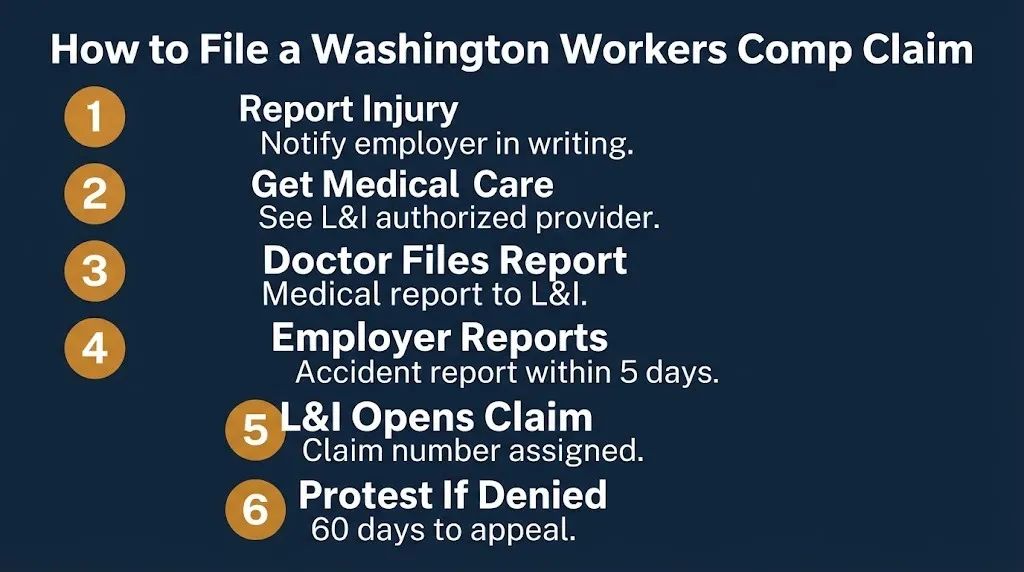
Filing a claim in Washington follows a specific process.
- Report the injury to your employer immediately, ideally in writing.
- Seek medical treatment from a provider authorized by L&I or your employer’s self-insurance program.
- The doctor files a report with L&I describing the injury and treatment.
- Your employer must file an accident report with L&I within 5 days of learning of the injury.
- L&I opens a claim and assigns a claim number.
- If L&I accepts the claim, benefits begin.
- If L&I rejects the claim, you have 60 days to protest.
- If you disagree with any L&I decision, you can request a hearing.
Washington also allows workers to file claims directly with L&I. If your employer refuses to report the injury, contact L&I yourself. The one-year deadline still applies.
What Benefits Does Washington Workers Compensation Pay?
Washington pays medical benefits and wage replacement benefits.
Medical benefits cover all necessary treatment related to the injury. There is no deductible and no copay for the injured worker.
Time-loss compensation replaces a portion of lost wages when you cannot work due to the injury. The amount is based on your wages at the time of injury.
If you are able to work part-time, you may receive loss of earning power benefits for the difference.
Permanent partial disability awards come when the injury leaves a permanent impairment. The amount depends on the disability rating and the body part affected.
Pension benefits may be paid for permanent total disability, which prevents you from returning to any gainful employment.
How Much Can You Receive in Washington Workers Compensation?
The amount depends on your wage and the type of benefit.
Time-loss compensation generally pays 60 to 75 percent of your average monthly wage, depending on your marital status and dependents. The state sets a maximum monthly amount that adjusts each year.
Permanent partial disability awards follow a schedule. The schedule assigns a dollar value to different impairments. For example, loss of a finger has a set award amount.
Permanent total disability pensions pay a percentage of your wage for life in some cases.
| Benefit Type | Typical Rate | Duration |
|---|---|---|
| Time-loss | 60% to 75% of wages | Until released to work |
| Loss of earning power | Difference between old and new wages | Varies |
| Permanent partial disability | Scheduled amount by impairment | One-time award |
| Permanent total disability | Percentage of wages | Potentially lifetime |
The actual dollar amount depends on your wages and the state maximum in effect on the injury date.
What Is the Deadline to File a Washington Workers Compensation Claim?
The deadline is one year from the date of injury.
There is an exception for occupational diseases. The clock runs from the date the worker knew or should have known the disease was work-related.
For injuries, the one-year deadline is strict. If you do not file within one year, the claim is barred.
The deadline applies to filing the claim with L&I. Reporting the injury to your employer is not the same as filing a claim. Make sure L&I has your claim on file.
Key Takeaway: Report immediately and file with L&I before the one-year deadline. Employer notification alone does not preserve your claim.
What Is the Role of the Washington Department of Labor and Industries?
The Department of Labor and Industries, L&I, is the state agency that runs the workers compensation system.
L&I sets premium rates, processes claims, pays benefits, and resolves disputes. It also enforces workplace safety rules.
If you are injured, L&I is your point of contact for claim status, benefit questions, and disputes.
L&I has offices around the state. You can also manage many claim functions online through the L&I website.
The agency is not your advocate. It is a neutral administrator. If you disagree with an L&I decision, you have the right to protest and request a hearing.
What Happens If Your Claim Is Denied in Washington?
A denial is not the end of your claim.
L&I must issue a written decision explaining the denial and your appeal rights.
You have 60 days from the date of the decision to protest. The protest is filed with L&I.
If L&I upholds the denial after protest, you can request a hearing before an industrial appeals judge.
Many denials are overturned at hearing. The process is administrative, not a full civil trial. You can present evidence, call witnesses, and cross-examine.
You do not need a lawyer for every case, but one helps with complex medical issues or disputed facts.
How Does Washington Workers Compensation Compare to Private Insurance States?
Washington is a monopolistic state. Most states use private insurance.
In private insurance states, the employer buys a policy from a commercial carrier. The carrier handles claims and pays benefits.
In Washington, the state handles everything. There is no commercial carrier and no profit motive in the same way.
The trade-off is efficiency versus choice. Washington’s system is efficient because there is one set of rules and one payer. But there is no competition to drive innovation or customer service.
For workers, the benefit structure is similar to other states. Washington’s time-loss rates are comparable to the national average.
What Should You Do If Your Employer Has No Washington Coverage?
An uninsured employer in Washington faces serious penalties, and you still have options.
L&I can issue fines, stop-work orders, and other enforcement actions against uninsured employers.
For the injured worker, L&I may still pay benefits from the state fund. The state then pursues the employer for reimbursement.
In some cases, the worker may also sue the employer directly. The normal exclusive remedy rule may not protect an employer that failed to pay premiums.
If your employer claims to have no coverage, contact L&I immediately. Do not delay your claim.
Reality Check: No one from L&I will call you asking for payment to process your claim. Filing is free. If someone demands money to expedite your claim, it is a scam.
What Is the Washington Workers Compensation Website?
The official website is maintained by the Washington Department of Labor and Industries.
The site allows workers to file claims online, check claim status, find authorized medical providers, and access benefit information.
Employers use the same site to report accidents, pay premiums, and manage their accounts.
The site also has a coverage verification tool. You can enter an employer’s name or UBI number to see if they have active coverage.
This is the official source for Washington workers compensation information. Use it before relying on third-party sites.
How Long Does a Washington Workers Compensation Claim Take?
The timeline varies by claim complexity.
A simple undisputed claim can be accepted within a few weeks. Medical treatment and time-loss benefits often begin before formal acceptance if the injury is clearly work-related.
A disputed claim takes longer. You may need an independent medical examination and a hearing.
Permanent disability awards add time. You must reach maximum medical improvement before a rating can be assigned.
Most workers receive time-loss benefits quickly if the claim is accepted. Permanent awards take longer because they require a stable medical condition.
What Happens Next in Washington Workers Compensation?
The system continues to operate under state law.
Expected annually: L&I updates premium rates and benefit maximums. Workers should check current figures for their injury date.
Ongoing: Enforcement of uninsured employers remains a priority. L&I conducts audits and site visits.
For workers, the next step is to file any pending claim before the one-year deadline and to respond to any L&I request for information promptly.
Frequently Asked Questions
Is Washington workers compensation required?
Yes, for any employer with one or more employees.
Employers pay premiums to the state fund.
How much does Washington workers compensation pay?
Time-loss pays 60 to 75 percent of wages depending on dependents.
Permanent awards follow a schedule based on impairment.
What is the deadline to file a claim in Washington?
One year from the date of injury.
Occupational disease claims run from the date of discovery.
Can I file a claim if my employer refuses to report it?
Yes. File directly with L&I before the one-year deadline.
L&I will investigate and process the claim.
What if my Washington claim is denied?
You have 60 days to protest the denial.
You can request a hearing before an industrial appeals judge.
Does Washington have private workers compensation insurance?
No, except for approved self-insured employers.
Most employers participate in the state fund.
How do I check my Washington claim status?
Use the L&I online portal with your claim number.
You can also call the L&I claims office.
The single most important action is to report the injury immediately and file your claim with L&I before the one-year deadline.