Workers Compensation Insurance Requirements by State: 2026 Employer Rules and Deadlines
Quick Answer
- Workers’ comp insurance is required in every state except Texas, but employee thresholds vary by state .
- South Dakota does not legally mandate coverage, while North Dakota requires it at one employee .
- Texas allows employers to opt out, but non-subscribers lose lawsuit immunity and must file with the state .
Workers Compensation Insurance Requirements by State in 2026
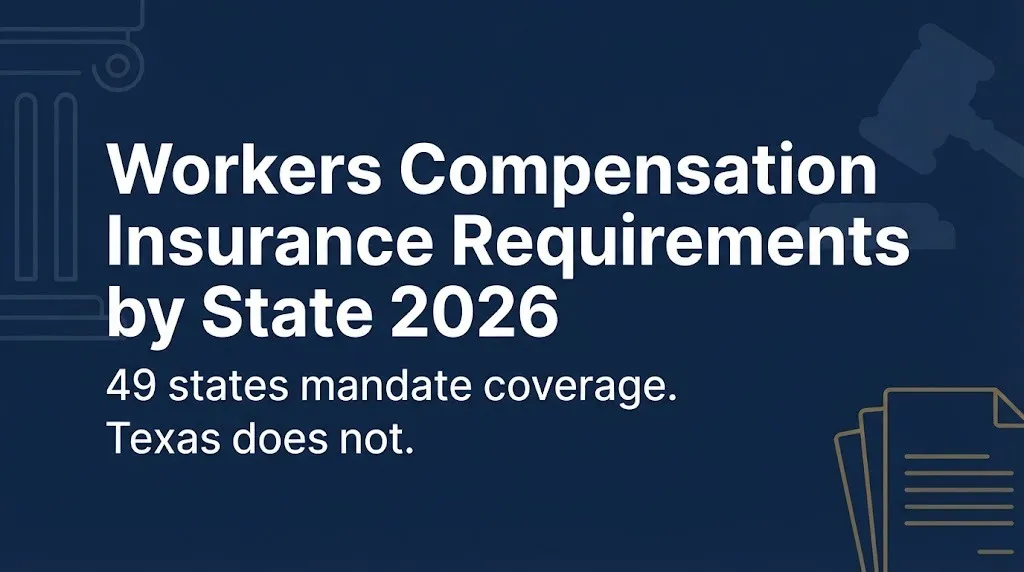
Workers’ compensation insurance requirements by state means the rules that determine whether your business must carry coverage, how many employees trigger it, and what happens if you don’t comply. As of 2026, 49 states mandate workers’ comp in some form. Texas stands alone as the only state where coverage is optional, but opting out comes with a steep tradeoff: you lose immunity from employee injury lawsuits .
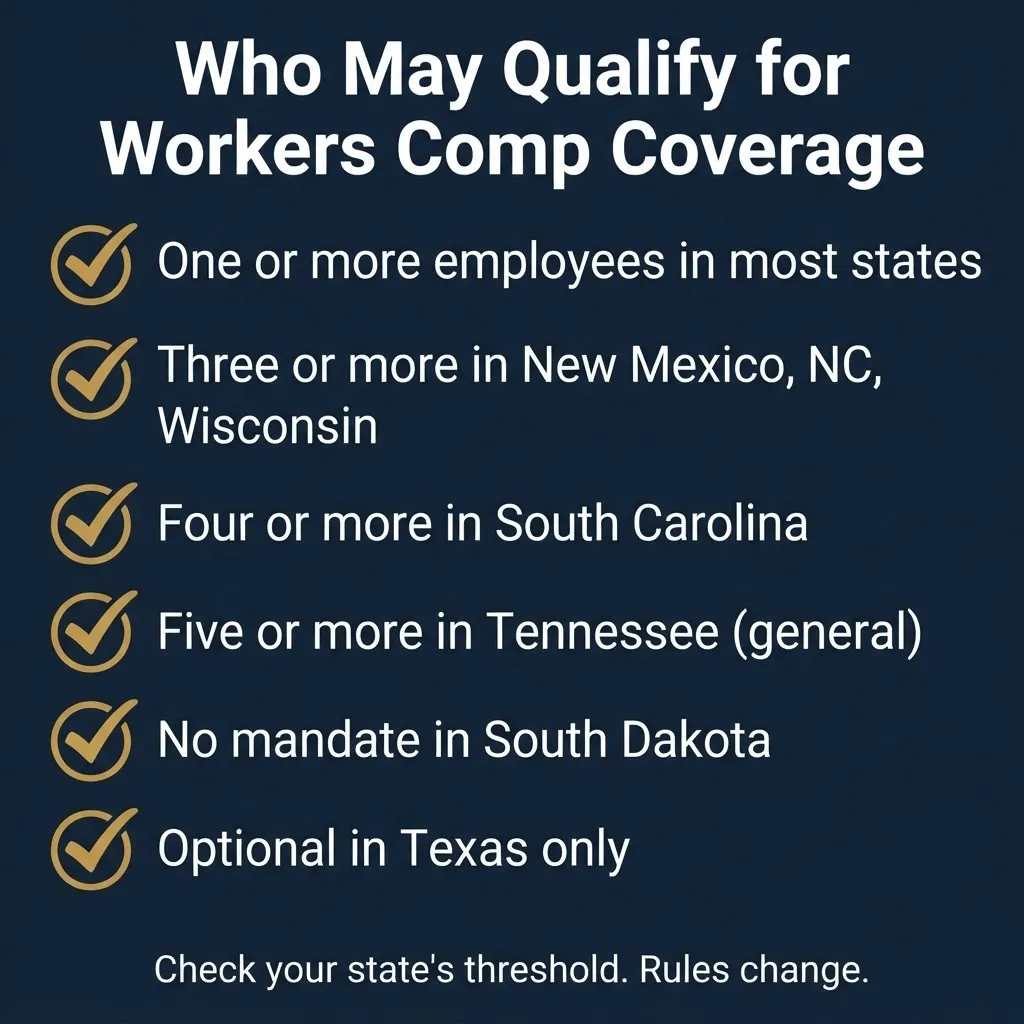
The threshold question matters most for small employers. Most states require coverage from the first employee you hire. Others use a headcount trigger that catches growing businesses off guard. South Carolina waits until four employees. Tennessee requires coverage at five general employees, but drops to one for construction, mining, and coal work .
South Dakota occupies its own category. The state does not legally require employers to carry workers’ compensation insurance. That doesn’t mean going without is safe. Without coverage, you lose the legal protections the system provides, and an injured worker can sue you directly .
Four states operate monopolistic workers’ comp funds: Ohio, North Dakota, Washington, and Wyoming. In these states, you cannot buy a policy from a private carrier. Coverage must come through the state fund, whether that’s the Ohio Bureau of Workers’ Compensation, North Dakota Workforce Safety & Insurance, Washington State Department of Labor & Industries, or the Wyoming Workers’ Compensation Division .
Key Takeaway: The two numbers that determine whether you need coverage are your state’s employee threshold and whether your state runs a monopolistic fund or allows private carriers.
Workers Comp Insurance by State: Which States Require Coverage From the First Employee?
If you have one employee, you likely need workers’ compensation coverage in most states. The employee-count rule is where compliance trips up small business owners, because part-time, seasonal, and sometimes family workers count toward the threshold in many states.
Here’s how the thresholds break down in 2026:
| Employee Threshold | States |
|---|---|
| 1 or more employees | Most states, including New York, New Jersey, Pennsylvania, Michigan, Nevada, Oklahoma, Oregon |
| 2 or more | Virginia (some industries at 3+) |
| 3 or more | New Mexico, North Carolina, Wisconsin |
| 4 or more | South Carolina |
| 5 or more | Tennessee (general); Mississippi |
| No mandate | South Dakota |
| Optional | Texas |
New York requires coverage at one employee, but sole proprietors, partners, and one- or two-person corporations can opt in rather than being mandated . Virginia uses a two-employee threshold for most industries, though some trigger at three . Wisconsin sits at three employees, with construction often facing stricter rules .
The counting rules matter as much as the number. In North Carolina, officers may waive their own coverage but still count toward the three-employee rule. Truck drivers must be covered even if treated as owner-operators . New Hampshire includes family members in the count and only allows up to three executive officers to opt out .
Key Takeaway: Counting employees for workers’ comp compliance is not the same as counting W-2 employees for payroll. Part-time, family, and some contractor classifications can push you over the threshold.
Which States Have the Highest Workers Compensation Insurance Costs in 2026?
Hawaii employers pay the highest workers’ comp rates in the country, at an index rate of $2.52 per $100 of payroll, while North Dakota employers pay the least, at $0.50 per $100 . That’s a five-fold difference for identical work.
The Oregon Department of Consumer and Business Services premium rate ranking study is the best apples-to-apples comparison available. It prices an identical mix of industries in every state, so you can see the true spread without your own payroll mix skewing the picture .
| State | Index Rate per $100 Payroll | National Rank |
|---|---|---|
| Hawaii | $2.52 | 1st (most expensive) |
| New Jersey | $2.16 | 2nd |
| New York | $1.98 | 3rd |
| California | $1.86 | 4th |
| Wisconsin | $1.42 | 7th |
| Illinois | $1.34 | 13th |
| Florida | $1.00 | 30th |
| Texas | $0.78 | 40th |
| Ohio | $0.68 | 47th |
| North Dakota | $0.50 | 51st (least expensive) |
The national median sits at $1.09 per $100 of payroll, the lowest since Oregon began the study in 1986 . That median matters if you’re trying to benchmark whether your own premium is reasonable.
Where your business is headquartered doesn’t determine your workers’ comp rate. The state where the work is performed does. If you run a multi-state operation, the same crew doing the same job is rated separately in every state where they perform work .
Key Takeaway: Workers’ comp is rated by the state where the work happens, not where your business is incorporated, so multi-state employers face separate policies and rates in each jurisdiction.
Reality Check
No legitimate workers’ comp compliance service texts you a fine amount and a payment link. State agencies do not demand immediate payment via text message. If you receive a text claiming you owe a workers’ comp penalty and need to pay now, that’s a scam. Verify any compliance notice by calling your state’s workers’ compensation board directly using a number you look up yourself, not one from the message.
What Happens If You Do Not Carry Required Workers Compensation Insurance?
Operating without required workers’ comp insurance triggers financial penalties, stop-work orders, and in some states criminal charges. The penalties scale with how long you’ve been non-compliant and how many employees you have.
California imposes $1,500 per employee for misdemeanor uninsured operation, and $10,000 or more for repeat or fraudulent violations . New York charges $2,000 per 10-day period of non-compliance, with no maximum cap . Florida issues stop-work orders plus penalties of twice the evaded premium, with a minimum of $1,000 . Illinois charges up to $500 per day, with possible misdemeanor or felony charges .
North Dakota imposes a $10,000 one-time penalty plus $100 per day for continued noncompliance. Falsely reporting payroll or worker hours can trigger a penalty of up to 10 times the premium amount the employer would have paid .
The criminal exposure is real. Several states classify willful failure to carry required workers’ comp as a misdemeanor or felony. In Wyoming, not having coverage can result in a misdemeanor charge with a fine up to $1,000 and up to a year in prison .
Beyond state penalties, going without coverage eliminates your lawsuit immunity. Injured employees can sue you directly for full medical costs, lost wages, pain and suffering, and punitive damages. Those judgments can far exceed what workers’ comp would have paid .
Key Takeaway: The cheapest way to handle workers’ comp compliance is to carry the coverage. Penalties for non-compliance start in the thousands and escalate from there.
How Do You File a Workers Compensation Insurance Claim?
Filing a workers’ comp claim follows a sequence that starts with reporting the injury and ends with either a benefits decision or a dispute. The exact steps depend on your state, but the general process is consistent.
- Report the injury to your employer immediately. Most states require notice within 30 days.
- Get medical treatment. Tell the provider it’s a work injury.
- File the claim form with your state’s workers’ comp board or commission.
- Your employer’s insurer investigates and accepts or denies the claim.
- If accepted, medical bills and partial wage replacement begin.
- If denied, you have a limited window to appeal.
- Watch for deadlines. Missing an appeal date can end your claim.
Each state sets its own filing deadline. Some require the employee to file within one year of the injury. Others use two years. Check your state workers’ comp board’s website for the exact form and deadline .
Key Takeaway: The single most important step in a workers’ comp claim is reporting the injury promptly. Late notice is one of the most common reasons claims get denied.
Which Employers Are Exempt From Workers Compensation Insurance?
Sole proprietors, partners, and LLC members with no employees are exempt by default in most states. Corporate officers can often opt out. Agricultural, domestic, and casual labor exemptions vary widely .
The exemptions that matter most for small businesses:
- Sole proprietors and partners with no employees: exempt in most states, can usually opt in for self-coverage.
- Single-member LLC owners: generally exempt by default, but rules vary.
- Corporate officers: many states allow opt-out even when the company must cover other employees.
- Domestic workers: often exempt below specific hours or wage thresholds.
- Agricultural workers: frequently exempted or covered under lower thresholds.
- Real estate agents and direct sellers: exempt in many states under statutory classifications.
Federal employees are covered under the Federal Employees’ Compensation Act, not state workers’ comp. Railroad workers fall under the Federal Employers’ Liability Act .
Don’t assume an exemption applies to you without confirming it with your state’s workers’ comp board. Misclassifying employees as independent contractors to avoid coverage is a separate violation that carries its own penalties .
Key Takeaway: Exemptions exist for owners and certain worker categories, but they are state-specific and often conditional. Verify before relying on one.
How Has Workers Compensation Insurance Changed in 2026?
Most states cut workers’ comp rates effective in 2026, continuing a long trend of declining premiums driven by falling claim frequency. California is the outlier, having raised rates 8.7% in 2025 and proposing another increase for 2026 .
The National Council on Compensation Insurance reported that the 38 states where it provides ratemaking services saw an average loss cost decrease of 5.0% for 2026. The range within that average went from a 15.6% decrease in New Mexico to a 22% increase in Nevada .
Specific state actions for 2026 include:
- Florida: 6.9% decrease, the ninth consecutive year of cuts.
- New York: 13.2% loss cost decrease.
- Texas: 11.5% average loss cost decrease.
- Ohio: 6% cut for private employers, with an additional 1% cut announced for July 2026.
- New Jersey: 4.3% decrease.
- Arizona: 6.7% cut, the 12th consecutive year of decreases.
- Tennessee: 2.0% loss cost decrease, the 13th consecutive year.
- Pennsylvania: 1.22% decrease effective April 1, 2026.
California stands apart. The Workers’ Compensation Insurance Rating Bureau requested another increase of over 10% for 2026, on top of the 8.7% hike that took effect September 2025. California’s system costs twice as much and takes twice as long to resolve claims as the national median, according to industry analysis .
Key Takeaway: If you operate in California, your workers’ comp costs are rising while most of the country sees decreases. Budget accordingly.
What Happens Next
Expected Q4 2026: Several states will announce 2027 rate changes, with most expected to continue decreases.
January 1, 2027: New rate filings take effect in many states, including NCCI advisory loss costs.
Ongoing: California’s September 2026 rate filing will be decided by the Insurance Commissioner, potentially adding another double-digit increase for California employers.
Ongoing: State legislatures will continue debating employee thresholds and exemption rules, with construction and agricultural classifications most likely to see changes.
Frequently Asked Questions
Is workers compensation insurance required in all states?
No. Texas is the only state where workers’ compensation coverage is optional. South Dakota does not legally mandate coverage either, though the state strongly recommends it . All other states require coverage in some form.
How many employees do you need to have before workers comp is required?
It depends on the state. Most states require coverage from the first employee. South Carolina waits until four employees. Tennessee requires it at five general employees, but one for construction, mining, and coal work. South Dakota does not mandate it at all .
What happens if you don’t have workers comp insurance?
You face financial penalties, stop-work orders, and potentially criminal charges. California charges $1,500 per employee for misdemeanor violations. New York charges $2,000 per 10-day period. You also lose immunity from employee injury lawsuits .
Which states have monopolistic workers compensation funds?
Four states require you to buy coverage through the state fund: Ohio, North Dakota, Washington, and Wyoming. Private carriers are not allowed to write workers’ comp policies in these states .
How much does workers comp insurance cost in 2026?
The national median is $1.09 per $100 of payroll. Hawaii is the most expensive at $2.52, and North Dakota is the least expensive at $0.50. Small businesses pay an average of $54 per month, or $643 annually, according to Insureon customer data .
Do sole proprietors need workers comp insurance?
Generally no, if you have no employees. Sole proprietors and partners are exempt by default in most states. You can usually opt in for self-coverage. If you hire even one employee, the requirement typically kicks in .
Can I be exempt from workers comp as an LLC member?
It depends on your state and the LLC’s structure. Single-member LLC owners are generally exempt by default. Multi-member LLCs are treated more like partnerships. Corporate officers often have opt-out rights. Check your state’s specific rules .
What is the penalty for not carrying workers comp in California?
California imposes $1,500 per employee for misdemeanor uninsured operation, and $10,000 or more for repeat or fraudulent violations. The state can also issue stop-work orders and pursue criminal charges .