Need Cash Now Settlement in 2026: How Pre-Settlement Funding and Structured Settlement Factoring Actually Work
Quick Answer
- Pre-settlement funding is a non-recourse cash advance repaid only if you win or settle your case.
- Structured settlement factoring means selling future payments for a lump sum, usually at a deep discount.
- Court approval is required for structured settlement transfers in 49 of 50 states, and approval is not automatic.
Need Cash Now Settlement: What the Search Term Actually Means
A “need cash now settlement” search usually means one of two situations. Either you’re waiting for a lawsuit to resolve and need money before it pays out, or you already receive structured settlement payments and want to cash out future installments. The two transactions are completely different legally and financially.
Pre-settlement funding is a cash advance against an expected settlement or verdict. If you lose your case, you typically owe nothing back. That non-recourse feature is what separates it from a traditional loan .
Structured settlement factoring is the sale of your right to future annuity payments. A factoring company buys those payments at a discount. You get cash today, they collect the future payments .
Neither option is free money. Both reduce what you ultimately keep from your case. The question is whether the immediate need justifies the long-term cost.
Key Takeaway: Pre-settlement funding is a non-recourse advance repaid only if you win; structured settlement factoring is a discounted sale of future payments requiring court approval.
How Much Cash Can You Get From a Lawsuit Before Settlement?
Most pre-settlement funding companies advance between 10% and 15% of your case’s estimated value. If your case is expected to settle for $100,000, the maximum advance would be roughly $10,000 to $15,000 .
Actual advances often fall in the $500 to $10,000 range. A plaintiff’s million-dollar demand in court filings rarely reflects the true settlement value. Funding companies underwrite based on realistic outcomes, not demand letters .
Factors that determine your advance amount:
- Case type: Personal injury, workers’ comp, and auto accident cases attract funding. Class actions and mass torts are harder to fund.
- Liability strength: Clear fault cases fund easier than disputed ones.
- Documentation: Filed complaints, medical records, and police reports help.
- Attorney cooperation: Funders need your lawyer to confirm case details.
For structured settlements, the lump sum depends on how many future payments you’re selling, how far out they extend, and the discount rate the factoring company applies. A higher discount rate means a lower lump sum .
Reality Check
No legitimate funding company texts you cash first. Reputable pre-settlement funders review your case with your attorney before any money moves. If someone promises immediate cash with no case review, no attorney involvement, and no paperwork, that’s a red flag. The CFPB has sued debt-relief operations that collected millions in illegal upfront fees from consumers while delivering nothing .
What Are the Requirements to Get Pre-Settlement Funding?
You need three things to qualify for pre-settlement funding. An active lawsuit or claim, an attorney representing you, and a case with enough expected value to justify the advance .
Most funding companies do not run credit checks or require employment verification. The underwriting focuses on the case, not your creditworthiness. That’s the key difference from a bank loan.
Here’s what the process typically looks like:
| Requirement | Typical Standard |
|---|---|
| Active lawsuit or claim | Required |
| Attorney representation | Required |
| Case type | Personal injury, auto, workers’ comp most common |
| Credit check | Usually not required |
| Employment verification | Usually not required |
| Monthly payments | None until case resolves |
The funding company evaluates your case by reviewing documents from your attorney. The attorney must cooperate by sharing pleadings, discovery, and medical records. Without attorney cooperation, funding almost never happens .
Applications can process in 24 hours to a week. The timeline depends mostly on how fast your attorney provides documentation .
Key Takeaway: Pre-settlement funding requires an active case and attorney representation. Credit and employment checks are typically skipped because underwriting focuses on case strength.
How Do You Get Cash From a Structured Settlement?
Getting cash from a structured settlement means selling some or all of your future payments to a factoring company. This is not a loan. It’s an outright sale of your payment rights .
The process works like this:
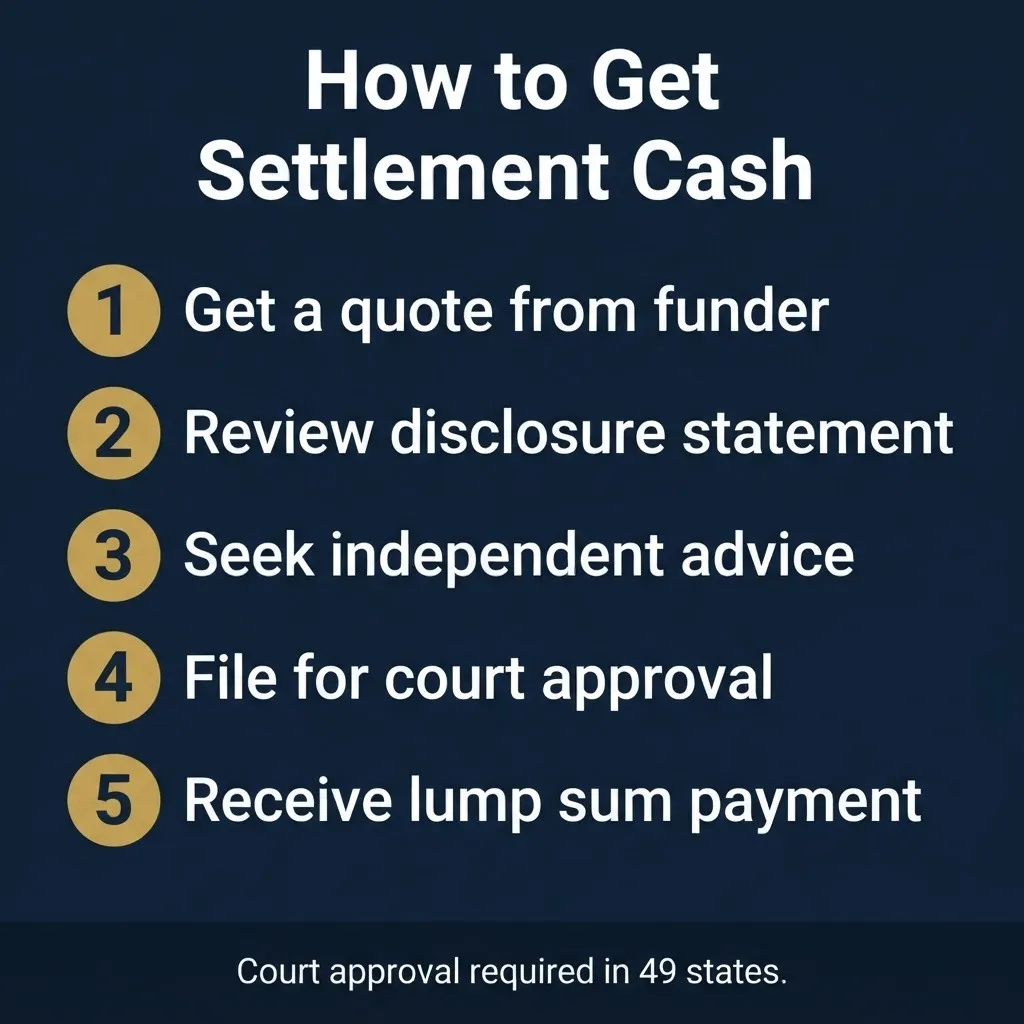
- Get a quote. Contact factoring companies or respond to advertisements. Most payees contact multiple purchasers to compare offers .
- Review the disclosure. Purchasing companies must provide a written transaction disclosure statement showing the payment amounts, present value, and the amount you’d receive .
- Seek independent advice. All states require you to either obtain or waive independent professional advice (attorney, CPA, or actuary) .
- File for court approval. The transfer must be approved by a judge in 49 of 50 states. The judge determines whether the transfer is in your best interest .
- Receive your lump sum. After court approval and closing, the factoring company pays you. Future payments now go to the buyer.
Court costs add up. Filing fees run around $400. Attorney fees for the transfer can reach $4,000 to $5,000 or more .
Key Takeaway: Selling structured settlement payments requires court approval in almost every state, and transaction costs can consume thousands of dollars before you receive anything.
What Is the Catch With Lawsuit Cash Advances?
The catch is cost. Lawsuit cash advances carry interest rates that can reach 40% annually or higher. In a long case, the repayment can consume much or all of your settlement .
Here’s a concrete example. You get a $15,000 advance at a 40% annual rate. Your case settles for $100,000 exactly one year later. You repay $15,000 in principal plus $6,000 in interest. Total repayment: $21,000 .
Now stretch that timeline. If the case takes three years, the compounding effect can push the repayment far higher. In some cases, plaintiffs end up owing more to the funder than they receive from the settlement.
Some states have moved to cap the amount funders can recover. Indiana, for example, established a 25% cap on what a funder may recover from any award or settlement . But most states have no such limit.
The non-recourse protection is real. If you lose, you owe nothing. That’s meaningful. But if you win, the cost comes directly out of your compensation.
What Happens If You Lose Your Lawsuit After Getting a Cash Advance?
You owe nothing back on a true non-recourse advance. The funding company absorbs the loss. That’s the defining feature of pre-settlement funding and the reason it’s not technically a loan .
This protection is why funding companies are selective. They only fund cases they believe will settle or win. A funding company that advances money on weak cases would go out of business.
The non-recourse structure does not apply to all transactions. If you signed a recourse loan disguised as lawsuit funding, you could be personally liable regardless of case outcome. Read the contract carefully. If it says “loan” or requires repayment from your bank account, it’s not true non-recourse funding.
For structured settlement factoring, there is no “losing” scenario because the payments already exist. You’re selling an asset you already own. Once the sale is approved and closed, you keep the lump sum even if the annuity issuer later has problems.
Is Pre-Settlement Funding Regulated in 2026?
Regulation is uneven. The legal funding industry is not uniformly regulated across states . Some states have consumer protection laws. Others have little oversight.
The structured settlement side is more regulated. The federal tax code requires court approval for transfers of structured settlement payment rights. Forty-nine states have enacted Structured Settlement Protection Acts implementing that requirement .
What the court must find before approving a structured settlement transfer:
- The transfer is in the payee’s best interest, considering dependents.
- The transfer doesn’t violate any statute or court order.
- The payee received independent professional advice or waived it in writing .
Legal Aid attorneys report that payees often don’t understand the financial price of cashing out. Some don’t realize the amount is negotiable. Others are referred to affiliated attorneys paid by the factoring company, which defeats the purpose of independent advice .
Key Takeaway: Structured settlement transfers face mandatory court review in nearly every state. Pre-settlement funding regulation varies widely, and consumers have fewer built-in protections.
What Happens Next
Expected late 2026: State legislatures will continue debating legal funding disclosure requirements and rate caps.
Ongoing: Courts will keep applying Structured Settlement Protection Act standards to factoring petitions, with scrutiny on whether payees understand the transaction.
Ongoing: The CFPB and state attorneys general will continue enforcement against debt-relief and funding operations that charge illegal upfront fees.
Expected 2027: More states may follow Indiana’s lead and impose caps on funder recovery percentages.
Frequently Asked Questions
Is pre-settlement funding a loan?
No, it’s typically a non-recourse cash advance. If you lose your case, you owe nothing back. That’s why the industry prefers “funding” over “loan” .
How much does a lawsuit cash advance cost?
Funding fees can reach 40% annual interest or higher. The cost comes out of your settlement when the case resolves .
Can I sell my structured settlement payments?
Yes, but a court must approve the transfer in 49 of 50 states. The judge must find the sale is in your best interest .
Do I need an attorney to get pre-settlement funding?
Yes. Almost all funding companies require you to have an attorney representing your case .
What happens if I lose my lawsuit after getting an advance?
You typically owe nothing back on a non-recourse advance. The funding company absorbs the loss .
How long does it take to get a lawsuit cash advance?
It can take 24 hours to a week, depending on how fast your attorney provides documentation .
Is it worth selling structured settlement payments?
The lump sum is almost always significantly lower than the present value of the payments you give up. Court approval is required because of the risk .
Can I get cash from a settlement that hasn’t been approved yet?
Pre-settlement funding is available while your case is pending. But the amount is limited, usually 10% to 15% of expected value .