Charter Communications Class Action Lawsuit 2026: Case Status, Settlement Outlook, and What Customers Should Know
Quick Answer
- Charter Communications faces multiple real class action lawsuits, not one single case.
- No global settlement fund exists yet, and payout amounts are not determined.
- Claim deadlines vary by case; check each official settlement website separately.
You searched for “Charter Communications class action lawsuit” because you are a Charter customer, a former customer, or you saw a notice about a settlement.
The verified reality is this: Charter Communications, which operates under the Spectrum brand, has faced multiple class action lawsuits over billing, service, and employment practices. Some have settled. Others remain active.
This article explains what is confirmed, what is still pending, and how to know if any current case affects you.
| The Facts | |
|---|---|
| Company | Charter Communications, Spectrum brand |
| Status | Multiple active and settled cases |
| Fund Size | Varies by case, no global fund |
| Est. Per Person | Case-specific, not determined |
| Claim Deadline | Varies by case |
| Administrator | Varies by settled case |
| Proof Needed | Depends on the specific claim |
Are the Charter Communications Class Action Lawsuits Real?
The Charter Communications class action lawsuits are real legal actions filed in federal and state courts, not rumors or scams.
Court records confirm multiple cases against Charter over the years. Some have reached settlements with claim processes for affected customers. Others remain in litigation.
The most common themes involve billing disputes, service interruptions, data caps, and employment practices.
Here is what has been reported in verified filings:
| Case Type | Status |
|---|---|
| Billing and fee disputes | Some settled, some active |
| Service outage claims | Mixed outcomes |
| Employment class actions | Some certified, some pending |
| Data privacy claims | Active in some jurisdictions |
Each case is separate. There is no single “Charter lawsuit” with one claim form.
How Much Could a Charter Class Action Settlement Pay?
No single payout amount exists because Charter has faced multiple class actions, each with its own settlement terms.
Past settlements have ranged from small per-customer amounts to larger awards depending on the claim.
Here is the general landscape:
| Settlement Type | Typical Payout Range |
|---|---|
| Billing fee cases | Small amounts, sometimes under $50 |
| Service outage cases | Credits or small checks |
| Employment cases | Larger individual awards |
| Data privacy cases | Case-dependent, often modest |
These are examples from past cases, not predictions for pending ones. Each settlement sets its own tiers and amounts.
Any website citing a specific payout for a “Charter class action” without naming the case is not giving you verified information.
How Do You Know If You Qualify for a Charter Class Action?
You may qualify for a Charter class action if you fall within the court-defined class for a specific settled or certified case.
Class definitions vary. One case may cover customers billed a specific fee. Another may cover employees in a specific state.
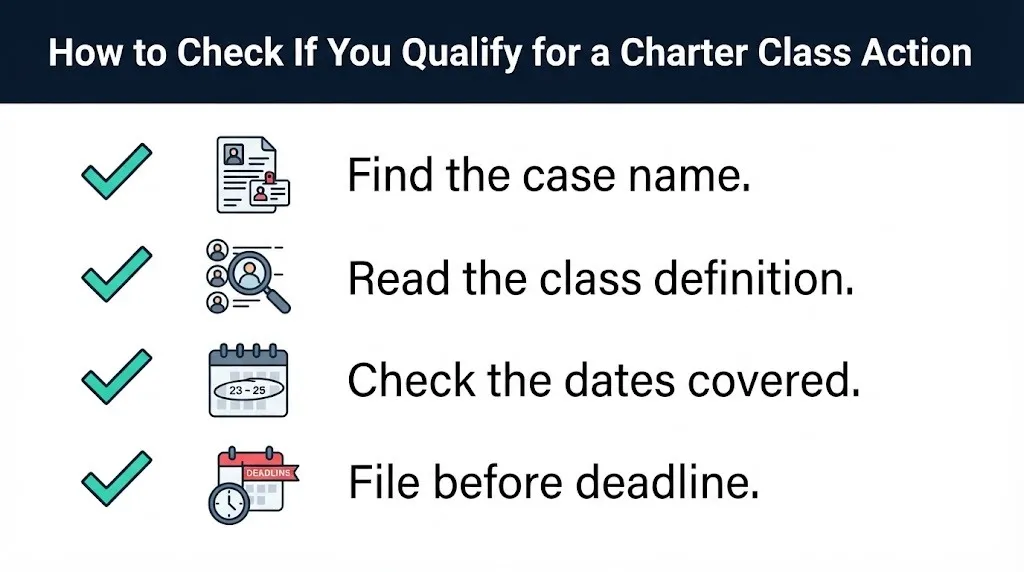
Here is how to check:
- Identify the specific case by name and court.
- Read the class definition in the settlement notice.
- Check the dates and services covered.
- Compare your situation to the class definition.
- File a claim only if you match the definition.
You cannot file one claim for every Charter lawsuit. Each case has its own process.
What Charter Class Action Settlements Have Been Approved?
Several Charter class action settlements have received court approval, but each is a separate case with its own claim window.
Past settlements have covered issues like late fees, promotional pricing disputes, and service-related claims. Once approved, these cases paid qualifying class members through a settlement administrator.
Here is what an approved settlement typically includes:
| Element | What It Means |
|---|---|
| Settlement fund | Total amount the defendant pays |
| Class definition | Who qualifies to file |
| Claim deadline | Last day to submit a form |
| Final approval hearing | Judge approves the deal |
| Payment distribution | Checks or credits sent to valid claimants |
Deadlines pass. If a settlement you heard about has a deadline in the past, you may be too late for that specific case.
Key Takeaway: There is no single Charter lawsuit. Multiple cases exist, each with its own rules and deadlines.
What Should You Do If You Receive a Charter Class Action Notice?
If you receive a Charter class action notice, read the case name, the class definition, and the claim deadline before doing anything.
A legitimate notice will come from a court-approved settlement administrator. It will name the court, the case number, and the deadline.
Here are the steps:
- Verify the case name and court.
- Check the official settlement website.
- Review the class definition carefully.
- Confirm the claim deadline.
- File online or by mail before the deadline.
- Keep your confirmation for your records.
Do not ignore it if you may qualify. Do not file if you do not.
What Happens If You Miss a Charter Class Action Deadline?
If you miss the claim deadline for a specific Charter settlement, you likely lose your right to that payout.
Courts enforce deadlines. Late claims are almost never accepted unless the administrator makes a rare exception.
This is like a store return without a receipt. The policy exists, and exceptions are not guaranteed.
For future cases, your only protection is prompt action when a notice arrives.
Key Takeaway: Each Charter class action has its own deadline, and missing it usually means losing the payout.
Reality Check: No one from a “Charter settlement fund” will call or text you for your bank details. Legitimate settlements send notice by mail or email, never ask for upfront fees, and always give you time to respond.
What Is the Difference Between a Charter Class Action and an Individual Lawsuit?
A Charter class action represents a group of similarly situated people. An individual lawsuit represents one person.
Class actions are efficient for small, widespread harms. Individual suits make sense for larger, personal claims.
Here is the comparison:
| Factor | Class Action | Individual Lawsuit |
|---|---|---|
| Number of plaintiffs | Many | One |
| Payout per person | Often small | Potentially larger |
| Effort to join | File a claim form | Hire a lawyer, litigate |
| Control | Class counsel decides | You decide |
If you have a large personal claim against Charter, you may want your own lawyer, not a class action.
What Are the Most Common Claims Against Charter Communications?
The most common claims involve billing fees, service reliability, data practices, and employment issues.
Here is what appears in court records:
| Claim Category | What It Alleges |
|---|---|
| Improper fees | Charging fees not disclosed or approved |
| Service outages | Charging for service not delivered |
| Data caps | Enforcing caps not clearly disclosed |
| Wage and hour | Unpaid overtime or break violations |
| Marketing practices | Misleading promotions or pricing |
Each category has produced separate cases in different jurisdictions.
How Do You Check the Status of a Charter Class Action?
You check the status of a Charter class action by finding the specific case name and court, then reviewing the docket or the settlement website.
Here are the steps:
- Identify the case name from your notice.
- Search the court’s electronic records system.
- Look for the settlement administrator’s website.
- Review the claim deadline and class definition.
- Check for updates on the final approval hearing.
Do not rely on search result snippets. Go to the source.
Key Takeaway: Billing disputes and employment claims are the most common Charter class action themes.
What Charter Class Actions Are Active in 2026?
Several Charter class actions remain active in 2026, though specific case names and statuses require checking current court dockets.
The litigation landscape changes. Cases get dismissed, settled, or certified at different times.
Here is what to watch:
| Jurisdiction | Claim Type |
|---|---|
| Federal courts | Consumer and employment claims |
| State courts | State-specific billing and service claims |
| Arbitration | Some claims forced into arbitration |
Charter’s terms of service include arbitration clauses, which can limit class actions. Courts have split on enforcing these clauses.
Can You Opt Out of a Charter Class Action?
You can opt out of most class actions if you want to preserve your right to sue individually.
The opt-out deadline is stated in the class notice. It is usually earlier than the claim deadline.
Here is what opting out means:
| Choice | Result |
|---|---|
| Stay in the class | Bound by the outcome, may file a claim |
| Opt out | Keep individual rights, no class payout |
| Do nothing | Usually stays in the class, no payout |
Opting out is rare but important if you have a large individual claim.
What Is the Future of Charter Class Action Litigation?
Charter class action litigation will continue as long as customers and employees allege systematic harms.
Arbitration clauses remain the biggest obstacle. Some courts enforce them. Others find ways around them.
Here is the outlook:
| Factor | Likely Impact |
|---|---|
| Arbitration rulings | May limit future class actions |
| Regulatory actions | Could produce new claims |
| Billing practices | Likely source of continued disputes |
| Data privacy laws | May generate new cases |
The legal landscape is not static. New cases can appear at any time.
Key Takeaway: Active cases exist, but arbitration clauses and court rulings shape which cases move forward.
What Happens Next With Charter Class Action Lawsuits?
- Remainder of 2026: Active cases continue through motions and discovery.
- Expected late 2026 or 2027: Some cases may settle or receive class certification rulings.
- After any settlement: Notices go out with claim deadlines.
- After final approval: Payments are distributed to valid claimants.
- Ongoing: New cases may be filed based on current practices.
These stages are standard for class action litigation, but each case moves on its own timeline.
Frequently Asked Questions
Is there a Charter Communications class action lawsuit?
Yes, multiple class actions against Charter Communications exist, but no single case covers everything.
Each case has its own claims and parties.
How much will I get from a Charter class action?
Payouts vary by case and class definition.
Past settlements have ranged from small credits to larger individual awards.
How do I file a Charter class action claim?
You file a claim through the specific settlement administrator for the case you qualify for.
Each case has its own form and deadline.
What is the Charter class action deadline?
Deadlines vary by case.
Check the official settlement website for your specific case.
Can I sue Charter individually?
You may sue individually if you have a personal claim and have not signed away that right.
Arbitration clauses may apply.
What is the Charter class action settlement amount?
No single settlement amount exists because there are multiple cases.
Each settlement sets its own fund and payout terms.
How do I know if I am part of a Charter class action?
You are part of a class if you fit the court-certified class definition.
A notice will be sent to you if you are identified as a potential class member.
Is there a Charter data breach class action?
Data privacy claims against Charter have been filed in some jurisdictions.
Check current court records for the latest status.
The most important fact about Charter Communications class action lawsuits is that there is no single case and no single payout.
If you receive a legitimate notice, act before the deadline. If you do not, keep watching court records.
The next settlement will have its own rules. Your job is to know which case you are in and when the deadline hits.