Total Compensation vs Salary 2026: What’s the Real Difference?
Quick Answer
- Salary is your fixed, guaranteed cash pay before taxes and deductions.
- Total compensation includes salary plus benefits, bonuses, retirement matches, and perks with dollar value.
- Asking for the total compensation statement can reveal your job’s true worth, often 20% to 40% above base salary.
If you’re comparing job offers right now, you probably started with the salary numbers. That’s the mistake most people make. A $75,000 offer and a $72,000 offer can look like a clear winner until you factor in health insurance, retirement matching, and paid time off.
The difference between salary and total compensation isn’t just semantics. It’s the difference between knowing what you’ll deposit each month and understanding what your job is actually worth. For you, that gap could be worth thousands of dollars per year.
This article breaks down exactly what each term means, what’s included in total compensation, and the step-by-step process to calculate your real earnings. You’ll also find the red flags that signal a weak offer hiding behind impressive-sounding language.
The Facts
| Term | Definition |
|---|---|
| Base Salary | Fixed annual pay before taxes, excludes bonuses and benefits |
| Total Compensation | Full value of salary plus benefits, bonuses, retirement, and perks |
| Salary vs Total Comp Gap | Benefits typically add 20% to 40% on top of base |
| Key Document | Total compensation statement from employer |
| Core Components | Base pay, insurance, retirement, PTO, equity, perks |
| When to Use | Evaluating offers, negotiating, financial planning |
What Is the Difference Between Salary and Total Compensation?
The difference between salary and total compensation is that salary is one fixed number, while total compensation is the sum of everything your employer provides. Salary is what you’re guaranteed in cash each pay period. Total compensation is what that job is actually worth when you count every benefit.
Your salary appears on your offer letter as an annual figure, like $65,000. It’s predictable. You know what you’ll earn before taxes, and you can budget around it.
Total compensation, by contrast, requires you to add up numbers that don’t appear on your paycheck. Health insurance premiums your employer covers. Retirement contributions they make on your behalf. The cash value of your vacation days. Stock options with uncertain future value.
Most employers don’t hand you a total compensation number unless you ask. That silence lets weak offers hide behind competitive-sounding salaries.
What Does Total Compensation Actually Include?
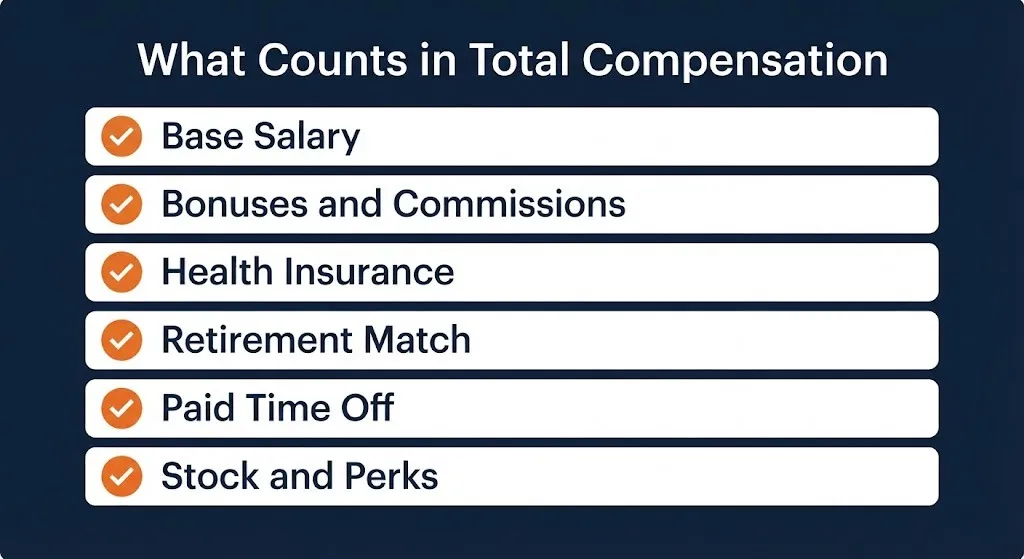
Total compensation includes direct pay and indirect benefits. Direct pay is money you receive. Indirect benefits are things your employer pays for that save you money or add value.
| Category | Examples |
|---|---|
| Direct Pay | Base salary, overtime, bonuses, commissions |
| Health & Welfare | Medical, dental, vision, life, disability insurance |
| Retirement | 401(k) match, pension, profit sharing |
| Equity | Stock options, restricted stock units, ESPP |
| Time Off | Vacation, sick leave, holidays, parental leave |
| Perks | Gym, tuition aid, commuting, relocation, meals |
Not every job includes all of these. Entry-level roles often have fewer components. Executive roles usually have more. What matters is identifying what your specific offer includes and putting a dollar figure on each one.
Some benefits are easy to value. A 5% 401(k) match on a $70,000 salary is $3,500. Others need estimating. Value your paid time off by multiplying your daily rate by the number of PTO days you receive.
Key Takeaway: Total compensation isn’t a vague concept. It’s a sum of specific, quantifiable components you can and should calculate.
How to Calculate Your Total Compensation Step by Step
Calculating total compensation means adding the dollar value of every component in your offer. You need actual numbers, not marketing language. Ask HR for the employer cost of each benefit if it’s not already listed.
Follow these steps:
- Start with your base salary. This is your fixed annual pay before any deductions.
- Add variable pay. Include target bonuses, commissions, and predictable overtime.
- Value health benefits. Find the employer’s monthly premium contribution. Multiply by 12.
- Add retirement contributions. Calculate the employer match or pension deposit.
- Value paid time off. Multiply your daily rate by the hours or days of PTO you receive.
- Include equity and perks. Use current value of stock grants or annual allowances.
- Add everything together. The total is your annual total compensation.
Here’s a worked example. A $70,000 salary plus $5,000 target bonus, $9,600 health premium coverage, $3,500 retirement match, $2,800 PTO value, and $1,200 in perks equals $92,100 total compensation.
That’s $22,100 more than the salary alone. If you only compared salary numbers, you’d miss nearly a quarter of the real value.
Why Employers Push Total Compensation (and What to Watch For)
Employers promote total compensation for legitimate reasons and strategic ones. The concept helps recruiters show the full value of an offer when the salary alone isn’t competitive. It also supports pay transparency and can improve retention.
But the term can obscure weak offers. A company might lead with “competitive total compensation” while paying below market and offering mediocre benefits. The phrase sounds impressive. The numbers might not be.
Watch for these red flags:
- Benefits described in vague terms without dollar figures
- High-deductible health plans with low employer contributions
- Retirement matches that vest slowly or not at all
- “Unlimited PTO” policies that discourage actually taking time off
- Equity grants with long vesting schedules and uncertain value
The total compensation statement is your tool. Ask for it in writing. If the employer won’t provide specific numbers, that tells you something.
Base Salary vs Total Compensation: Why the Base Still Matters Most
Your base salary is the foundation of your total compensation. It drives almost everything else. Retirement matches are usually a percentage of base pay. Bonus targets are often a percentage of base. Future raises start from your base number.
A low base salary compounds. Accept $60,000 instead of $65,000, and your retirement match drops. Your annual raise percentage applies to a smaller number. Your next employer may anchor to that lower figure when negotiating.
That’s why you should negotiate base salary first, then benefits. A higher base lifts every percentage-based benefit attached to it. A better health plan is valuable, but it doesn’t compound the way salary does.
If an employer offers a lower base but “great total compensation,” ask for the breakdown. Sometimes the benefits genuinely make up the difference. Other times they don’t.
Reality Check: Total compensation is not a scam, but it can be used to distract you from a low salary. Always compare the actual dollar value of each component, not the marketing language around it. If a recruiter can’t tell you what the health insurance costs the company, that’s a gap you need to fill before you sign.
What Is a Total Compensation Statement?
A total compensation statement is a document that lists every component of your pay and benefits with assigned dollar values. Many employers provide these annually or with offer letters. If you don’t have one, request it.
The statement typically shows:
- Your base salary and any variable pay
- Employer contributions to health, dental, and vision insurance
- Retirement plan contributions
- Value of paid time off
- Equity grants or stock purchase plans
- Other perks with assigned values
Read it carefully. Verify that health insurance values reflect the employer’s actual cost. Confirm retirement contributions match what you expected. Look for benefits that sound good but carry low dollar values.
A statement with a $5,000 health insurance line might mean the employer covers only a fraction of the premium. A $15,000 line means they cover most of it. The number matters.
How to Compare Two Job Offers Using Total Compensation
Comparing job offers means converting each one to its total compensation number, then comparing apples to apples. Salary alone will mislead you.
Here’s how to do it:
- Get the total compensation statement from each employer.
- List every component side by side: salary, bonus, insurance, retirement, PTO.
- Assign dollar values to each using employer-provided figures.
- Add up each column to get the total compensation for each offer.
- Compare the totals, not the salaries.
- Factor in intangibles like commute, flexibility, and growth potential.
One offer might pay $5,000 more in salary but offer no retirement match and a high-deductible health plan. The other might pay less but fully cover health insurance and match 5% of your salary. The second offer could be worth more.
What Happens Next
October 2026: Many employers open annual benefits enrollment. This is the best time to review your total compensation statement for the coming year.
January 2027: New salary and bonus figures take effect for most companies. Compare your total compensation against market data.
March 2027: Annual bonus and equity vesting cycles often complete. Recalculate your total compensation with actual numbers.
Ongoing: Request updated total compensation statements whenever you receive a raise, promotion, or new benefit.
Frequently Asked Questions
What is the difference between salary and total compensation?
Salary is the fixed cash you receive. Total compensation includes salary plus the dollar value of benefits, bonuses, retirement contributions, and perks.
What does total compensation include?
Total compensation includes base salary, overtime, bonuses, commissions, health insurance, retirement matches, paid time off, stock options, and other employer-provided benefits.
How do I calculate my total compensation?
Add your base salary, variable pay, employer health insurance contributions, retirement match, PTO value, and any equity or perks. Ask HR for exact benefit costs if they’re not listed.
Is total compensation the same as gross pay?
No. Gross pay is your salary before taxes and deductions. Total compensation includes gross pay plus benefits and perks that never appear on your paycheck.
Why do employers use total compensation?
Employers use it to show the full value of an offer and to compete on benefits when salary alone isn’t competitive. It also supports pay transparency.
Should I negotiate based on total compensation?
Yes. Negotiating base salary first is smart because it drives percentage-based benefits. But you can also negotiate health coverage, retirement match, PTO, and signing bonuses.
Can total compensation include non-cash benefits?
Yes. Stock options, company cars, gym memberships, and tuition assistance all count if they have measurable dollar value. Estimate their worth at market rates.
What is a total compensation statement?
A total compensation statement is a document from your employer listing every component of your pay and benefits with assigned dollar values. Request one if you don’t receive it automatically.
Your Next Move
If you’re evaluating a job offer, don’t accept or reject it based on salary alone. Ask for the total compensation statement in writing. Add up every component. Compare the real number, not the headline.
Your base salary drives future raises, retirement matches, and bonuses. Push for the highest base you can get, then negotiate the benefits. The difference between a $70,000 salary and a $70,000 total compensation package can be $20,000 or more per year. That’s not a rounding error. That’s your rent.